
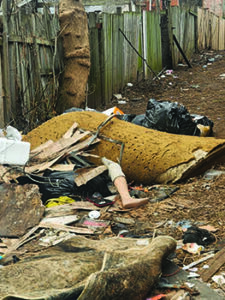
A more broken down part of Hamilton.
What comes to mind when you think of Hamilton, Ontario? The waterfall capital of the world? The armpit of the Golden Horseshoe? Or perhaps you’ve visited recently, and found the “Social Services Capital of Canada” to be seriously… hurting.
The city is fraying at the edges. Encampments continually crop up in our parks, leaving behind needles, actual mounds of garbage, and disturbed souls hanging out by the playground. It’s a city where drug addicts shoot up on streets, many bent in the signature “fenty-fold.” Police recently discovered a labyrinth of tunnels in our largest park, connecting tents to a generator and tapping into the city’s power supply.
This is where my kids play next to the “Truck Man,” who lives out of a beat-up black pickup and occasionally flashes his brass knuckles. Just last fall, thieves broke into a nearby vehicle. Discovered by a vigilante neighbor, they dashed within five feet of my kids as they played in our yard. Down the escarpment, my friend’s aged neighbor was attacked in his own home last year, stabbed to death by a homeless man on drugs.
This is the new Hamilton, and we’re all still trying to cope with it.
When I see a new tent being pitched just down the road, I cringe. Not another one. Not more brokenness and filth in our neighborhood. Please just move away!
Then I feel a twinge of guilt because Jesus calls us to love our neighbor (Matt. 22:39) and minister to the least of these (Matt. 25:40). He reaches out to the most vulnerable and rejected of society, and commissions us to do the same. “Please move away!” isn’t in the Great Commission. My cringing disgust and Christ’s commands have created a strong dissonance within me. I suspect that many Canadians and Americans feel the same, as our lands slip deeper into brokenness and ruin.
An idolatry of comfort
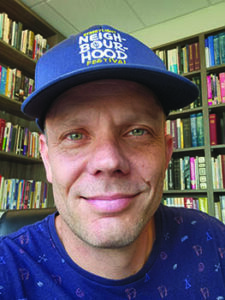
Winston Bosch is the pastor of
Hamilton’s Streetlight Christian Church.
Pastor Winston Bosch ministers to Streetlight Christian Church, a missional Canadian Reformed congregation set in Hamilton’s inner city. After serving impoverished peoples (both in Hamilton and abroad) for over seven years, Bosch still feels that dissonance.
“I’m constantly uncomfortable,” he admits. “Christ is no longer here on earth, and so we His Church go about sharing the Gospel, being the voice and hands of the Good Shepherd. That involves getting dirty and messy with poverty and it’s uncomfortable. We share in His suffering.”
As middle-class Canadians, we’ve been shielded from much of the brokenness of this world. But it’s moving in, it’s around the corner and it’s in our face. That desire to hunker down with our families in a fortress, walled off from the problems of the world? Maybe it points to something hidden deep in our hearts. Pastor Bosch calls it “the idolatry of comfort.”
“If the religion that the Lord accepts as pure and faultless is to look after orphans and widows and to keep one’s self from being polluted by the world, then the Lord also wants us not to be polluted by the world of comfort and ease, but to move towards suffering.”
Move towards suffering? That’s tricky to do, especially when that suffering comes with a smell or bed bugs. Yet the Scriptural imperative to minister to our poor is clearly written throughout Scriptures. James 2 lays a finger on our tendency towards favoritism. “Suppose a man comes into your meeting wearing a gold ring and fine clothes, and a poor man in filthy old clothes also comes in…” Who do we give the best seat to? James brings us back to the second great command, love your neighbor as yourself.
So how do we? Let’s tackle that question step by step.
The “problem” – a closer look at our poor and needy
Admittedly, I’ve been quick to spout out all sorts of excuses when I see homeless people. “Why don’t they just get a job? They’re only on the street because they can’t do drugs in shelters…” And there’s some truth in those objections.
But when you look closely at the real facts, these trite little phrases ring hollow. Last year the City of Hamilton reported that only 747 shelter beds are available for the estimated 1,500 homeless people in the city.1 Across the lake in Toronto, dozens of calls requesting shelter (and as many as 150+ requests a day during certain months) were not matched to a bed last year. Though the 2026 numbers seem to be improving, unmet requests can mean death on frigid Ontario winter nights.2 That can mean death on those frigid winter nights. For many, Pastor Bosch says, it’s easier to skip the shelter lineups and just live in a park.
We’ve all felt the financial crunch as the cost of living has risen – that’s had an even greater impact on the poor. Our social services are overwhelmed and insufficient to meet the needs of many. Consider the prospects of someone on disability support in Ontario. They can receive up to $1,408 per month.3 About $1000 of that goes to rent (if they’re lucky! Market rent on studio apartments averages $1450, although individual rooms are under $1000 if you can weather the safety hazards). $125 buys a bus pass, leaving just $283 for the month’s groceries. Bosch says that social workers will actually tell their clients, “‘Look, your Ontario Disability is not enough for rent and food, so you need to go around to all the churches and ask for help. That’s the only way you’ll survive.”
Another contributing factor to poverty is disability and mental health struggles. Teresa Howe is a community engagement manager for Indwell, a Christian charity devoted to providing affordable housing. She reports that almost 80 percent of Indwell’s tenants have a chronic mental health diagnosis, including schizophrenia, bipolar disorder, etc. “We don’t have cures for any of these,” Howe reflects.
“It’s just something you’re living with… But a large part of [our tenants’] challenges are gone when they have supportive housing. If people are taking meds regularly and going to appointments, we can help prevent hospitalization.”
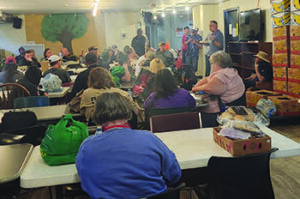
Serving at Mission in the Margins
Of course, addiction is a huge driver of poverty and homelessness – as is painfully obvious on Hamilton’s streets. Howe says Indwell has many supports in place for tenants struggling with addictions, to help them “meet their recovery goals.” This approach breaks down when tenants show little in the way of recovery goals, but at this time and place in Canada, it’s something. “Their best chance at recovery is stable housing,” Howe says. “Whoever got sober living in an encampment or under a bridge?” But what does providing stable housing look like for unstable people? If it is accompanied with any sort of requirements – like sobriety – some won’t accept it. And it if is provided with no obligations, it doesn’t take a prophet to predict what an apartment or small room will soon look like if an addict treats it with the same respect they give their own body. A more drastic abstinence-focused approach is necessary – but more on that later.
Perhaps the most heartrending aspect of all this is family and generational breakdown. Pastor Bosch tells story after story of this, as adults with a history of enormous trauma raise children of their own. In Streetlight Christian Church, where Bosch pastors, the vast majority of church members coming from surrounding neighborhoods have suffered extreme trauma, like severe physical or sexual abuse and neglect. Grandparents raise their grandchildren, because parents are addicted and off the radar.
Bosch recalls one kid whose only real interaction with either parent was searching out his mom in an encampment on his birthday every year, and getting a few bucks as a present. One fellow recently told Bosch that he had four different names before turning five years old – because every time he was “thrown around” to another home, the caregiver would give him a new name.
There’s a 17-year-old girl who came to Streetlight’s family support worker. She was born in a tent, her birth never registered. The worker went to enormous lengths to get government ID so this girl could then attend school.
This is the legacy that is passed on – a burden of generational problems, both learned (addiction, etc.) and inborn (e.g. Fetal Alcohol Spectrum Disorders.)
“We have six-year-olds coming in with no bowel control,” Bosch says, “They stink and are dirty, they have no shoes in the winter… when that person becomes an adult, there’s a good chance that person will be on and off the street.”
Jim*, a 16-year-old young man, was raised by his grandparents. They gave him marijuana as a child when he was anxious. With no one sending him off to school, Jim’s attendance was spotty. He came to Streetlight, and began a youth internship, setting up chairs and cleaning. Jim shared his two life goals with Streetlight’s youth worker: he wanted a job (nobody in his family had a job), and a family that sat down to eat together (the very things we usually take for granted!). Jim applied to jobs with nothing on his resume but the Streetlight internship. One day he came up to Bosch, beaming. “Pastor Winston, guess what – I got a job!”
Streetlight celebrates the wins, but doesn’t lose sight of the pattern. Family and generational brokenness are the norm, the legacy being inherited. It’s a community crying out for the healing of the Gospel.
And it brings me back to my own, beautiful upbringing – two godly parents, five wonderful siblings, a home and three meals a day. What do I have that I haven’t been given?
The need for a multi-pronged response
Things look pretty dark for Canada. We’ve cast off our Christian heritage with vitriolic fervor and are reaping the rewards of godlessness. Poverty is moving in quickly. Brokenness is becoming the norm. Amidst this, may Christ’s Church shine out like a city on a hill.
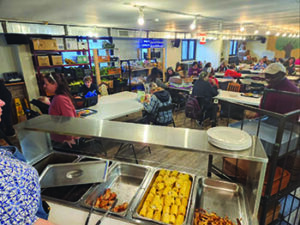
Serving with Mission in the Margins
Pastor Bosch sees a strong need for a multi-pronged response to homelessness and addiction. Much like Christians have split the pro-life cause into political action (lobbying for legal change) and mercy ministry (pregnancy centers, etc.), Bosch sees room for a similar approach here.
On the political front, Canada’s soft response to encampments has had a ruinous effect on our communities and the homeless themselves. Alberta Social Services Minister Jason Nixon points out that encampments are not a humane response to homelessness – they quickly become cesspools of homeless-on-homeless abuse, drug addiction, human trafficking, often being run by drug cartels.
By contrast to much of Canada, Alberta disassembled many homeless encampments and provided residents with social services, including rehab and mental health supports. This hasn’t been a seamless process, but it’s a better response for all concerned than simply enabling lawless encampments.4 As Romans 13:3 says “For rulers are not a terror to good conduct, but to bad.” It’s time for the government to take up its role in protecting the vulnerable and punishing the evil-doer.
In the realm of drugs and addictions, the federal government has moved from prevention to “harm reduction,” effectively turning itself into a colossal drug dealer.5 The Association for Reformed Political Action (ARPA) recommends an alternative model similar to Portugal’s, which offers addicts a choice between treatment or legal penalties. The sad truth is that many addicts are, well, addicted and won’t choose treatment of their own free will. Addiction motivates many homeless people towards violent or criminal activity, thereby harming residential neighborhoods and parks. A move to mandatory treatment would greatly improve the lives of our addicts, homeless and general population. To date, ARPA does not have an active campaign pushing for this approach – it remains an area of need for Christian political action.
When you throw in the crush of waves of recent refugees and an overwhelmed social system so bureaucratically constipated that accessing services is a monumental job, things are dark for impoverished and homeless Canadians. So what’s a Christian to do?
The Church’s response – far from easy to know what to do
Ministering to the homeless gets complicated. My cousin Steven Williamson pastors Cornerstone URC in London, Ontario. London is known as the “Zombie Capital of Canada,” and Williamson’s church is in the thick of it. The church has actively reached out to the homeless camping on church property and in the neighborhood. Williamson tells the story of one fellow – we’ll call him Zach. Zach attended church and Bible study for four months, bringing his backpack along with him every time. One morning, a church member nudged his bag – Zach began screaming and shouting. He turned violent, pulling a long butcher knife from his backpack. A week later, he returned. Williamson and some other fellows escorted him out the door, locking it behind him. Zach then attempted to throw bricks through the windows but couldn’t break the safety glass. He tried to enter by sliding his knife through the double doors and opening the lock, while Williamson held the doors shut from inside. That wasn’t in his seminary training!
“Our justice system is not protecting us properly,” Williamson commented. He discovered that the man had a whole history of pulling knives on others. “The church bears the basin and the towel, but the government bears the sword. We have to hold our government to the fire.”
Williamson and his church are in a tight spot. “We want to be kind and merciful, but we also need to be safe. We don’t really have many good answers and it feels very much beyond us as a church.”
Streetlight Christian Church
The Church shines brightest in the dark. Someone told Pastor Winston Bosch the other day that, “If Reformed Christians and Roman Catholics were not doing work in Hamilton it would be like hell on earth.” Bosch says most of the real ministry to the poor is being done by Christians. “The church is active and the Gospel is going out.”
Streetlight Christian Church has been reaching out to the poor regions of Hamilton for 26 years. They work with many people upstream or downstream from homelessness.
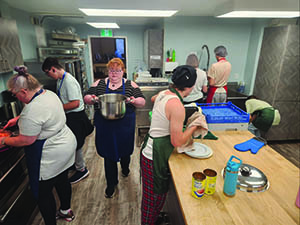
Serving with Mission in the Margins
An active part of their support is working together with city and housing workers to help people navigate social services. Many folks need help recovering identification papers or, with the many who are illiterate, simply reading documents. Streetlight holds adult Bible studies, and offers community kids’ sporting opportunities. They also offer weekly meals, Bible lessons and discipling for those who want to know God more. The church provides a sense of love and community, always accompanied by the good news of the Gospel.
It can be discouraging work. Bosch says the Streetlight team has to “fight for joy, seeing where wonderful things are happening.” And there are many. Like one teen who recently asked Streetlight’s youth worker, “I’m a Christian… is that an insult to my First Nations ancestors?” Or the folks who used to be sleeping outside the building, now coming to church healthy and clean. And the 16-year-old girl from a loving – and very Buddhist – family. “I think I’m a Christian,” she told Bosch, “But my parents are Buddhists…” How does she reconcile these two things?
Healing and growth don’t always look like we’d expect. “I meet so many people in downtown Hamilton that are believers,” Bosch shares, “and their life is just a living miracle. Everything in life has been against them. And they’re still alive. They live in a tent, but they’re praising the Lord! The Holy Spirit is doing work right now, in unexpected places.”
The miracles are all around, for those with eyes to see. Bosch recalls a church member – once a drug addict, now a believer. Her life is still a mess. One day Bosch found her outside, screaming and cursing out another church member. Bosch tapped her on the shoulder. “Hey, can I talk to you?” he asked. Her response caught him by surprise. “Praise the Lord, Pastor! Five years ago, I would have beat the s* out of that b*, and today all I did was yell at her. The Holy Spirit is working in my life!” And so He is!
Mission to the Margins
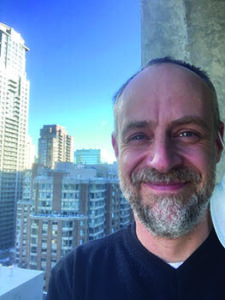
As a young man Jeff Hesselink walked away from his loving Christian family and struck out for western Canada, and ended up on the streets. Now, in the city of Cambridge, Jeff Hesselink works as a chaplain with Mission to the Margins, ministering to the homeless and impoverished.
In the nearby city of Cambridge, Jeff Hesselink works as a chaplain with Mission to the Margins, ministering to the homeless and impoverished.
The Gospel is at the heart of everything they do. “What we bring most of all is the message of the Gospel, but we do that in conjunction with meeting people’s tangible needs as much as we can.” Twice a week they work with churches to provide meals to those who need it. A Gospel message is served before the meal (prepared in-house by church volunteers.) Guests are welcome to the ministry’s food bank, clothing room, and laundry and shower facilities. Throughout the week, the ministry offers pastoral, grief and community support, a bike repair clinic and mentorship.
“Here, in this place,” Hesselink says, “People find a warm place like home on cold winter nights; a refreshing place to halt their unceasing march, to come cool off from the oppressive heat of scorching summer days. And here people find relief from that crushing, suffocating plague of loneliness… All this is nothing new or innovative. The church has been caring for the poor and needy like this… since its inception.”
Hesselink knows firsthand that unceasing march. As a young man he walked away from his loving Christian family and struck out for western Canada. He came to the end of himself and made a deal with God: either God would reveal Himself to Hesselink, or the desperate young man would call it quits – because life without Him was unbearable.
God heard, and answered in a powerful way. Hesselink vividly recalls those days. “Suffice it to say that as I made my way West I was given a new life, and a hope and a future in Him.” Hesselink had peace – but he didn’t have a home. “Here on the streets, in a city I had never been in before, people treated me like I was a thing and not a person, like a garbage can or street post they needed to get around…” Many years later, God has given Hesselink a home, a family and a calling – to reach out to others on the margins, as he once was, with the hope of the Gospel.
He recalls a recent conversation with Barry*. As they were discussing Matthew 7, Barry asked in a hushed voice, “How do I do it? What do I do? How do I take the next step in Christianity?” Essentially it was the question of the Philippian jailor, “What must I do to be saved?”
The Gospel will triumph in Hamilton, Canada, and the world
As Canada slides into deeper poverty and brokenness, Christians need to shine the light of Christ to the impoverished and homeless. The call is both personal and corporate. On a personal level, it starts with seeing the resident homeless man, not as a “street post” to get around, but as a person made in the image of God. We can pray for them and offer to buy them food or other necessities. Corporately, we as churches have a mandate to minister to the least of these. Partnering with an inner-city church or Gospel-driven ministry is both obedient and redemptive.
The seed of the Word will fall on good earth. Bosch and his church are seeing that. They work with eyes open to the suffering, and with sights fixed on the future. “I know the end of the story,” Bosch says. “I’ve read the end of the Bible and Jesus wins! There’s no more suffering. He’s going to take His nail-scarred hand and wipe away every tear… He’s going to make all things new. And all the brokenness, sin, suffering and bad decisions; all of that will be pushed into outer darkness and will be made right. Jesus is doing that. He’s going to win!”
Names with an * have been changed to protect privacy. Pictures graciously supplied by Jeff Hesselink.
Endnotes
1 https://www.hamilton.ca/city-council/news-notices/news-releases/city-calls-enhanced-support-government-partners-address
2 https://www.toronto.ca/city-government/data-research-maps/research-reports/housing-and-homelessness-research-and-reports/shelter-system-requests-for-referrals/
3 https://www.ontario.ca/page/income-support-odsp
4 https://www.youtube.com/watch?v=_2V8nKqLkFg
5 In an effort to move addicts away from dangerous street drugs, Safe Supply Centres offer “safer supply” drugs – prescription fentanyl and other drugs. https://arpacanada.ca/articles/canadas-drug-crisis-a-wicked-public-policy-problem-part-4/