















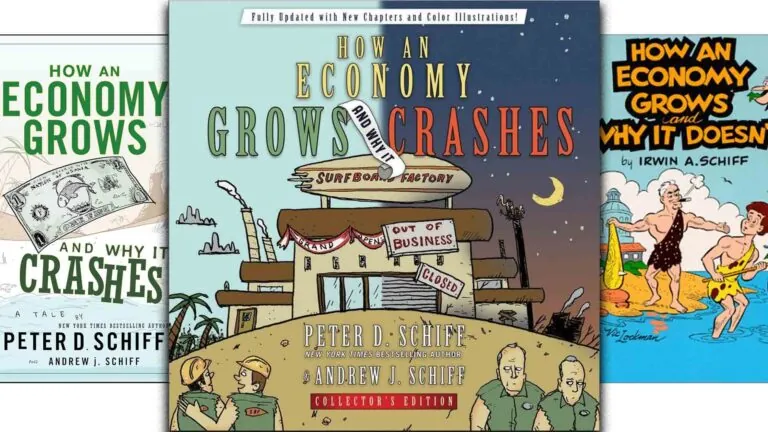
by Peter Schiff and Andrew Schiff
2014 / 304 pages
Economics affects everyone but few people care to learn much about it. All the numbers and graphs make it seem complex and quite boring.
Of course some subjects are so important that even if they were boring we’d just have to soldier on and learn them anyway. And you could certainly make that case for economics – every citizen has to get a handle on the basics of economics so we can properly evaluate government policies and get a handle on where the economy may be heading.
However, Peter Schiff and Andrew Schiff have done us a service by making it possible to learn economics without being bored to sleep. Peter Schiff is an investment manager who was also an economic adviser to Congressman Ron Paul’s 2008 presidential campaign. Andrew, Peter’s brother, is the communications director for Peter’s investment firm. In 2014 they released a Collector’s Edition of their book How an Economy Grows and Why It Crashes that is part fiction, part comic book, and educationally entertaining throughout.
[Editor’s note: while that version is getting harder to come by, the 2010 original is easy to find, and basically the same book, minus the color].
A fish story
Their book is written in the form of a story, with some cartoon illustrations thrown in, which makes this a lot easier to digest and follow than, say, a university economics textbook.
The story begins as follows: Three men, Able, Baker, and Charlie, live on an island and survive by catching fish with their bare hands. They just barely subsist from day to day, catching only enough for their next meal.
Then Able gets the idea of making a simple net to catch fish, but to make it, he has to invest a day’s worth of time. Instead of going fishing, he spends the day crafting the net. This investment is not only costly – he has to go a day without food – it is also risky: he doesn’t know if his net will work. But Able is an entrepreneur, so he takes the risk, and makes the investment.
And work it does. The net enables him to dramatically increase the amount of fish he catches, and therefore improves his lifestyle. The net is “capital” he created that increased his productivity. He subsequently catches more fish than he can consume, and this situation initiates improvements on the island. The lesson, as the Schiffs write, is that “spare production is the lifeblood of a healthy economy.”
Because he has surplus fish, Able lends them to Baker and Charlie. Those two fellows can then take time off from catching fish with their hands to make nets for themselves. That is, they too create capital to improve production. With the extra fish they can now catch, they pay Able back with interest, and all three of the men are better off than before. Even though they had to pay interest, Baker and Charlie increased their own standard of living.
Able’s motivation in loaning the fish was to earn a profit. But the loan he provided benefited the other two men as well as himself. As the Schiffs explain,
The pursuit of profit drives innovation, business formation, and economic growth. It’s the force that raises everyone’s living standard. A big profit just means that a business is good at satisfying customers. Those who earn it should be celebrated not vilified.
Increasing productivity
The story continues from this point with the three men able to spend less time fishing, and more time developing other tools and implements (capital) for improving their lives. For example, they make more nets to build larger fish-catching devices. The new capital they create increases productivity even further.
The Schiffs strongly emphasize the importance of increasing productivity as the key to a successful economy. It benefits everyone. Besides using their story to show how, they also add a real-life example: the industrial revolution of the nineteenth century. They write that the
…vastly increased productivity of the industrial revolution made it possible for working-class people to afford all kinds of goods, like upholstered furniture, tailored clothing, plumbing, and wheeled transportation, that were previously available only to the rich.
Eventually Able, Baker and Charlie begin trading with people on other islands. Immigrants come to their island, a government is formed, and the economy becomes more complex. Their island society becomes known as Usonia. It’s an easy story to follow with lessons on basic economics interwoven with the story’s events.
Paper currency
Fish function in this story not only as food but also as currency. Everyone eats fish and they are easy to exchange for other items.
Once a government is created for Usonia, it issues paper currency backed by fish. Each “Fish Reserve Note” could be redeemed for actual fish at a central bank. Using paper money was much easier than carrying actual fish, so it became the common currency.
Over time, though, the government produces larger and larger amounts of paper currency without maintaining enough fish to redeem the notes. Eventually the government declares that the Fish Reserve Notes could not be redeemed for actual fish after all. The value of the currency then becomes based on the citizens’ confidence in the government.
This is much like the situation with money in the world today. The currencies of modern nations are no longer based on particular sources of value (like gold) but on confidence in the nations’ governments. The Canadian and US dollars were at one time backed by gold (that is, a dollar represented a specific amount of gold), but that is no longer the case. Now they are just paper. The Schiffs point out that this kind of paper money is
commonly called “fiat” money. The word “fiat” comes from Latin and literally means “let it be done.” The word applies because paper money does not have any intrinsic worth, but rather derives its value from government decree.
Right now the worldwide economy based on fiat money seems to be working. But the Schiffs do not think it will last. They do not consider fiat money to be real money because it has no inherent value, the way gold and other precious metals do. In their view,
we are in a “through the looking glass” world where, for the past 40 years, no country issues real money. This is the biggest monetary experiment ever conducted. No one knows how or when it will end. But rest assured, it will.
Government debt
The government of Usonia, like actual governments today, increases spending beyond its means and finances its operations through increased taxes, borrowing money, and also printing more paper money. These activities are harmful to the economy in the long run. The Schiffs state that
Taxes and borrowing merely divert private-sector spending or investment to government. Printed money has the same effect. Newly created money spent into circulation by the government depresses the purchasing power of money held by the public.
In the United States, President Barack Obama has pursued a policy of high government expenditures financed by borrowing and printing money. The US government debt is so large, in fact, that the Schiffs do not believe it can ever be paid. They paint a rather unnerving picture:
Ultimately the U.S. government will have only two options: default (tell our creditors that we can’t pay, and negotiate a settlement) or inflate (print money to pay off maturing debt). Either option will lead to painful consequences.
They believe that the value of the US dollar will drop steeply because so much is currently being printed. However, its status as the official “reserve currency” of the world keeps its value artificially propped up. Being the international reserve currency means that
the dollar is accepted as the exchange currency for any international transaction. This means that everyone, not just the United States and its trading partners, needs dollars to conduct trade. So even if no one actually buys things that are made in this country, dollars are always in demand. No other country has this monetary good fortune.
In their view, if the US dollar was to lose reserve status, its value would drop severely, wiping out much of the wealth Americans currently possess. Its present value only remains high because of its wide acceptance around the world.
Conclusion
Economics may not be inherently exciting to many people but it affects everyone. The basics are understandable if they are presented properly, and the Schiff brothers do a great job in their book. They provide a simple basis for understanding the kinds of measures that help an economy grow as well as those that stifle growth.
Some policies (such as printing more money) provide a temporary illusion of prosperity followed by a financial downturn. Politicians campaigning for re-election love policies that provide an illusion of prosperity. They often make decisions that will benefit themselves in the short run but actually harm the economy in the long run.
The Schiffs emphasize work, saving, thrift, and innovation as keys to economic success. To a large degree the virtues that lead to prosperity are also Biblical virtues. Therefore, even though the book is not specifically Christian, it reflects much that is compatible with Biblical Christianity.
This was originally published in the May 2015 issue under the title “Economics for Everyone.”