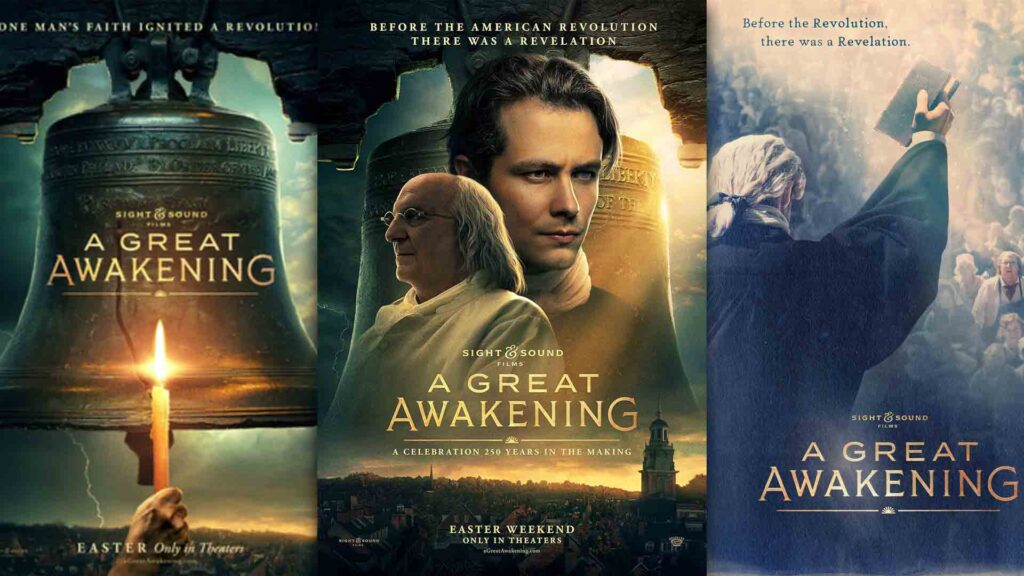
Drama
2026 / 129 minutes
Rating: 8/10
If you like watching movies worth talking about afterwards, you need to go see A Great Awakening – it’s a film with real heft to it.
If you haven’t heard of America’s “Great Awakening,” it was a revival that occurred through the 1730s and 1740s, with God using a lot of Calvinist pastors, including Jonathan Edwards and the man at the center of this film, George Whitefield, to turn a generation to Him. Even if Church history isn’t your thing, you’ve likely heard of George Whitefield, the traveling pastor with the booming voice that could be heard by tens of thousands at a time, and was heard by hundreds of thousands on both sides of the Atlantic. And you don’t have to be American to know that Benjamin Franklin – the “co-star” of this story – was a printer, journalist, inventor, one of America’s Founding Fathers, and not a Christian.
But did you know Whitefield and Franklin were friends? They formed a partnership early on, with Franklin happy to print and sell Whitefield’s sermons and pamphlets. Franklin was only about the money. Sure, he’d admit there was a God, but not one he wanted to know, and certainly not one he wanted to submit to. But God remained sovereign, and whether Franklin wanted to be or not, he was an agent of that Will, with his printshop supplying pamphlets that made God’s Name known to thousands who, more humble than Franklin, were eager to bow their knees and worship.
Viewers will understand this film in at least a couple of different ways.
- Some will say this is about how God used Whitefield, and Franklin too, to turn the hearts of a fledgling nation-to-be toward Him. It will appeal to the American who recognizes his country is something special, and then sees this story as an explanation of why – because Christianity was a substantial part of its founding, and even now some ripples remain from that generally Christian beginning. Some of A Great Awakening‘s posters bill it this way, talking about how “one man’s faith ignited a Revolution” and “before the American Revolution, there was a revelation.” But I don’t think these taglines do the movie justice – it is about much more than the American Revolution.
- This is, instead, about how God transformed Whitefield and then transformed thousands through him. We see Whitefield tearing down dead rituals and rites as no way to serve a living God. We see him fighting his own and then Franklin’s works-righteousness, begging the printer to understand that he can’t earn the forgiveness that Jesus freely gives. We also see Whitefield’s courage, but the film understands that we can’t get caught up in the man if we’re going to give glory to the God he serves. So Whitefield’s hypocrisy is addressed head-on – that this man preaching God’s liberty was also an enslaver of men, buying slaves to help run his orphanage more cheaply. But as he shouts at Franklin, “Do not base your faith upon my flawed life. Do not base your faith upon the cold religion of your father. Base it upon what He has done on a cross of wood.”
Worth talking about
There’s nothing new under the sun (Eccl. 1:9), so this blast from the past certainly has a lot to say about today’s issues. In what may be my favorite clip, Whitefield takes to the pulpit in an Anglican church, and starts with this story:
“In 1675, the Archbishop of Canterbury became acquainted with an actor of some renown, Mr. Betterton. One day, the Archbishop said, ‘Mr. Betterton, pray tell me, how is it that you actors on the stage can so move your audiences while speaking of things imaginary, while we in the pulpit speak of things real, which our congregations receive as if they were but imaginary things?’ ‘Why, my Lord,’ Mr. Betterton replied, ‘the answer is quite plain. We actors speak of things imaginary as if they were real, while you, in the pulpit speak of things real as if they were imaginary.’”
Whitefield attacks the formalism of his time – preachers and parishioners going through the motions but not living like they believed in a mighty God who is to be feared and loved and Who will not countenance us being lukewarm (Rev. 3:16).
Towards the end of the movie, the elderly Franklin gives a surprising speech to the 1787 Constitutional Convention, suggesting that they begin now, to start each day with prayer. Why?
“I have lived, sir, a long time, and the longer I live, the more convincing proofs I see of this truth – that God governs in the affairs of men. And if a sparrow cannot fall to the ground without His notice, is it probable that an empire can rise without His aid?”
And what response did this deist get to his encouragement for those assembled to turn to the God Who will decide whether or not they would succeed in founding a country? The film shows us an awkward moment of two of silence before Alexander Hamilton rises to object. While the official “Records of the Federal Convention” don’t give Alexander’s exact wording, they say enough to show the film captured the sense of it. Hamilton didn’t like the optics. He thought it would make them look weak.
And isn’t this our concern too? Whenever we speak up in public about any moral matter, we seem to always want to ground our arguments in common sense, or public opinion, but certainly not on God’s Word. After all, to appeal to God’s Word would make our position seem weak, right? Like we’ve got nothing better to offer, right? It’d be like we were basing our position on some religious text that so many others don’t even believe in.
But if that’s how we’re thinking – and I believe it is – then we should take the lumps that Whitefield dished out to the Anglican churchmen. Then we are acting as if the reality of God as Creator and Upholder of all is just some imaginary thing. Then we are acting as if the opinions of the masses and their “common sense” were our only real firm foundation. Then we are getting things exactly backwards, and we need to stop offering up such a confused performance, and start speaking of our God as the Sovereign Lord He really is.
Cautions
The most notable caution might be a single usage of God’s Name in vain. While measuring the size of the crowds that could hear Whitefield speak, Benjamin Franklin is astonished to realize it could number as many as 30,000. And in amazement this non-Christian exclaims, “Dear God!” I don’t normally recommend any films that take God’s Name in vain – I can think of only one other, a documentary by Francis Schaeffer that includes street-side interviews where someone blurts out God’s Name this way. I’m making this exception here because this whole film is about honoring God’s Name. And while I wish the scriptwriters had cut this line, it does strike me as an instance of even an unbeliever having to give credit where it is due. Only God could make a man like Whitefield.
Conclusion
There’s been a decent film or two on Martin Luther, a good one on missionary Jim Elliot, and a better one on pastor Richard Wurmbrand, but I don’t know if I’ve come across a better Church history film. A Great Awakening was good enough to keep even my teens engaged (though, admittedly, they wouldn’t give it the 8 I’ve awarded it) and it has enough depth to it that it’s worth watching multiple times.
We live 250 years later, but our time time doesn’t seem all that different from Whitefield’s. We too need to hear Whitefield’s promise and his plea:
For you who honor my name, the sun of righteousness will rise with healing in its wings. My friends, do you want to be free? Liberty is found in Him alone. Do you want to live? He alone gives eternal life. Because of the tender mercy of our God, the rising sun will come to us from heaven to shine on those living in darkness. I beseech you, do not reject so great a gift. A great awakening has come.
Arise, O sleeper!
Awaken!
Discusion questions
- In the opening scenes Franklin expresses frustration that the different Constitutional Convention delegates are using a word that once united them all – “liberty” – to now justify doing whatever they wanted. “Everyone seems to be at liberty to do whatever they want.” Was Franklin’s complaint ironic? Whitefield and Franklin had their own disagreement about what liberty really meant; how very differently did they each use the word? In Franklin’s worldview, how could he prove to Rhode Island they shouldn’t be so “rogue”? Why shouldn’t all the delegates be able to do whatever they want? Didn’t Franklin want that same freedom for himself, to do whatever he liked?
- How did Whitefield’s fast compare to the actions of the young Martin Luther? What was wrong with Whitefield’s understanding of “crucifying the flesh” and how was he misunderstanding Gal. 5:24? How is his idea more like Greek dualism, than biblical Christianity?
To learn more about the man, and his interaction with the Wesleys, you may also be interested in the free 1-hour documentary George Whitefield: The Preacher Who Sparked the Great Awakening. And if you have any suggestions for more discussion questions, I’d love to hear them.