















I can vividly recall one spring afternoon many years ago when I came across an unexpected sight in the woods near my childhood home: an apple tree in full bloom, its delicate pink-tinged petals drifting down like snow. It was a moment of wonder, not only at the magical scene I had unexpectedly entered, but because I was the only one there to see it. All this beauty seemed wasted in its hiddenness. Why would God lavish such loveliness on a place where no one would notice?
 What does undiscovered beauty say about God?
Many similar moments since then have made me ponder what this reveals about God: a Creator who cares about beauty for its own sake. He fashioned a world that is not only functional but beautiful. When one reads the detailed specifications for the temple and its articles, it’s clear that God values craftsmanship and artistry. Further reading reveals how He cares about skilled musicians and beautiful lyrics, good storytelling, and lyrical poetry (How differently we’d feel about the Psalms if they were written in prose!).
All throughout creation, we see beauty for the sake of beauty, often with no apparent practical function. We marvel at this truth on clear nights when we look at the stars. “And He made the stars also,” the creation account tells us (Gen. 1:16), nearly in afterthought, as though the spontaneous flinging of innumerable flaming orbs throughout the universe by just a word requires no further elaboration. We wonder at the purpose of this vast universe, much of it unseen and unknowable. The Psalmist hints at a reason:
“When I consider your heavens, the work of your fingers, the moon and the stars, which you have set in place…what are human beings that you care for them?”
This Creator, Artist, Designer – the one who brings all this wondrous, breathtaking beauty into being so effortlessly – cares about insignificant you and me. Clearly, all this impractical, creative beauty reveals something about God’s character that we are meant to discover in the midst of our practical, everyday lives.
Made in the Image of my Creator
I am, by nature, a practical person. My background is in nursing, not art. I only recently took up painting as a hobby during Covid lockdowns when my usual routines slowed. But practically speaking, I struggled to find purpose for creativity. The impetus behind creating sometimes feels uncomfortably more like drive than pleasure. But even without outside motivation or practical reasons, I’m not alone in simply pursuing creativity for its own sake. Though this drive may reveal itself in a variety of ways, it all points to being created in the image of a Creator who loves to create.

After the Storm: A storm rolling through Destin, Florida, left behind waves that were perfect for one of our family’s favourite beach activities, boogie boarding.
There are other reasons to lean into this drive to create. Andy Crouch in Culture Making reminds us that it is easy to slip into the role of consumer (and critic) of culture, rather than putting effort into a counter-cultural offering of our own. Christians are called not only to reject what is false, but also to offer something better. When we write a song, paint a picture, cook a delicious meal, cultivate a garden, craft a story, or build something skillfully, we have the opportunity to reflect goodness, truth, and beauty.
Practicality: a good tool but a lousy master
Practicality, for all its advantages, has its faults. At times, it can blind us to things important and valuable. Jesus’ followers and disciples were (relatably) concerned about practical things: feeding hungry crowds, keeping pesky children out of Jesus’s way, staying afloat on stormy seas, managing the household and hostess duties. Jesus gently rebukes this way of thinking; not encouraging neglect of the practical necessities, of course, but reminding them and us that there were important things to see and learn in those moments that could be missed if focus was only on what was practical.
When a woman poured out expensive oil on Jesus, the disciples were aghast. It seemed a waste; surely there were more pragmatic uses for the money spent on this costly, fragrant oil. But Jesus does not rebuke the woman for this extravagance; rather, He rebukes the disciples, saying, “She has done a beautiful thing to me.” This beautiful act continues to be told “as a memorial to her” ever since, just as Jesus said it would. Beauty has that ability to linger on in hearts and minds, inspiring others for generations to come.
It’s easy, like the disciples, to get caught up in all our cares and concerns, the toiling and spinning of everyday. What will we eat, wear, and how will we get everything done? Jesus points out, “Life is more than food, the body more than clothes.”
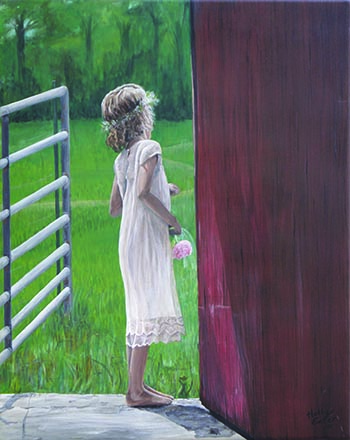
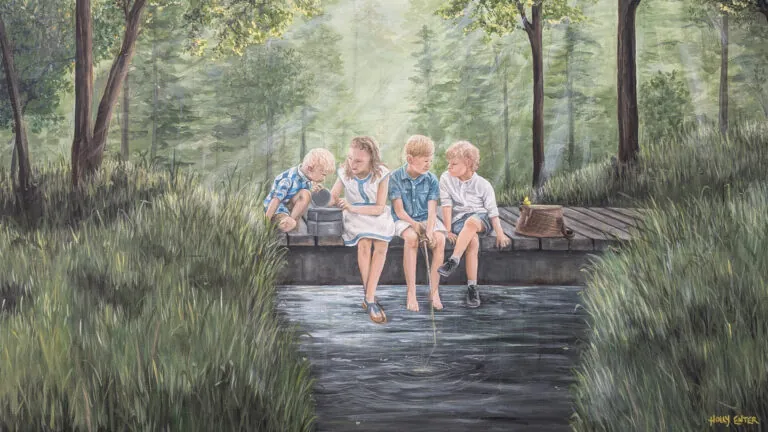
Flower Girl: Her flower girl duties over, my young daughter explores the wedding venue, an old barn.
Beauty pushes back the dark
For those of us whose tendency is to focus solely on these practical things, He encourages us to consider the lilies of the field, “they neither toil nor spin, yet not even Solomon in all his splendor was dressed like one of these.” All this created beauty not only points to a creative God who loves beauty, but has the further purpose of reminding us of His great care and love for us. He adorns even the grass of the field with such beauty, which is “here today and gone tomorrow.” He creates beauty that is fleeting, unnoticed, even unseen, like trees in full blossom in a forest or galaxies far away. How much more will He not care for us? Truly, the business of life can steal from our sight the beauty of these truths if we don’t take time to seek them out. Creativity encourages us to open our eyes to new perspectives, drawing us into new moments of awe and wonder. We find ourselves not only seeking beauty in a new way, but also finding it in unlikely places.
Jesus made the startling announcement that “The kingdom of God is at hand,” then spent His ministry years fixing the broken, teaching the ignorant, reversing the curse, lighting the darkness. In the “already, but not yet,” we too can offer glimpses of this Kingdom. Andrew Peterson calls it “adorning the dark.” I love the picture portrayed by this phrase: giving words to how we push back darkness through our creative endeavors; motivation to spur us on when inspiration fades. We offer our gifts of creativity and beauty to the Creator Who doesn’t see it as wasted effort. We dive into this opportunity to reflect the creativity of God, Whose image we bear. We accept His gracious invitation to create, knowing that though it may not always be practical, it is not without purpose.
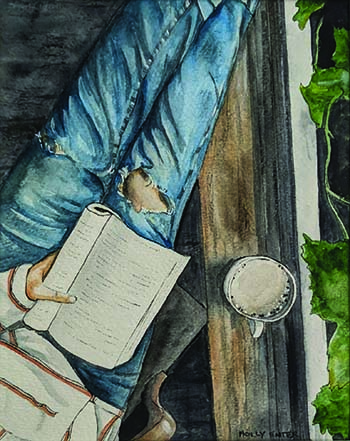
Artwork provided by the author. Find more of Holly’s art, and details about her new novel for young teens, on Instagram and on her website.