Transparent heart icon with white outline and + sign.

Life's busy, read it when you're ready!

Create a free account to save articles for later, keep track of past articles you’ve read, and receive exclusive access to all RP resources.

White magnifying glass.

Search thousands of RP articles

Helping you think, speak, and act in Christ.

Open envelope icon with @ symbol

Get Articles Delivered!

Helping you think, speak, and act in Christ. delivered direct to your Inbox!

People we should know, Theology

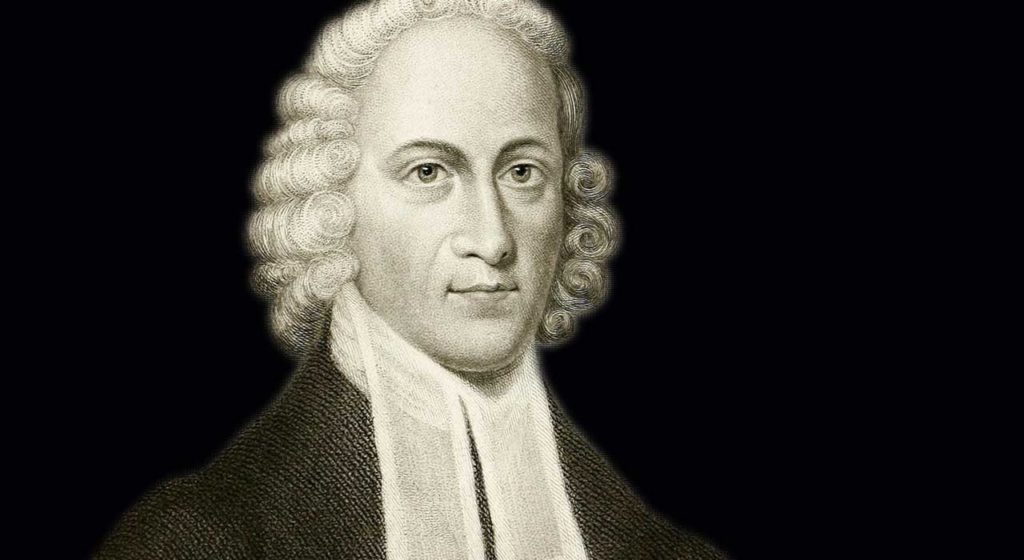
Jonathan Edwards: The pastor who packed them in the pews while preaching the wrath of God

Much like today, during the early colonial years in America, preachers rarely spoke about the wrath of God – this did not seem the type of topic to draw in the masses. One man, however, thought very differently. He brought the message of God’s wrath and, in doing so, ignited a revival which spread throughout the colonies.

Jonathan Edwards was born on October 5, 1703, in East Windsor, Connecticut and began preaching in 1722. Although hell and God’s wrath are unpleasant topics, Edwards became one of America’s best-known evangelists by preaching on just these topics. We can get an understanding of how God used him to spark a revival across the colonies by looking at three specific sermons Edwards delivered at different points throughout his ministry. Through these sermons he taught the reality of God’s wrath by:

  • showing how it will destroy unrepentant sinners
  • explaining that it is the power of God which can save them from this wrath
  • warning that those who do not glorify God are deserving of destruction

Edwards knew that the themes of wrath and hell needed to be taught to cause the hearts of those listening to be convicted about their sins and to realize the reality of eternal punishment.

#1: When the wicked have filled up the measure of their sin…

He began preaching on the subject in May 1735 when he delivered his sermons “When the wicked shall have filled up the measure of their sin, wrath will come upon them to the uttermost.”

Edwards’ text was 1 Thessalonians 2:16, which reads, “To fill up their sins always; for the wrath is come upon them to the uttermost.” He immediately presented a picture of hell and never let go of that illustration throughout the sermon. He clarified that God enacts His wrath “very dreadfully in this world; but in hell wrath comes on them to the uttermost.” God executes his wrath on the sinners in this world to a smaller extent, either outwardly on the body or inwardly on a mental or emotional scale. However, “these things are only forerunners of their punishment, only slight foretastes of wrath.” When God’s full wrath comes upon them, it will come with no restraint and no moderation of degree, for “His heavy wrath will lie on them, without any thing to lighten the burden or to keep off, in any measure, the full weight of it from pressing the soul.”

Perhaps the most powerful point Edwards made in this sermon is that once the day of judgment comes, the wicked are sealed in their punishment eternally. There is no longer any chance for repentance or forgiveness once death has come. This is a message that the content Christians in the pews needed to hear. Without knowing the reality and severity of hell, the sinner did not feel a need to repent.

Edwards concluded by noting how dreadful the wrath will be, for it is given by the One who created the universe, shakes the earth, rebukes the sea, and shines His majesty over wicked men. The judgement of God is certainly coming, but it will not be known until it comes. Therefore, Edwards begged everyone listening to “haste and flee for their lives, to get into a safe condition, to get into Christ.” This sermon carefully presents the danger of those who are content with living in sin, and it presses the message of hell to convict them of their rebellion.

The reaction to this sermon inspired many in New England to change their lives. However, much more was to come when, six years later, Edwards preached his most famous sermon.

#2: Sinners in the hands of an angry God

On July 8, 1741 Edwards delivered “Sinners in the hands of an angry God” in Enfield, Connecticut. He was not supposed to preach that night, and he had preached that same sermon before at his home church. He happened to have his manuscript with him, and after receiving the last-minute request to fill in for the pastor, he preached a message that had an amazing effect on many of the hearers, spurring on a revival.

Jonathan Edwards was born on October 5, 1703, in East Windsor, Connecticut to his father Reverend Timothy Edwards and his mother Esther, the daughter of Reverend Solomon Stoddard. Stoddard would become a mentor to Jonathan. Edwards attended Collegiate School, later called Yale College, graduating in 1720. In 1722, he accepted a call to a Scotch Presbyterian church in New York. He then went to Bolton, Connecticut in 1723. In 1724, he became a teacher at Yale College, and finally succeeded his grandfather Reverend Stoddard at Northampton, Massachusetts in 1727.

The text of this sermon was Deuteronomy 32:35, which says, “Their foot shall slide in due time.” Edwards opened his sermon by saying:

“In this verse is threatened the vengeance of God on the wicked unbelieving Israelites, who lived under the means of grace…yet remained void of counsel.”

He began by stating that all sinners are exposed to destruction, a destruction that is unexpected and brought about by the sinner himself. The only reason why this destruction has not yet come is because of the mere mercy of God, which He gives under no obligation but by grace. Edwards was keen on portraying the power of God by reminding his listeners that even the strongest man has no power over God, and not even the mightiest fortress can defend against Him. He emphasized the fact that sinners deserve to be cast into hell, saying that they are the objects of the anger and wrath of God. He painted a vivid picture by declaring:

“the wrath of God burns against them, their damnation does not slumber; the pit is prepared, the fire is made ready, the furnace is now hot, ready to receive them.”

Edwards revealed the reality of death and claimed that God is under “no obligation by any promise” to keep sinners out of hell. God is provoked by sin, and nothing can be done by sinners to appease that anger. Edwards was trying to “awake unconverted persons in the congregation… who find are kept out of hell, but do not see the hand of God in it.”

Edwards ended his message by urging the congregation to consider the danger that they were in, that if they did not change their lives for Christ they were in danger of suffering an everlasting wrath, where “it would be dreadful to suffer…one moment; but you must suffer it to all eternity.” The Christians of the early British colonies had forgotten that if God withdrew His hand from them, they would fall into the depths of hell. This is what it means to be in the hands of an angry God, that sinners are born again and made new creatures because the God of wrath and justice found pleasure in making the damned soul worthy of salvation. Edwards pushes the reality of God’s wrath and hell, a topic which was rarely preached. It is this topic which ignited a revival.

The effect of this sermon was immediate and powerful. According to one listener, even before the sermon was done “there was great moaning and crying out – ‘What shall I do to be saved?’… amazing and astonishing power of God was seen.” Another eyewitness, Stephen Williams, wrote:

“Mr. Edwards of Northampton…preached a most awakening sermon…‘Oh, I am going to Hell,’ ‘Oh, what shall I do for Christ,’ and so forth…went out through whole .”

Edwards was able to vividly portray the wrath of God on sinners, causing those who heard him to know the true condition of their hearts. A revival swept through the towns. Hymns were sung, taverns were closed, and young people poured into churches. Congregants arrived at church hours before the service in order to get a seat in the sanctuary. It is estimated that 10 percent of New England was converted during this time. That is equal to 28 million people today. Clearly, Jonathan Edwards sparked a revival in Enfield.

#3: Wicked men useful in their destruction only

While that might have been Edwards’ most famous and impactful sermon, he continued to tell the people of New England about the reality of God’s wrath. In July 1744, he preached a sermon called “Wicked men useful in their destruction only,” and as the title suggests, his main point was that “if men bring forth no fruit to God, they are wholly useless, unless in their destruction.”

His message was from Ezekiel 15:2-4, which asks what the worth of a dead vine is. The answer is that “it is cast into the fire for fuel; the fire devoureth both the ends of it, and the midst of it is burned” (Ezek. 15:4). Edwards expanded on this passage by comparing sinners to the vine, saying that the dead vine which is good for nothing deserves the same fate as a dead sinner: utter destruction.

Edwards claimed that the only two ways in which a person is useful is either in acting or in being acted upon. A person is useful in acting when they display the “fruits of the Spirit” and use them for the love of God and neighbour. If, however, a man does not do this, then there is no purpose for him to exist. Yes, there are other uses for mankind, as man was made for one another to be friends and neighbours. However, these are inferior ends and are subordinate to the main purpose, which is to serve and glorify the Creator. Therefore, since a wicked man cannot glorify God, he is only useful passively by being destroyed. Edwards claimed that it goes against God’s justice to let wicked men “live always in a world which is so full of divine goodness…that this goodness should be spent upon them forever.” Even though the world is full of sin, so much of God’s undeserved blessings can be seen and enjoyed. The rest of creation is made subservient to mankind, which is wasted on men who bear no fruit for God. The only use that wicked men can be is in their destruction for God’s glory, by both having God’s majesty and justice acted upon them and by being an example to the righteous, giving them “a greater sense of their happiness and of God’s grace to them.”

Edwards applied his point so that all may learn the justice and righteousness of God. God takes no pleasure in the death of the wicked, but no one blames a farmer who cuts off a tree which no longer bears fruit. Edwards is calling his congregation to consider all the good things God has bestowed on them, including having a soul which houses the Holy Spirit and by having hosts of angels working for them. All of creation works for man’s pleasure, so “how lamentable it is, then, after all these things he should be a useless creature.” The one who is useful will experience pleasure in this world, and the pleasures will be even more wondrous in the world to come. However, those who do not continue “to bring forth any fruit to the divine glory, hell will be the only place fit for … nature ceases to labour any more for sinners.” Again, Edwards is stressing the point that God’s wrath is real, and unrepentant sinners will suffer it.

Conclusion

Jonathan Edwards inspired many revivals through his preaching by talking about God’s wrath and hell, topics that were unpopular to the crowd and avoided by other preachers. Through this unpleasant topic, Edwards ignited a fire of repentance in the hearts of the people of New England. His sermons presented God’s wrath by showing how He will destroy unrepentant sinners utterly, how it is the power of God which can save them from His wrath, and how those who do not glorify God are only useful to be destroyed.

Texts are quoted as Edwards translated them in his sermon manuscripts. This article was first published in the Jan/Feb 2019 issue of the magazine.

Red heart icon with + sign.
Theology

The pursuit of wisdom: do it ‘til you die

Some might assume that, as they grow older, they will grow in wisdom. But the Bible tells us that’s hardly a given. One of the themes of the book of Proverbs is that wisdom is something that has to be pursued. We can see this in three of the characters we are introduced to in Proverbs. One of these characters is “the righteous” – humble and actively seeking out God’s wisdom. The wicked, on the other hand, are proud, and in their selfish ambition they are active too, but actively seeking out folly. They get into trouble because they are looking for it. But perhaps it is the third character who should most interest us. This third sort is also seeking folly…but not actively. In a sense he finds folly only because he isn’t seeking wisdom. He is the sluggard. So both the wicked and the righteous go out and make choices – they choose between wisdom and folly. The sluggard? He just stays home. And folly finds him. Between wicked and wise That’s why the sluggard is encouraged to stir. We find him in Proverbs 6 being told: “Go to the ant, you sluggard! Observe her ways and become wise.” The ant doesn’t have somebody telling her what to do. She acts on her own initiative. She goes out and finds a job, so that she may learn her trade. The sluggard needs to get up out of his bed and learn from the ant. The author of this proverb wants to encourage his readers in godly ambition. Then again, in Proverbs 26:13 and onward, we see a warning against sloth. Here the sluggard cries out, “There is a lion in the streets.” The sluggard makes excuses for himself, for why he just wants to stay home. He won’t risk any effort. Again, we see the need for godly ambition. We can’t be afraid of risks when we go out into the world. We have to be wise and prudent in our actions, but if we live in fear of what might happen, we will never find the prize. The reward will be gone. Christians have no excuse for sitting around and waiting; we have no excuse for endless leisure time. We either have to go out and seek wisdom, or we will lose it. Then we’ll become the fool, fearing even imaginary lions. And ultimately, we will lose the Wisdom of God; Jesus Christ. We are all called to that search for wisdom in so far as God has given us the ability to do so. Wisdom put to use Wisdom, in our passages, is the ability to discern between to choices. Practically speaking, wisdom is the means by which we make business decisions, choose a marriage partner, or make any number of other choices that come to us each day. But within Proverbs all wisdom ultimately points to the Wisdom of God, the Wisdom that God reveals in Jesus Christ and the Wisdom by which God made the world. He is the one who holds the universe together. We can distinguish between practical wisdom and the Wisdom of God in Proverbs, but they cannot truly be separated. If we do not seek wisdom, we ultimately lose the Wisdom of God; Jesus Christ. We are all called to that search for wisdom in so far as God has given us the ability to do so. So one of the messages of proverbs is, “get up, get out and find wisdom.” Search then. Seek out the wisdom of the universe. We need to have the attitude of the man Jesus speaks of in the parable of the pearl of great price. This man sells everything in order to find what is most precious; the kingdom of God. Search for the Wisdom; Christ. That is a life-long search, a life-long desire, for those who have found him. Do not cease from scouring the Scriptures. Do not cease from praying for understanding. Search until God gives you the fullness of eternal life and rest with Him. This article was originally published in the Sept/Oct 2017 issue of the magazine. ...

woman frustrated at work
Red heart icon with + sign.
Theology

Should a Christian ever be discontent?

She sat across from me, sipping coffee, her forehead wrinkled with unhappiness. She’d struggled for two years in a job that clearly made her miserable, and which everyone else thought she should quit. But she couldn’t quite agree, wondering if there was a reason God had blessed her with the position. “I’m trying so hard to be grateful,” she said. “I just want to be satisfied with what I have.” **** My friend’s words hit me right in my chest. I didn’t know what to say, because I’ve struggled with the exact same issues. When is it okay to give up on the path you’re currently traveling on? When is it okay to quit and change what you’re doing? We know God has a reason for everything He brings into our lives, so doesn’t it just make sense that we should figure out that reason – figure out how to glorify Him in this situation – before we think of moving on to something else? But like so many other situations in life, we often don’t understand the invisible plans of God, or know what His goal is for us in our current season of life. And so we can be left unsure if it is okay to move on to something else, or if God means for us to learn contentment where we are. Often, when we find ourselves feeling like I or my friend felt in that moment – recognizing the strain of dissatisfaction running through our lives – we respond with guilt. We might think this discontent points to a lack in our spiritual lives. But is discontent always wrong? Dissatisfaction certainly can be caused by a spiritual lack. We humans never are satisfied with what we have. We never have enough. If we had the power to change everything in our lives, we still would not feel fulfilled. But this does not mean we should never take our discontentment seriously. Discontent might be the motivation to change something in our lives that needs changing. The value of discontent When we look at other people’s lives, it’s easy to recognize what’s causing them unhappiness, and it’s easy to say they should change these things. In fact, we often wonder why they don’t. This person is still young, so why don’t they try a new career? Or this person has the freedom to move, so why don’t they try living in another city? But when it comes to ourselves, we see how hard it is to justify our choices to make changes. Is “unhappiness” really a good enough reason, when we know we’re called to be content? To get here we've struggled, we've prayed, we've relied on God to achieve things – and by the grace of God we have achieved them. We know, because our strength was so weak and we needed God's strength so much to get where we are today, that our current situation is straight from the hand of God. What we need to know is if we can be grateful for God’s gifts while still choosing for change. No wonder people hesitate to make a change! One way forward is to consider when feelings of discontent have value. This is not to say discontentment should be embraced, but that the feeling can point us to areas of our lives we do actually have power over. So let’s look at discontentment a bit more closely. We shouldn’t be content with just this world First, there are some obvious things God intends for us to be discontent about. We are not supposed to be content with the fallen state of the world. We are supposed to be content that all things are in the hands of God, but we are not supposed to look at injustice be pleased about it. Some of our dissatisfaction points us to the new creation we are looking forward to. When we recognize that we never feel fully fulfilled, we also recognize that we are waiting for eternal fulfillment. We live with “eternity in our hearts” – we have a vision of an ideal kingdom this world cannot live up to. This also means that life’s frustrations, dead ends, and futility were never meant to be part of God’s good creation. No wonder we react so strongly to them. And yet, while we understand this, we also understand God is still holding all the threads of our lives in His hands. We cling to His promise that in him everything that seems meaningless has meaning. We shouldn’t be satisfied burying our talent There’s another aspect of discontentment to consider. Contentment ought to be separated from passivity. A wrong emphasis on contentment can make us believe we’re not allowed to change anything in our lives. But contentment and passivity are not the same thing. Perhaps discontentment may be a challenge to us. We may hide behind “contentment” because we’re afraid to take the risk of change, because we might fail if we try something new. But our dissatisfaction could hint that we are not reaching for goals that we could try to reach. We are not risking the bumps and falls that might develop our skills. Discontentment might tell us we are meant to challenge ourselves. And if we are taking the easier path without really thinking it through, our emotions may be a sign something is wrong. We should consider whether we need to choose a more challenging goal. If we do not separate contentment and passivity, it can result in a fatalistic determinism. We might conclude that wherever we happen to be, that is where God placed us so it must be where He wants us to be, and therefore we should be content. But this cuts off the possibility that God also blesses us with opportunities. Determinism leads us to say—You’re still single? God must not want you to be married. You’re poor? God must not want you to be rich. Don’t try to achieve anything. Just wait peacefully. Don’t try to change. Everything you’re meant to have will just happen if it’s meant to be. But clearly this is an unbiblical message. Learning contentment from Paul Contentment is still a good thing, and it is a virtue to be pursued in our lives. After much struggle, I’ve realized that while there may be something behind the vague sense of discontent that so often crops up in our lives, and that these reasons can be addressed, contentment is still the goal, not discontent. How, then, should we pursue contentment while avoiding utter passivity? There are a few things to keep in mind. Content even as we strive First, contentment is about where you are in the present moment. It is not a denial of any change in the future. When Paul talks of being content in all circumstances, he was working towards a goal, and the circumstances occurred while he was attempting to achieve it. Having a goal does imply you expect to cause change in the future. So perhaps it is not the goal you’re supposed to avoid having, but the discontent over the difficulties that spring up on the way to the goal. It may in fact turn out to be that the goal is not one you’re meant to achieve, but contentment in all circumstances includes contentment during the deep disappointment that hits when you don’t achieve your goal. In other words – strive! Keep striving! But be ready to be content with what the Lord brings you. Content in suffering Another caveat is that contentment in Scripture, including the contentment passage in Philippians 4 (“I have learned in whatever situation I am to be content”), is mentioned in relation to suffering. It is an approach to situations that are not in Christians’ control. When life is hard, especially when life is hard as a result of being Christians, Christians are to be content. So the intent is not to say, “don’t change your life path,” but rather, “I know you’re suffering, and this is where you can find comfort.” These passages also emphasize that no circumstances of life ever prevent us from being saved by God – whether in chains or free, whether rich or poor – no one needs to be discontent because their circumstances prevent them from truly being Christians. If such circumstances did exist they would surely be reason for despair—but thanks be to God there are none! We can be content because our circumstances do not prevent our salvation. Content when we have choices and when we don’t We all suffer in some way, but in comparison to many Christians in the Bible we are faced with an endless array of choices – we can choose a career, we can choose a spouse, we can choose where we want to live, we can choose to travel, we can choose our level of education. It’s not a surprise the Bible doesn’t predict that we in the future would be faced with this array of choice, and advise us on how to wrap our minds around the dizzying display. And therefore it is not a surprise when we try to apply biblical principles to our choices instead of our sufferings, and end up at the conclusion that we should never desire anything, and never try to achieve anything. But rather than arriving at this conclusion and automatically accepting it, we should think about whether this is really correct. We are to be content in situations we can’t change, including those which are really, really hard. But our contentment in the present moment doesn’t prevent us moving from one choice to another in the future. Second, we often think contentment means being stationary unless we’re sure God means for us to move. But Paul did not always sit and wait until absolutely sure that God was sending him somewhere else. If he was called by the Spirit he followed, but he continued to work and preach in all places while waiting for the Spirit’s call. He often made plans to go to different places, or to start new missions. When the Spirit of God prevented him from preaching throughout Asia Minor, he continued trying in place after place until he reached the sea – only then did he realized he was being called to Macedonia. In other words, sometimes we are not sure what we should do, but we do not necessarily have to wait for a firm confirmation from God before every action. Content in the day-to-day faithfulness Lastly, we are often discontent with our lives not because of the goals but because of the mundane tasks and the drudgery. Our actions seem so little, and so dull. We cry, like me and my friend did when we were having coffee, “I just want to work in God’s kingdom!” But perhaps the cathedral builders did the same, as they painstakingly placed stone on stone for hundreds of years, unable to see the buildings we’d gasp at in wonder today. Perhaps our grandparents did the same as they struggled to get their children to listen to a Bible story, not knowing if the generations who’d follow would do the same. When we ask God to use our lives according to His plans, we sometimes suppress a fear that God doesn’t want us to go anywhere, or do anything. This is our fear when we walk into the office and face a mountain of paperwork that needs to be done but hardly seems worthwhile – am I really contributing to God’s kingdom, we wonder? But our God is not a God of waste. If we are to be ordinary, it will be worthwhile. Our call to contentment brings us to a new understanding, where ordinary labour is not undervalued. We are not pressured to all conform to the mould of world-changer. We can put our hand to the task in front of us without fear our efforts will be washed from the earth, because we know they’re seen by the eyes of God. Conclusion What, then, is contentment? First, it is a focus on the kingdom of God, not the kingdom of the world. It shifts our focus from yearning for the things of this world, such as money, fame, or power. We can trust there are eternal things that we are building, and contentment means that we can rest. Second, it is not a struggle with God over what can’t change. While we are not called to passivity, in our lives we will sometimes be told “no.” This is where we are most often tempted to fight, not necessarily with our actions, but with a rebellious spirit that insists on despising the situation forced on us. Only by looking to God in His Word and in prayer will we find the strength to turn back to contentment again. When my friend and I left the cafe, our lives were still the same as when we had come in. Yet somehow Christian company and very good coffee gave us new capacity to rest in the goodness of God. Harma-Mae Smit blogs at  HarmaMaeSmit.com. This article was first published in July 2018....

Red heart icon with + sign.
Theology

Proverbs: a different sort of devotional

“Do you have a devotional that you would recommend?” I get asked this question in various forms from time to time, and I think my answer sometimes surprises or disappoints people, because I don’t recommend what they might expect. I don’t really find most devotionals fruitful. But in my mid 20s I came across the Steven K. Scott’s book The Richest Man Who Ever Lived, a book which lays out “King Solomon’s secrets to success, wealth, and happiness.” The author describes how he went through nine jobs in five years, constantly failing at everything he tried, and convinced he would never succeed. Then he was challenged by a friend to read one chapter of Proverbs, write down his insights, and find ways to apply those insights to his day-to-day activities. And do that every day again for two years. The author went on to find success in his financial and business ventures and credits it to the wisdom of Solomon. I don’t remember much else of the book, but I did take up the same challenge, though not quite as long. How I read the book of Proverbs every day for eight months, reading Proverbs 1 on the first day of the month, Proverbs 2 on the second, and so on, 31 chapters for a month with 31 days (yes, sometimes you’ll have to read a few more chapters per day for the shorter months). Each day I would read a chapter and write down my own takeaways in a notebook, leaving enough room between the notes on each chapter so I had space for the following months’ notes. I would write down verses that really stood out to me, some months word-for-word, and other months challenging myself to write it in my own words. Some months I would listen to the audio version, and some months I would read it in a different translation, to break up the monotony of reading the same words over and over, and to see if there were verses that would stand out to me more than in other translations. Why Did I become wise overnight? No, but I can attribute much of my own personal growth to studying the book of Proverbs consistently. I still refer back to my notes from years ago, and I still read through the entire book of Proverbs once or twice a year. Proverbs is chock full of wisdom on relationships, avoiding temptation, being a good steward of God’s resources, surrounding yourself with godly people, and bridling your tongue (an area where I need constant encouragement). Proverbs can be challenging to read at times. Some proverbs seem to conflict with one another, which can be confusing: how do we know when it’s the right time to “answer a fool” (Prov. 26:4-5)? Some proverbs can be very convicting and make us uncomfortable. But these proverbs are given by God not just for wisdom information (good for our head only); these proverbs are meant for the transformation of our hearts and lives. I’m grateful for Solomon’s wisdom, gifted to him by God. And I’m grateful for the one who was greater than Solomon (Matthew 12:42). It can be difficult at times to see Jesus Christ in Proverbs, and that’s going to be my next focus as I read through the book again. So when people ask which devotional I recommend, I encourage them to read Proverbs. Read one chapter every day and record your own insights. It’s been very fruitful for me and for those that I’ve recommended it to. Andrew Lootens is a disciple of Jesus Christ, a husband and father, a resident of Chilliwack, BC, and a voracious reader who is kindling the flame to write a little bit more and read a little bit less....

Red heart icon with + sign.
Christian education - Sports, Theology

God and the 2014-15 Seattle Seahawks

All about God’s sovereignty, Man’s free will, and American football ***** When the editor suggested I write a piece about American Football, I was a little taken aback. Firstly, this did seem like an odd subject for a magazine like Reformed Perspective. “But still,” I thought, “I suppose we can hardly claim on the one hand that Christ is Lord over all of life, then on the other hand rule American Football as being off-limits.” The second reason was even more fundamental. I’m a Brit. And not a Brit that has any love, let alone knowledge of American Football. In fact, I’ll put my cards on the table right now: the game has about as much fascination for me as the game of cricket probably has to the average US Football fan – that is to say none whatsoever. So I was relieved as I read through the editor’s request to find that the American Football bit was somewhat incidental, and I was not being asked to spend hours watching old Giants vs. 49ers games on YouTube. Rather, the request was to try and make some sort of sense of comments made by Russell Wilson, the Seattle Seahawks quarterback, after his side’s victory over the Green Bay Packers in January (2015), which sent Seattle to the Superbowl. The most improbable of comebacks For those not familiar with what happened, with less than four minutes left in the game and trailing 19-7, the Seahawks staged a dramatic recovery, tying the game to take it into overtime, before going on to win 28-22. What was especially amazing was that the Seahawks’ quarterback, Russell Wilson, went from playing one of the worst games of his life, throwing four interceptions, to scoring three touchdowns in the game’s final 6 minutes. Wilson then caused a stir with his post-match comments when he was asked to explain how his team has gone from being down and out without any hope to being victorious a few minutes later: "That's God setting it up, to make it so dramatic, so rewarding, so special." Of course, this set the whole Twittersphere afluttering with many ridiculing his claim. It also set off a series of articles on the web with titles like, “Does God play a role in picking the winning team?” What are our options? So what should we make of Wilson’s comments? I think we have to break our answer into two parts, one of which deals with the general question of God’s relationship with His creation, and the other which deals with the more specific question of whether He intervened in this particular instance. The first and more general question is basically a question about the nature of God’s sovereignty, and I think the best way to look at this is to examine all the other possible answers that could have been given as to whether God really did intervene to make the match so dramatic. These positions are: God has nothing to do with Seattle Seahawks games because there is no God. God has nothing to do with Seattle Seahawks games because He does not deal directly with the created order. Although God is sovereign, He has nothing to do with Seattle Seahawks games because He could care less about US Football. God has everything to do with Seattle Seahawks games, foreordaining their results, and so when Wilson threw his interceptions, that was because of God’s direct “interception.” God has everything to do with Seattle Seahawks games, foreordaining their results, yet he does so in such a way that does not involve the kind of direct intervention Wilson suggests We can further categorize these positions as follows: God is in control of nothing because he is not there (Atheistic). God created the universe, winding it up like a watch, and then left it to its own devices (Deistic) God has created the universe, but He is only interested in “spiritual things” (Pietistic) God is sovereign and controls everything that happens, to the extent that no-one has free will (Ultra Sovereignty) God is sovereign and is involved in everything, yet in such a way that man has liberty to act and to make choices (Sovereignty) Narrowing it down I trust that readers of Reformed Perspective can see that both the first two positions are highly illogical, not to mention unbiblical. It is highly illogical to believe that something came from nothing – and by that I really mean nothing: no time, no space, no matter – not to mention also believing that the something was then capable of organizing and sustaining itself into an amazingly complex order. It is also highly irrational to believe that a creator would go to the trouble of creating an amazingly complex order, only to walk away with total disinterest, leaving it to itself. What of position three? It actually turns out to be quite odd, since it refutes the very claim it makes. Those who hold to this position tend to be loud about the “sovereignty of God,” yet they then extend this sovereignty to include about 0.000000001% of the universe that God created. Well, if God is sovereign, He is sovereign over all creation and so the idea that He cares nothing for certain parts of His creation – especially “physical things” – is a denial of His sovereignty. What of positions four and five? They actually share many things in common. Both agree that God is sovereign over all things, including Seattle Seahawks games. Both agree that God foreordains the results of Seahawks games. Both agree that God upholds all the players involved and without this the game could not have been played, let alone played out so dramatically. Yet the difference is that whilst the fourth point understands this to mean that God controls everything, down to the last interception, and so basically micromanages His creation, which seems to me to be closer to Greek fatalism than biblical Christianity, the fifth view understands this in a way that retains God’s sovereignty, but also insists on man’s “free will.” Personally I take the fifth view to be the correct one. Free will?!? I realize that this might spook some readers. “We don’t have free will,” some might say, “as we lost it in the Fall.” My response is as follows. What we lost when Adam sinned was communion with God, righteousness, holiness and spiritual life, so that we need to be saved, and have no free will to choose salvation. We are by nature dead in trespasses and sins – as dead spiritually as Lazarus in the grave was physically – and as you know, dead people can’t bring themselves to life. However, this is not the same as saying that we lost our ability to make choices in all other areas of life, though of course those choices will be dictated by our sinful hearts. So as I sit here typing, did God foreordain it? Yes. Am I doing it out of free will? Yes. This seems impossible and counter-intuitive, but then He is an "impossible and counter-intuitive" God. Here is how chapter three of the Westminster Confession puts it: "God from all eternity, did, by the most wise and holy counsel of His own will, freely, and unchangeably ordain whatsoever comes to pass; yet so, as thereby neither is God the author of sin, nor is violence offered to the will of the creatures; nor is the liberty or contingency of second causes taken away, but rather established." This is a grand and frankly amazing statement. The God it presents is infinitely bigger than our imaginations can grasp. Look at it like this. Can you imagine a God who sets up the world and then gives perfect free will to his creatures so that He doesn’t know what is going to happen next and can’t control it? Yes, I can easily imagine Him. What about a God who unchangeably ordains whatsoever comes to pass, and does so by micro-managing every single detail to the nth degree? Yep, I can get my head around Him too. But what about a God who unchangeably ordains whatsoever comes to pass, yet does so without infringing on the liberty of His creatures to make choices of their own “free will”? I must confess that I am unable to comprehend such a God, or to understand how this is possible, but then again I have no understanding of how a universe can be spoken into existence either, or how the eternal Son of God can become a baby. Such things are too high for me, and I accept them by faith. What I am suggesting is that God is neither a deist God who is uninvolved in His creation, nor a pietistic God who is sovereign over a tiny portion of His creation, nor is He a micromanager who manages every aspect of it in the kind of minute details we understand by micromanaging. Rather, He is in sovereign control, upholds everything by the Word of His mouth, foreordains all things, yet does so in such a way that He is not in the business of micromanaging Russell Wilson’s passes. Conclusion But moving on to the second question, couldn’t He do that if He wanted? Doesn’t God intervene in His creation? Of course He does, and the Bible is full of instances of His interventions in human affairs. But the question is not whether He can intervene, but rather did He intervene in this specific instance? The question here hinges to a large extent on just how much priority God puts on the results of American Football games. Now as someone who upholds the sovereignty of God in everything, and the Lordship of Christ over everything, I understand that God cares about all of His creation and this includes American Football. But is this the same as saying that He cares about it to the extent that He is prepared to intervene to “change the result” and give the watching audience a good time? Emphatically no. Pietists (number three in the positions mentioned above) often want to reduce the things God cares about to “spiritual things” such as salvation, worship, prayer and Bible-reading, with everything else reduced to nought. Then over in the other ditch, there are others who want to flatten everything to make out that God cares for all things equally. This is not so. Just as we hierarchies of importance in our lives, it is fairly clear from the Bible that God has hierarchies of interest and importance. Yes, He is interested in American Football, in that He created the players, gave them the ability to play what is essentially a perfectly okay game (well cricket is better of course), and in that He calls on man to do things with all their might and for the glory of God. However, this is not the same as saying that He is interested enough in it to intervene in a game to make the game more exciting and give everyone a good time (except of course for Green Bay fans). In conclusion, though God cares about His entire creation, and though He ordained the surprising events and the result in the match between the Seahawks and Green Bay Packers, I think Russell Wilson would have a hard time making a Scriptural case that God intervenes directly in such matters. This was originally published in the March 2015 issue under the title "God and the Seahawks."...

Red heart icon with + sign.
Theology

What does fleeing sin look like?

Despite endless attempts to do so, fleeing sin can’t be done halfheartedly – that only sets the stage for failure. A tepid turning away is like a drunk who doesn’t buy beer anymore but still goes to all the same parties and hangs out with the same drunken crew. He’s pushed off his sin, but only a short distance. So what does fleeing sin look like? It’s radical. It involves complete commitment. In Genesis 39 we find an example of this radical commitment. When Potiphar’s wife propositions Joseph first he refuses her, and, when that isn’t enough and she grabs hold of his garment, Joseph takes off running. Now, grown men don’t run away, do they? It’s undignified. And they certainly don’t shed clothes to get away. But that’s what Joseph did. She was holding his cloak, so he let her keep it. We don’t know exactly what state of undress this left Joseph – was he naked, or did he just lose his outer layer? – but we do know this was no calm and cool departure. This was a man desperate to do what God wanted, even if it left him clothed only in righteousness. This is complete commitment. Matthew 5:29 outlines another radical response to sin: “If your right eye causes you to sin, tear it out and throw it away. For it is better that you lose one of your members than that your whole body be thrown into hell.” This passage is most often explained as a figure of speech, not to be taken literally. And that’s true enough – Jesus’ point here is to highlight just how important it is to flee sin but He isn’t prescribing the specific means of doing so. However, we shouldn’t “explain away” the radical nature of what’s being said. God can’t stand sin and we need to do whatever it takes to fight our entrapping, entangling sins. The reason that we don’t go plucking out eyeballs is because there are other means – more effective and less harmful – of fleeing sin. But these other means can be painful too, and we may be tempted to dismiss them as too radical. But if that leaves us trapped in our sin, then we need to hear what Christ says next: better a one-eyed man in Heaven than a two-eyed man in Hell. This is about our salvation! If your smartphone causes you to sin… Computers and smartphones are a part of our daily lives – most jobs involve them, and almost everyone has one. But they are also portals to pornography. If that’s a problem for you, then in Matt. 5:29 Christ prescribes a radical, and vital, solution: “if your computer/smartphone causes you to sin, pluck it out.” But how can we manage without a computer? How can we keep in touch with our friends without a smartphone? Is it even possible today to do without these devices? Well, plucking in this case might not mean doing completely without. They can be managed via various technological and practical means. A person can: install accountability software like Covenant Eyes on their computers that monitors where they go on the Internet and then shares it with an accountability partner get filtering software that will block most (but not all – nothing is 100% effective) of the harmful content on the Internet use software or hardware means to limit the time your computer is hooked up to the Internet place their computer in a public area in the home, where other can see what you are up to when you are online install monitoring software on their smartphone swap their smartphone for a simple cellphone (some still allow you to text friends, but not surf the Internet). What if none of this is sufficient? Then, Christ tells us to remember, better computer-less and on your way to Heaven, than a social media king on your way to Hell. If your friends tempt you to sin... Temptation comes in all sorts of forms, and some of us will find it harder than others to resist peer pressure. If your good buddies are into all the wrong things, and you find yourself pulled in again and again, then you need to give up on this group of friends (Prov. 13:20, 1 Cor. 15:33). It doesn’t matter if you’ve known them since elementary; don’t place your friends above God.  If your job tempts you to sin... Some jobs involve travel, leaving you alone in your hotel room with the porn channels, or maybe it’s simple risqué R-rated films, readily available. Maybe all that time alone on the road causes temptation. Or maybe you work in an office where there is a growing pressure to conform to their politically correct culture (and in doing so deny your Lord). Or you work with coarse colleagues who have nude pics on the walls. Or you have dishonest colleagues who pressure you to fudge figures. There’s any number of ways your job can be a source of temptation. There is also any number of ways of managing this. It could involve creativity, and a willingness to make strange requests. I heard of one man who required that any hotel room he stays at have the TV removed from his room. Maybe it means speaking to colleagues and asking them to take down their girlie pictures. It could be embarrassing. But that’s the level of commitment God calls us to. If a workaround isn’t possible, and temptation at your job is unavoidable and causing you to sin, then don’t think it too radical to quit…even if you don’t have another job lined up (this is what deacons are for). If your “me time” is causing you to sin... We are called to flee from more than just sexual temptation and drunkenness – Matthew 5:29 applies to all of life. So, for example, God also wants us to control our anger…even if you are a parent running on very little sleep. Tiredness can leave anyone short-tempered, and some of us have to watch out for this even more than others. Maybe it’s been a long day, the kids are finally in bed, and now we just want a little “me time” before we head to bed – just an hour of TV, or a couple chapters. We just want to unwind. Except, that we’re exhausted. And that exhaustion has meant that instead of being a loving disciplinarian, we’ve been a ticked off grump every time our kids have been kids. So it might only be nine o-clock, but if your “me time” is causing you to sin, you need to pack it in early. Flee to Now there is more to fleeing than simply fleeing from. Running from can give us only the temporary sort of victory that Jesus speaks of in Matthew 12:43-45. Here He describes a man who has a demon leave him. Success? Well, no, because after the demon leaves, the man doesn't replace it. When the demon comes back he finds his former abode "unoccupied" and so brings seven other demons to come join him, and "the last state of that man becomes worse then the first." This is what comes of fighting sin on our own. Our fleeing can't simply be an aimless fleeing from but must be deliberate fleeing to our Saviour. He can help us not only put off our old sinful ways, but renew us, so we can put on a new self (Ephesians 4:22-24) "which in the likeness of God has been created in righteousness and holiness of the truth." Conclusion When we are entangled in sin it may feel like there is no way out. It can feel like we are caught in such a complicated situation we are unable to get free. It’s important then to understand that fleeing sin isn’t complicated…but it is radical. And while fleeing sin isn’t complicated, that doesn’t mean it’s easy. Proverbs 22:6 says that if we train up a child in the way he should go, when he is old “he will not depart from it.” That works both ways, for good or evil. If you’ve been partaking in the same sin again and again, you’ve “trained” yourself – you’ve carved some deep ruts that will be hard to get out of, and easy to fall back into. That means fleeing from sin may be hard to do. But it isn’t hard to figure out what to do. It is a matter of placing God as first and throwing off everything that hinders (Hebrews 12:1). The reason we fall into sin, then, is because we count everything as too high a cost. Now anyone who has been entangled in sin knows they can’t get free on their own; that’s why in setting out the radical nature of what fleeing from sin involves, it’s vital we not forget the radical nature of what has already been done for us. Those entangling sins? Jesus has paid for them, so He can loose us from them. We need to flee from sin, yes, but more importantly, we need to run to the God who loved us so much He died for us to set us free. So what does fleeing sin look like? It means running from temptation and putting off every sin and weight that hinders us. It means turning and sprinting full out – arms flailing, legs churning, spittle flying, maybe even cloak leaving – towards our Father and his secure embrace. For more, see John Piper on Hebrews 12:1 and running. This article was first published in August 2017....

Red heart icon with + sign.
Theology

I won't go with you: abandonment as an act of love

“You’re kicking someone out of your church?” It can be hard bringing friends into our churches – our music is slower, our benches are harder and our sermons are longer – but it gets harder still when a friend is brought the same Sunday an excommunication notice is read out. Excommunication is almost impossible to explain, because almost no other churches do it. It is a completely new thing to most people outside our Reformed churches, and on the surface it seems so harsh and uncaring. It seems mean. The biblical basis is clear enough, Matthew 18:15-18 speaks of excluding an unrepentant sinner, from the communion of the Church: “Let him be to you as a heathen and a tax collector.” 2 Thessalonians 3:14 even gives a clear reason for this exclusion: “do not keep company with him, that he may be ashamed.” But the biblical explanation isn’t very satisfying. Yes, that’s what it says, but can that be what it really means? It doesn’t seem to make sense. Wouldn’t it be better if this sinning brother kept coming to church, and kept hanging out with his Christian friends? How can God’s word act on his soul if we prevent him from even hearing it? This is the sort of thinking that has eliminated excommunication in most churches, and delayed and lengthened the process in many of our own churches. There is always the hope that as long as the sinning brother keeps attending, something might change. This hope for change seems to disappear once they have been excommunicated, and so the process is dragged out as long as possible. The pro-life explanation I never fully understood the rationale behind excommunication until a Lutheran, in my university pro-life group, explained it to me. She didn’t talk about excommunication though. Instead she talked about abandonment as an act of love. Our group was discussing what one of our members had gone through when her friend asked her to go with her to an abortion clinic. “What could I do? She’s my best friend, and she was going crazy. She needed me so I went with her.” “Did she know you were pro-life?” “I told her.” “She knew you were pro-life and she still asked you to help her get an abortion? Does she know what being pro-life means? Does she know you think abortion is murder?” “She needed me so she asked me. We’re best friends!” “Your friend asked you to help her murder her baby. Do you think she really understood what she was asking you to do? If she had really understood, do you think she would have asked you?” “But she did ask…what else could I do?” “You could have said no. You could have said, ‘You know I love you, you know we are best friends, but what you are doing is wrong, and I cannot help you do it. You know I would do anything for you, but I will not do this. If you are going to do this, you will have to do it alone.’ That would have given your friend – the friend who knows you love her dearly – something to think about. If you go with her, she’ll never understand how serious abortion is. After all, her pro-life friend went with her. But if you refuse to help her, if her best friend abandons her, then she might just be shocked into realizing just how serious this is. Abandoning her gives her more to think about than accompanying her ever could." Shock and shame An unrepentant sinner is often an ignorant sinner. He doesn’t see the need to repent and doesn’t think his particular sin is a big deal. That thought is confirmed when the church refuses to discipline him. There is no sharp break to snap the sinning brother back to his senses. Instead he’ll probably start attending less and less frequently, and start making more and more friends outside the church. Finally discipline becomes impossible because the man no longer has any friends left in the church. Excommunication at this point is incapable of shaming him, because he doesn’t care what the people in the church think. But if we act while the church is still the focal point in his life, then the unrepentant brother will see the people he loves, and the people who love him, telling him they will not walk down the wide path with him. Then the brother will be left alone with his thoughts, left alone to evaluate his path. And Lord willing he will then be forced to see the error of his ways. Excommunication does make sense, and we should thank God for it. First published in the November 2000 Reformed Perspective....

Red heart icon with + sign.
Theology

Practicing the Sabbath: on living out the 4th Commandment

It is not uncommon. Under pressure at the office or on the job, at school or right at home, vacation can’t come soon enough. “Ah,” we console ourselves, “Three weeks away from it all, filled with hiking, camping, touring, biking, sailing, and maybe even a trip to Disneyland itself.” When it finally arrives, we throw ourselves into our leisure, making the most of every moment, wringing every last drop of excitement out of our all too brief respite from the drag of our daily grind…and come home plumb worn out. We go back to working, lamenting the brevity of our respite, grudgingly facing the unwelcome demands of the job once more, trapped into knowing we have no other choice: it’s the only way to keep the wolf from the door. Whatever happened to real, solid rest, the kind that refreshes our spirits so deeply it reinvigorates us all the way down to the very depths of our beings, or, as Psalm 23 would describe it, “restores our souls”? Vacation is not enough What happened is that we confused rest with respite, as if a 30-second timeout in the fourth quarter makes athletes as full of energy as when the game began. A vacation is merely a respite (which we all need, just like a good night’s sleep); it’s far from the kind of deep rest the Bible calls a “Sabbath.” Vacations don’t cut it; real Sabbaths do. No wonder our Father commanded that we practice Sabbath every week and he used plenty of words to insist upon it. Have you ever noticed that in the NIV, the Exodus 20 version of the 4th commandment is 99 words long? The final five commandments, altogether, take up just 53 words. God has almost twice as much to say about remembering the Sabbath day than He does about murder, theft, adultery, lying, or coveting combined, suggesting to us that one of the most powerful defenses against immorality of all kinds is (did this ever occur to you?) a soul saturated to the full with God’s kind of deep rest. And then, as if to give it even more firepower, would you observe that it’s the only commandment which reinforces its demand by insisting that we face up to the compelling reality that this is what God Himself did, as if to both warn us that we best follow our Creator if we know what’s good for us, and besides, call us to humble ourselves enough to learn just how to do it from His example. If you came home tired from vacation, or, more seriously, if you sense a weariness in your soul so deep that not even a full night of sleep (induced by medication), or a day of surviving demands (eased by your regular dose of Xanax) gives you the kind of relief you crave, perhaps it’s time to seriously reconsider practicing Sabbath as devoutly as you practice your fitness routine. In other words, have you ever considered fitting, into the rhythm of your week, a 24-hour period where you stop living as a human “doing” and actually enjoy living as a human “being”? If you’re even slightly curious enough to keep reading, then let me be audacious enough to prescribe for you the pathway to deep rest: watch how God rested, and then, go and do thou likewise. The commandment makes it as simple as imitating God. Of course, where it gets complicated is trying to figure out just how God did it. But He has not left us without a description: He finished his work: “Thus the heavens and the earth were completed in all their vast array. By the seventh day God had finished the work He had been doing (Gen. 2:1-2a). He savored the goodness of his workmanship: “God saw all that He had made, and it was very good (Gen. 1: 31). He ceased from all working: “…so on the seventh day He rested (NIV footnote: “ceased”) from all His work. …because on it He rested (NIV footnote: “ceased”) from all the work of creating He had done (Gen. 2:2b, 3b). Each dimension deserves such careful scrutiny, we’ll ponder them one at a time. Finished work God entered into his Sabbath by first having completely finished the work he set out to do during his “work week.” If we are to enter into deep rest, we simply must get our work done first. The commandment is firm on this: Six days you shall labor and do all your work. Finish your homework, your housework, or your assignments at the office. If you have work that was supposed to have been finished during your six days of labor, and could have been finished, but wasn’t due to your own procrastination, I can virtually guarantee this: that undone work is going to infect any rest you try to find on your “day off.” It will weigh on you. It will preoccupy you. You’re compromised! Now I can just hear it already: “My work is never done.” A mother’s work is never done. A farmer’s work is never done. A teacher’s work is never done. True enough, but then God’s work is never done either. Jesus said that his father was always at his work to that very day (John 5:17). But, what was finished was the work of creating. That was completed. True enough: much remained to be done in this creation. There was no pizza or lasagna. Nobody had written poetry yet, and the only music came from birds because there were no violins. There was so much yet to do, which we call culture. But the work of creation itself was fully completed. Every day has its task; every week, its duties; every meeting, its agenda. You want to know what really kills our rest? Work that should have been finished, and could have been finished, but isn’t finished. Unfinished assignments absolutely bar the way into joyful rest. So, be like your Father. Do it. Get ‘er done, even if you have to work extra hard as your particular work week approaches its final day or hours. Nothing relaxes us more than being able to look back upon a truly finished task, be it anything from a reading assignment, having made the required number of sales calls, or having done our rounds in the hospital. The finest picture of such profound rest in Scripture is the utterly still body of the One who had just said, “It is finished” lying quietly and calmly in a borrowed grave even while His spirit savored the joys of Paradise. Imagine the depth of His holy rest having fully drunk the cup of God’s wrath to the very last drop! Can there be any rest deeper than that? The wonderfully good news of the gospel is that, through Jesus, we are called and welcomed to enter into and savor that finished work. There is no richer Sabbath. Savoring accomplished work When He finished creating, God savored his accomplishment. Scripture puts it like this: “God saw all that He had made, and it was very good” (Gen. 1: 31). That is how He entered into His rest. Now that is something most of us moderns hardly take the time to do. Look back? Savor what you’ve done? Who has time for that? Who even thinks of that? Especially on our days off! We’re just glad to be away from the scene of the grind. I recall a breakfast I had with a friend, a highly paid professional in a tough line of work: lawyering! His iPhone lay next to his plate. His eyes darted toward it frequently as we munched on our muffins. I could tell he was preoccupied. I asked him, “Don’t you ever give yourself a break from that thing?” “I can’t,” he said; “in fact, I can’t afford to.” “When do you ever rest?” I probed. “Well,” he said, “I try to rest on the weekends but….” I waited. “But what?” Then he opened a glimpse into his uptight world I’ve never forgotten. “I never get a full weekend of rest because already on Sunday afternoons, right around 3, every week, it starts,” he continued. “What?” I asked. “This tightness in my gut; I can just feel the pressure rising. The stuff waiting for me in my office on Monday morning starts forcing its way into my mind, and from that point on, I’m toast. I can forget about getting any more rest.” “In other words,” I gently teased, “you actually show up at the office about 17 hours before your body gets there?” “You’re not kidding!!” he moaned. I suspect my friend has plenty of company. Our driven hearts are forever pushing us forward, even to the point that we are so focused on what lies ahead, Monday pushes itself up into our Sundays, as unbidden as acid reflux, and as sour. Not so the Trinity! As God entered into His rest, this is the exercise He went through at the end of the sixth day: He looked backward. He surveyed his workmanship. He paused to delight over it. He admired the beauty of Eve, marveled at the masculinity of Adam. He saw all with His all seeing eye and rejoiced over every one of His works. That’s the exercise God Himself went through as He entered his rest. He studied what He had done, and celebrated it. In fact, He ended every day savoring what He had done on that particular day, but at the end of the sixth day, He savored the whole panorama of His creativity, from the light He created the first day to the light-clothed humans He created on the sixth, and He rejoiced over all his works (Psalm 104: 31). A second key to entering a place of deep rest calls us to imitate God and look back, savoring all that He enabled us to do during the previous six days. The doctor looks back in her imagination upon the faces of the patients she has treated. The waitress, the customers she has served. The trucker, the loads he delivered. The teacher, the lessons his students learned. Looking back moves the soul from anxiety to celebration as it disciplines itself to survey the beauty of a steady stream of accomplishments, each a trophy to the God who was right there empowering us every step of the way. That simple exercise has immense power to lay a soul down into deep rest by stiff-arming the intrusions of future “undones” as it relishes the joys of past “dones.” For what the soul is doing at such moment is supercharging itself with wonder and gratitude at the remarkable faithfulness of God who was right there with us during every moment of those six days past, assuring it that so much went well, once again. I wonder if my neighbors just might think I’m nuts. Like all good Lyndenites, I edge, trim and mow my lawn faithfully every Saturday. It’s a rite around here. When finished, I stow my equipment and then do something which, if they are watching, might suggest to them I’m a little “off.” I take a good ten minutes and just walk around my lawn, and yes, frankly, I admire what I and my equipment have just achieved! I marvel at the sharp edges around the flowerbeds and savor the smells of newly mown turf. Odd? No. Like God? Yes. Now God did something there that is crucial to being able to rest. He affirmed his work as valuable; He gave it worth. He savored its beauty. He celebrated His accomplishment. The three persons of the Trinity rejoiced in what They had made, rejoiced in Their workmanship. They stopped, turned around (unlike the other six days which were all forward looking, this was backward looking; from all the undone work ahead to the finished work behind), looked back, and They delighted in Their finished work. Do you ever do that at the end of your work week? Your day of rest begins by looking back. Let’s say you deliver and pick up mail. Do you ever think back to all the people you serve every week by bringing them their mail? Think of the hundreds of people who every week find something in their mailbox they have just been waiting for – and you brought it to them. Now that is something to savor, to celebrate. Most of us try not to think about our work on our day off. Not God. God entered his Sabbath by ruminating, savoring, delighting in what he had just done. One of the key elements of deep rest is savoring a sense of accomplishment. This is what shelters us from the tyranny of future tasks charging in and infecting our rest. You rest when you learn to resist this “Oh, there is so much I have yet to do” (which is very true for all of us) to “But look at what we have managed to accomplish.” We are so driven by the demands of the future that we have forgotten to pause and take delight in the regular accumulation of the accomplishments of our lives. Ceasing from all work There is a third Sabbath practice to consider, but be forewarned: you may not like this. In fact, you may think I’m just being a fussy old legalist. We cannot truly Sabbath, unless every 7th day we totally cease, as much as is reasonably possible, our daily work for 24 hours and refuse to come anywhere near it. We don’t even check our phones for work-related text messages. Why? Because of the explicit prohibition in the commandment itself: “On it you shall not do any work.” Worship? Yes! Play? Sure. Work? None. Zilch. Nada. When deadlines, demands, homework and duties bear down on us relentlessly this may seem hard. Who can afford this, especially in today’s highly competitive, low profit margin, economy? Close up shop, one day a week? Ridiculous. Students stay away from studies a full day in every seven? Sure way to flunk out! Really? Are you so sure it’s ridiculous? Have you checked that with conservative Southern Baptist Truett Cathy, who, from the beginning in 1946 insisted that his fast food Chick-fil-A restaurants be closed every Sunday? Today there are over 2,200 of them, and they are flourishing. In 2014 the chain was #9 in total profit among all fast food restaurants, but #1, by far, in profitability per store. Each store earned $3.2 million vs. second place McDonalds at $2.6 million. They have been #1 in customer service for years. Rested and cared for employees are much more industrious and compassionate, and the result is customer loyalty that creates long lines in the drive-in lane and tidy profits at the bank. And they are closed everywhere, every Sunday. But perhaps that’s not convincing. Then consider this remarkable story. My town of Lynden, Washington has a mother, Phoebe Judson, who founded our city, arriving here in 1871. She promoted Sunday closure. Here’s why. In May, 1853, Phoebe and her husband Holden joined a covered wagon train near Kansas City hoping to reach Washington Territory by mid-October, a distance of more than 2,000 miles over the rough Oregon Trail. Like all wagon trains, they elected a captain. His word was the law. Well, they chose Rev. Gustavus Hines, only to be surprised one Saturday night when he announced the train would never travel on Sundays. Phoebe was shocked. They had half a continent to cross, at oxen pace (15-20 miles per day on a good trail), with at least four mountain passes and innumerable river crossings ahead of them. She sat in her wagon and just fumed. One family deserted the train and joined another. On their first Sunday, while they stood still, one train after another passed them by. But, being the daughter of a minister herself, Phoebe felt they had no choice but to honor their captain’s scruples. They started out again on Monday, bright and early, only to reach their first river cross on Tuesday evening. A long line of wagons stretched out ahead of them, waiting for the single “ferry” to carry them across. They waited 3 days. On Saturday they resumed the journey, only to be told they would still rest the whole next day. Phoebe was livid. This made absolutely no sense to her. Still, the minister’s daughter obeyed. Then, a few weeks later she began to see scores of dead oxen, mules and horses along the trail. They had been driven so relentlessly, they had collapse and died. She grudgingly admitted that perhaps the animals needed a day of rest. A few weeks later, she ruefully admitted that maybe the men needed it too, since they walked most of the time. Then she slowly began to notice that as they worshipped, ate, rested and even played together on Sundays, it had a remarkably salutary effect upon people’s spirits. There was less grumbling, more cooperation. She even noticed that they seemed to make better time the other six days. Finally, what totally sold her on the value of the Sabbath happened one Sunday evening: the family that had deserted them came limping into their campsite, humbly asking to rejoin them. She had assumed they were at least a week ahead; in fact, they had fallen behind. Their own wagon train had broken down! Of course they welcomed them back. And so it happened that they reached their destination in plenty of time, as friends, and out of the 50 head of cattle with which they began, only two were lost. Conclusion May I be so bold as to caution us about spiritualizing the meaning of the Sabbath commandment so much that we forget its literal and physical side? Bodily stepping entirely away from all work for 24 hours is clearly what is prescribed. Its benefits are enormous. For one day, it moves us from life as a “human doing” to life as a “human being.” For one day, it compels us to recalibrate our hearts back to the stubborn fact that “…God is the only source of everything good, and that neither our work and worry nor His gifts can do us any good without His blessing” (L.D. 50, Q&A 125). For one day it allows our souls to catch up with our bodies, or vice versa! For one day it arrests our drive for profits by reminding us that our real wealth is not in what we have but in whom we love and in who loves us. For one day it slows us down enough to ease our anxiety over reaching our destination to actually enjoy the journey. And for one day it brings us back to that Light, in Whose Light, we see the light which brightens every day. Rev. Ken Koeman is a retired pastor living in the quite restful town of Lynden, WA. A version of this article first appeared in Christian Courier and is reprinted with permission. It was first printed in RP in February 2018....

Red heart icon with + sign.
Theology

The sovereignty of God

Despite it being proclaimed as “back” by no less than Time magazine, Calvinism is not well-regarded by most Western Christians and particularly Americans. Calvinism does not, after all, fit the America mantra of “choice, choice and more choices.” Even to us, we can see that the much better theological fit for this type of thinking is certainly Arminianism. Of course we shouldn’t be so very concerned about what type of theology best fits with our culture's thinking, but should instead be seeking out what sort of theology best fits God’s revealed Word – we’re concerned with what is True, not what is popular. So what is true then, Calvinism or Arminianism? Well, both the core, and the most controversial element of Calvinism is the belief in God’s absolute sovereignty – He rules over all, including us, and the choices we make. In Arminianism the limits of salvation are based fundamentally on human responses – God invites us, and we decide whether we want to “let Jesus into our hearts.” Arminians hold that all people are sufficiently enabled to accept the gospel, if they’ll just decide to do so. Consequently, Arminianism tends to overestimate human ability. This debate is therefore basically about the relationship between divine action on the one hand, and human responsibility on the other, in salvation and history. Arminian critique of Calvinism Arminians are extremely critical of the Calvinist view of salvation. Some claim that, to be consistent, a Calvinist needs to be a thoroughgoing determinist – a fatalist even. They caricature Calvinists as believing, “God will do what He will do, and has already decided who He will save, so it doesn’t matter what we do.” We Calvinists, therefore, are hard-pressed to give an account for sin and evil in a way that is morally plausible. If God determines everything that happens, then it is hard to see why there is so much sin and evil in this world and why God is not responsible for it. If God determined all things, including our choices, surely He would not determine the sort of evil and atrocities that we have witnessed in history? Arminians charge that Calvinists can't make coherent sense of our claim that God makes a bona fide offer of salvation when he tells us to “repent and believe!” Furthermore, Arminians consider God's sovereignty over human affairs is a threat to human freedom and responsibility. They claim that the doctrine of election casts God in the role of an arbitrary despot who is indifferent to human choice. Arminians also claim that Calvinism offers the false hope of “once chosen, always chosen.” They caricature God’s predestination of the elect as a warrant to sin, since if you are elect, you will always remain elect, no matter what you do. Calvinism is said to lack the clear warrant to speak the most liberating word of encouragement available for persons struggling with their faith and doubt. How can anyone have assurance of salvation if you don't know whether or not you belong to the elect? Limiting the sovereignty of God It’s clear then that the dispute between Calvinism and Arminianism represents starkly opposing theological views, at the heart of which are profoundly different views of God. Though an emphasis on the sovereignty of God is frequently associated solely with Calvinism, it’s not unusual to hear Arminians also speaking about God’s supreme power and authority, and how He controls all things. That’s because Arminian pastors preach from the very same Bible we have, and there is no avoiding the conspicuous theme running through the Scriptures that God rules over all. Thus the Arminian’s objection to the doctrine of sovereignty arises not from the Bible, but rather from man’s basic dislike for this disturbing and humbling aspect of God's character. If God is in charge, we aren’t, and we don’t like that. An evangelical theologian claims that the kingly model for understanding God's authority is out-of-date. In our democratic times, he argues, it is more understandable and easier to comprehend God as Parent or as Friend, or even as Judge. We may call God Stronghold, Shield and Savior, but not King. I suggest that the wide variety of contemporary formulations of God to redefine His sovereignty are the direct result of denying a knowledge of God through His self-revelation in the Scriptures. So in evangelical sermons we seldom hear of God's demand for total submission to the authority of His appointed king, Christ Jesus. Another practical result of refusing to recognize God as the sovereign Lord over all is to carefully exclude Him from the decision-making institutions of our national life. If He is sovereign over all, then it’s clear there is no excluding Him from anything we do. But if we won’t acknowledge that, then we can pretend it is possible to exclude Him from certain parts of our life – we can kick Him out of our schools and workplace, and separate not just church from state, but God from government. Our limited minds So is God's sovereignty limited?  Absolutely not! The Bible everywhere declares that God is sovereign. All creation, from the falling of the smallest raindrop to the fate of the nations is in His hands and has a place in His plan.  As someone puts it, "Scripture contains no hint that God has limited his sovereignty in any degree. God is Lord, from Genesis 1 to Revelation 22.  He is always completely sovereign." Can we logically explain this doctrine?  As James Montgomery Boice notes, "We may not understand that doctrine.  We may still wonder why God tolerates sin.  But still we won't doubt the doctrine nor retreat from its consequences." This doctrine gives meaning and substance to all other doctrines. "It is," as Arthur Pink observes, "the foundation of Christian theology." But God's sovereignty also means we must acknowledge Christ as King over every sphere of human activity, over the entire domain of human life, whether in education, politics, or business. And if God is not sovereign, how can we then believe in the fulfillment of prophecy? God is fully sovereign. He is active in all events and He always accomplishes His will. He assures us that the world in which we live is not chaotic, without a future. Instead it is under His fatherly control.  He rules history and guides it to its goal. He restores and renews all things. He is the God who will one day consummate earthly judgment and redemption through the returning risen and ascended Savior. Sovereignty of God in salvation In Reformed theology God's sovereignty is the ground of predestination and election, and God's glory the chief goal of His decrees. The doctrine of election permeates and controls the whole Bible.  From the beginning of the Bible to its end we are presented with the story of a universal purpose carried out through a continuous series of particular choices.  For example, Abraham is chosen to be the pioneer of faith and so to receive the blessing through which all the nations will be blessed. The ground of election is not in those who are chosen, but in God Himself. The Bible states explicitly that God chose the redeemed "according to the good pleasure of His will" (Eph. 1:5).  While not coercing the will, God irresistibly and effectively draws the elect to faith. Without God reaching out to us, we would never become members of God's family.  On our own, we would not even think about the need for salvation.  We are sinful by nature. Sin is the wrong orientation of all human existence since Adam's fall, an orientation from which no one can free himself. The sinful inclination inherited from Adam pervasively impacts every area of our lives and bends every faculty toward the self and away from God.  As C.H. Spurgeon notes: "There is hardly any doctrine more humbling than that of human depravity or original sin...The evil nature of man brings with it the fact that his will is altogether perverted." God's gracious election, however, does not take away the need for individual  repentance and faith in Christ.  God's sovereignty is a reality, and man's responsibility is a reality too. God surely demands accountability for our actions (e.g. Acts 2:23).  In other words, when a sinner is saved, all the glory belongs to God; when a sinner is lost, the sinner must take all the blame. The blessings of sovereignty The Bible presents the doctrine of God's sovereignty as a source of great comfort and blessing to the saints.  The evil in our life is real evil; our suffering is real suffering. But God is still in control and has a good purpose in all of it, even though we probably cannot see it now. Knowing that God is sovereign provides a deep sense of security.  Christians will persevere in faith until the very end, when Jesus returns in glory or when they die.  God perseveres with them (l Pet.  5:10). The assurance that we will reach our eternal home gives us courage to keep walking with the Lord. Rev. Johan Tangelder (1936-2009) wrote for Reformed Perspective for 13 years and many of his writing has been collected at ReformedReflections.org....

Red heart icon with + sign.
Theology

Does 1 Corinthians 6 mean Christians can never appeal to the courts?

When Charter rights appear to be violated, what can a Christian do? ***** Does being submissive to the ruling authorities mean that a Christian cannot seek their day in court? Would going toe-to-toe with the government in a court of law be a form of insubordination, or show a lack of respect and submission to the civil government? Or can Christians take the government to court? Does the Bible give us any guidance on this question? Some Canadian constitutional context Court action, in a constitutional democracy, is a legitimate form of government interaction. Within the modern constitutional state, there are three branches that hold each other in check: the legislature (makers of the law), the executive (those who carry out the law) and the judiciary (those who review the application of the law). This separation within the civil government is described in our constitution as “the separation of powers.” No one man is lawmaker, police officer, judge, jury, and executioner. We divide power, and for good reason: power tends to corrupt fallen man. All of the civil government in Canada is limited, by law, and is under the law, particularly under the Charter of Rights and Freedoms. Does the Charter govern you as a citizen? No, it doesn’t. It is the highest law in Canada, but it only limits the power of the civil government. So, judges, lawmakers, and police officers, together with the Charter, are a package deal, and together make up “the civil government.” The Charter of Rights and Freedoms was added to our constitution in 1982. It owes some – though not all – of its language to the Christian legacy of limited state power. (If you want to read more of the legacy, I shamelessly recommend chapters 2 and 4 of A Christian Citizenship Guide, 2nd Edition, which explains it in detail.) The preamble to the Charter states that: “Canada is founded upon principles that recognize the Supremacy of God and the Rule of Law.” This “Supremacy of God” clause is supposed to be a reminder to our lawmakers that they are under the ultimate Lawgiver. (Even if they don’t believe in God, they should at least be able to recognize that they aren’t God!) But note as well the reference in the Charter’s preamble to the rule of law. That echoes the Belgic Confession, article 36, which in turn echoes Deuteronomy 16 and 17 – we are to be governed not by the whims of kings and tyrants, or bureaucrats for that matter, but by laws and statutes. And everyone is under the law, including the king, the prime minister, the premier, the police, the bylaw officer, and any other government employee. The Charter of Rights and Freedoms is, in some ways, a product of Christianity’s influence on law in the West. So, what are some things the Charter guarantees? In Canada, according to the Charter, everyone enjoys fundamental freedoms like freedom of religion, conscience, expression, and association, certain democratic rights and mobility rights, certain legal rights and more. These are not absolute rights; the civil government can restrict them in certain, limited circumstances. But, when the civil government imposes on Charter rights like freedom of peaceful assembly, the burden in law is on the civil government – not citizens – to demonstrate that the restrictions are justifiable in a free and democratic society. But what good does this do us in light of everything we know from Scripture about submission to the governing authorities? So what if we have legal rights – aren’t we called to just submit to the government? What does 1 Corinthians 6 teach? Our tendency as Christians is to be suspicious of using the judicial branch due to the misapplication of 1 Corinthians 6, where Paul seems to be telling Christians not to go to the secular courts. "If any of you has a dispute with another, do you dare to take it before the ungodly for judgment instead of before the Lord’s people? Or do you not know that the Lord’s people will judge the world? And if you are to judge the world, are you not competent to judge trivial cases? Do you not know that we will judge angels? How much more the things of this life! Therefore, if you have disputes about such matters, do you ask for a ruling from those whose way of life is scorned in the church? I say this to shame you. Is it possible that there is nobody among you wise enough to judge a dispute between believers? But instead, one brother takes another to court – and this in front of unbelievers!" However, this passage applies to two private individuals, particularly, two members of the church, and the passage urges settling the matter before going to an “ungodly court.” In the case we are considering here, the “ungodly court” and the other entity in the legal dispute are of the same nature – both government bodies. What we are doing is much more akin to Paul’s own appeal to Caesar in Acts 25 than to Paul’s urging to avoid court. Further, the 1 Corinthians 6 passage must be seen in the context of internal church strife: in the church the wisdom of fellow-members or church leaders should prevail over the need to go to court, assuming that these “wise men” dealing with the matter will deal with it in a just, calm, and wise manner. The brothers challenging each other on a judicial matter should be humble and spiritual enough to accept the wise counsel of fellow believers rather than sue each other. A court challenge of the government’s allegedly unjust actions or laws is not within the scope of what Paul is talking about in 1 Corinthians 6. In Canada, then, a judge is allowed, or even duty bound, to curb the injustice of a higher civil power for the protection of the people under his oversight. In our current context, the Canadian civil government is split into three arms (the "separation of powers"), as explained earlier. Thus when a Christian challenges government action in court (or defends himself against government action in court) it should not be seen as a lawsuit in the sense that we hear about from time to time – a vengeful opportunity to get rich over against an equal opponent. Rather, we are simply approaching one of the three branches of the government and asking the magistrate to do its God-given duty to call the other branch to account, and to remind it of what exactly its obligations are under the Constitution and what its obligations are with regards to justice and righteousness. But what about Romans 13? But what about Romans 13:1-7 and 1 Peter 2:13-17? Don’t these passages demand submission to the governing authorities? Yes, the general rule of Scripture is that Christians are subject to the governing authorities. But in order to make a proper application of this rule, we have to understand how our civil authorities govern. How citizens interact with governing authorities looks different in a constitutional democracy (where the constitution is supreme even over judges and premiers) than in an ancient absolute monarchy. In a participatory democracy, it isn’t only the premier who gets to decide what the law requires. In fact, lawyers and judges, and police officers and citizens should all know what their rights and responsibilities are in law. We are all equally under law and ruled by law. This legal reality is a blessing of Christendom. The Magna Carta, which enshrined this concept over 800 years ago in English law, is rooted in Christian culture. Ambiguities, over-reach, constitutional violations, inequal application of the law, all of this needs to be winsomely exposed, and Christians ought not to shy away from this. It is good and right to point these injustices out. Furthermore, the judiciary is also part of the civil government. When a citizen appeals to a judge to clarify whether or not the actions of the government are constitutional (i.e. legal), then this shows respect for the government and her institutions and uses the law to our advantage. Paul – who wrote Romans 13 – does this multiple times, when he uses his Roman citizenship status to avoid being flogged (Acts 22:22-29), then again when he demands that the local magistrate personally escort him and Silas out of jail after their rights had been violated (Acts 16:37-40), and again when he appeals to Caesar (Acts 25:10-11).  Daniel’s example Consider also Daniel’s example. It’s a striking story: King Darius signs a law that says, for 30 days, if men are going to pray, they can only pray to Darius and no other. Daniel 6:10 says, “When Daniel knew that the document had been signed, he went to his house where he had windows in his upper chamber open toward Jerusalem. He got down on his knees three times a day and prayed and gave thanks before his God, as he had done previously.” Daniel acts immediately and decisively. And what is the charge against him? “Daniel pays no attention to you, O king, or the injunction you have signed.” In other words, “Daniel is violating Romans 13, O king! He’s a lawless man, O king. Throw him to the lions!” But what is the first thing Daniel says to King Darius, after miraculously surviving a night with the lions? “O king, I have committed no crime against you” (Dan. 6:22). (If there were any lawyers in the room, they would have interjected, “Oh yes you did! You broke the clear meaning of the law. You prayed to your God, and your God is not the king, and the law says explicitly and clearly that you can’t do that, and we have witnesses and …!”) But Daniel says, rightly, that by disobeying this silly law, this law which does not align with God’s law, he commits no crime against the king. In other words, obeying the law of God, even if it clearly breaks the law of man, is no crime. More than that, when citizens obey the law of God, they will be no threat to a ruler, Christian or not. John Calvin on legal action In Calvin's Institutes, in the chapter on the Civil Government, Calvin outlines several factors in favor of pursuing litigation: He writes: “Judicial proceedings are lawful to him who makes right use of them; and the right use… is… without bitterness, urge what he can in his defence, but only with the desire of justly maintaining his right; and…demand what is just and good.” Later, in the same subsection, Calvin writes, “When we hear that the assistance of the magistrate is a sacred gift from God, we ought the more carefully to beware of polluting it by our fault.” This then, speaks of a specifically Christian approach to litigation: that we “feel as kindly towards opponent… as if the matter in dispute were amicably transacted and arranged.” Later, Calvin also rejects the idea that Paul absolutely or universally prohibits litigation in 1 Cor. 6; rather, an interpretation of that text is to apply to brothers inside the church. Even so, Calvin speaks very highly of the Christian duty, as private individuals, to respect the civil government. Nevertheless, he does discuss briefly the role of other parts of government, which is very applicable to the question of whether Christians in a constitutional democracy can also challenge government action or laws in court. He writes (quoting from a modern translation): “there may be magistrates appointed as protectors of the people in order to curb the excessive greed and licentiousness of kings… I would not forbid those who occupy such an office to oppose and withstand, as is their duty, the intemperance and cruelty of kings. Indeed, if they pretended not to see when kings lawlessly torment their wretched people, such pretence in my view should be condemned as perjury, since by it they wickedly betray the people’s liberty of which, as they ought to know, God has made them defenders.” Asserting legal rights is not (necessarily) insubordination Asserting Charter rights is not insubordination. As a Canadian citizen, you bear Charter freedoms. Making your case in court, as the law entitles you to do, is a lawful exercise of your office of citizenship. So there may be situations where both the civil government and the Christian citizen must justify their actions, the former in a courthouse and the latter before God. What should make Christians distinct from their neighbors is not whether we speak up about our freedoms but how. Our tone of respect, our posture of prayer, and our spirit of submission sets us apart. And not only our tone, but also our philosophy of freedom and submission will shape a distinctly Christian approach to speaking up. Will we advocate for outright defiance, or make our case calmly and reasonably, according to law? I reject the passivism of being totally and silently subservient to the State. This is not biblical (Ex. 1:15-21; Dan. 3:8-23; Dan. 6:5-10; Mark 12:15-17; John 19:11; Acts 4:18-20; Acts 5:17-42; Acts 16:37; 2 Cor. 11:32-33). But I also reject the revolutionary spirit of obstinate civil disobedience. Two examples Let’s consider two examples. Pro-life billboards First, a couple years ago, one of the Ontario ARPA chapters raised a few thousand dollars to put an ad on London city buses that simply said “Canada has no abortion laws.” About a month or so into the contract, due to mild pushback, the city pulled the ads down, without explanation, without notice or opportunity to reply, and without compensating the local ARPA group for the remaining two months of the contract. We wrote to the city, explaining that what they had done was unconstitutional, and asked them to reinstate the ads. They refused. So, together with ARPA Oxford, we took legal action. And we won! It cost time and money, but the city apologized for what they had done and ran the ads again. A few years later, the City of Hamilton refused to run an ad from another local ARPA chapter, this one simply stating, “We stand for women’s rights. Hers, hers, and hers too” – with the final “her” referring to an ultrasound image of a baby. Again, we are taking the City of Hamilton to court, because their silencing of citizens’ participation in an ongoing political and moral debate is repugnant. Standing up for freedom through the courts shows respect for our laws, and for political or legal institutions. This is not about freedom of expression to say whatever we want to say, whenever and however we want to say it. It is the freedom to communicate a message that ought to be shared, without censorship. Dining but not the Lord’s Supper A second example: during the first summer of Covid, a Reformed church presented a re-opening safety plan to a government bureaucrat working within the local health authority. The document indicated that the church planned to recommence with the sacrament of holy supper. By this time restaurants were open again, and churches were gathering at 30% capacity. What was the reply of the local government employee? Without any sense of irony, he told the church that sacraments were “off the table.” Could the bureaucrat point to any law, order, or regulation that prohibited the sacrament? No. It was merely his opinion that allowing the church to celebrate the sacrament was too risky. That is unjust on its face, and a church would do well to challenge such a decision. A church that decided to celebrate communion anyway would not be the one acting illegally. The one acting illegally is that particular bureaucrat. Conclusion Like Paul, Christians ought not to shy away from appealing to the courts of law for redress. It is good and right to contend with injustice. May God preserve the rule of law in Canada for the sake of the gospel witness of the church. André Schutten is ARPA Canada’s Director of Law and Public Policy and General Legal Counsel (ARPACanada.ca)....

Red heart icon with + sign.
Theology

The problem with "pan-millennialism"

“I’m not amillennial, postmillennial, or premillennial. I’m pan-millennial.” “Huh?” “Yep, I’m pan-millennial—I believe it will all pan out in the end!” I’ve occasionally heard this humorous remark made when the end times are discussed. Technically, if we believe in the biblical gospel, we should all be panmillennialists. The risen and ascended Christ will return and everything will “pan out” for believers who will ultimately enjoy “new heavens and a new earth in which righteousness dwells” (2 Peter 3:13). But the person who tells the “panmillennial” joke, and really means it, isn’t interested in details about the end times. He realizes that eschatology (the study of last things) is loaded with difficulties, and says, “I’m not going to think much about end times doctrine anymore. Jesus is going to make everything right when He comes again, and that’s good enough for me.” This man hasn’t just given up on figuring out what “a thousand years” means in Revelation 20, but has decided that thinking about the end times beyond generalities is just too hard and ultimately fruitless. There’s a major problem with the panmillennial mindset. The Bible does speak about the particulars of the end times, so to ignore those verses is to disregard what the Holy Spirit made sure was included. Furthermore, when we skip over those passages, we lose more than just knowledge. God has spoken in understandable ways about the end times to give us hope and joy Transforming grief The Thessalonian believers enthusiastically awaited the return of Christ (1 Thess 1:9-10). But after Paul was forced out of town by persecution, some believers died, sending the remaining Christians into a state of hopeless grief (4:13). They didn’t just miss the deceased believers, but apparently thought the dead believers would miss out on some blessing at Christ’s return. Paul addressed the Thessalonians’ ignorance by speaking of some of the details about the day of Christ’s return. In 1 Thessalonians 4:16-17, he gave an order of some of the events of that day: “The Lord himself will descend from heaven with a cry of command, with the voice of an archangel, and with the sound of the trumpet of God. And the dead in Christ will rise first. Then we who are alive, who are left, will be caught up together with them in the clouds to meet the Lord in the air. And so we will always be with the Lord.” In the first frame of a Peanuts comic strip, Lucy is looking out the window and says, “Boy, look at it rain… What if it floods the whole world?” Linus responds, “It will never do that…In the ninth chapter of Genesis, God promised Noah that it would never happen again, and the sign of the promise is the rainbow.” Lucy replies, “You’ve taken a great load off my mind…” So Linus concludes, “Sound theology has a way of doing that!” Paul wrote to the Thessalonians about the return of Christ and the resurrection of the dead in order to give them sound theology so they could take a great load off of their minds. They needed to know that their beloved sleeping believers (4:13) wouldn’t miss anything when Jesus came back. Instead, they would have front-row seats! With that kind of information, their grief would undergo a dramatic transformation. Paul refused to ignore the details about the return of Christ in addressing the Thessalonians, because he understood how relevant and encouraging that information really was. He even charged them to “encourage one another with these words” (4:18). What words? The specific words about the believers who had died and their participation in the events surrounding Christ’s return. Blessed is the one… Revelation is full of end times information, yet it is one of the most neglected books of the Bible due to interpretive difficulties. However, in his opening comments John promises, “Blessed is the one who reads aloud the words of this prophecy, and blessed are those who hear, and who keep what is written in it, for the time is near” (1:3). We should humbly admit when we are confused about certain aspects of Christ’s return. Yet, not everything that God has said about the end times is puzzling. Read those verses carefully and thoughtfully, and blessing is sure to follow. Copyright © 2013 Steve Burchett (www.BulletinInserts.org). Permission granted for reproduction in exact form....

Red heart icon with + sign.
Christian education, Theology

Why biblical poetry matters

Skim through any modern Bible and you will notice something peculiar: many pages are laid out as poetry, with appropriate spacing and indents. But have you ever wondered what makes these verses poetic? For most people, this subject remains an enigma, and some will wonder why they should even care. Poetry seems like the wrapping around a present, or the envelope for a card — superfluous and largely decorative. It is the message that is important, and paying attention to the form may be a distraction. Of course, for a believer that should be a flimsy argument. Surely God loves beauty and complexity (Gen 1:31, Psalm 139:14), and although beauty is fleeting (Prov. 31:30), that is no excuse to ignore it.1 It does not make sense when Christians stand in awe of a gorgeous sunset, or we all hang the same poem about footprints on our walls, but we cannot be bothered to learn how the Psalms were composed. Beautiful in any language The astonishing thing about biblical poetry is that it generally translates into any language. The principal technique is not a matter of meter or rhyme: it has to do with the structure of the lines. In most cases, two or more lines run parallel to each other. Consider Psalm 122:7: May there be peace within your walls and security within your citadels. You can see that the terms run parallel. Peace and security mirror each other, as do the walls and citadels. The name for this type of poetry is Hebrew Parallelism. In what follows, we’ll explore how this poetic technique works and why it matters. Robert Lowth’s rediscovery of Parallelism It was the Anglican Bishop Robert Lowth who in the 18th century rediscovered Hebrew Parallelism. For centuries, Christians had been confused about how best to describe biblical poetics. According to Lowth, Hebrew parallelism typically follows one of three patterns: Synonymous Antithetic Synthetic2 Let’s take a closer look at each of these. The example we just looked at is a form of synonymous parallelism. In such cases, the same idea is repeated in similar language. One of the more famous examples of consistent synonymous parallelism is Psalm 114: 1 When Israel came out of Egypt, Jacob from a people of foreign tongue, 2 Judah became God’s sanctuary, Israel his dominion. 3 The sea looked and fled, the Jordan turned back; 4 the mountains leaped like rams, the hills like lambs. 5 Why was it, sea, that you fled? Why, Jordan, did you turn back? 6 Why, mountains, did you leap like rams, you hills, like lambs? 7 Tremble, earth, at the presence of the Lord, at the presence of the God of Jacob, 8 who turned the rock into a pool, the hard rock into springs of water. In this psalm, every verse consists of a mirroring of terms. Lowth felt that parallelism might be compared to the way two choirs can sing back and forth — a type of chant known as antiphony. Lowth speculated that the Jews might have incorporated something similar in their worship. Think of Psalm 136, where the refrain “His love endures forever” is a repeated response. Lowth’s second type, antithetic parallelism, involves a sharp contrast. It is particularly common in the book of Proverbs: A cheerful heart is good medicine, but a crushed spirit dries up the bones. (Prov. 17:22) The poor plead for mercy, but the rich answer harshly. (Prov. 18:23) The idea is that when we reflect on such contrasts, we can grow in wisdom. Finally, Lowth used synthetic parallelism as a catch-all category for anything that is not synonymous or antithetic. Synthetic parallelism typically involves a progression of ideas, so that one thing follows another. Take this passage from Psalm 84: 5 Blessed are those whose strength is in you, whose hearts are set on pilgrimage. 6 As they pass through the Valley of Baka, they make it a place of springs; the autumn rains also cover it with pools. 7 They go from strength to strength, till each appears before God in Zion. While the end of verse 6 may contain an element of synonymous parallelism, these verses are more about developing an idea. In keeping with the focus on pilgrimage, the emphasis is on movement. Two of Lowth’s examples of synthetic parallelism eventually came to have their own names. The first is now usually called staircase or climactic parallelism. Psalm 93:3-4 provides a dramatic example: 3 The seas have lifted up, Lord, the seas have lifted up their voice; the seas have lifted up their pounding waves. 4 Mightier than the thunder of the great waters, mightier than the breakers of the sea— the Lord on high is mighty. The repetition of phrases (like a staircase) creates a crescendo that builds to a climax. In this passage, we can imagine the waves growing in size! Another type of synthetic parallelism is commonly called numerical parallelism. This is a poetic use of counting, something that is used to great effect in Amos 1: 3 For three sins of Damascus, even for four, I will not relent. The same device occurs four more times in the rest of the chapter. The Sharpening Theory Robert Lowth established the basics of Hebrew Parallelism, yet his simple categories were not beyond criticism. Scholars objected that the synthetic category was ill-defined, that the term parallelism may imply too much similarity between the lines, and that parallel structures are not exclusive to poetry, but can be found elsewhere in the Bible as well. The most forceful critique came in 1981 from James Kugel, the author of The Idea of Biblical Poetry: Parallelism and Its History.3 Kugel developed what we might call the “Sharpening Theory” of Hebrew Parallelism. To understand what he meant, it is good to reflect on the nature of proverbs. Proverbs are a bit like riddles. When someone says, “the apple does not fall far from the tree,” it takes us a moment to figure out what that really means. A proverb makes us stop and think. James Kugel points out that in the Bible this quality is sometimes described as a certain sharpness. A proverb pricks our conscience and makes us reflect on the proper way to act. Unfortunately, the fool feels the prick, but does not benefit from it: Like a thornbush in a drunkard’s hand is a proverb in the mouth of a fool. (Proverbs 26:9) If we take these observations about proverbs and apply them to Hebrew Parallelism, then we see that the parallel lines also force us to slow down and consider their relationship. At first, we might observe mostly repetition, but a closer look reveals that there is more to the picture. The unique features of each line stand out in sharp relief. This makes reading the Bible exciting. The following verse provides a good example: Through love and faithfulness sin is atoned for; through the fear of the Lord evil is avoided. (Proverbs 16:6) Is the same thought expressed twice? Not really. Not only do the lines mention different, yet related actions (love and faithfulness; the fear of the Lord), but the verse makes us contemplate the connection between atonement and avoidance of sin. Atonement might make up for past transgressions, whereas avoidance is about future temptations. In this way, the proverb creates a complex picture that encourages the righteous to live wisely. Midrash James Kugel further pointed out that Jewish rabbis who interpreted the Bible preferred to focus on the differences between parallel lines. In the Jewish tradition, the word Talmud refers to a variety of rabbinic texts that came to supplement the Old Testament books. After the return from exile in Babylon (6th century BC), the Jews increasingly developed an oral tradition that interpreted the Torah (the five books of Moses) and added further regulations and customs. Written compilations of the Talmud stem from as early as the third century AD. The act of interpreting the Talmud and the Bible came to be known as Midrash. This word refers to both rabbinic interpretation and an actual written collection of such interpretations. Rabbis who practiced Midrash (especially during medieval times) often came up with ingenious ways to contrast poetic lines that seemed to say the same thing. Let’s look at a couple of examples that Kugel provides. First, we read in Genesis 21:1: Now the Lord was gracious to Sarah as he had said, and the Lord did for Sarah what he had promised . Sounds the same. But at least one commentator suggested that the last “he” might refer to Abraham. A couple of verses earlier (Gen. 20:17), Abraham had prayed on behalf of Abimelek: Then Abraham prayed to God, and God healed Abimelek, his wife and his female slaves so they could have children again. Taking this line into consideration, Gen. 21:1 might be interpreted to mean: Now the Lord was gracious to Sarah as he had said, and the Lord did for Sarah what he, Abraham, had spoken to God about in his prayer, namely to provide fertility. Suddenly the two lines become quite different in meaning. The second pronoun he now refers to Abraham. Here is another example, from the instructions for Passover celebrations: Do not eat it with bread made with yeast, but for seven days eat unleavened bread. (Deuteronomy 16:3) A midrashic reading might note that these are two different commandments—a negative and a positive one. Not only must bread with yeast not be eaten, but unleavened bread must be eaten. It is in part because medieval rabbis were so focused on the differences that a full understanding of Hebrew Parallelism was lost during this time and had to be recovered by scholars such as Robert Lowth. At the same time, the Midrash does remind us not to assume that parallelism is always about exact similarity. The differences are important! A dynamic movement Kugel’s Sharpening Theory has us examine each set of parallel lines on its own terms. Instead of reducing parallelism to a few main types, we look for a wide variety of features. For each verse, the question is, how does the second line (B) extend the first (A)? To use Kugel’s wording, it’s not “A=B” but “A, and what’s more, B.” Instead of Lowth’s three main categories, we can now have any number of relationships between A and B. It is up to each reader to meditate carefully on the subtle similarities and differences between the lines. The scholar Robert Alter, expanding on the work of James Kugel, provides a great description of this relationship between A and B. He talks about a “dynamic movement.”4 The second line should never seem predictable or merely repetitive. There’s something captivating about the way the thought is extended. For Alter, the second line often includes an intensification or focusing of the first thought. You can compare it to seeing something and then getting out the binoculars or microscope to take a closer look. The tricolon (a triple parallelism) in Psalm 100:3 provides a great example: Know that the Lord is God. It is he who made us, and we are his; we are his people, the sheep of his pasture. Each line zooms in a little. Each line makes the thought more specific. This dynamic movement between the lines requires our participation. As readers, we are drawn into the text. If that sounds like a lot of work, then recall that Hebrew Parallelism is also quite slow-moving and unhurried. Each idea is expressed in multiple ways. The effect is somewhat like hearing a choir sing in a cathedral, repeating phrases and letting their voices echo through the cavernous space. This is not to say that an Old Testament psalm is like a Bach aria, but that in both cases the speed and cadence is measured and controlled. Important phrases and ideas come back in new form, so that we do not only listen for individual lines, but we also gradually gain a sense of the whole piece. The big picture Speaking of the composition as a whole, the final step is to put it all together. It is one thing to spot parallel structures, but it requires more practice to discern how the lines work together. For example, Psalm 133 has quite a neat and tidy structure, with two similes (verses 2 and 3a) framed by an opening statement (1) and a conclusion (3b): 1 How good and pleasant it is when brothers live together in unity! 2 It is like precious oil poured on the head, running down on the beard, running down on Aaron’s beard, down on the collar of his robe. 3 It is as if the dew of Hermon were falling on Mount Zion. For there the LORD bestows his blessing, even life forevermore. Verse 2 is a great example of what Robert Lowth called staircase parallelism. This technique is all about movement and intensification. Just as the oil runs down the high-priest’s beard, so the lines flow on and on. The liquid imagery is extended in the comparison to dew. Clearly, the author of Psalm 133 thought carefully about best to match the form of the poem to the content. The poetry helps to express the message. In other words, not only should brothers live in harmony, but the psalm itself has to have a sense of “unity.” Conclusion In addition to Hebrew Parallelism (the main feature of biblical poetry), God’s Word displays many other poetic techniques (personification, chiasmus, etc.). For a long time, Christians have been content to ignore these features, whereas in reality the beauty of the Bible provides an incredible appeal. Why is a passage such as Isaiah 53 so moving? Why do we memorize Psalm 23 or 103? The poetry in these passages does not detract from the truth of scripture, but makes it resonate in our hearts. I imagine many conversion stories also include an element of awe at the sublimity of Holy Scripture. Mission work is enhanced by bringing out those qualities that make the Bible the Great Book. I would therefore encourage Christian parents and educators to know the basics of biblical poetry, not only for their own appreciation, but also so they can teach children to marvel at the beauty of the Bible. Psalm 19 describes how the heavens “pour forth speech” (verse 3), before adding, paradoxically, “They have no speech, they use no words; / no sound is heard from them.” Creation can speak of the glory of God, without using actual words. Indeed, we teach children that Nature displays God’s goodness and faithfulness. But Psalm 19 points out that God’s Word (the “law”) is likewise worth meditating on, and it does contain words and speech. The “precepts of the Lord” are “sweeter than honey” and give “light to the eyes.” The fact that the Psalmist used paradoxes, metaphors, and parallelism to describe his delight in the Word can only mean that biblical poetry is an equally nourishing and eye-opening experience. So, take the time to study and appreciate the poetry of the Bible, not just to know why some lines are indented on the page, but to truly savour the divine artistry of the Word. Dr. Conrad van Dyk is Professor of English at Concordia University of Edmonton, where he teaches everything from medieval literature to children’s classics. Recently he has started creating online literary courses from a Christian perspective (and for a reasonable price). The very first course is a detailed introduction to biblical poetry which you can find at LitCompanion.com. Portions of this course have been used in this article. He attends Immanuel Canadian Reformed Church in Edmonton. Endnotes 1) Quotations from the Bible are from the NIV, with one exception. For Psalm 133, I have reintroduced the word “brothers.” 2) I have used G. Gregory’s English translation (1753) of Robert Lowth’s On the Sacred Poetry of the Hebrews, which is freely available online. 3) See James Kugel, The Idea of Biblical Poetry: Parallelism and Its History (Yale UP, 1981). The examples of Midrash are taken from Kugel, pp. 98-106; the discussion of how A and B relate can be found on p. 8. Kugel’s ideas were developed by S. E. Gilllingham, The Poems and Psalms of the Hebrew Bible (Oxford UP, 1994), who suggests that we tend to see three patterns of parallelism, i.e., A=B (comparison and contrast), A>B (the second line is subordinated to the first), and A<B (where the second line develops the first, for example through intensification or comparison). A summary of Gillingham’s approach can be found in William W. Klein, Craig L. Blomberg, and Robert L. Hubbard, Jr., Introduction to Biblical Interpretation (Thomas Nelson, 2004), p. 289ff. Personally, I prefer Kugel’s less formulaic approach, where each set of lines is treated on its own terms. 4) Robert Alter, The Art of Biblical Poetry (Basic Books, 1985), p. 10....

1 2 3 4