















For they will be given care
*****
Although we don’t get a diploma and cap, many of us graduate from the role of caregiver when our youngest child spreads their wings and leaves our home.
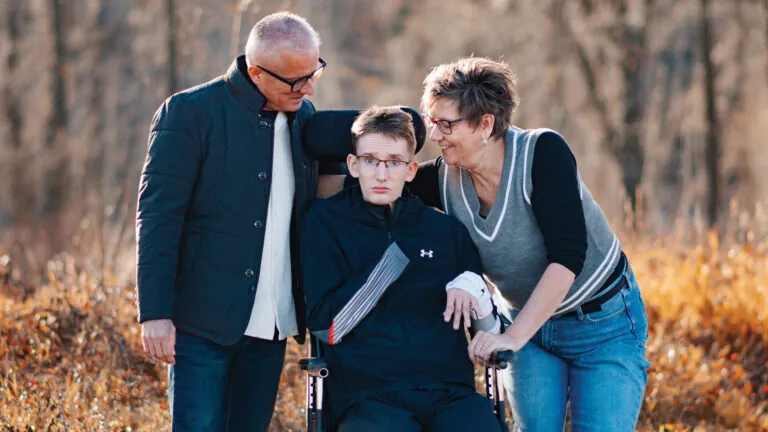
For Ed and Alice Hoogerdyk, their caregiving journey began in 2000, when God blessed them with their one and only child: Zach. Two decades later, shortly after Zach spread his wings and became engaged to a wonderful girl named Megan, a sudden illness and anoxic brain injury changed everything. Ed and Alice were called back to full-time caregiving.
Ed and Alice aren’t alone. Ed shared that 160,000 Canadians sustain brain injuries each year and a quarter of older adults are family caregivers, with projections that this will increase significantly in our lifetime.
Although we may have other plans for our lives, the LORD’s plan is sovereign. We then must decide whether we will run alongside the Zachs in our lives, or run away from them.

Zach ran hard as a little guy. He’s running just as hard now.
A string bean becomes a man
Ed and Alice were married on August 1st, 1998. Ed was a school teacher, and after they married, took a position in Alice’s hometown of Carman, Manitoba. On July 23, 2000, God blessed them with the joy of their life: a healthy boy whom they named Zach. Two years later, they moved to Calgary as Ed took on a new role as school principal, and they have made that city home since then.
Zach was shy. “He didn’t leave my side,” said Alice. She tried to make him more social, but he preferred to stay close and sit on her lap. Someone from her church reminded her to treasure this time, because it doesn’t come back. “He wasn’t Mr. Popular in the class. You could tell he was an only child,” she added.
But he had a caring heart, looking out for kids who were left out. This carried on as he became a teen and then a young adult. He despised cliques and was intentional about spending time with young people on the margins. Although he wouldn’t have put the label on himself, Zach was a caregiver.
As he grew, so did his love for sports, particularly ball hockey, and then running. He got his love of running from watching Ed. “He came to all my races, or most of them,” said Ed. “The next thing you know, he starts running. His goal was to beat my best running times.”
As a young adult, Zach got his friends off their couches, organizing activities like skiing and, you guessed it, running races.
He didn’t know what he was going to do as a career until he met a gentleman at a school career fair who pointed him to the masonry trade. “He went for an interview, and as he drove off all the other guys at the masonry industry laughed and said, ‘That kid ain’t gonna last a week. He’s such a little string bean,’” Ed shared. But Zach ended up flourishing in the trade, to the point that, when his boss had to downsize his crew from 40 to 5 not long after hiring him, Zach made the cut.
Ed reflects that this was a stage where the whole family was thriving: Alice was enjoying her job as a controller at a construction and building supply company, Ed was experiencing a “whole new lease on life” with a position as Grassroots Director of ARPA Canada, and Zach was flourishing in his new career as a brick layer, with a boss commenting that “people like you come only once every 25 years.”
That is also when Zach met Megan at a young adults’ conference in Calgary on a February long weekend. The two clicked, and in due time they were engaged, looking forward to a life together.
But the LORD had different plans.
From full of life to life-support
 In March of 2024, Zach made a trip to Megan’s hometown of Winnipeg. When he left, he had a really sore throat and was losing his voice. Ed encouraged him to go to the doctor, but Zach didn’t think it was necessary.
“We dropped him off [at the airport], and I still have the vision of him walking through the doors, pulling his little carry-on,” recalled Ed.
That was the last time they saw him walking.
Zach spent the weekend at the home of Ed’s brother and sister-in-law, but he wasn’t getting better. On Monday, Megan took him to a clinic, but by that point he could hardly walk out of the house. From the clinic he went straight to critical care in the hospital, and immediately needed assistance with his breathing.
At this point, Alice was at home in Calgary, unaware of any issues, and Ed was just starting a two-week speaking tour in southern Ontario. Megan let them know that Zach was checked into the hospital, and Alice was able to talk with Zach on the phone. He told her he was all right, would likely stay overnight, but would be just fine.
An hour later a phone call came that Zach had just had a cardiac arrest. Alice immediately went to the airport and was able to catch a flight to Winnipeg because it was delayed. Ed dropped everything and joined her at the hospital soon after. The news they received wasn’t good. “The doctor put his hand on my shoulder and Megan’s and told us to prepare for the possibility that Zach may lose his life.’”
Ed and Alice later learned that Zach was going through a combination of strep pneumonia, influenza A, septic shock, bacterial infection, and then the cardiac arrest.
The following hours were a blur of medical care, as the team worked hard to get Zach’s temperature down and his oxygen up. They packed bags of ice all over his body.
“I still sometimes do it where I go to my phone and scroll up to the 2024 pictures,” shared Ed. “When you look at March, I’m at this gig and that gig. It’s all go, and lots of hype, and all of a sudden there’s a picture of Zach laying in this bed.”
“Your whole life perspective changes in a second,” added Alice. “You hear stories from other people. You don’t know what it’s like until you have it yourself.”
Although their life changed in a blink, their Foundation didn’t.
“It’s amazing. Amazing how the Lord held us up through all of that,” Alice testified. She proceeded to share how they were surrounded by loving care from family, friends, and the church community. “It was always just at the right time to build you up again.”
The nurses and others asked “how are you handling this?” To this they replied: “Only by the grace of God.”
In the proceeding days, weeks, and months, as Zach’s life hung in the balance, there were points when Ed and Alice asked the LORD to spare him from further suffering and take him home. Zach was still on the ventilator, intubated, and endured multiple instances of septic shock.
Eventually his hand was amputated, followed by both his feet. He hadn’t spoken since the cardiac arrest, and it was difficult to know the extent of his brain injury and how aware he was of what was happening around him. But when they wheeled him off to surgery to have his feet amputated, Zach was very emotional.
Through this journey the family kept loved ones updated through a blog, titled “Running with Zach.” It didn’t take long before countless people from across the country were journeying with them, reading the health updates, meditations, and accompanying Scripture verses, praying for Zach and his loved ones.
A new calling
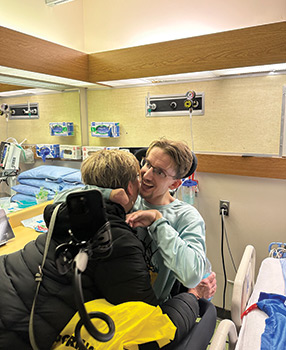
He won’t let go of his mama!
It wasn’t just Zach’s life that changed, Ed and Alice were given a new calling: caregiver.
Ed knew very quickly that he couldn’t carry on with his job, as it required him to travel regularly. He recalled calling his boss and informing him that “it’s obvious to me that this is my new calling. It’s as simple as that.” Alice, meanwhile, was able to carry on with her bookkeeping work, as it could be done remotely.
Ed admits that they went through some dark valleys in the weeks and months following the hospitalization. “But when the time came, we had to be up at Zach’s unit and be there for him.”
And just like the early years when he needed his mom close by, Zach needed them in the same way now. “If he needed to get changed, or any kind of care, he needed one of us there,” shared Ed. When Zach no longer received one-on-one medical care, he needed Ed or Alice to be close by. “So, we took turns sleeping in his room. And he definitely needed it. He would look, to make sure I wasn’t leaving, then he would lay down and sleep.”
When Zach’s health stabilized, it took Ed and Alice some time to find a good care home for their son in Calgary, as some of the care homes for “young adults” (under age 55) were sketchy, filled with rough music, rough language, and even drug trading.
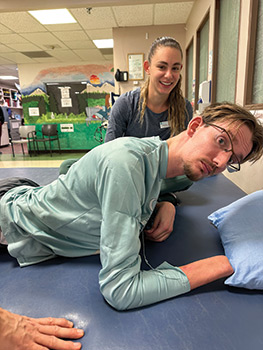
A successful physio session sitting up in the prone position.
The Hoogerdyks found something special at AgeCare Seton, particularly with the staff. “If you want to learn about care from a culture, look to the Filipino culture. These people get care. They just live care. Young or old,” explained Ed. “They love Zach and a lot of them go to church. They talk about God and faith.”
Zach also receives great care from the rehabilitation he is getting at the Association for the Rehabilitation of the Brain Injured (ARBI). “It is a great place. The team is very, very caring,” Ed commented.
“He’s gained a lot of muscle back,” Alice said. “I can’t put my fingers around his arm anymore. He can ‘beat us up,’ and he takes great joy in that.” Lately, Alice has been challenging Zach to give better hugs, and he squeezes her hard, “laughing his head off.” “That’s not good, Zach,” she responds. “That is not loving your mother,” she jokes and then Zach responds with a laugh.
Although he remains non-verbal, Zach is now using a tablet to communicate with his caregivers.
“The best time of each day is 4:30-5:00, giving him supper, until we leave between 8:30 or 9:00,” explained Ed. “It is almost as if the family memories are all back. You can say certain sayings we used to say at home and he starts to laugh. So he is in a good mood, with lots of laughs.” They always read a devotional together and pray before leaving for the night. “He is dialed in when you’re reading. I try to keep my finger on the words.”
He is also able to make it to church some Sundays. “He is listening,” Alice explained. She gave an example of the pastor sharing a one-liner joke and “Zach was even laughing without prompt, where it’s like he sort of gets it.”
Blessed is he who considers the poor
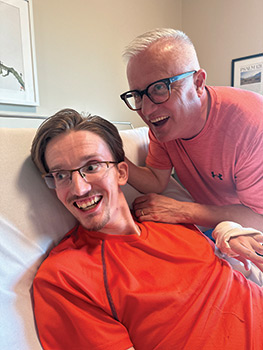
Having a good laugh with his pappy.
Ed and Alice testified that their loving Father has been caring for them every step of the way. “God gives you strength for every day. Not for the next year, not for the next…. No, he gives it for today. It is a real thing,” emphasized Alice.
Both Ed and Alice see God’s hand particularly in how He prepared Ed for this new role with his recent career. A lot of Ed’s work was related to protection for the vulnerable. The transition was from advocating for this protection, to actually providing it themselves.
But the work experience had deeper application. It didn’t take long and Ed was convicted, particularly through a family member, to advocate for other caregivers through setting up a platform called “Running for Zach”. “We aren’t the only ones doing this. There is a brain injury every three minutes in Canada and it is the leading cause of disability and death in adults under the age of 35. There is a real, real need.”
Ed pointed particularly to Psalm 41:1: “Blessed is he who considers the poor.” He explained that the word “poor” means much more than those without financial means. It is the vulnerable, the weak, those who can’t help themselves.
“To consider the poor means to pay close attention to them and then to spend significant time and energy changing their lives.” Always one for a quip, Ed proceeded to connect this Psalm to a quote from Dr. Seuss: “Unless someone like you cares a whole awful lot, nothing is going to get better. It’s not!”
This goes beyond the Zachs of the world. “We are all vulnerable in one way, shape, or form. We’re all weak. The church should be a haven of caregivers and a haven for caregivers. It should be caregiving central.”
I asked Ed and Alice how we, as a church community, can better care for caregivers. Ed said the first step is to overcome the fear of approaching and speaking with the caregivers. “It’s fear. Fear that you are going to say something stupid, fear that you are going to cry. If you are exiting church, don’t try to find a different route to bypass the caregiver.”
“Quit stewing too much over ‘I’m not sure what to say’ or ‘I’m not sure what to do.’ Doing something or saying something is better than nothing.” He added that “if you can go to the fellowship hall and talk to somebody about your fishing trip the previous week, surely you can go to a caregiver and find out what’s going on in their lives.”
Ed and Alice are grateful to be part of a church community where the leadership led by example in this regard, with an elder or deacon coming to visit them every week. Ironically, it has often been the elder or deacon who leaves feeling lifted up.
Kion Foundation

First trip back to the mountains since the injury.
Ed is now working on building a charitable organization called “The Kion Foundation.” Kion means pillar, and the foundation hopes to be a pillar of hope for families navigating acquired brain injuries.
Beyond awareness, the goal is to help fill the care gap between a hospital discharge and home, providing things like centralized therapy and support spaces for caregivers to go to and receive help.
Ed shared that it would take 2.8 million full-time equivalent workers to replace the 5.7 billion unpaid hours that family caregivers provide each year in Canada. That is a lot of people, including Christians, who are humbly serving outside the medical system. They need support.
The Kion Foundation’s board includes Ed’s brother-in-law, Ed Tams, an entrepreneur, as well as Dr. Stephen Neal; Alisa Lieuwen, whose brother was diagnosed with a rare neurological condition that resulted in him becoming quadriplegic and non-verbal; and Wanda Knol, a business owner and volunteer serving the vulnerable.
Designed to be a burden
Although we can look forward to a world without the effects of sin, we can trust that God has a good purpose for where we find ourselves today. That includes the burdens He gives us.
Ed quoted pastor and theologian John Stott: “We all are designed to be a burden to others. You are designed to be a burden to me, and I am designed to be a burden to you.” Instead of doing everything possible to run from these burdens, we can take to heart our LORD’s calling to “carry each other’s burdens and in this way you will fulfill the law of Christ” (Gal. 6:2).
Zach isn’t running like he used to. But he is running the race marked out for him.
Running alongside him, we can look forward to crossing the finish line, where we will not just run, but soar like eagles.
“Let us run with perseverance the race marked out for us, fixing our eyes on Jesus, the pioneer and perfecter of faith.” (Heb. 12:1-2)
“Even youths grow tired and weary, and young men stumble and fall; but those who hope in the Lord will renew their strength. They will soar on wings like eagles; they will run and not grow weary, they will walk and not be faint.” (Is. 40:30-31)