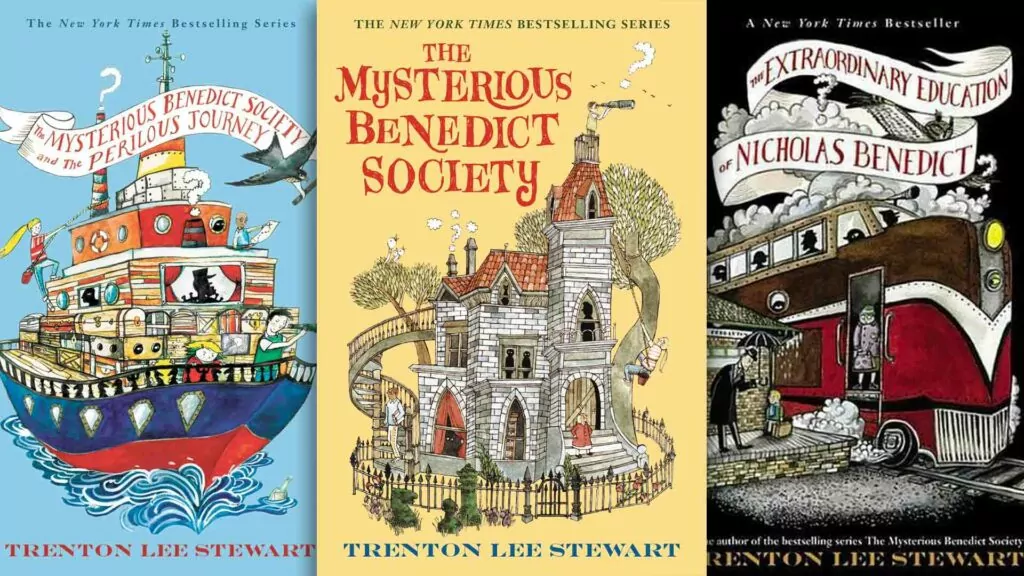
The Mysterious Benedict Society
by Trenton Lee Stewart
512 pages / 2008
Rating: Good/GREAT/Give
Reynie Muldoon is an 11-year-old orphan who knows he is smart – he certainly reads more than any of the other boys at the orphanage – but he doesn't quite understand just how smart. The orphanage administrators seem to have an inkling, assigning him his very own tutor. His tutor, Miss Perumal, is certainly aware, so when she notices an ad in the newspaper offering a scholarship for gifted children who pass a special exam, she signs Reynie up.
It might seem just a multiple choice exam, but there's more being tested here than knowledge. I don't want to give too much of the fun away, but I'll share just one example. The children are told to take one pencil, and one pencil only; not any less or any more. Simple enough, except that as Reynie and several other children approach the exam building, the girl in front of him manages to drop her pencil down a sewer grating. The exam is just about to begin, and she has no pencil. Reynie stops to help but she tells him to just go – he doesn't have an extra pencil, so what can he do anyway? That's when Reynie takes out his pencil and breaks it in half. Problem solved. All it took was some creative thinking by a kind soul. The first half of the book is full of all sorts of puzzles like that, that involve not only clever thinking, but often thoughtfulness.
While dozens of children take the test, only Reynie, and three others pass. Like Reynie, they are all missing their parents, and they all have their own unique way of looking at the world, and their own gifts. George "Sticky" Washington can remember everything he reads, Kate Wetherall is quick thinking, athletic, and always positive, and Constance Contraire... well the children aren't quite sure what Constance is, other than grumpy. After passing the tests, they meet Mr. Benedict, the man behind it all. He explains to them that the world is facing a mysterious danger, that the world is only aware of as "The Emergency." No one quite seems sure what the emergency actually is, but it has everyone feeling discombobulated, and looking to their leaders for direction.
Mr. Benedict reveals that the Emergency is actually being caused by subliminal messages being sent over the radio and television airwaves. And the messages are coming from an elite children's school called the Learning Institute for the Very Enlightened or L.I.V.E. (and note also, what it spells backwards). Mr. Benedict wants them to go undercover as his operatives at the school to find out what's really happening.
I loved the first half of the book best, with all its different puzzles to solve. But another highlight was the creepy L.I.V.E. Institute, and their rules. Kids might not catch it, but if parents are reading this out loud, it might be worth noting to your children that the double-speak here is of the sort we hear from our own political leadership, who will transform tolerance to mean its opposite, and love to mean embracing what shouldn't be. Here are a few of the Institute rules:
There are no rules here!
You can wear whatever you like. However, trousers, shoes and shirts are required at all times.
You don't have to bathe if you don't want to. Simply be clean every day in class.
You may stay up as late at night as you wish. Lights are turned off at 10 PM and you must be in your room at that time.
You are free to go where you please. Please note, however, that you must keep to the paths and the yellow-tiled corridors.
Cautions
A common and troubling theme in children's books is for the kids to be much smarter than their parents, such that they don't feel a need to listen to the authorities in their lives. After all, their dumb parents just don't get them. That the protagonists here are four pre-teen geniuses mean there is at least a little of that, but it's balanced off by the fact that Mr. Benedict himself is a genius and several of the other adults – his assistants Milligan, Number Two, and Rhonda – are highly capable. But there are still occasions – particularly in the first sequel – where the kids ignore an adult's order because they know better. And because they are geniuses, they often do actually know better! The author balances that out by the number of times the adults are involved in rescuing them – sometimes adults know best too.
There are 5 books in the series, with each clocking in at 400+ pages, so with the amount of time a child might put into it, it is worth noting the complete lack of spirituality in the series. This is 2,000+ pages of God being almost entirely ignored. The only exception I can recall is in the prequel, Book 5, in which a mention is made of a chapel service.
Conclusion
Overall, this is a fairly gentle series – it could make for bedtime reading without much danger of giving anyone nightmares. I appreciated it for making television one of the tools of the bad guys, as it so often is in real life too. There is also an implicit warning against overreaching government control, with the bad guys trying to use the Emergency as an excuse for them to seize the political reins of power. This isn't really a political book, but what politics is has, I rather like.
There are three sequels to The Mysterious Benedict Society, then a prequel for #5 telling the young life of their mentor Mr. Benedict, and finally, a companion puzzle book for #6 that invites us to become a puzzle-solver too, just like the Benedict Society. The series, in order, is:
The Mysterious Benedict Society (2007, 512 pages)
The Perilous Journey (2008, 440 pages)
The Prisoner's Dilemma (2009, 400 pages)
The Riddle of Ages (2019, 416 pages)
The Extraordinary Education of Nicholas Benedict (2012, 480 pages)
Mr. Benedict's Book of Perplexing Puzzles, Elusive Enigmas, and Curious Conundrums (2011, 176 pages).
I'd recommend the first two and last two. The first of the bunch has an originality to it, and a very clever reveal at the end that'll have you saying "Of course!" even as you had no inkling of it before that moment! The second doesn't reach the same heights... but how could it? It is, however, very fun.
The second-best book in the series is actually the fifth, the prequel about the young Mr. Benedict, and his own adventures in an orphanage. I read about 15 minutes of this to our girls each night, for about 2 months straight, and they were always asking for more. While the puzzle book was interesting, I was glad we got it out of the library and didn't buy it.
I wouldn't bother with books 3 and 4. In these two, Constance has developed telepathy, and since mind-reading is beyond all of us (even as figuring out puzzles isn't) this development makes these two books a good deal less relatable, and consequently less interesting. Telepathy also seems a cheat – how hard is it to outwit your enemies when you can read their minds? To top it off, Constance also learns how to manipulate minds with her telepathy, influencing them to think as she wants them to. This takes us into the realm of mind-control, not by machine as in the first book, but by supernatural powers, and for a decidedly unspiritual book, this is getting too weird for my liking. Thankfully each book is entirely self-contained, so it is easy to get just 4 out of the 6, without any sense of incompleteness.
Books 1 and 2, along with 5 and 6 total more than 1,500 pages of reading, which should keep even the most avid bookworm in your family chewing for a long time....