
Even today, the Dutch immigrant work ethic and zeal for kingdom-building remains alive in southern Alberta, three generations after a wave of immigrants first settled on the wind-swept prairie landscape and built homes, churches, and Christian schools.
But the focus now is on building a different type of institution: care homes for the elderly, who include some of those very same immigrants who built those first churches and schools.
“We have such a rich heritage of hard work, and being willing to roll up our sleeves, and being convicted by God’s Word and doing what we think is right,” explained Melanie Harthoorn. She is a nurse, wife, mother of six, and now also the Administrative Manager of BeLoved Care, a new non-profit organization devoted to building Christ-centered care homes in southern Alberta.
Melanie’s grandpa, John DeHaas, was a pioneer when it came to settling in the area, and he chronicled his story in his autobiography And Replenish the Earth. Re-reading it was a reminder of how challenging it was to face the elements and start from scratch. “He’s digging a cellar with a pickaxe early in the morning before work, and again late at night by the light of the moon,” recounted Melanie. “So willing to work hard for his family.”
While Dutch immigrants were finding their feet in a new land, they were by no means the first Christians to build institutions there. There are “…deep Christian roots in this area, and a lot of the hospitals locally were started by the Mennonite community,” Melanie explained in an interview with Reformed Perspective’s Assistant Editor Marty VanDriel. “Historically too, if you look at the first hospitals instituted, it was the church that took up that calling to care for the sick and needy.” But times have changed, and quickly.
“With the centralization of healthcare in Alberta, a lot of these hospitals that had been fundraised for and built by communities, especially Christian communities, were taken over by the government, sometimes against the community’s wishes.”
It is now the norm in Alberta and throughout the country, for Christians to rely on government-run hospitals and care homes. Some notable exceptions exist when it comes to senior care, particularly in larger centers like BC’s Fraser Valley, and in Edmonton, and in southern Ontario. But a significant part of the Reformed community in Canada is located in more rural areas like southern Alberta, where very few options exist.
A wake-up call
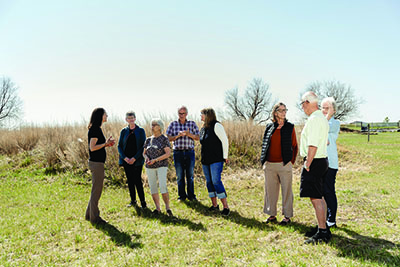
Here’s where things are at, for the BeLoved Care center, with the board and senior supporters taking a look at the site.
Although she worked in the public health system as a nurse, it was during Covid that the lack of options hit home for Melanie. Her grandmother suffered a debilitating stroke and ended up in a long-term care facility because the family didn’t have the ability to care for her high level of need. Melanie didn’t like how her grandmother was shut off, away from her family, but understood why the government had enacted their many restrictions in response to Covid.
“It struck me that we had no ground to complain about any rules that were being put in place in our long-term care centers because they were not our long-term care centers. They were built by the government and being run by the government.”
“It convicted me at the time that this ought not to be this way,” Melanie explained. “When the infirm in our midst need a place to go, when they can’t remain in their own homes anymore, who are the ones who should be providing them with that home?” She knew the answer. “God’s Word is very clear that it is the family’s responsibility primarily. But it is also the communion of saints. We are called to care for our loved ones.”
This got the wheels turning in Melanie’s mind. And it has since compounded with developments like government-sanctioned killings of some elderly citizens (euphemistically called Medical Assistance in Dying or MAiD). She shared that southern Alberta has some of the highest rates of MAiD in the province.
The idea took shape, from a concept to a plan, a design, and now a board-governed organization with charitable status. Melanie left her job as a nurse and devoted her full effort to navigating BeLoved Care from this concept stage to reality. Although the practical need for housing like this is a motivating factor (there is already a greater need than they would have space for), it is evident that the primary motivation for BeLoved Care goes much deeper.
Distinctively Christian care
Referencing the increase in MAiD, it is particularly in situations when someone is in extreme pain, or very lonely, that Melanie sees the need for Christ-centered care.
“We need to surround our loved ones, when they are in that incredibly vulnerable state, with constant reminders of who they are. They are created in the image of God. They are loved.”
Satan doesn’t give up in his attacks, particularly when we are alone and struggling. Melanie recalled the character Christian, from John Bunyan’s Pilgrim’s Progress. Although he was strong in his faith, Christian faced many crises on his journey towards the Celestial City, culminating when he faced a raging river, representing the last challenge we all face – death. Christian was overwhelmed with fear. As Melanie noted,
“It was Hopeful, who helped him through that time and reminded him of God’s goodness and the eternal weight of glory that was waiting for him on the other side. That is what we need to do as Christians.”
One of the blessings that BeLoved Care has is a provincial government that recognizes the importance of not just creating more beds for an aging population, but promoting what they call “culturally appropriate care.” Melanie explained that there is a wide body of evidence that when the elderly become confused and have to move out of their homes, it is best to make the new home as similar to their own home as possible. For the Christian and Reformed community, this includes things like Scripture reading and prayer at mealtime, singing, and how the nurses and staff speak, which all contribute to a sense of security and peace.
No shortage of support
Since there is a severe shortage of beds in the province, the Alberta government is looking to partner with for-profit and non-for-profit organizations. And judging from the letters of support (published on the BeLoved Care website) from Alberta Health Services and four MLA’s who represent southern Alberta in the provincial legislature, the new non-profit has good reason to proceed in confidence.
It isn’t just the government that is supportive. The website also includes letters of endorsement from the leadership of a variety of Reformed churches in the area (including URC, CanRC, CRC, and FRC). BeLoved Care isn’t tied to a particular denomination, though the mission is primarily directed toward members of churches that ascribe to the Three Forms of Unity or the Westminster Standards, in an effort to keep the mission faithful to God’s Word.
Melanie is very grateful that a variety of Christians and churches can partner together with this project. “To have support and collaboration from a mix of Reformed churches has really been beautiful and unifying.”
“I think Reformed Christians have long recognized that our children do not belong in secular institutions.” The same need exists for others.
“I think this is an area where we can also work hard and work collectively to provide for our parents and grandparents, and maybe even the younger person who suffered from a brain injury, or a paraplegic who needs this sort of care.”
From concept to reality
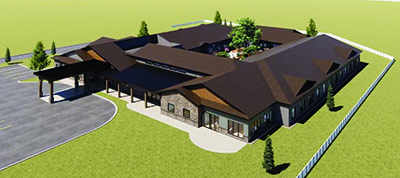
What this could look like, not too long from now.
BeLoved Care is aiming for a home with 20 rooms, 15 of which would allow couples to stay there together. They have a property located in Coaldale, across from Coaldale Christian School. But the vision goes beyond this one location. “We created a design that could be easily reproducible, that could just be plunked in another location, with its own management, but still under the charitable organization of BeLoved Care.”
They rolled out a capital campaign in November, seeking donations, pledges, and loans with a goal of reaching the $12 million needed to turn the vision into a reality. That is a substantial sum, though the Reformed community is in a very different place financially than when immigrants first arrived with empty pockets and still managed to build institutions in their lifetimes.
Gathered to their people
Although our calling extends far beyond our own families and churches, and includes seeking the good of our neighbors in Canada and throughout the world (Luke 10:25-37), Paul warns us sternly in 1 Timothy 5:8 that “if anyone does not provide for his relatives, and especially for members of his household, he has denied the faith and is worse than an unbeliever.”
Melanie pointed to when the saints of old died in Scripture, they were “gathered to their people.” Although this is a reference to being gathered with God’s people in eternal life, she sees this as something to aspire towards already towards the end of our lives on earth.
“When we are nearing the end of our life, that’s also when we need to be enfolded into the community.”