This essay was drafted with the assistance of an artificial intellect. The irony is not lost on me. Read the confession at the end.
Consider the loom.
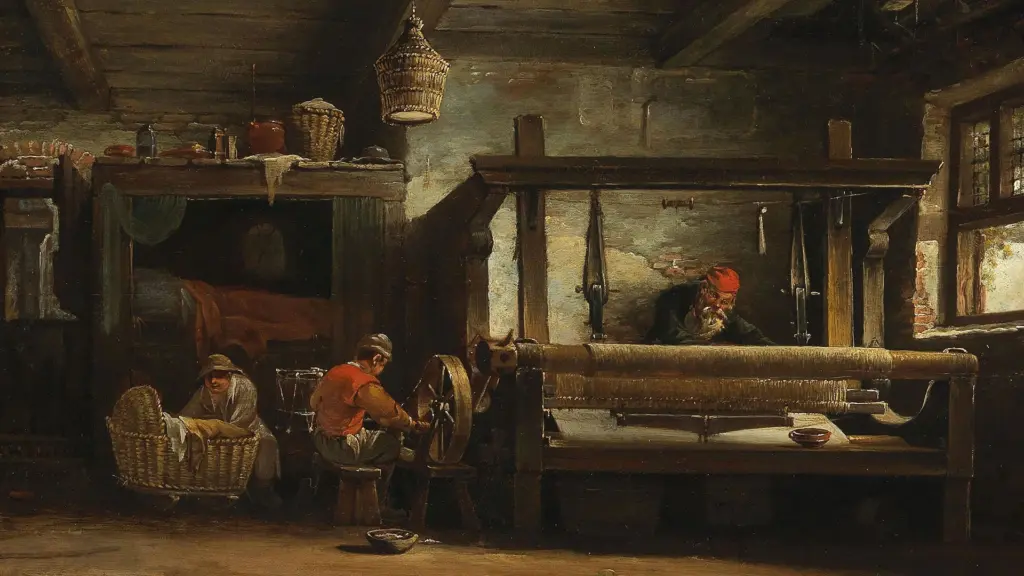
Not the industrial power loom of the 1800s – the hand loom. The one that sat in the corner of the house for thousands of years. A mother worked it while her daughters watched. Conversation filled the room. Skill passed from hand to hand across generations. The household clothed itself by its own labor. The loom made thread. But it also made something else: a form of life. A pattern of shared work, shared knowledge, shared presence. The thread was the product. The life together was the form.
Its greatest impact was felt in families
Now consider the factory loom. Same thread. Same cloth. Entirely different form. Women and children laboring in a mill, away from home, under a foreman’s eye, for a wage. The household no longer clothed itself. It purchased cloth with money earned by selling its members’ time to strangers. The product was identical. The form of life was destroyed.
The question of form is a question both most necessary and most forgotten. We evaluate every new technology by what it produces — its output, its efficiency, its measurable benefit. We never ask what form of life it creates. What pattern of human existence does it call into being? What does it do to the household, to the community, to the way we know and love and work and rest?
We have forgotten this question because we have lost the vocabulary for it. The old philosophers called it formal cause – the organizing principle that makes a thing what it is. The formal cause of a spinning wheel is not “a device that makes thread.” It is the entire domestic world the wheel sustains. Change the tool, and you change the world it builds. We can see this clearly looking backward. We are blind to it looking forward.
What will AI do for us?
What will AI do to us?
And so we arrive at the artificial intellect.
The promises are extraordinary. It can detect cancers that trained physicians miss. It can translate between tongues in real time. It can predict crop failures and prevent famines. It can draft legal instruments that would take clerks weeks. It can tutor a child in a remote village who has no schoolmaster. It can design bridges, compose music, accelerate the discovery of cures for diseases that have tormented mankind for millennia. By any honest accounting, it is the most powerful instrument of production ever devised.
These are real goods. We must not be dishonest about them.
But what is the form of the thing?
Ask yourself: where does knowledge come from in Scripture? It comes from specific persons, in relationship, under authority. A father teaches his son a trade by working beside him – not by handing him a manual.
“Train up a child in the way he should go” (Prov. 22:6) presupposes a trainer, a child, and shared life between them. “The fear of the LORD is the beginning of knowledge” (Prov. 1:7) – knowledge begins in a posture of reverence before a Person, not in a query typed into a search box. The Apostle Paul did not write a textbook on church planting and distribute it across the Mediterranean. He took Timothy with him. He lived with the Thessalonians. He wept over the Corinthians. Knowledge, in the Biblical world, is personal, relational, covenantal. It passes from one who knows to one who is known, through shared labor and shared life.
Knowledge depersonalized
The artificial intellect produces something that looks like knowledge. But its form is entirely different. When you ask it a question, you receive an answer that is the statistical average of everything that has been written on the subject.
It is not what your father knows. It is not what your pastor counsels. It is not what the old farmer down the road has learned from fifty years of walking his fields. It is what the internet thinks – pattern-matched, placeless, stripped of relationship and authority. It arrives without a person behind it. No one is responsible for it. No one loves you through it.
Information without formation
And here is the deeper problem: it does not ask anything of you. A book demands that you read – that you sustain attention, wrestle with the argument, bring your own mind to bear. A master craftsman demands that you practice, fail, try again, submit to correction. A father demands that you listen, obey, and eventually grow into the knowledge he has given you. All genuine education is difficult because the difficulty is the formation. You become wise not by receiving information but by struggling to understand under the guidance of someone wiser than you.
The artificial intellect removes the struggle and the guide in a single stroke. It gives you the answer without the formation. It gives you the output without the character. And over time – this is not speculation but the consistent pattern of every supplementary technology in history – what is supplemented is supplanted. The man who uses a calculator loses the ability to calculate. The man who uses a machine to navigate loses the ability to navigate. The man who uses the artificial intellect to think loses – slowly, imperceptibly, but really – the ability to think.
“But I only use it as a tool,” you say. “I remain the knower. The engine is my scribe.”
Perhaps. Today. But the engine that can take dictation this year can draft the letter next year and compose the argument the year after. It is designed to become more capable. You are not designed to become more vigilant. The commercial logic of the technology is to make itself indispensable. And once it is indispensable, who is the master and who is the servant?
We don’t need to accept that life
Tom Bombadil, in Tolkien’s great story, is the one creature over whom the Ring of Power has no hold. The Ring offers dominion over all Middle-earth. Bombadil is not tempted, because he does not want what the Ring offers. He is content with his own small domain – his house, his river, his songs. He exercises dominion without domination: skilled mastery within proper bounds, tending some things for his own good and other things for the good of those things in themselves.
This is the image we need. The question is not whether the artificial intellect can do extraordinary things. The question is whether you want what it offers badly enough to accept the form of life it creates. A form in which knowledge is severed from relationship. In which the father is no longer needed as a teacher because the machine teaches faster. In which the struggle that forms wisdom is eliminated because the output can be had without it. In which every man is a sovereign individual with a machine-oracle in his pocket and no need of his neighbor, his elder, or his God.
“It is not good for man to be alone” (Gen. 2:18). God said this before the Fall. The first thing declared not good in a creation pronounced very good was solitude. Every technology that replaces the elder, the master, the father, the pastor with an impersonal machine is dissolving the bonds God ordained for human flourishing – and moving man toward the condition God called not good.
Conclusion
This is not a call to smash your machine or flee to the wilderness. It is a call to ask the question our world has forgotten: what is the form of the thing? Before you adopt a technology – before you hand it to your children – ask: does this tool call forth the active exercise of my God-given capacities, or does it render them unnecessary? Does it draw me deeper into the lives of those God has placed around me, or does it make them redundant?
“For what does it profit a man to gain the whole world and forfeit his soul?”
The artificial intellect offers all the world’s information without wisdom. It is the most generous offer the Machine has ever made. The only price is everything that makes you human.
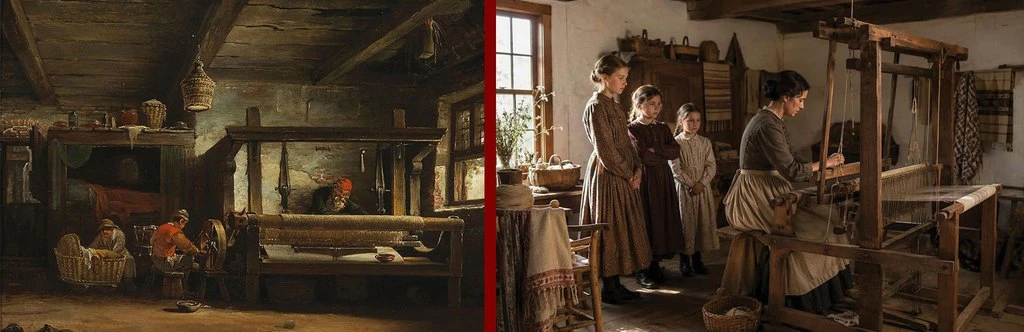
We chose to feature a master painting from the 1600s here on the left – Cornelis Gerritsz Decker’s “In the Workshop of a Weaver” – alongside an AI-generated image, to the right, as a way to visually articulate “the form of the thing.”
The AI picture is the result of asking it to generate: “A 19th-century rural cottage interior, wooden hand loom in the corner, an adult craftswoman weaving fabric, family members observing nearby, warm window light, authentic period clothing, highly detailed, photorealistic historical photograph style.”
Decker made a conscious decision to create a painting of a very everyday life in the 1600s. Consider the effort he must have made to capture such a scene! Any artist knows what it truly is to practice, fail, try again and submit to correction and finally get a chance to enjoy the end result when it comes – the struggle is in many ways the art. We encourage you to take a minute to notice the differences between the two images. Both are, technically, art… but which one has heart?
– Stephanie Vanderpol
AI-assisted warning
A confession. This essay was composed with the aid of the very instrument it critiques. AI helped me research, draft, and sharpen these arguments. I used the Machine to see the Machine.
I will not pretend this is comfortable. The essay argues that the artificial intellect severs knowledge from relationship, removes the formative struggle, and substitutes pattern-matching for wisdom. And then the author used pattern-matching to find the words. The dissonance is real. I will not resolve it, because it cannot be honestly resolved. The man who warns you about the oracle consulted the oracle to compose his warning.
However, the question is direction. God calls us to be in the world but not of it – and the question is not whether we are compromised but which way we are moving. I used this tool with my eyes open, named what it is, and told you. That is the discipline I’d commend to you: no technology should ever be adopted without asking the forgotten question: What is the form. Then pray, “Lord what is your will with this?” Then read His word and do it.
Ben is working for a family-owned glass wholesaler in Perth, Western Australia doing business development. His current project is a software migration for their core systems. By God’s grace, he and his wife Melanie are eagerly expecting their first child later this month. A version of this article first appeared in the April 2026 issue of Una Sancta.