Transparent heart icon with white outline and + sign.

Life's busy, read it when you're ready!

Create a free account to save articles for later, keep track of past articles you’ve read, and receive exclusive access to all RP resources.

White magnifying glass.

Search thousands of RP articles

Helping you think, speak, and act in Christ.

Open envelope icon with @ symbol

Get Articles Delivered!

Helping you think, speak, and act in Christ. delivered direct to your Inbox!

A A
By:

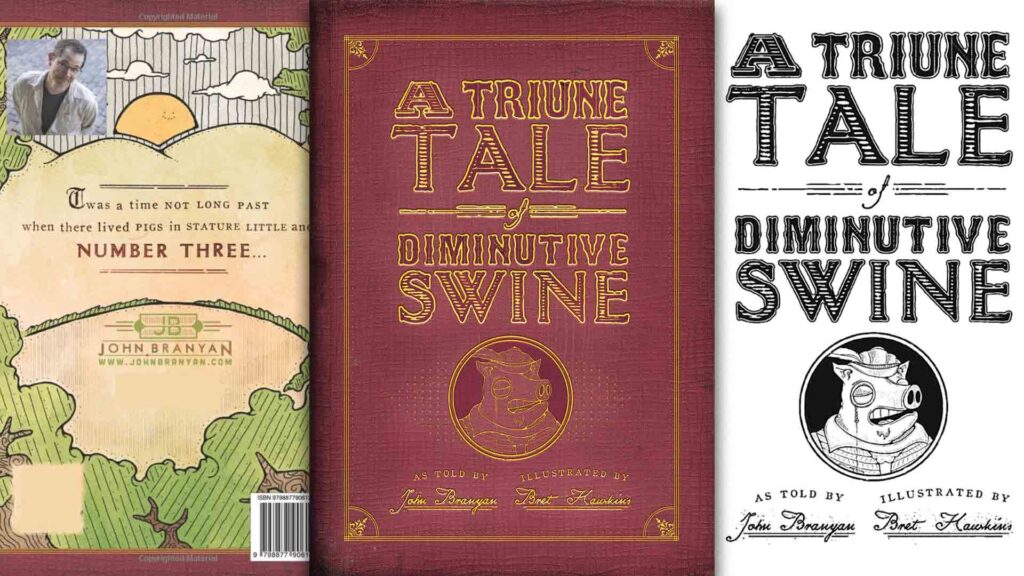
A triune tale of diminutive swine

42 pages / 2012
by John Branyan

 What if the Three Little Pigs was retold in Shakespearean English? And what if the third pig, just to mix things up a bit, spoke good ol’ American English? Wouldn’t that be the best fairytale ever?

A triune tale is purportedly a children’s book, but it would be best appreciated by adults. And it might be of the greatest benefit to high school English students who don’t yet appreciate Shakespeare’s vast 54,000 word working vocabulary. (As author John Branyan points out in the comedic stand-up bit that inspired the book, that is a stark contrast to the 3,000 word working vocabulary of the modern North American.) How could any student not appreciate this display of verbal variety?

In time, there HAPPENED along, as is frequently the scenario in classic tales of PROTAGONIST PIGLETS or RED-HOODED CHILD, A WOLF.

CARNIVOROUS NATURE in full season, he called out to the STRAW-ENSCONCED swine, saying,

“PRAY THEE LITTLE PIG, GRANT ME ENTRANCE!”

Pig NUMBERED FIRST recalled with sage foreboding that it is the MADMAN who trust in the tameness of the BELLY-PINCHED wolf. His reply in earnest,

“NAY, IT SHALL NOT BE! NOT BY WHIT NOR WHISKERED JOWL!”

I read this to my four-year-old, and while she enjoyed it, that was probably only because she likes seeing her dad laugh. This is a fantastically fun book to read out loud, with the screeching pigs and howling wolf speaking thisly and thusly. So it’s very high on my list of best picture books, but it hasn’t cracked her top 100.

This could be a great tool for a high school English teacher. For those of us who hated Shakespeare in school – why couldn’t this guy just write in real English? – one can only wonder what might have been, if only we had first been exposed to a Shakespearean English tale that was laugh-out-loud funny. I’m quite sure this would have helped.

You can find this at Amazon. And you can watch the original 8-minute comedic bit which spawned the book.

Enjoyed this article?

Get the best of RP delivered to your inbox every Saturday for free.

A A
By:

Ella’s big chance: a fairy tale retold

by Shirley Hughes
48 pages / 2003
Rating: Good/Great/GIFT

This unique spin on the story of Cinderella is so good it improves on the original. Some of that is due to Shirley Hughes’ artwork, charming as always. Then there is the setting: this is a “Jazz-Age Cinderella” pushing the story forward to the 1920s. Ella and her father run an elegant dress shop, making the finest of clothes. The evil stepmother, in this case, has some business acumen, turning the small shop into an even bigger success. But the greater the demand, the more work there is to do for poor Ella.

The story follows along the familiar course of other Cinderella versions, but with pictures all the more stunning, and a twist at the end in which (SPOILER ALERT!) the love-at-first-sight duke finds his Ella but doesn’t get the girl! This is really what sets this version both apart and above all others – none of the nonsense about knowing someone for an evening and then getting married when next you meet again. Nope, Ella ends up with the store’s delivery boy, who has always been there for her and wanted to be so evermore.

While Hughes’ artwork is wonderful, the prose is superb as well. It flows so very naturally that, as I read this out loud to my girls, I felt as if I was one of those professional readers. I sounded good! But that is all to Hughes’ credit, and not my own – there is a wonderful flow to each page of text.

I will add one caution: there is one use made of the term “good heavens,” which some view as a substitute oath and too much like a real blasphemy for their liking. Though I don’t agree, I do sympathize and wanted to alert readers to its use.

I would give this two very enthusiastic thumbs-up, and recommend it highly to anyone who has three- to ten-year-olds. While this is probably far more a girl than a boy book, I really liked it. I think other dads will enjoy reading it too.

And if you’re looking for another inventive spin on Cinderella, be sure to check out Jan Brett’s Cinders: A Chicken Cinderella.