
I am the Lord your God, Who brought you out of Egypt, out of the land of slavery. (Exodus 20:2)
Before the Ten Commandments, God said that He was the Lord, the Redeemer. He emphasized that He had chosen His people. He said that He would guide His people throughout their lives to have a personal relationship with them.
In the mid-seventeen hundreds in a small borough between Leicester and London, lived a man by the name of James Turnstock. James was a very tall man and, as such, when he rode his horse astraddle, he came across as both impressive and towering. He rode confidently one fine morning of a gentle spring day, to all outward appearance taking inventory of his property. Paying no attention to the small whirlwinds of dust that the mare kicked up around its hooves, he scrutinized the fields open and wide at his side.
Well into his thirties, James was a farmer, albeit a gentleman farmer, and one who, reputedly, did not mind getting his hands dirty. He took joy in planting and harvesting and reveled in the beauty of nature. The feel of soil as it crumbled between his fingers could stop him short as he would suddenly be minded of God’s forming man out of the dust.
An avid reader of both agricultural and spiritual matters, he tossed the two in his mind as he would a salad. Riding along, he mulled over the fact that he had recently learned that the Dutch planted turnips in fallow areas and that these root vegetables restored a soil’s fertility. An Englishman by the name of Robert Townsend, widely known as “Turnip” Townsend, had worked with these root bulbs.
The mare neighed and snorted at a partridge ground-nesting in a nearby bush, interrupting James’ musings for a moment. He patted the horse’s neck soothingly before his thoughts sank back into farming. This rotation of turnips, barley, clover and wheat crops could perhaps be compared to the way one occupied one’s time – work, leisure, prayer and sleep. He smiled at his passing strange fancies. Perhaps thoughts were like seeds and weeds, giving birth to harvests of good and bad days, depending on what you had sown.
A pheasant sedately walked out of a clump of trees to his right and began crossing the path. Suddenly becoming aware of the horse and its rider, the bird began to run, its red face wattles trailing. Then it burst into the sky as if flushed out of a thicket, the small head and long neck pointing upward. Entranced, James watched. It was a male bird, its bright and colorful feathers sweeping behind him. Smaller females were a dull, grey brown. Not like human beings, he pondered, not like them at all.
Holding the reins with his right hand, he stroked his short beard with his left, sighing deeply before he turned his thoughts back to turnips. He would have liked to converse with Townsend face to face about agriculture. There were few enough with whom to speak intelligently on farming methods, let alone other matters.
*****
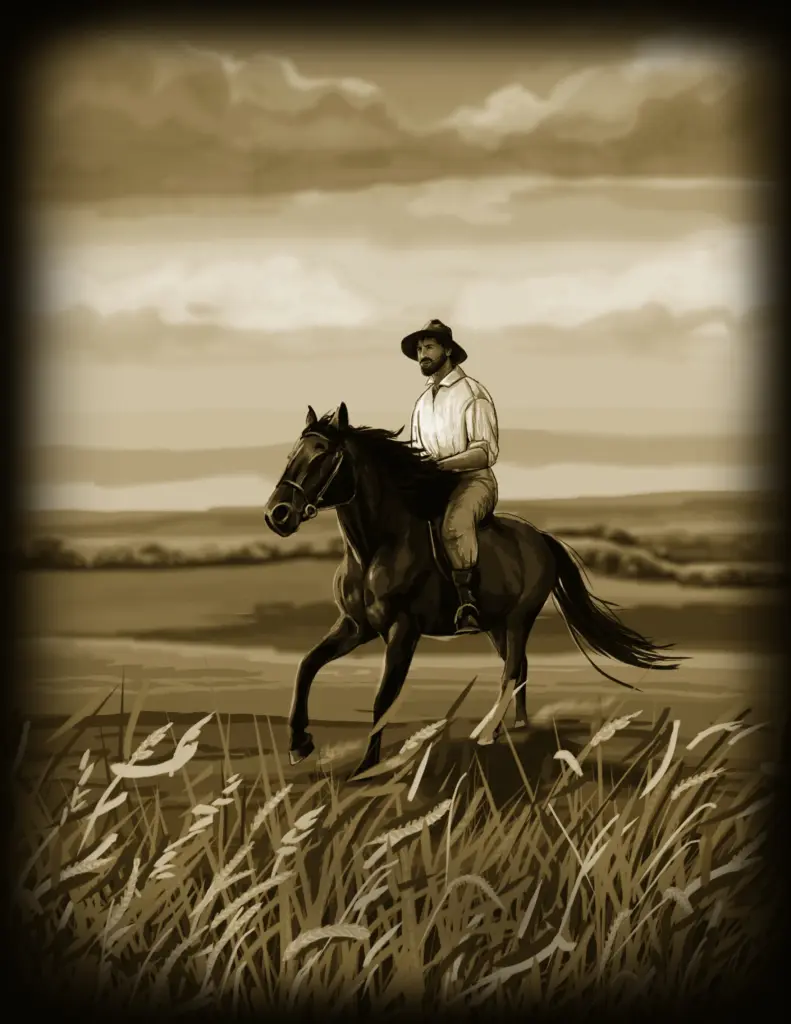
As he rode on, James Turnstock took measure of himself. He considered that he was an average farmer, neither overly prosperous nor dirt-poor. His holding was noted for some of the best pigs in the North Hampton area and, as well, he had been complimented on the size and quality of his sheep. The grass in his fields was sweet and his horses were respected for their gentleness and good behavior in working the plough. A quick sigh escaped him at this point. He knew his thoughts were drifting dangerously close toward the sin of pride but he did take such pleasure in caring for his fields, and his livestock. Did not all in the county agree that those employed by himself were a fortunate folk? And was he not even now undertaking a mission of mercy?
He stroked his beard once more and turned his gaze away from the land, urging the mare on to a quicker pace. On his way to see Morgan Kilby, a neighbor, he felt guilty that he had briefly given in to the temptation to stop and admire the fields God had given him – an occupation he vastly preferred to the nearing visit. Although Kilby was a farmer like himself, James had no great liking for the man. Rough in language, generally unkempt in clothing, shoddy in caring for his animals, his lifestyle and mannerisms irritated James to no end. Yet, there was the upcoming visit – a matter neither to be shirked nor put off.
*****
The Kilby farmstead, a stone and timber construction, came into his view. It boasted a thatched roof – albeit a rather sorry thatch. The ramshackle walls were in dire need of re-plastering and a thin straggle of smoke rose out of the red-stoned chimney. The entire structure reflected the owner’s character. James slowed his horse down and turned into his neighbor’s laneway. There were very few signs of life about the place, although it must be nearing seven o’clock. The singing of a thrush in the thicket indicated that there was, indeed, some beauty to be garnered in this neglected place. As the bird flew up past James, its warm yellow underwing visible as it sang, a smile appeared on his face. Dismounting, he tied his horse to a post and approached the side door. Before he could lift his hand to knock, however, the door opened and he stood face to face with his neighbor, Morgan Kilby.
“Good-morning.”
The greeting simultaneously fell from the mouths of both men. Then Morgan added a question to his greeting. “What brings you here so early in the morning, James?”
Morgan’s clothing was disheveled and sour breath exhaled from his lips. James steeled himself not to turn and walk away from his errand. Then he chided himself for being a hypocrite. Did clothes make a man? Was breath an indication of what was contained within a heart?
“I wonder if I might come in and have a word.”
Kilby moved a step back and indicated with a hand gesture that James might step inside. So he did.
The open hearth in the small kitchen held a smoldering fire. A massive black dog was stretched out in front of it. The animal neither rose nor acknowledged the visitor in any way.
Morgan pointed to one of the six solid wooden chairs ranging about a long table. “Sit yourself down then, man, and tell me what it is that you have on your mind?”
James strode over, pulled out one of the chairs and sat down. Kilby positioned himself across from him.
“I’d offer you something to eat but Edythe hasn’t yet cooked porridge or made cakes.”
James shrugged. “That is fine. I have not come to eat.”
His words were terse. It was quiet for a long moment and the unfriendliness of James’ tone permeated the air. Then Kilby’s curiosity got the better of him.
“Well, talk on, man, and I will listen.”
As he spoke, Morgan Kilby crossed his arms and leaned away from the table, eyeing his neighbor with increasing interest. The look was neither companionable nor hostile. It was neutral. There had been words throughout the years about fencing, about Morgan’s dogs roaming the Turnstocks’ property too freely and bothering the sheep, about poaching, and the list could go on. Morgan was half-expecting some other contentious matter to come to the fore and set himself to argue. Even though all these issues had never been serious matters, the truth was that there had never been a warm relationship between these two men or their fathers. James took a deep breath.
“Kilby, I would like to ask your permission to marry your sister.”
The thought flew threw his mind that the girl was not really Kilby’s sister, only his half-sister, but for all intents and purposes it was easier to refer to her as sister in this matter.
Morgan snorted, surprised and somewhat relieved. “Edythe?”
“Yes.”
James’ answer was short, not forthcoming with any explanation. Morgan uncrossed his arms and began tapping his black-haired fingers on the table, staring down at them before raising his dark eyes to gaze straight into James’ green ones.
“Does she know you are asking?”
“No.”
“Why do you want to marry her? The girl has no dowry. She is not pretty and is getting on in age.”
“I am also getting on in age, Kilby. I would like to have a woman about the place and she knows farming.”
Kilby’s eyebrows drew up slightly. “Ah, it’s a worker you are looking for?”
“No.” James sighed. It was difficult, no, it was impossible to give Kilby the real reason for his request.
“Well,” Kilby scratched his head, “I won’t say ‘no’ and I won’t say ‘yes’. The girl does a fair bit of work around the place, and I would miss her. But to tell you the truth, I suspect you know that I’m getting married myself next month to Agatha Loudon and she’s not keen about having another woman in this home. As they say, ‘Too many cooks spoil the broth.’”
He laughed half-heartedly but, as James did not respond, Morgan went on, scratching the stubble on his face as he spoke. “If Edythe were to leave, we would actually not be shorthanded. Agatha’s bringing a maid, a cook and a laborer. Her father’s paid their wages for the next five years. Part of her dowry. So, the way of it is that it would suit me fine to have Edythe leave. That’s the truth of it! But you’d best ask Edythe yourself. She’s in the milkhouse.”
He yawned, appearing rather bored with the whole matter. James nodded and stood up, pushing his chair away from the table. For a moment he contemplated the fireplace with its array of andirons, tongs, bellows, fire shovel and warming pan. Was he doing the right thing? Then he smiled, extended his hand to Morgan Kilby, who, without getting up, took it rather sloppily, and shook.
“Fine, I’ll go and speak with her now.”
“Well,” Morgan responded, yawning again and stretching, “I wish you success and hope you’ll be my brother. Rather useful, actually, to have a brother so close by.”
James winced within himself. That was something to which he was not looking forward. He smiled again, a rather thin smile, walking on towards the other end of the kitchen, past the stairs and through the hall. He knew the way. The milkhouse was attached to the west end of the hall. Glancing over his shoulder, he was glad that Kilby was not following him. Steeling himself, he opened the door and entered.
*****
It was semi-dark in the milkhouse. The three windows that let in the light were partly glazed over with dirt and covered with cobwebs. After standing in the doorway for a moment, letting his eyes adjust to the half-light, James softly called out the girl’s name.
“Edythe.”
There was no answer. She was not there. He carefully moved toward one of the windows, pulled away some of the cobwebs, rubbed the pane and peered through. Not too far off, he saw Edythe Whitehall’s silhouette. She was sitting under a walnut tree beside a large cow, gently moistening its dugs with a little milk. She had neither seen nor heard James, as was evidenced by her composure as she worked. He stood watching a long while. Her skillful and long fingers moved up and down. The milk flowed steadily into the pail by her feet.
Although the milkhouse windows could do with a good scrubbing, James noted, as he walked around and peered about, that the rest of the building did not harbor any moat of filth. The buckets, milk pans, cream pots and cheese vats sitting on a sideboard all looked clean. Edythe’s work no doubt.
He took a deep breath before he opened the outside door leading into the small field. The hinges squeaked as he stepped out and Edythe immediately turned, although her hands continued, without any break, the smooth up and down motion of milking.
“Good-morning,” he began and then stopped.
She now ceased her work, wiped her hands on her apron, and stood up. Half-curtsying, she replied, “Good-morning.”
He coughed, nervously contemplating the vast sky above them both. “I have just,” he began, and then repeated, “I have just spoken with your brother.”
She nodded, looking slightly puzzled, choosing not to reply. Indeed, what could she say? Half-glancing over her shoulder, he understood that she was impatient to get back to her milking. It pleased him. What a contrast she was to her brother.
“I have spoken to him,” he continued, leading his words carefully as one might lead a horse over a stony passage, a passage rather fraught with dangerous and unknown steps, “about you.”
“Me?”
“Yes,” and he now gingerly edged towards her, as he went on, “Edythe, I have thought on this for a long while and I do not want you to give me your answer immediately, but to think on what I am about to say. The reason I spoke to your brother was to ask if I might have your hand in marriage.”
Her first reaction was to look down at her hands. Folded across her apron, they were beautiful hands – long and slender – capable hands.
“My hand?”
“I need someone to help me… to be with me to run the farm. A woman… My parents and my brother are gone now….”
He stopped and studied the reaction to his broken speech. She had taken her hands and put them behind her back. But her gaze was frank and open and did not shy away from his. She had very blue eyes, Edythe did. Very much like a deep pool of water, a pool of which you did not know where the bottom lay. There was such a pool at the east end of his farm.
“So you need help on the farm. But you have your hired help and surely….” She stopped also and the cow behind her lowed. It was eager to be emptied of its milk.
“I need someone with whom I might speak… of things and ideas….” He paused again and she shifted from one foot to the other. But her gaze did not falter and she did not look away from him.
“What did my brother say?”
“He said I should ask you.”
“That is all he said?”
“He also said that he was eager to marry Agatha Loudon next month.”
A shadow crossed her face. She was tall and slender but Morgan Kilby had been wrong when he said she was not beautiful. She had dignity, and dignity was a beautiful thing.
“Yes, I know,” she replied and suddenly was engaged in staring down at the ground. But then she lifted her blue eyes back up to him, “We have had words over whether or not I should stay on here after he marries. My stepfather did leave me some of the stock, but Morgan says it is not written down. So there is no dowry, James Turnstock.”
James could hear his heart beating, beating right through the song of a thrush and the intermittent lowing of the cow.
“Agatha has no great love for me,” Edythe continued a moment later, even as the bird sang its musical repetitive phrases, “and has threatened to break off the engagement if….”
The thrush now flew overhead, singing as it went. Edythe turned and sat back down next to the cow but even as she sat down, resting her head against the beast’s side she called out her answer.
“I accept your offer, James Turnstock, if you hold to it. When would you marry me?”
“In a fortnight,” he answered, “if that would suit.”
“It would,” she replied, even as her fingers began their work of milking once again, “It would suit me indeed.”
*****
Although women’s dowries generally consisted of fine linens and household goods that had been accumulated by them over the childhood years, as well as any money or property their fathers might bestow, Edythe had none of these things. That is to say, she did not insist on any of these things. Her step-brother and his affianced wife made it very clear to her that there was very little that she could take with her to her new home.
“He is better off than we are,” Agatha offered a few days after the proposal, “and I dare say you will lead the life of a fine lady whereas we….”
She stopped abruptly and then sighed as she contemplated the nicks on the surface of the long wooden table in the kitchen. Edythe, who was sitting across from her, did not reply. It was not her nature to argue, to push forward rights.
“Besides that,” Morgan added, “father specifically left the farm to me and my heirs. And the farm, as you know, includes all things here. All things.”
Edythe still said nothing. She would be happy to leave the Kilby farm, even though she did not know if she would feel at home on the Turnstock farm.
“I wonder why,” Agatha pondered out loud, “the man wants to marry you.” She rested a penetrating gaze on Edythe. “It is not your looks,” she added slowly, “but perhaps he still hopes to have children. He is an older man but you would think that he might have had his pick of the younger women in this county.”
Edythe blushed and looked down at the table. She wished she was working out in the field, hoeing – or that she was in the byre, cleaning the gutters. Anywhere but here with Agatha and Morgan who were always finding fault with her. Rather abruptly, she pushed her chair away from the table and stood up.
Her brother laughed. “Look at the rosy cheeks on her now,” he chuckled, “and no matter what you say Agatha, Edythe is most becoming when she is red like that. A hard worker too and neighbor James will get his worth out of the fine lady you picture. I dare say that you and I will miss the chores Edythe does around here.”
Perhaps it was a compliment and perhaps not. Morgan was not one to hand out praise, even as her stepfather had never praised her. Edythe felt her cheeks glow even more as she backed away from them, almost stumbling over the dog as she went. And as she made her way out through the side door, the laughter of the two followed her.
*****
She sought refuge in the milkhouse. Even as a little lass, she had loved the coolness of the place, the quiet of it. If her stepfather had been upset with her, or her mother displeased for some reason or other, this is where she had been wont to go for refuge.
Taking a seat on a wooden stool by the milk vat, she sighed deeply. How could she have said yes to James Turnstock? She did not know him very well at all. There was no one with whom she could discuss this matter. Her mother used to urge her to pray. They had not been a churchgoing family but her mother had told her that God was always present, always there for you to speak with. But she did not know Him very well either.
Fingering a rumple in her skirt, she contemplated on what she knew of James Turnstock. She had known his brother Jeremy, a big gangling lout of a boy who had been much too free with his hands and who had loved the bottom of an ale glass. A friend of sorts to Morgan, he had frequented the Kilby farm often in the past. She had not liked him, had not liked him at all and even thinking of him made her shudder with distaste akin to horror. So why…?
But James in no way resembled Jeremy and to stay on here, living with her brother and his new wife would be impossible. There was truly no other place to go except for the Turnstock farm. Agatha constantly bullied and bossed and although Morgan was not intentionally unkind, he was very eager to please his soon-to-be bride. For would she not bring a fine dowry as she was the only daughter of Albert Loudon and the obvious apple of his eye. She, Edythe Whitehall, had not really known her own father and her stepfather had rarely spoken to her the last year of his life. And she recalled, recalled with a wry and bitter taste in her mouth, what had occurred to make him so increasingly dour.
*****
It had been the spring of some three years ago and it had been an evening. She remembered that it had promised to be a gentle spring with daffodils beginning to peep open and crocuses blooming in great patches in the back fields. And it was her time. The baby within her had stirred and fidgeted, wanting out. She had not known where to go. No one knew that she was expecting. She had kept the round and rounder form of her belly well hidden under a loosely-fitting apron. Morgan had been away from the farm that afternoon and evening, probably carousing with some friends, and her stepfather, after eating a big meal and drinking heavily, was asleep in his chair by the hearth.
She had made her way to the barn, carrying a pail of hot water, cloths, some blankets and a knife. Lying down between two stacks of hay, she had given birth to a little baby shortly afterwards. It was a boy child. Red-faced and wide-eyed, he had cried his first cries so loudly that the cows pricked up their ears and the lambs in the far corner had bleated in echo to the mewling. Sitting up painfully, she had dried the child, cutting the cord with the knife, afterwards wrapping him up in the cloths and blankets she had taken along. He was beautiful, so beautiful.
Even now, as Edythe sat on the stool in the milkhouse three years later, she remembered his features. She could sense the softness of his cheeks; could picture the fullness of his red, little lips; and could still feel the firmness of the grip of his little fingers on her own fingers. She had held him in the crook of her arms in the byre until the first light of day, dozing off and on, weary with the hard work of birthing. Crooning soft lullabies, she was just preparing to stand up and slip away into the house to hide the child in a makeshift crate in her bedroom, when her stepfather had walked into the barn.
He had sighted her immediately, striding over, fully taking in the entire scene. Then he’d spit into the straw. “Slut,” he said, “my stepdaughter is a slut.”
Her arms had tightened around the baby who had begun to whimper.
“You shame your mother’s memory. Get out and get rid of it,” her father continued, “and don’t come back until you do.”
“But,” she began as she rose, straw clinging to her hair and her dirty gown, “I….”
He had slapped her then, slapped her so hard that she staggered against the bales of straw, and it was all she could do not to drop the child who was crying in earnest now.
“Get out,” he repeated, “and don’t come back until it’s gone. Do you hear me, Edythe Whitehall? Do I make myself clear?”
She had not replied, but had slunk past him, out through the byre door, into the brisk morning air. Once outside, despite her aching, tired body, she had begun to run towards the house. And even as she ran, she could hear her stepfather calling from his place at the barn door.
“And I would not hesitate to drown the mite, even as I drown baby kittens.”
She had made it to her bedroom, his words chasing her like an ill wind and it had been difficult to shut the door on the blast of that wind.
*****
Washing herself and the baby had been a strange task, fingers shaking and tears falling. Then she had fed the boy for the first time. He drank from her breast hungrily, afterwards falling asleep in the crate. Through the bedroom window she had watched her stepfather out in the field as he was beginning the early stubble ploughing for turnips, coleseed, and rye. Theirs was a two-furrow plough and she had remarked to herself how very stooped her stepfather appeared.
Sitting down on the bed, she had contemplated. There was no hope that he would change his mind. He never did. Her mother, who had died of the pox when Morgan was but seven, had been a kind woman but not one to ever go against her husband’s wishes. She had imprinted that same mentality on her daughter.
Sighing, Edythe had stood up, beginning to pack a few clothes for herself and for the child. She also carefully wrapped, in a rag, her mother’s brooch. It was the one thing of value that she possessed besides a small ring on her finger. The satchel she packed was not heavy and could easily hold some food as well. Months ago, a passing tinker had spoken to her of a place in London called the Foundling Hospital. Women left babies there, he told her, not knowing that she carried one under her apron. These babies, he had gone on to say, were provided for and were given an education through the kindness of rich benefactors. She had carefully asked others passing through if this Foundling Hospital was real, and was assured that it was. One itinerant laborer had even told her that a lamb was embossed on the Hospital crest and that the Home’s motto was “Help.”
*****
Even now as she sat in the milkhouse recalling all these matters, Edythe felt tears well up in her eyes. Her arms automatically became a cradle and she sheltered an invisible child.
The long journey to London had become a blur in her memory. She remembered walking for hours on end and being given a ride a good part of the way by a kindly couple driving to Luton, and then walking again. Eating some bread and drinking from a flask of ale she had taken along, she had slept fitfully under a hedge that first night. The baby had been good, not at all fretful or whiny.
Once in London, by asking and asking again, she had at long last found her way to Hatton Gardens where the Foundling Home was located. And had it not been truly amazing that she had come when it had just been advertised that there were openings for new babies? She vividly recalled standing adjacent to a crowd of women by the gate of the Home. They were all holding babies and she guessed that there had been more than one hundred – more than one hundred women scrambling and fighting to be the first through that gate when it opened. She asked a young girl who was also standing at the group’s edge what all the commotion was for.
“There are only a few spaces available,” the child answered, for child she was though almost a woman.
“Spaces?” Edythe repeated.
“Yes, spaces,” the girl answered patiently, “and they think that by getting in first they will get one of those spaces for their babes. But it is not true. There is a lottery.”
“A lottery?” Edythe again repeated.
“You know very little,” the girl smiled at her, revealing a set of strong, white teeth and she continued instructing Edythe above the hubbub next to them, “You see, once you pass in through the gate, you are taken into the Home. There you will be instructed to sit on a bench without moving. A man, one who is employed by the Home, will come to you with a sack and you will be asked to reach into it to take out a ball. If you take out a white ball, it means that your baby will be examined at once and if the child is in good health, he will be taken in. If you take out a red ball, you are put on a waiting list. And if you take out a black ball, you will be sent back into the streets.”
Edythe’s arms tightened around the baby in her arms. The boy whimpered and her breasts strained with milk. “Back into the streets,” she whispered, “and then what shall I do?”
“You are not from London?” the girl inquired.
“No,” Edythe whispered, her eyes glancing down at the baby and then back at the girl.
“My name’s Joan,” the girl offered. “Why do you want to get rid of your baby?”
“I…” Edythe stuttered, suddenly overcome with guilt, “I… I don’t really want to… to get rid of it, but my stepfather….”
“Who is your stepfather?”
“A farmer.” It was all Edythe could manage and she didn’t know why she was conversing with this girl Joan, who had rips in her dress and dirty nails and who was thinner than the kindling wood used to make the morning fire. She did not understand at all why she was giving this child information that was really none of her business, except that Joan seemed interested and appeared to be an expert on the Foundling Home.
“Ah, a farmer,” the girl responded, “and you are not poorly dressed so he must be a fairly well-to-do farmer.”
Edythe said nothing in reply. She only stared at the girl.
“What’s your name?” Joan asked.
“Edythe Whitehall.”
“The thing is,” Joan went on, “they sometimes let me do sweeping and cleaning at the Home, if there’s a need. But that’s hardly ever the case.” She stopped and regarded Edythe once more, regarded her very carefully, letting her eyes run up and down. She took in the homespun blue gown, the ring on her finger, and the embroidered cap on her dark hair. “If I help you get in,” she eventually offered, “would you take me back with you to your farm and help me get work?”
“Yes,” Edythe replied, “I would.”
“Do you swear it?”
“I do.”
“Give me your ring as a token.”
Edythe took off the ring. Her only concern was that her baby have a home, and this was a path to that home. Slipping the ring into a torn pocket, Joan next put a protective arm around Edythe and stood by her for several hours until she was admitted through the black iron gate – the last woman to be admitted through that gate. While they were waiting, she advised Edythe to feed the baby and to change his clout so that he would appear as fresh-smelling as possible. Laying the child on the grass, Edythe heeded the advice and changed him with trembling fingers, even as he kicked his legs and blew milk-bubbles. And at the last moment, as the doorkeeper was preparing to let her in, Joan slipped a ball into Edythe’s hand.
“Here,” she whispered, “it’s white so you can set your mind at ease now. Only, when you reach into the bag, make sure it’s in your hand.”
*****
It was as Joan said. Led to a huge room, a room which was more like a hall, Edythe was instructed to sit and wait on a bench. The child was content on her lap. Joan had disappeared once they had passed through the gate.
She studied the formidable paintings on the wall and dandled the child. After waiting about half an hour, a man came and instructed her to reach into the bag he was holding and take out a ball. She slipped her hand in quickly, afraid that he would see she held another within her grasp. Then, slowly withdrawing her hand, she opened the palm before the man. He appeared surprised at the appearance of a white ball. Then he held out his arms for the child. But as he did so, her whole being turned to stone and she was unable to move.
“I must have the child,” he said softly, “I must take him to the Stewards Room where the proper officers together with a doctor are to examine him.”
Woodenly Edythe’s arms extended the bundle towards the man. He seemed kindly enough and is this not what she wanted?
“I have a remembrance for him,” she said haltingly, as he took him out of her arms. “It is a small brooch….”
He smiled and took the proffered packet she took out of her satchel. “The token will be kept with his file,” he answered, “in case you are ever reunited with the child. I assure you it will be with his records. Now please wait in the hall and I shall shortly return to tell you what the outcome is.”
She stared after him as he walked off with her baby. Her arms felt increasingly weary even though they now held nothing. The baby began to cry as the man, authoritative in his black uniform, reached the door. It was but a whimper of a cry, and a cry which faded even as the door shut.
*****
She was informed shortly afterwards, that the child had been accepted into the Foundling Hospital. Then she was back on the street and began her trek homewards. But she had scarcely taken twenty steps before Joan magically appeared at her side.
“Here then,” the girl had said, amicably linking arms, “can’t forget me now, can you?”
The strangeness of it was that upon her return home her stepfather had asked no questions. Not by a single word did he refer to what had passed. He had never spoken with her very much to begin with – he never had – but he now deliberately eschewed her company. Avoiding her in the field where they had many times worked side by side, he never addressed her, even at mealtimes. She recalled that Morgan had remarked on it.
“Out of the will, are you, Edythe? Father’s not very set on your company these days, is he?”
She had shrugged as if it did not matter. But oh, whenever she heard a lamb cry out for its ewe, she wondered – wondered whether the child was growing, was growing and was being loved.
She had taken Joan to Loudon’s, where she knew a maid was wanted. “Keep the ring,” she had said, and Joan had smiled a great white, happy smile. The Loudons had promptly hired the girl and Edythe had rarely seen her since.
*****
On the morning of the second day of their marriage, James took Edythe for a leisurely stroll around his property. He pointed out a place where the sun rose magnificently over the horizon of the east fields and showed her where deer drank from the stream which ran through his property, early in the morning. Smilingly he commented on clumps of calendula growing in various parts of the flower garden, saying that his mother had been wont to use these flowers to add color to butter and cheese. And, leading her past fast-growing elderberry hedges, he promised to let her taste some of the wine he had made that past year. In the afternoon, walking with Edythe through some of his fields, he demonstrated his seed drill, a device which could sow seed in straight lines, and, with a certain measure of pride, he later demonstrated a horse drawn hoe which both hoed and destroyed weeds between rows.
*****
It was not until the late afternoon of that second day, as they were standing next to a hedgerow of hazels delineating the boundary line of a field, that Edythe asked James a question, one that had been confusing her to no end the last few weeks.
“Why did you marry me, James? Truthfully, why did you marry me?”
He stared soberly over the top of the hedge into the horizon and did not respond for some minutes. Then he turned towards her, an almost neutral look in his eyes.
“I wished to make up for the wrong that was done to you by….” He stopped and, pushing his hands into his pockets, turned away from her again, almost as if he were angry.
“What wrong?” she replied, the color leaving her cheeks, “and by whom?”
“My brother,” he continued as if she had not spoken.
He was still facing the other way. “He was a spineless sort and one easily led astray. He fell in with a bad lot and often drank until he did not know what he was doing. That is the only excuse I can offer for his misbehavior. I am merely doing my duty, obeying the law as it were to….”
He stopped, almost at a loss before he went on. “It was the right thing to do.”
“I see,” Edythe whispered softly.
And she did see. James knew. He knew about the horrible disgrace that had happened to her. Did he know about its consequences? No one else did.
“Did he speak to you of… of this?”
“On his deathbed, he spoke of it. He was afraid to die. He was…. In any case, I promised him I would make up for…. That is to say, I would atone for his misconduct towards you.”
Atonement? Edythe’s arms ached with remorse. She now turned away. She must do so for her eyes had filled with tears. Beginning to walk away from James, she blindly found her way back to the house. Her bridegroom did not follow. Once at the house, she fled to the bedroom and sat, for a long while, in the armchair across from the bed weeping uncontrollably. Then she got up, washed her face, and went down for the evening meal. And they did not speak of the matter again.
*****
It was, by all accounts, a happy marriage. Edythe, even though she need not, rolled up her sleeves alongside the others at the Turnstock farm. She would wait by a ewe for hours on end during the night of a lambing, ready and able to reach in and help the animal if the delivery proved difficult. James marveled at her perseverance and ability. He often spoke with her about crops and fields, about horses and pigs, and she listened quietly, astounding him afterwards with insight on the various problems he presented to her. But although these farm matters were of great import in their camaraderie and were good conversations, their talk never again encompassed personal matters, matters of the heart.
At first it did not bother Edythe overly much as she was determined to put these uncomfortable matters behind her. But there were nights as she lay next to James, that a terrible longing would creep over her, a longing to speak with him about other things. There was at such times a deep need within her to rock the cradle of her thoughts and speak of the invisible child that slept in her soul.
*****
There was, even after two years of being wed, no sign of a child. Sometimes a constricting pain would well up within Edythe’s throat, and a fear of being punished by the Almighty for giving away her firstborn would render her numb. It happened when she stood by the fence, watching the antics of a foal as it frolicked around the yard, or when she saw a mother cat carry a newborn kitten from one place of safety to another. These animals had an instinct for protecting their young. She knew that the servants were whispering, that they were considering her physical person with some curiosity.
“Barren,” she heard them say in the corridors of her mind, “the wife of James Turnstock is barren.”
The strange part was that both she and James never mentioned children. Her brother, whom she actually rarely saw now that she resided at the Turnstock farm, had laughingly remarked last month that Agatha was quicker in cradle preparation than she was. A little girl toddler crawled about their kitchen and next spring would see the birth of another child. Edythe had simply smiled without commenting but James, who had heard the remark, had turned to leave the room. At that moment she had turned away also, tears welling up in her eyes. Was James now regretting the fact that he had married her?
*****
In spite of the dowry which Agatha had brought Morgan in her marriage to him, affairs did not seem to be going well at the Kilby farm. James briefly passed the information on to Edythe one night.
“I hear your stepbrother sold off a field and some stock,” he said, “and I also heard that old Loudon, when he passed away last year, was saddled with debts for which Morgan stood surety. A foolish thing to have done on his part as they say that his father-in-law suffered from gin drinking and that it did him in.”
“Where did you hear this?” Edythe asked.
“In town.”
“Oh,” she replied, not knowing what else to say because she was shamed. For was James not speaking about the home in which she had grown up and was it not her stepbrother who was being gossiped about in town?
*****
James was kind to Edythe and in many matters deferred to her judgment. But there were times when she was sitting at the large oak table in their dining room, or working at the loom, when she would catch him staring at her and there was something in his eyes that she did not understand. It was not in her to stare back, or to ask what his thoughts were. But she keenly felt that there were two lives that were lived side by side. She had told herself at the onset of their marriage that she would repay James for the kindness he had shown in taking her away from the Kilby farm. And there were times when she truly felt that he considered her dear. A few months ago he had brought her a stray puppy – a puppy around whose neck he had tied a blue ribbon.
“The color of your eyes,” he had said.
When she had laughed with joy over the gift, a contented look had appeared on his face. And she had felt contentment in seeing his contentment. A strange feeling!
*****
Often field preachers passed through the area. Tinkers, peddlers and laborers who frequented the county, these were all wont to mention snippets of sermons they had heard while standing on grassy slopes. The same tinker who had told Edythe about the Foundling Hospital, and who often stopped by to show her his wares, now told her what had happened to him.
“A while ago,” the old man said, “I heard a preacher named Whitefield. I can’t remember too much of what he said, although I can tell you that his words made me long for Jesus. But one sentence I remember vividly. He said, ‘I hope to grow rich in heaven by taking care of orphans on earth.’”
The tinker fell silent for a long moment before he went on.
“You can see, mistress, that I’m an old man. But when I was a little lad, I was an orphan myself – a little lad with no one to take care of me. But there was a couple, a baker and his wife, whom I suppose wanted to grow rich in heaven. They took me in and sheltered me and raised me as their own.”
Edythe listened quietly. They were standing in the front yard, and as she was fingering his goods, he recalled more words and they fell on her as rain falls from the sky. His box of wares was spread open before her on the grass. There were beads and buttons and ribbons and trinkets.
But she did not really see them. Rather she saw the great hall of the Foundling Home where she had sat, and she saw the paintings hanging on its walls. She heard the sound, not of the tinker’s voice, but of a baby whimpering as it was carried through the door away from her. She blinked rapidly and bought a great many things that she did not really need and the tinker left whistling.
*****
Later that morning, after the tinker left, Edythe went for a long walk. Moving along the paths of the estate, she thought and pondered the words of the preacher which the tinker had quoted to her.
“Many people live thoughtlessly, drifting from one day to the next,” the old man had recalled, “whereas they ought to reflect on their inevitable end.”
“How could you hear what he said?” Edythe had asked, “for you told me there were hundreds of people around you.”
“He stood atop a portable preaching platform,” the tinker replied, “and he had a voice that carried.”
“What else did he say?”
“He said, never rest until you can say, ‘The Lord is my righteousness.’”
“My righteousness?” Edythe repeated.
The tinker nodded.
“And then he said, ‘Who knows but the Lord may have mercy and pardon you for your sins. Beg God to give you faith in your heart’.”
The tinker stopped. His face was almost embarrassed with the information, with the personal and intimate communication, that he was spilling out next to his wares. Nevertheless, looking at Edythe’s puzzled face, he went on.
“And if the Lord gives you faith, ” he quoted Whitefield, “you will receive Christ and His righteousness.” These were a vast many words for the poor tinker, for the traveling tinsmith who said he could recall but little. Edythe had stared at him. She had not even understood half of what he said. But her heart yearned for mercy and for pardon.
Then Edythe whispered, barely knowing what she was saying, “Please Lord, please pardon my sin and give me faith,” adding a moment later, “and take care of my child. “
*****
In the afternoon, that very same day that the tinker had left whistling, James had also taken her for a stroll, her second walk that day. James had not been there in the morning when the tinker had spoken. As they walked, she wondered what he would have said, had he been there, and how he would have reacted. James was a good man. He attended church regularly and she sometimes went with him. He never insisted she go to church, but he had never spoken to her of God and faith as the tinker had done. She was about to tell him what the tinker had said when he stopped walking, explaining that he must return to the house and see to a lame horse but that she could keep on for the day was beautiful.
Then, looking at the ground he had said, as if speaking to the pothole at his feet, “I care for you, wife of mine.”
Turning about quickly, he was gone, off down the path and she stared after him. In her heart James’ words intertwined with the words of the tinker’s preacher. Was there then, the continued meandering paths and fields called out to her searching feet, hope for the future? Lost in thought, she stumbled, without meaning to, onto her brother’s property, onto the spot where his laborer’s cottage was situated.
“Hello.”
Startled, Edythe saw Joan – Joan who was part of her shadowed past – standing in front of the cottage. The thin girl had grown into a healthy young woman and she was heavily pregnant.
“Have you come for a visit?” The question was asked sweetly, almost longingly.
Edythe smiled. And it seemed to her then that she had been smiling since the time that James left her side. “Yes,” she replied, “I have.”
“Well, please come in.”
Edythe followed Joan in through the door. It was a one-room cottage, heated by a large fireplace. There was a bed, a table and chairs, a storage chest, a few dishes and not much more except for a small cot. And on that cot a child slept.
“Please sit down.”
“I cannot stay long,” Edythe said, “but I will stay for a little while. It is a cozy cottage you have here, Joan.”
“Aye,” the young woman rejoined, “and much, much better than the streets of London. I am still so grateful that you brought me back with you.”
She laughed but now Edythe felt slightly ill at ease, for the words brought back again the hours that she had carried her child to London. They brought back an aching and a weariness in her arms. And they threatened to engulf her in panic. Joan, after all, was the one person who knew what she had done.
“Is your husband kind?” she asked, changing the subject. “Is he good to you, Joan?”
Joan grinned – grinned from ear to ear – flushing red at the same time. “Aye,” she replied, “Tom is a good man and I am an uncommonly fortunate girl.”
“Was he a widower?” Joan questioned curiously, thinking of the child asleep on the cot, “and did he bring a little one into the marriage?”
They were sitting down at the table facing one another.
“No,” Joan answered shortly, “the child is not his.”
“Oh,” Edythe replied, “and whose child is it then?”
“Yours,” the girl said, and repeated once more, “It is yours.”
Edythe blinked, woodenly moving her head back towards the corner where the cot was standing. “Mine?”
There was a silence for the space of a minute or more. Edythe could not tear her eyes away from the little humped up form under the blanket. There was a small tuft of hair showing at the top – a little tuft of black hair like her own. Was Joan lying? She slowly rose from her chair and, as if drawn by an invisible cord around her waist, moved towards the place where the child was sleeping. Then she sat down on the floor in front of the bed and softly began to talk.
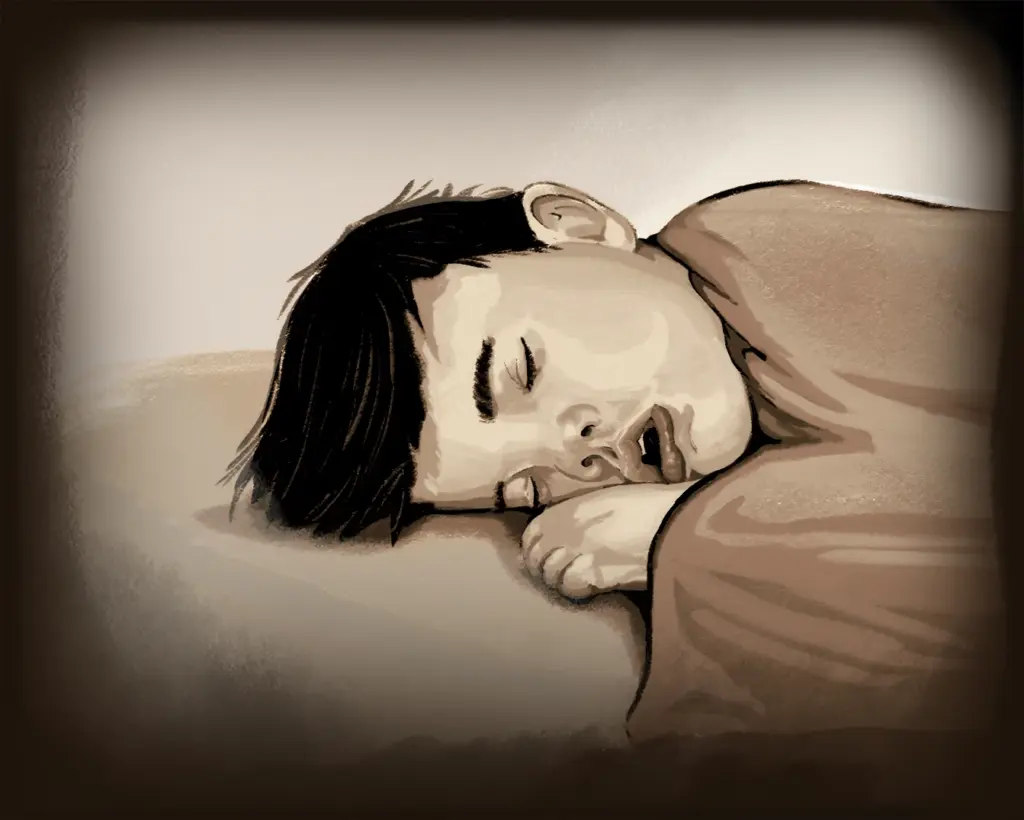
“Are you my son? Are you indeed my son? How do you come to be here in this cottage with Joan?”
“He was brought here by Agatha.”
Joan’s voice behind her was soft but unwavering. “She took him from the Foundling Hospital and brought him here a month or so ago.”
“Why were you brought here, child? And what do they call you?” Edythe continued to talk to the sleeping child as if it was he who had answered her. But it was Joan who kept up the conversation.
“His name is Thomas. He was named for Thomas Coram, the man who founded the home for the orphans.”
“Thomas?” Edythe ran the name across her tongue as if she were tasting a new food.
“It is my fault, Edythe. Agatha saw the ring you let me keep and asked me where I got it. When I would not answer, she pestered me until I let it slip out that I had met you in London at the home and that you had given me the ring. After that she… well, she would not let up and threatened to let both Tom and I go from service if I did not tell her why you were in London. I now know that I did wrong by telling her and I am sorry for she means to….” The girl stopped talking and now Edythe rose from her place by the little cot and returned to the table.
“What is it that Agatha means to do?”
“She means to blackmail you for she and Morgan are short of money, and they envy you and James. She knows that James does not know about the baby, so she will….”
There was another pause before she continued. “…. she will probably ask you for money.”
It seemed to Edythe that her world, which had held some solid hope but an hour ago, was collapsing again.
“Please, Lord, pardon my sin and give me faith – and take care of my child.” Those were the words she had whispered. And here was her child. And she was aware of a great urge within her to hold that sleeping child in her arms.
“How did Agatha know,” she asked suddenly, overcome with doubt, “what child in the Foundling Hospital was mine – that this child was my child?”
“The clothes worn by Thomas the day you took him in, were recorded on a list. It was written down that there was a brooch with the clothes – and the brooch had your mother’s name inscribed in it.”
Thomas, the child, stirred in his sleep. And Edythe, the mother, suddenly felt the floor turning sideways under her feet.
*****
In the stall, James examined the right hind leg of his mare carefully. The animal had begun to develop a slight limp during his morning ride. A black spot on the sole of the foot held a small puncture wound. It was oozing a bit. He had meant to check the mare after his ride, but there was the matter of speaking with Edythe. It had been on his mind all morning and had driven every other thought from him. Now he spoke carefully and soothingly to the mare.
“I think you have the beginning of a small abscess, my beauty, and it will have to be drained.”
He let the foot down again, and leaned against the stall door. Edythe was out walking still and he longed to catch up with her. The foot problem was not serious. He could let Robert, his groom, handle it.
*****
Within half an hour, James was back on the path trying to trace which way Edythe had continued to walk after he left her. It was lovely out. James felt good – good about the birds singing, about the land sprouting green, about the great blue sky above, and about himself. Mostly about himself. He reflected in his heart that he had done the right thing after all. There was an attractiveness about being moral, about being proven right in one’s actions. It had taken him a long time to come to the decision to marry Edythe. There was no doubt about it, the marriage had been below his station. But the girl, Edythe that is, was sweet, a hard worker and a good soul-mate. Did she not listen to all that he said and was she not obedient to his every desire?
*****
James had reached a fork in the path he was taking, giving him two options. The one trail led to the pasture land where his sheep were grazing and the other led past the hazel property hedge. Which one would Edythe have taken? He recalled with pleasure the flush that had deepened on her cheeks when he had said that he cared for her and suddenly decided that he would follow the privacy of the hazel path. It was festooned with large yellow spring catkins, and surely that would have decided Edythe for she loved flowers and all things growing.
The path eventually stopped, veering off sharply to the right at the border between his and Morgan’s land. He opted for staying with the hedge, which continued straight on to Morgan’s land.
It brought him to thinking on Morgan and he dwelled on the misfortune of his stepbrother’s folly. Surely such a financial fiasco would never have happened to himself. He usually weighed material matters carefully; he always counted the cost an action would bring. Well, perhaps he had been taking a chance in wedding Edythe. But had not God blessed him for being good, for being morally upright.
The hedge grew wilder now and was tall next to him. Its soft, large and slightly hairy leaves needed quite a bit of trimming. Leave it to Morgan to not take care of it. But he welcomed the height of the plants, and did not mind that he could not look over the top of them. Edythe had surely continued walking next to the hedge.
Later, a mile or so downward, the hedge did not rise as high and a traveler might gaze out over to the other side. That would be the place where he and Edythe had walked that second day of their marriage. It was the place where she had felt shamed, as indeed, perhaps she should have felt. It was where he had told her…. His thoughts were interrupted by a voice.
“There once was a man who built a house.”
Startled, James halted – halted both his walking and his process of reasoning. Who was speaking?
“He furnished the house with many things, comfortable things. In the beginning, before he built that house, he used to share with his friends and neighbors. He used to fellowship with them. But the larger his house became, the less he felt inclined to leave it. He had become too at ease in that house – too proud of his own ability to manage.”
The voice boomed out the words on the other side of the hazel hedge and James’ feet slowly began to walk again. Who was speaking? The voice traveled on with increased gusto.
“Some of you think that the kingdom of God consists of mere morality. Now there is nothing wrong with morality, with being moral, but this is what I also tell you – do not rest in it. Do not depend on it for your salvation.”
The voice rose as it emphasized the last sentence. James tilted his head towards the hedge. Was this voice speaking to him? He had a strange impulse to clamber over the leafy barrier to see whom the speaker was. But such a thing would be unseemly. He could rip apart the branches and peer through. But such an act would also not be in keeping with his station. He kept straight, eyes down, and the voice kept talking.
“What I mean to say is this: you ought not to think you are Christian because you are not obviously wicked; you ought not to think you are a Christian because you commit good deeds every now and then; and you ought not to think you are a Christian because you can quote several Bible texts. Your unbelieving neighbor might, after all, be able to mirror you in all these matters.”
Whoever was speaking was now striding right alongside James. The man was marching fast and James unconsciously adjusted his step to the voice.
“There is such a thing as love of self – a love which will motivate a man to perform moral duties. For example, a man might not murder his neighbor because he fears being caught and convicted. Or a man might go to church simply to sow a good reputation. And again, a man might praise a friend just because he wants a favor. And so I might go on and on.”
James tripped over a boulder on the path and sprawled face-down in the dirt. He lay dazed for a minute, fearful that the orator on the other side of the hedge might have heard, might discover his presence. But the voice trumpeted on.
“You might ask me then, ‘If a man can do good deeds, and still not be saved – what then must he do to be saved?’ And that is a good question – a very good question indeed. I would answer, ‘Have you ever looked at yourself as a poor, miserable sinner? Have you ever looked at yourself as wearing filthy rags?’”
James stood up and brushed himself off. His right knee was bruised and fine pebbles had settled in the palms of his hands. He grimaced.
“I repeat, do you ever see yourself wearing filthy rags? Do you ever see yourself as a damned and dirty sinner?”
A cuckoo flew overhead. An early harbinger of spring, the clear, two-note call identified it as a male. The female laid her eggs in the nest of an entirely different species of bird so that others would raise her children. James judged it to be a dishonest practice, even as he gingerly cleaned his hands.
“Do you possess a false peace, my friends, a peace which has been placed in your heart by yourself and the devil – a peace which you treasure and rear carefully – but a peace which will not get you to heaven? You are mistaken in owning it. Get rid of that false peace before it lulls you to hell.”
The cuckoo sang overhead. James considered turning around and going back to take the other trail. He was not comfortable. He did not know whom the man on the other side of the hedge was, but then he shrugged. Was this not a free path and surely these words could not be directed towards himself?
“You must know yourself to be a sinner, my friend, before you can be saved. Indeed, is it not logical that you must confess your sins before you can be forgiven? A sinless man need not confess. Indeed, a sinless man needs no Savior. But we all know that there is no such thing as a sinless man, don’t we?”
A yellow catkin touched the left side of James’ face. Soft and fuzzy, he automatically raised his right hand to brush it away. Unlike the catkin, he could not brush away the words that still kept coming, that kept touching his heart.
“Unless you bow down and confess how vile you are, you will not know the love of God. And if you do not know the love of God, Who chose you while you were nothing and wallowing in your sin, how can you love others?”
The voice was losing volume. James judged that the man was now a number of paces ahead of himself. His knee stung and he limped as he moved on. But still he caught the timbre of the last statement.
“There is no one, no one at all who knows the hour of his death. Confess your sins now, brother, for it could be that this very evening you will breathe your last and return to the dust. But your soul will stand before God. And what will you plead? Your good deeds? Your moral living? Or the blood of Jesus Christ? But you can only plead that blood if you own that you are sinful!!”
He was gone then, even as the cuckoo’s song faded in the distance. And James sat down, sat down on a clump of grass and noted that his bruised hands were shaking.
*****
When Edythe opened her eyes, she saw a planked, wooden ceiling above her head. It was not familiar and she turned her head slightly to ascertain where she was. Someone smiled at her. It was a child’s face that held the smile. A small round face with a shock of black hair falling over the forehead.
“Hello.”
“Hello,” she whispered back, and then she must close her eyes again, because her head was throbbing so.
A wet cloth gently wiped her forehead.
“Are you awake, Edythe?”
It was a few moments before she was able to open her eyes again, before she saw Joan. It took her a moment to recall all that had happened.
“You fell down. I was afraid you had hurt yourself rather badly, but I think you will be all right after a bit of a rest.”
Edythe tried to peer around Joan’s form to see if the child was still there, or if she had dreamt him.
“Where,” she whispered, “is the boy?”
“Thomas? Oh, he has just gone out to play. He is a fine little fellow and makes me smile a great deal.” To prove it Joan smiled even as she spoke and took hold of Edythe’s hand, stroking it gently.
“A fine fellow?”
“Yes, he is a fine lad. His hair was quite short when he first arrived, for they kept it quite short in the Home. They were afraid of lice, I think. But it’s grown longer and is very much the color of your own hair.”
Edythe lay back, eyes half-closed and listened. For a while, she reasoned within herself, for a little while she would allow herself to hear things about her child and pretend that all was well.
“He knows his prayers,” Joan continued, “and he makes his bed, small as it is and he can sing, Edythe, like a lark.”
The faintest shadow of a smile appeared on Edythe’s face.
“And,” Joan added, “he fetches water for me in the morning and he asked me just yesterday, if I should want him to knit me some socks.”
She laughed as she passed on this information. Edythe opened her eyes wide. “He knows how to knit?”
“Indeed, I think he does. I think all little boys have to knit the stockings for the other children in the home. He also told me,” Joan added, “that he always went to bed when the bell was rung at seven in the evening and if I could please ring it a little later for he told me that he does so love to play outdoors.”
“Does he know… know that he has a mother?”
“I have not spoken to him of it but I’m afraid that Agatha has.”
There was a creaking sound as the door to the cottage opened and Agatha walked in. Great with child, she moved slowly, puffing heavily. She eyed the form of Edythe on the bed with some surprise. Moving towards the table, she pulled out a chair and sat down, her eyes never leaving Edythe’s face.
“Well, sister-in-law, this is a chance meeting, is it not?”
Edythe did not reply. Her thoughts were in turmoil. What would Agatha say? What would she demand?
“Have you seen your child?”
Agatha did not beat around the bush. She was direct and studied Edythe’s face keenly as she spoke. As Edythe did not answer, but lay quite still on the bed, she pulled out a brooch from her skirt pocket.
“This is your mother’s brooch, girl. It identifies Thomas, who is playing outside, as your son.”
Still Edythe did not answer. For some reason she saw James’ face as he had left the room that time after Morgan had joked about her not having any children. James very much wanted a child. She knew that for certain. And here was a child – but he was her child and not his. Strangely enough though, the boy carried a certain resemblance to James – and to Jeremy. And that was not strange, really, because he was, after all, related to James. She shut her eyes again. Her head pounded.
“Morgan and I,” Agatha shifted her bulky weight about on the chair as she repeated, “Morgan and I need help. My father left some debts and it behooves us as Christian folk to pay these debts.”
“I have no money of my own,” Edythe replied, not opening her eyes but feeling that her words would find their way to Agatha’s ears.
“No, but James has money. He has lots of money.”
“Would you have me steal it?”
“If that is the only way to get it,” Agatha’s voice floated back across the room, “then, yes, I would have you do that.”
“I acknowledge the child is mine,” Edythe said, now opening her eyes wide and making an effort to sit up. “I was wrong to bring him away and….”
“Yes, I cannot conceive myself doing such a heartless thing,” Agatha responded sharply, “But you have done so and I cannot help but say that your act stands Morgan and myself in good stead presently.”
Then, studying the forlorn form of her sister-in-law, she changed her tone. “Come, come, Edythe,” she said in a low voice, “it is not all bad. I dare say we can move the boy from this cottage to your home and you can tell James that you fancy the lad, and that he would make a good stable hand trained by the groom.”
“I cannot lie to James,” Edythe whispered shakily.
“But you have done so already.”
“He knows,” Edythe continued her whisper, “He knows….”
And then she stopped.
“What does he know?” Agatha demanded, a touch of fear in her voice.
“He knows everything,” and the voice that answered Agatha was not Edythe’s voice, but the voice of James himself, James who stood in the doorway – tall and imposing.
There was silence. And in the silence, Joan curtsied and pulled out a chair for him. He thanked her, came in and sat down, sat down next to Agatha.
“Was there something you had to tell me, sister-in-law?” he queried softly, but not so softly that Edythe could not hear him.
Agatha coughed into her hand and as she was coughing, the child Thomas walked in.
“Mistress Kilby,” he called out in a childish treble, “Mistress Kilby, you will not believe what this man has told me.”
James turned and reached out for the boy with his hand. The child came instantly and stood by him enfolding his hand into James’ outreached one.
“Hush, Thomas,” James said, “I think I would like to tell your mother myself what it is that we plan to do – the two of us.”
Thomas and James both smiled conspiratorially and Edythe was struck by the fact that they resembled one another so very much.
“First of all, let me tell you, Agatha, that I have been standing by the door for a long while listening to your conversation with my wife. I would also like to tell you, Agatha, while I have the opportunity, that there is no one like my wife. She is good; she is a hard worker; she is beautiful and selfless, and,” at this juncture he looked straight into Edythe’s eyes, “I love her dearly.”
Edythe blushed but did not look away. Indeed, she could not have looked away if she tried.
“Agatha,” James went on, “the truth is that love begets love and if you and Morgan need help you have only to ask. And now,” he said, getting up from the table, “I will walk home again and fetch the carriage for my family.”

Do you believe anything is left to chance? Is there any event outside the circle of divine predestination? No, my friend, with God there are no contingencies. The mighty Charioteer of Providence has gathered the reins of all the horses, and He guides them according to His infallible wisdom.
– Charles Spurgeon
*****
This is an excerpt from “Towards the Fullness of Time Stories,” an upcoming book by Christine Farenhorst. She is also the author of Upheld, a wonderful book the RP Bucket List Book Club rated very highly when we discussed it earlier this year.