















From a young age some people are fascinated by beetles. For example, English author A. A. Milne wrote a delightful poem concerning a boy and his pet. The poem, in Now We are Six (1927), recounts the experiences of a boy who put a beetle in a matchbox for safekeeping. However disaster struck when his nanny, apparently looking for a match, inadvertently let the beetle out of the box.
And Nanny let my beetle out –
Yes Nanny let my beetle out –
She went and let my beetle out –
And beetle ran away.
A search is set up and, happily, a beetle is discovered.
It was Alexander Beetle I’m as certain as can be
And he had a sort of look as if he thought it must be ME.”
So Nanny and the boy quickly shovel their find into the matchbox. This lady is determined not to make the same mistake again.
And Nanny’s very sorry too for you-know-what-she-did,
And she’s writing ALEXANDER very blackly on the lid.”
This delightful scenario has no doubt occurred through many generations in many countries. Even today, some children enjoy beetle pets. And all of us can appreciate beetles for what they tell us about their Designer, even if we are not in the market for a pet.
Rhinos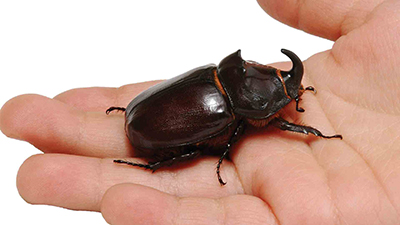
The scary looking rhinoceros beetles are among the largest beetles. Although they may grow to more than 150 millimeters, or 6 inches long, they are completely harmless to humans since they do not bite or sting. The claim to fame of these beetles is the horns, one projecting from each side of the thorax (section behind the head), and another one pointing forward from the centre of the thorax. These insects are sort of the Triceratops (horned dinosaur) of the insect world!
They are a subgroup of the scarab beetles and, like most scarabs, they have strong legs – some species can lift up to 850 times their own weight! Our interest in this group of insects comes from the fact that children in Japan like to buy or catch these insects for pets. Apparently it is particularly fun to breed these pets. While most scarab beetles are not as showy as the rhinoceros beetles, they nevertheless are a most interesting group of insects.
Beetles are a group of insects that exhibit sheathed wings. The front pair of wings (projecting from the back of the middle section or thorax) is hardened for protection. Underneath we find a second pair of wings which look more typical of insect wings. In order to fly, the beetle raises the hardened pair to expose the other pair which do the actual work of flying. In that beetles all exhibit a head, thorax (with three pairs of legs, besides the 2 pairs of wings), and an abdomen (covered by the hardened sheathed wings), they all are basically similar in design. It is in the design of the antennae, mouth parts, leg structure and ornamentation (color, patterns and projections) that we see variety between beetle groups. And variety there is indeed! In total, worldwide, there are about 165 families of beetle. We find most species collected in six extremely diverse families, each with about 20,000 or more described species.
The scarabs or Scarabaeidae, are stout-bodied beetles measuring between 2mm long to 17 cm (almost 7 inches). Many scarab beetles exhibit bright metallic colours, especially on the hardened exterior wings (called the elytra). These insects have distinctive club shaped antennae, the component parts of which can fan out like leaves, in order to sense odours. The front legs often are broad and powerful for digging and the hind legs more so.
Some of the most famous scarabs include dung beetles, June beetles, rhinoceros beetles, Hercules beetles and Goliath beetles, as well as those ever unpopular rose chafers. The Hercules beetle is the most famous of the rhinoceros beetles. Native to the rainforest of the Americas, this creature’s central horn is extremely large and intimidating. Goliath beetles on the other hand, are among the largest insects in terms of body size and weight. Native to Africa, they measure 60-110 mm (2.5 – 4.5 inches) for males. The diets of scarab beetles range from fruit, to fungi, to dead animals and even the slime trails of snails.
Dung beetles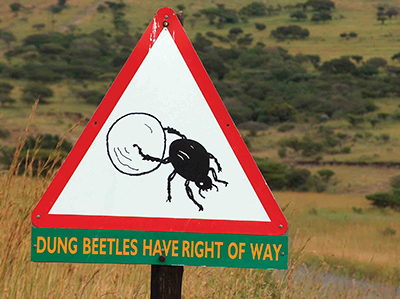
It is however the dung beetles, which are particularly remarkable. These species feed partly, or exclusively, on animal droppings. Dung, however, can be resource in short supply. The dung beetles have a wonderful sense of smell, based in their antennae, for locating this resource when it is fresh. Cows in a pasture apparently produce about 12 pats per day, per individual animal, but the location of these droppings is hard to predict. Once the odour reaches one beetle, it probably has also attracted many competitors, so speed is essential. One elephant dropping in east Africa was monitored in the 1980s. Four thousand insects arrived within a half hour. It took 16,000 dung beetles only two hours to entirely clear away 1.5 kg (3 lbs) of manure.
Some dung beetles roll the dung into round balls which they immediately remove from the scene. They then bury it in a suitable spot in order to use it as food, or as a chamber to shelter and feed their young. Others merely bury dung where they find it. Still other species simply live in the manure where it has been deposited.
The true dung beetles roll freshly deposited dung into round balls which may be very heavy compared to the insect. In one study, beetles averaging 2-5 grams in weight, moved dung balls which averaged 6-240 grams and they did this at speeds of up to 20 cm per second. That is fast going! Speed is essential because other dung beetles will steal the ball if they can (May Berenbaum. 1995. Bugs in the System. Helix Books p. 243). The male then pushes the ball in a straight line, despite all obstacles. One can move the farthest and fastest away from point A, when one travels in a straight line. If eggs are to be laid in the resource, the female follows behind, rides along, or helps push the ball. The dung beetles prefer the droppings of grazer animals (herbivores). These droppings are notoriously rich in undigested nutrients and in moisture. The beetles don’t need anything else to munch or drink.
Mostly the males push the ball backwards, rolling it with their hind legs. A recent item in National Geographic (May 2012) described how dung beetles may find themselves navigating across sand as hot as 150 degrees F (66 degrees C) during the day in South Africa. To cool their parched feet the beetles frequently climb up on top of the dung which may be only 73 degrees F, or 26 degrees C, compared to the hot sand. When scientists outfitted the beetles with heat resistant silicon booties the beetles did not need to climb up on the dung as frequently.
It is evident that dung beetles, while proceeding backward in a straight line, need to orient themselves to prevent their moving in a circle. Features in the landscape will not work as points of reference because the insects are too close to the ground. Obviously the key is to look up to the sky. Previous studies have shown that beetles can navigate using the sun or the moon, or patterns of polarized sunlight or moonlight.
Star bugs!
Now a study, just published in 2013, documents that dung beetles can also orient themselves by the stars, specifically the Milky Way. Marie Dacke of Lund University declares that her study with dung beetles is the very first demonstration that any creature, other than humans, can orient themselves by the Milky Way. In order to prove her point, she needed to be able to turn the stars on and off. Thus she obtained permission to deploy her beetles in the Johannesburg planetarium. With the “sky” darkened, the beetles went round in circles, but with the sky illuminated by stars, the beetles proceed nicely outward. One commentator remarked that dung beetles achieve a lot with minimal computing power in the brain. It is certainly interesting that this navigational skill is uniquely conferred upon a beetle (see Marie Dacke et al. 2012. Dung beetles use the Milky Way for orientation. Current Biology vol. 23 Feb. 18).
Scarab beetles are not exactly obscure insects. There are apparently about 30,000 species in the family, comprising about 10 per cent of all known beetles. The dung rollers were in former times venerated by the ancient Egyptians who compared the emergence of the young beetles from underground to the daily rising of the sun in the east. It is obvious, moreover, that these beetles are important contributors to a clean environment. By removing and burying dung they prevent disease-ridden insects from multiplying, and they also contribute to soil fertility. A project in Australia (1965-1985) involved the introduction of 23 species of dung beetles. There were native species already present, but they were unable to deal with the droppings of cattle, which have a different chemical consistency then the droppings of the native marsupials. This agricultural initiative resulted in improved fertility in pastures, and vastly reduced numbers of insect pests.
But the scarab beetles are only one beetle family out of about 165 families. No doubt, the diversity of beetles and their interesting stories could fill many books.
Other beetles
The weevils (Curculionidae) are a very large family of usually small beetles (less than 6 mm or 1/4 inch long). Their distinctive feature is their long downward curving snout. The mouth parts at the tip are less elaborate than in many other groups. This does not prevent these beetles from damaging many crops. One of their infamous members is the cotton boll weevil. Others of the 60,000 species include those munching on nuts, fruits, stems and roots.
The ground beetles (Carabidae) are another large and interesting group. Their claim to fame, besides their beautiful shiny black or metallic ridged hardened wings (elytra), is the pair of glands in the lower back of the abdomen. These glands produce nasty or even burning secretions guaranteed to make any creature threatening the beetle, extremely unhappy. Among the noxious products released by such insects are hydrocarbons, aldehydes, phenols, quinones, esters and acids. Among this infamous group we find the bombardier beetles which combine chemicals in a mixing chamber just prior to explosively releasing quinones at 100 degrees C along with a gas mixture. Most of these ground beetles live under bark of trees or under logs or rocks. Most are carnivores, eating any kind of invertebrate they can overpower. Because they eat many caterpillars which are plant pests, most ground beetles are fairly popular. Many of these beetles too, in former years, were prized by collectors because of their large size and showy color patterns.
Many beetle families have unpopular representatives. The small darkling beetles (Tenebrionidae) with about 20,000 species, are named for their plain dull bluish black or brown color. Their preferred diet is fresh and decaying vegetation. However some of them make a habit of exploiting processed grain products. This group includes the confused flour beetle, the red flour beetle and mealworms. Such spoilage of food has apparently long been a problem for human societies. May Berenbaum mentions (p. 144) that alabaster vases from Tutankhamen’s tomb (dating from about 1350 B.C.) were found to contain Tribolium castaneum, the red flour beetle. Many people feed Tenebrio (mealworms) to various pets, but the mealworms living on their own, are bad news for stored grain products.
The leaf beetles (Chrysomelidae) include the Colorado potato beetle which has no trouble, once present in any numbers, in eating a potato plant completely to the ground. Another infamous member of this family is the flea beetle. These small dark beetles have very strong hind legs for jumping. Flea beetles are particularly enthusiastic about plants in the mustard of crucifer family. Cabbages, broccoli, cauliflower, radishes and the like are all fair game. And these beetles are a major economic concern on canola crops, also in the same plant family.
Ladybugs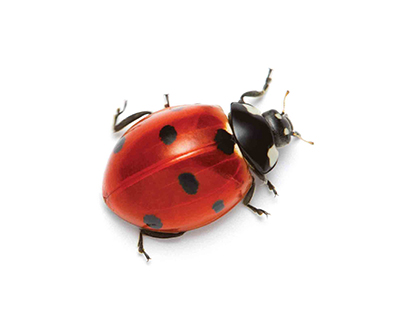
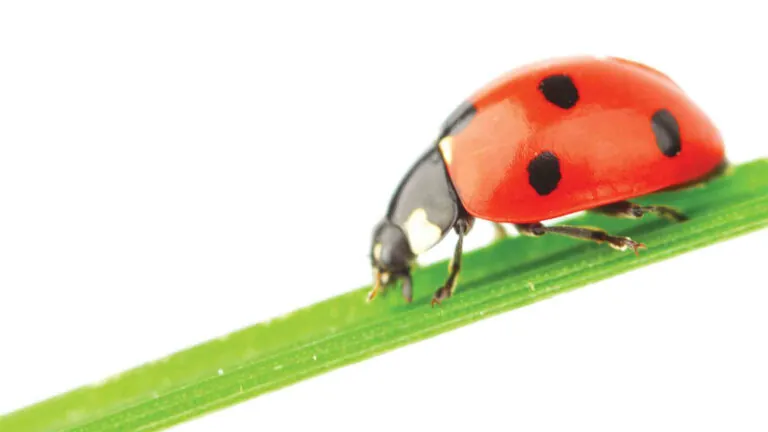
One of the most delightful beetles however is the Coccinellidae family which includes ladybugs. These are predators of aphids and scale (bad plant pests) among other victims. We have only to consider the ladybugs to derive some appreciation of the diversity among beetles. Ladybugs are small, up to 10 mm long (0.4 inch). They are round, broadly oval or narrowly oval. They can be orange, red, yellow or black. The elytra is decorated with black spots, red spots, white spots or spots stretched into bars. The number of spots varies from 0, 2, 3, 7, 11, 13 or more. Over 5000 species are found worldwide and of these, there are about 450 species native to North America.
Ladybugs and indeed all beetles, are wonderful examples of the richness and variety we see in nature. Beetles are quite plain in their basic organization. The amazing diversity in appearance as well as in lifestyle, tells us something about the Creator. God loves variety and He loves beauty! The fancy elaborations on the beetle theme in terms of talents and appearance, can only serve to increase our interest in the creation. Could the various ecosystems survive with plainer looking beetles? No doubt. But isn’t it fun to be able to observe and enjoy beetles in all their vast variety?