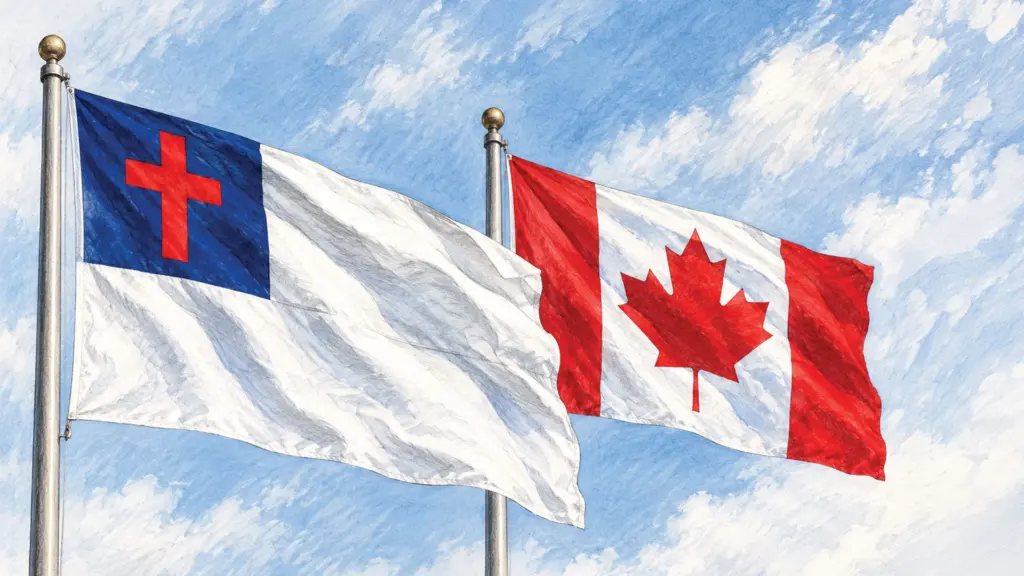
The term “Christian Nationalism” is heard a lot in the US, but it’s only starting to get bandied about north of the border. This pairing of words has generated plenty of heat – lots of theological tussling going on – some light – passive Christians realizing God is sovereign in the realm of politics too – but also a lot of smoke.
Smoke? Yup, obscuring everything. Confusion about what Christian Nationalism means has the Left using it as an insult, and some Christians holding it up as a banner to rally around. Adding to the confusion is a common response many have to the personalities involved – to bounce off of them. I’ll admit to not being a great appreciator of the works of Stephen Wolfe, the author of The Case for Christian Nationalism. Others have strong reactions to Douglas Wilson, who wrote Frequently Shouted Questions about Christian Nationalism. But it’s important that we not let ourselves simply “bounce off” personalities, but instead seek out God’s thoughts.
So, what is Christian Nationalism? That’s a hard question to answer. I recently heard a presenter define Christian Nationalism as a top-down imposition of Christianity on a nation – the State forcing faith on people. And because the listening audience was made up of solidly Reformed folk, they all knew that such a thing could not be done – the Holy Spirit changes hearts, not any Prime Minister or President – so they came to the very logical conclusion that if that’s what Christian Nationalism is, it is very, very wrong.
The problem was, this wasn’t Christian Nationalism; this was a strawman.
Of the vast range of definitions currently in play, the presenter picked one of the easiest to dismantle – it was akin to criticizing Presbyterianism on the basis of what the rainbow-flag-waving PCUSA denomination holds to. Interestingly, the PCUSA indulged in some Christian Nationalism caricaturing of its own, offering a resource with its own singular definition, which they titled “Confronting White Christian Nationalism.”
There are racists embracing the term “Christian Nationalism”… but then there’s also racists who skip over the nationalist part and just call themselves Christian. Either group is only relevant to the conversation in as far as the media will find these few and try to lump them in with God’s people. We can help clarify things by explaining to any media with ears to hear, that to be a Christian anything, you first need to be a Christian… and racists aren’t.
So, again, what is Christian Nationalism? It’s a really hard question to answer, but in his article this issue, “The PCA investigates Christian Nationalism,” Levi Minderhoud summarizes the PCA’s solid attempt where they examine a handful of different strains. That’s a great introduction.
What’s on offer below is more casual: a few hopefully illuminating quotes from participants in the discussion.
“From what I’ve read, there are 4 or 5 kinds of Christian nationalists. In a sense, this is mostly why I am not a Christian nationalist. I don’t think it’s wise to describe myself as a Christian nationalist when some of the people who embrace that label are completely unbiblical.”
– Samuel Sey, of SlowToWrite.com
“I’ve seen conservative Christians involved in any kind of activity in the public square, trying to influence the culture – we’ve been called the ‘New Right,’ the ‘New Christian Right,’ the ‘Radical Christian Right.’ ‘Christian Nationalist’ is the latest thing we’re called for daring to show up and say we’re going to contend for the sanctity and dignity of unborn life. So, I’m trying to say, number one, yes, it is a slur, and I don’t think there’s any way [of avoiding the label] if we’re going to say our Christianity informs our understanding of the public square and we believe – not that we want to make the Church a State or the State a Church – but we do believe that God’s truth isn’t limited to the Church. It’s public truth. And I do want an acknowledgement from our government that it doesn’t stand on itself.”
– Albert Mohler, contributor to Five Views on Christian Nationalism
“Christian Nationalism may appear on the outside to be all about Christianity, with their flags, and crosses, and signs, but deeper down their actual goal is not Christianity. Christianity is just a device, a tool that they use to achieve their real goal which is about cultural and political power.”
– Skye Jethani, Holy Post Media
“Christian Nationalism is the view that secularism is a hollow construct, now plainly revealed to be bankrupt. Additionally, Christian Nationalism is the belief that human societies require a transcendent anchor to hold everything together, and that this transcendent anchor should be the true and living God, and not a placeholder idol.”
– Douglas Wilson, contributor to Five Views on Christian Nationalism