
This is an overview of Sunday: Rest or Rules? – Ep. 155 of Lucas Holtvluwer and Tyler Vanderwoude’s bi-weekly Real Talk podcast. Real Talk is committed to having honest conversations that apply the Word of God to the nitty-gritty of life. Find it at RealTalkPodcast.ca or wherever you get your podcasts.
How we think about the Sabbath and Sunday is more foundational than we might think. It orients our lives and reminds us of why we are on this earth and where we are going.
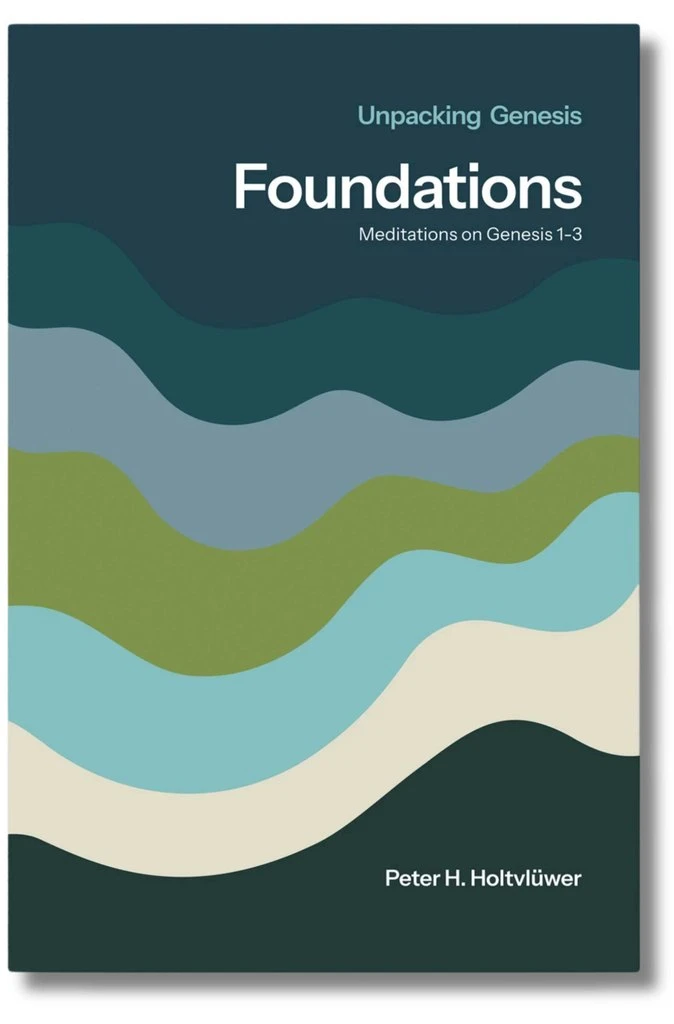
In a recent Real Talk episode, Lucas was joined by his father, Rev. Peter Holtvlüwer, who recently authored the devotional Foundations: Mediations on Genesis 1-3.
The Sabbath was right there at creation
To kick the discussion off, Lucas pointed out that it is easy to rally people around foundational topics we find in the opening chapters of Genesis – marriage, gender, the basis of equality, and more – but there’s not the same interest in the Sabbath, even though it’s right there in the beginning too. This disinterest is more common in the broader evangelical world, but is also making its way into Reformed circles.
Rev. Holtvlüwer explained that the problem is that many don’t understand the Sabbath’s rootedness in creation. They see the word “Sabbath” as something added at Sinai, or they think it’s no longer binding, being similar to the ceremonial laws that were shadows pointing to Christ and have passed away with His death and resurrection.
But Genesis 2 displays something different – the God of the universe created for six days and rested on the 7th.
Lucas / Real Talk (RT): “Why does God need to rest?”
Peter Holtvlüwer (PH): “He doesn’t, right?… God could have left the week at six days. We could have just had a six-day work week …But all of a sudden, after everything’s created, we get this special designation, the creation of another day. Some marvelous things are said. God blessed the seventh day. [He] didn’t bless any of the other six days, so that already marks it as something special. He made it holy. So please note that we’re before the fall into sin.”
This designation of a special day before the fall into sin shows something special. Something we ought not to take lightly.
The 4th Commandment
Now let’s jump a couple of Bible books to Sinai and the 10 Commandments. We read in Exodus 20:8-11:
“Remember the Sabbath day, to keep it holy. Six days you shall labor, and do all your work, but the seventh day is a Sabbath to the Lord your God. On it you shall not do any work, you, or your son, or your daughter, your male servant, or your female servant, or your livestock, or the sojourner who is within your gates. For in six days the Lord made the heavens and the earth, the sea, and all that is in them, and rested on the seventh day. Therefore the Lord blessed the Sabbath day and made it holy.”
This command rests on what happened at creation. Holtvlüwer noted, “It’s a day to set aside our work because God set aside His work…we are to imitate God.” God is calling the Israelites to remember creation. And this command matches up with what God has just commanded in the three previous commandments.
PH: “First commandment: whom we are to worship, only worship God. Second commandment: how we are to worship – worship God according to My instructions. Third commandment: …worship Me with the right attitude. So it’s all about worship. One, two, and three. Now we get to the fourth commandment, and it’s about worship again. The time is commanded.”
Right before the Israelites are to enter the promised land, they are given the law, and again God calls them to follow the fourth commandment. He builds on its creational foundation by calling Israel to remember, as Rev. Holtvlüwer put it, their “recreation, where God saved you from slavery to Pharaoh. And both of these are precursors to what the Lord Jesus would do for us.”
Jesus and the Sabbath
In the New Testament the Pharisees had a different understanding of the Sabbath, adding to the law beyond what God commanded. And Jesus rebuked them for it.
PH: “When he says the Son of Man is Lord of the Sabbath, He’s staking out the ground to the Pharisees that this is My day, and He actually had the right to say, ‘I was there in the beginning when this day was created, and this is My day, and I get to say what’s the right thing to do on it, yes or no.’ So the Lord Jesus lays that out. That’s what that claim is all about. And then He says, the Sabbath was made for man. Well, that actually takes us back to creation, right?”
RT: “It’s that gift idea.”
PH: “Yeah… Notice He doesn’t say the Sabbath was made for Israel. He doesn’t say the Sabbath was made for the Jews. He doesn’t say the Sabbath was made for God’s people. He says the Sabbath was made for man. That’s a very general word for mankind, for humanity.”
Just the 9 Commandments now?
When it comes to the other commandments, we are quick to affirm that Jesus came to fulfill the law, not abolish it. But what about when it comes to the fourth commandment?
PH: “That’s a big question mark for people. And I think there’s been an overreading of the fourth commandment to say, ‘Oh, that’s just all shadow. That’s just all temporary.’ See, they don’t root it in creation. They don’t see it as part of God’s permanent law. They see it only as a temporary thing. And that’s where I believe the big mistake is made.”
Yes, many of the ceremonial laws were the shadows of greater things to come in Christ. And even in the Ten Commandments, there are temporary elements that have passed away, but…
PH: “…with the fourth commandment, the permanent element is one day of rest out of every seven… The temporal element is the seventh day. We know that because of what the Lord Jesus (who’s the Lord of the Sabbath), did in His resurrection and how He basically taught His disciples to honor Him by worshiping him on the Lord’s Day, what the New Testament calls the Lord’s Day on that new…first day. So the fourth commandment is a moral thing. The day of rest is a moral thing. It’s not a temporal thing… If you just look at it practically, the people of God still need a day on which to worship.”
The New Testament affirms the remaining “shadow” of the weekly Sabbath we celebrate as “Hebrews 4… points forward to the great eternal Sabbath that God has in store for us. This is all outside of the shadows of the Mosaic Law.” So Jesus affirms the goodness of the Sabbath by claiming it as His day. Can’t we give Him one day in seven?
2026 / 150 pages
The heart of the issue
Like all the other commandments, “keeping the Sabbath holy” is a matter of the heart. Understanding this cuts through all the noise of pharisaical legalism and do-what-you-wantism.
PH: “[Jesus is] not saying, ‘Oh, do what you want on the Sabbath or the day of rest…’ He’s just saying the Sabbath was made for man, for man’s good. Well, what is man’s good? You go back to Genesis 2…. His highest joy is to spend quality time with his Maker. That’s what making the day holy is all about… the mindset has to be: this day is for me, is given to me by God, for my good. What is my highest good? It’s to be in the Lord’s company. It’s to give my heart to the Lord. It’s to fellowship with my God. What higher good can there be?”
Holtvlüwer encouraged us to be honest before God.
PH: “What are we doing on the Lord’s Day? Is it for me or for the Lord? Am I looking after my wants, or am I serving the Lord from the heart? Am I trying to get to know Him better? Am I trying to be in fellowship with His people better?”
Being honest before God and recognizing our heart posture will help us answer any of the can-we or can’t-we questions.
The nitty-gritty
We reached out to our audience to ask for their questions related to the Sabbath. We covered as many as we could as quickly as we could. Here are a few of the big ones:
Q. WHY TWO SERVICES?
Maybe the question should be: why not three or four? Holtvlüwer noted that the Old Testament worship was characterized by sacrifices both in the morning and evening. “That was every day of the week, but it was doubled on the Sabbath…”
PH: “The first Christians were Jews, and then they were quickly joined by Gentiles. We have evidence from history that they worshiped also…at sunrise and sunset…This idea that you worship in the morning and the rest of the day is for yourself, that’s a problem. That’s already moving away from the concept that this day is for the honor of the Lord and for my good. My good, my highest good, is indeed to give my heart to the Lord, to be in the Lord’s company, to think about the Lord, to fellowship with the Lord, to meditate upon the Lord, not to go off and do whatever I want, right?”
Q. HOW ABOUT LIVE STREAM?
PH: “Live stream service, in and of itself, can be a great blessing for those who legitimately can’t come to the worship services… It’s a second-best option for those who are unable to go to the gathering of God’s people, and then it can be a blessing because that’s all you can do. But if you’re staying home by choice, you’re not honoring the call of the Lord to worship on the Lord’s Day.”
Q. WHAT ABOUT EATING OUT ON SUNDAYS?
This is a common practice in many circles, especially in the US. The fourth commandment calls us to rest, but it also calls us to let our servants rest.
PH: “What’s the principle there? Well, basically, we should not make anyone work for us to the extent possible that we can. So, when I walk into a restaurant on Sunday and order food, I am making someone work. I cannot square that with the fourth commandment.”
Q. WHAT ABOUT TRAVELING ON SUNDAY?
PH: “…the root concept at creation. If we can get that back clear in our minds, then we’re going to treat this day differently. We’re going to treat it holy… I want to drive home from my holiday on Sunday because I need to be back at work Monday. Well, I don’t need to be back at work Monday, but I don’t want to take Monday off…We all have the flexibility to take Monday off, make that a travel day, but actually, I don’t want to do that because I want to save that holiday because you only have so many in a year for the next holiday. So, what’s really going on there?”
Q. HAVE WE MADE FAMILY AN IDOL WHEN IT COMES TO SUNDAY?
In our tight-knit churches where family is highly valued and often close by, we can often (unintentionally) gravitate towards our families when it comes to Sunday fellowship.
PH: “Look, it’s beautiful that we celebrate the Lord’s Day with family, but try to broaden that out. Don’t forget the family of God. The family of God is of critical importance, and I recognize your blood family is often part of the family of God. But can we look beyond our families to see the needs of others in the congregation?”
Don’t get lost in the nitty-gritty
When we contemplate the Sabbath, it’s easy to get lost in all the nitty-gritty questions. But as with all things, we have to get back to the heart of the issue. What is your heart posture? Where are your priorities? Do we see the whole day as for the Lord, and are we willing to treat it as such?
Let us then not neglect the gift and blessing of the Sabbath. If you want to learn more about what it means to apply the fourth commandment to our daily lives be sure to check out Lucas and his dad’s whole conversation in “Ep. 155 – Sunday: Rules or Rest?” at RealTalkPodcast.ca.