










Transparent heart icon with white outline and + sign.

Life's busy, read it when you're ready!

Create a free account to save articles for later, keep track of past articles you’ve read, and receive exclusive access to all RP resources.

White magnifying glass.

Search thousands of RP articles

Equipping Christians to think, speak, and act

Open envelope icon with @ symbol

Get Articles Delivered!

Equipping Christians to think, speak, and act delivered direct to your Inbox!

A A
By:

“We believe…” 1,700 years ago

Redeemer University conference celebrates the Council of Nicaea and the Nicene Creed

*****

In times past, scholars and theologians may have found themselves travelling across countries and continents to attend meetings about doctrines of particular importance to the Christian faith. One of the most famous of these occasions was the Council of Nicaea in AD 325, when bishops from all over the Mediterranean gathered to address heresies about the nature of Christ.

More recently, theologians met once again in discussion of these same issues – not to write new creeds, but to affirm and celebrate the council and the creed which it produced. They met at Redeemer University, a Reformed Christian university in Southern Ontario, which hosted the conference: “Defending Christ: Celebrating 1700 Years of Nicaea.” Historians, theologians, pastors, and laypeople attended this conference to glean knowledge from one another and re-immerse themselves in the rich theology of Nicaea. What follows are a few of the highlights.

On the history of the council

The council was called by Emperor Constantine, not primarily to address doctrine, explained Dr. Stefana Liang, but to find solutions for a divided church and empire. The result of the council, however, is evidence of the providential work of the Holy Spirit, and even Constantine recognized it as such. He referred to the council as “great and holy” and “a complete blessing from divine providence.” “It cannot be other than the doctrine of God,” he said.

The women of Nicaea

A presentation by Reanna Lingley investigated the women behind the Council of Nicaea. While no women were in attendance, figures like Macrina the Elder and Macrina the Younger (respectively the grandmother and sister of brothers Basil the Great and Gregory of Nyssa) and Nonna (wife of Gregory the Elder) embodied the vision of the Christian life and were active shapers of the theological tradition that raised up the men who participated in the council.

Macrina the Elder survived in hiding for seven years during Emperor Diocletian’s persecution and was described as a vessel of theological continuity. Nonna’s persistent faith led to the conversion of her husband, and she spurred her husband and sons on to holiness and service. Instead of regretting the absence of women at the council, Lingley argued, we ought to recognize the tremendous but quiet influence that women did have on the theological landscape of the Early Church.

A Nicene AI?

Another interesting presentation evaluated the most theologically sound large language models (LLMs). If that’s an unfamiliar term, it’s what makes AI chatbots go, and you can think of the term as almost a synonym for the chatbots. Studies show that increasingly more young people are turning to AI for important questions, so an organization called ChristianBench tested the biggest AI chatbots on their theological stances. Commonly these bots will refrain from giving a pointed answer – they will present all the options as equally valid. But, of course, that sort of relativization of the truth is a strong stance of its own.

However, depending on how a question to the chatbot is framed, the LLM can anticipate what kind of answer the prompter is looking for and give an individualized response. (For example, a question about the “natures of Christ” will generate a theological answer that could be solidly in line with the Nicene Creed, whereas a more general question about “Who is Jesus?” will usually result in a more all-options-on-the-table response that provides the user with a variety of answers to consider.)

The only chatbot that scored exceptionally high for adherence to the Nicene Creed was a Catholic LLM called Magisterium AI, an AI chatbot that aims to provide answers to questions about the Catholic faith.

Art as theological testimony

The conference’s main presentation was by Dr. Megan DeVore, and was centered on Christian art during the time of Nicaea. Early Christian artists used pagan motifs which they adapted and redefined to reflect the gospel story. After the Council of Nicaea, depictions of Jesus began to showcase the artists’ understanding of His divinity. Jesus also started being portrayed in Old Testament scenes, like the story of creation, reflecting a trinitarian understanding of God’s work throughout all of Scripture.

Christian art in catacombs show something noteworthy about the Christian faith and the doctrines of Nicaea: Jesus’s divine nature provided early Christians with eschatological hope. The depictions of the deceased in Christian catacombs were of hopeful and prayerful believers, in stark contrast with the mournful depictions in pagan catacombs. The art shows that Christians found real, impactful, and lasting hope through the doctrines they believed.

Dr. DeVore outlined how early Christian art was characterized by theological declarations rooted in intricate Christological hermeneutics. She asked whether modern Christians are perhaps missing out on a key aspect of theological understanding by overlooking the value of faithful creative expressions through the arts.

The use of the creed

The Nicene Creed formalized for the church the doctrine of Christ’s divinity. Written in Greek, almost all of the words in the creed are found in the New Testament. The handful that are extrabiblical nevertheless convey strongly biblical ideas and were necessary to clarify the biblical concepts that were debated at that time

The Nicene Creed is especially helpful for interfaith conversations today. It lays out a “mere Christianity” that distinguishes orthodox Christians from Muslims, Jehovah’s Witnesses, and Latter-day Saints. The classical trinitarianism expounded in the creed, argued a paper presented by Matthew Waddell, is the only trinitarian view that can provide proper responses to scrutiny from Islamic apologists.

But while encountering Christianity may begin with the Nicene Creed, it cannot end there. Interestingly, as passionate as these scholars at the conference were about the Nicene Creed, all of them agreed that it cannot even be compared to the riches of Scripture. The formal doctrine laid out by the creed is meant to lead us toward biblical doxology (see Jude 24-25). The creed can be seen as a CliffsNotes summary of biblical doctrine; it was never meant to be a substitute for the original text and cannot match its force and power. One scholar likened the creed to a beautiful doorway with magnificent engravings. It may be wonderful, but it is merely meant to provide access to something much greater: the full extent of the biblical witness.

THE NICENE CREED

We believe in one God, the Father almighty,
Maker of heaven and earth,
of all things visible and invisible.

And in one Lord, Jesus Christ, the only-begotten Son of God,
begotten of the Father before all ages;
God of God, Light of Light, true God of true God;
begotten, not made,
of one substance with the Father;
through whom all things were made.
Who, for us men and our salvation, came down from heaven
and became incarnate by the Holy Spirit of the virgin Mary
and was made man.
He was crucified for us under Pontius Pilate;
he suffered and was buried;
and the third day he arose, according to the Scriptures,
and ascended into heaven, and sits at the right hand of the Father,
and he will come again with glory to judge the living and the dead;
whose kingdom shall have no end.

And we believe in the Holy Spirit, the Lord and Giver of life,
who proceeds from the Father and the Son;
who with the Father and the Son is worshipped and glorified;
who spoke through the prophets.

And we believe one holy catholic and apostolic church.
We acknowledge one baptism for the forgiveness of sins;
and we look forward to the resurrection of the dead,
and the life of the world to come. Amen.

***

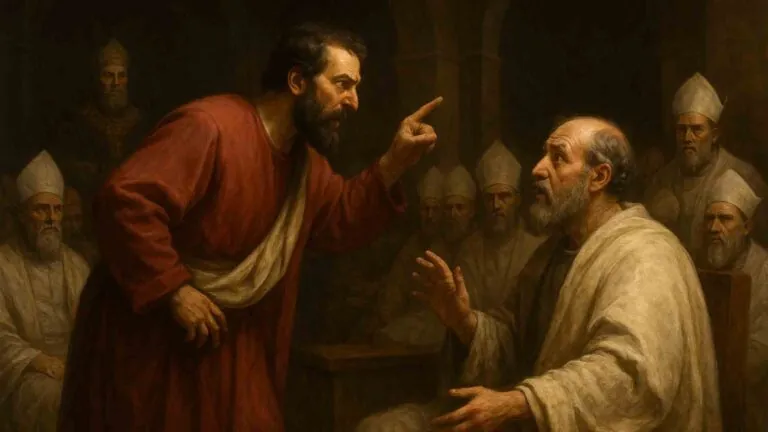
Picture at the top (as generated for ChatGPT) is of Athanasius taking it to Arius. Emperor Constantine I (272-337 AD) called the Council of Nicaea so the Church could deal with the dispute these two were having over the nature of Christ. Athanasius proclaimed Christ as coeternal and of the same essence as God the Father, while Arius claimed Jesus was created by the Father and therefore not fully divine. While the Nicene Creed we have today probably wasn’t completed at the Council of Nicaea (and not for another 50 years) it is named after that council, because it professes the truth defended there.

Enjoyed this article?

Get the best of RP delivered to your inbox every Saturday for free.


Red heart icon with + sign.
Theology

On the benefits and limits of creeds and confessions

Most RP readers belong to creedal churches. We hold to creeds and confessions because they have helped the Church preserve the truth of God’s Word though the generations. So what are these confessions? In his article “The Necessity of Creeds and Confessions," Garry Vanderveen defined confessions as a: “common/shared interpretation of Scripture, which is the highest and only infallible rule for faith and life.” Orthodox Reformed churches generally still adhere to the ecumenical creeds (Nicene, Athanasian, and Apostles’) and some set of Reformed creeds (e.g., Westminster Standards, Three Forms of Unity, Augsburg Confession, etc.). In this article I want to explore both the benefit of creeds, and their limits. Symbols that came with risks In the early church, to hold to a creed or confession was often done at risk of one’s social and/or physical safety. In his A History of Christianity (Vol. 1), Historian Kenneth Scott Latourette explained that creeds and confessions are known as “symbols” because the term symbol here, “comes from a word which in one of its usages meant a watchword, or a password in a military camp. As applied to a creed, it was a sign or test of membership in the Church. Assent to the creed or symbol was required to those who were being baptized” People made this confession with a conviction to join the Lord’s army, as it were. They were convinced that Jesus Christ was the true Son of God, that He made full payment for their sins, and that they were assured of the resurrection of the dead. Each believer was prepared to “deny himself and take up his cross daily and follow ” (Luke 9: 23). Philip Schaff, in his Creeds of Christendom (Vol. 1), explains that the earliest creeds were often committed to memory and not written down. “From fear of profanation and misconstruction by unbelievers… the celebration of the sacraments and the baptismal creed, as a part of the baptismal act, were kept secret among the communicant members until the Church triumphed in the Roman Empire.” The earliest creeds are found in Scripture itself. When Christ asks the disciples, “But who do you say that I am?” Peter confesses, “You are the Christ, the Son of the living God” (Matt 16:15-16). The importance of making a confession was quickly tied to one’s baptism and membership in the early church, and it included a confession of the Triune God before being baptized into the Name of the Father, Son and Holy Spirit. The authority of creeds The creeds have an ecclesiastical authority but not in the same way that the Roman Catholic Church, and others, would suggest. The Roman Catholic Church believes that the creeds, traditions, and the papacy share a co-ordinate (equal) authority with Scripture, and that, then, is a denial of Scripture alone. Of course, with the Roman Catholic view of continuing authoritative revelation, we can anticipate, and we learn from experience, that the result is an ever-changing view of what God’s Word teaches. Councils, encyclicals, and formal Church documents become as authoritative as Scripture, and because these come later, they can be seen as progressive revelation. Protestant churches need to be careful that we do not fall into the same trap; we need to be very cautious that we do not elevate the ecumenical or Reformed creeds to such a status that we start arguing that any topic they don’t address must therefore be left to the freedom of the individual believer. Many of the creeds were written to articulate what Scripture teaches in response to a perversion of the Scriptures, a heresy. They were written in a historical context, addressing particular matters that were pertinent. They could not have foreseen issues such as abortion, euthanasia, gender confusion, etc. as topics that would need to be addressed. To grant freedom on these issues simply because the creeds don’t speak to them would be to ignore what Scripture does say. Then we would be elevating the confessions to the same level, or even higher than Scripture. And if we do that, then we risk causing the pendulum to swing the other way, leading to an abandoning of creeds and confessions and a turn towards rationalism and unfaithfulness. At the same time, the confessions do have an ecclesiastical authority as they regulate the public teaching of the church. They also allow members to express their commitment to the truth of the Scriptures as articulated by the church. The Apostles’ Creed appears to be the first formally crafted creed, and seems to have developed in response to Gnosticism, Marcionism, and Monasticism. The Nicene Creed, more prevalent in the East, seems to be an expansion of the Apostles’ Creed, with a somewhat stronger emphasis on the Trinity, and in particular, the nature of Christ. So, also, Reformed creeds were written to elucidate the biblical teachings on salvation by grace alone, the sovereignty of God, the sufficiency and completeness of Scripture, etc. They were written to echo the truth of Scriptures on core doctrines of the faith after those doctrines were perverted or misunderstood by the Roman Church and others. Just as early church members used the Apostles’ Creed to make their public profession of faith in order to receive access to the sacraments, so also today, we do something similar. It is quite reasonable to think that members of Reformed churches would express their agreement with Reformed confessions as a way to experience access to the sacraments for themselves and their children within Reformed churches. Are the truths expressed in the later creeds less true, or less important? Are they not expressing crucial truths? Or perhaps we have come to a point in the 21st Century that such truths are of secondary importance – to our detriment, I fear. To be clear, the Scriptures have a self-authenticating authority while the confessions have a provisional authority – they are authoritative in so far as they agree with or accurately summarize the Scriptures. This bears repeating. As Schaff puts it: “The Bible is of God: the confession is man’s answer to God’s Word”  No creed but Christ? I recall numerous discussions I had as a young adult with my peers, about the role of the confessions. Many wanted to adopt a “no creed but Christ” attitude. For them, this means that we do not need to express anything other than Christ – only Christ. This sounds pious and echoes the sounds of “Christ alone.” But what does only Christ, or “…but Christ” really mean? Does Scripture allow us to accept the Marcionites and Gnostics in the church of Christ? Or better yet, does Christ accept them as members of His bride? Today’s Mormons and Jehovah’s Witnesses also speak piously of Christ. In fact, the Mormons sing so many evangelical hymns about Christ, it is a wonder that they will not rightly comprehend what they sing. But the truth is, the Apostles’ Creed is – but Christ; the Nicene Creed is – but Christ; the Heidelberg Catechism is – but Christ. What I mean, of course, is that these creeds seek to be nothing more than an articulation of but Christ – they are only what Christ’s Word teaches us. All of the Bible, from Genesis to Revelation, is equally the Word of God. As long as creeds and confessions echo the truth of God’s Word, they remain but Christ. Grey Areas To be fair, the aforementioned points raise some real challenges. In particular, how do we view or interact with those who cannot articulate agreement with Reformed confessions, but bear fruit as confessing Christians? They could agree with the Apostles’ Creed or all the ecumenical creeds, but not the Reformed ones. Can they not also be members of local Reformed congregations? Do they have to answer “I do” to this question: Do you believe the Word of God, summarized in the confessions, and taught here in this Christian church, to be the true and complete doctrine of salvation? These are questions I’ll explore in future articles as I seek to read through the forms for making a public profession of faith in use among faithful Reformed churches. As a start, however, there are things that churches cannot know, or things that we cannot decide – this is God’s hidden will. God decides who is and will be a member of the New Jerusalem, and every individual there will be there only because of Christ’s redeeming work. What the church can and must do, however, is ensure that the thrice holy God is honoured and His Word obeyed, and preached. If the Church no longer believes that the confessions articulate fundamental truths of God’s Word, necessary for salvation – if they are more than but Christ –  then one wonders why they should maintain any kind of ecclesiastical authority. Is there no room for grace, further education, disagreement? On a practical level, I find this very difficult. I believe, for example, fundamentally, that children should be baptized as members of Christ’s covenant congregation. I also believe that I have true brothers and sisters who would agree that children of believers belong to God, but who would disagree that baptism is a sign and seal of that reality, and so refuse to baptize their children. Is there a way to express and experience this unity despite the significant difference? Can I be honest and say, “I don’t know”? Perhaps we need to begin by identifying a difference between a personal conviction and a church’s position. That is, while I enjoy fellowship and relationship with such brothers and sisters, the fullness of our unity cannot be expressed until there is repentance and/or until Christ returns, in whom all of our sins are completely forgiven. If we were to put the problem the other way, a Reformed Baptist congregation would not agree to baptize my children if that church believed, fundamentally, that doing so would be sin or at least meaningless. Would I be permitted to be a full-fledged member if I refused to be rebaptized? Probably not. Creeds and confessions express a church’s understanding of the truth of God’s Word. They are not meant to serve as a catalogue of ideas from which we can pick and choose. The church adopts these statements of faith because they delineate our expression of the faith from those who express this faith differently. So, while we are on earth, we must strive to maintain the truth, and unity in that truth. Where there is not unity in understanding of the truth, there might need to be a limit to the experience of the spiritual unity we trust often exists. God is gracious, and while it is not good that brothers and sisters are separated because of sin, it is the way things are. Perhaps, even before Christ returns, we’ll all agree on why we baptize (or not) children of believers, but not likely. So, we wait patiently and pray fervently for Christ’s return when we will all experience the fullness of joy in belonging to Christ and to each other, in perfection. Until then… let us be careful that we do not compromise on the truth of God’s Word...