















Still true in some places…
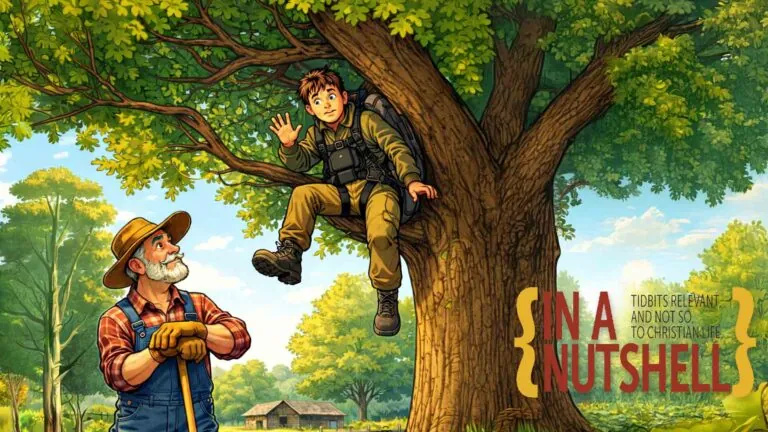
Johan had left Edmonton to go up northward, near Neerlandia, for a bit of skydiving. Late Sunday evening he was found in a tree by a farmer.
“What happened?” asked the farmer.
“My parachute didn’t open!” Johan replied.
“Of course not,” said the farmer. “Around here most nothing opens on Sunday.”
Even if your wife is a ninja….
In his book, This Momentary Marriage, John Piper takes on the task of teaching men what it means to be men. Building on Ephesians 5:21-33 he points out a number of roles males should take on including one he wishes was “too obvious to need illustration,” that of protector. He notes that this role is not given on the basis of ability, but gender alone – this is what real men do:
“If there is a sound downstairs during the night and it might be a burglar, you don’t say to her, ‘This is an egalitarian marriage, so it’s your turn to go check it out. I went last time.’ And I mean that – even if your wife has a black belt in karate. After you’ve tried to deter him, she may finish off the burglar with one good kick to the solar plexus. But you’d better be unconscious on the floor, or you’re no man. That’s written on your soul, brother, by God Almighty. Big or little, strong or weak, night or day, you go up against the enemy first. Woe to the husbands – and woe to the nation – that send their women to fight their battles.”
Great podcast for the kids
If you’re looking for a podcast to play for your kids on a long drive or family trip, you may want to check out Angela O’Dell’s explicitly Christian “Real Cool History for Kids.” These 15-minute-or-so episodes are aimed at kids 6-12, and with more than 150 to choose from mom and dad can pick a topic that will interest them too – O’Dell covers everyone from Queen Elizabeth to Karl Marx and Charlie Kirk to Bonnie and Clyde. Our family has been listening off and on for years now, and have really enjoyed tackling two or three at a time. She is very clear about bringing a biblical worldview to the show (and in her dinosaur episode, she even comes out as a 6-day creationist!) – I don’t know that we’ve ever heard a take we didn’t agree with. Check out “Real Cool History for Kids” at AngelaODell.com or wherever you listen to podcasts.
Chesterton and Charlie on Original Sin
Chesterton spoke of how some religious sorts were disputing whether Man was even in need of washing – was he actually sinful? How ridiculous, Chesterton argued, for men incapable of even imagining sinlessness in their dreams, to “deny human sin, which they can see in the street.” “Certain new theologians dispute original sin, which is the only part of Christian theology which can really be proved.” Charles Spurgeon made the same point this way:
“Any man who declares children to be born perfect was never a father. Your child without evil? You without eyes, you mean!”
Pious sounding evasion
When evangelist Ray Comfort first heard the St. Francis of Assisi quote, “Preach the Gospel; where necessary, use words” it, rather ironically, left him “upset beyond words.”
This quote is used to encourage a type of “lifestyle evangelism” that involves “less talk, and more walk.” Instead of preaching the Word to their unbelieving friends and neighbors, Christians are supposed to just let their light shine by living good lives. There is something to this idea – God tells us we can impact the unbelieving with the way we live our lives (1 Pet. 3:1-2). But that doesn’t negate the need to use the Word (Rom. 10:14).
Comfort exposed the empty piety of the St. Francis quote with a story. In a refugee camp thousands of children were on the brink of starving to death even though there was food enough to give them. Why weren’t they being given the food? Because one of the aid workers had held up a sign that said: “Feed the starving children. Where necessary, use food.” Such an approach would be insane, but, Comfort insists, no more so than thinking we can preach the Gospel without using words.
Earth thrown in
“If you read history you will find that the Christians who did most for the present world were those who thought most of the next. The apostles themselves, who set out on foot to convert the Roman Empire, the great men who built up the Middle Ages, the English evangelicals who abolished the slave trade, all left their mark on earth, precisely because their minds were occupied with Heaven. It is since Christians have largely ceased to think of the other world that they have become so ineffective in this one. Aim at Heaven and you will get earth ‘thrown in.’ Aim at earth and you will get neither.” – C.S. Lewis
Are creationists pitting Scripture vs. science?
We who hold to a recent (in the last 6,000 years or so), six-day creation are sometimes accused of pitting Scripture versus science. After all, doesn’t mainstream science tell us the universe is billions of years old? Now, if that’s what we’re calling “science” then it is true, us six-day sorts do know we’ve got a problem.
But when mainstream scientists hold as their a priori assumption that only naturalistic explanations are valid, they’re the ones picking a fight. After all, Romans 1 and Ps. 19 affirm (as do our own eyes) that all of creation testifies to its supernatural origins.
And that’s not the only Scripture vs. secular science conflict.
- Genesis 1:27 declares “male and female He created them” but the medical and psychological experts won’t stand for such binary bigotry.
- The Bible says children are a blessing but we’ve got experts lamenting each new addition’s carbon footprint.
- While God presents life-long monogamy as best, mainstream science says it simply isn’t natural…though homosexuality is.
Yes, this is science – of a sort – pitted against Scripture, but the conflict isn’t of our doing. If we are troublemakers it is only because, standing as we are on the firm foundation of God’s Word, we refuse to be moved. As Douglas Wilson put it: “The Bible teaches that Adam produced death. The opposing view has to say that in some manner death produced Adam.” Those are the two sides, and there is no reconciling them. We who follow a God/man who died and rose, can’t avoid a fight with any and all who say dead men don’t rise and the supernatural isn’t. That’s the fight to be had. So let’s rise to it!
Reagan’s principal, on parenting
Ronald Reagan remembered his high school principal fondly, recounting how he had his priorities in place. And as principal he was standing in loco parentis and so there is a reminder here how parents should prioritize:
“I was in the principal’s office once in Dixon High School, and I wasn’t there just to pass the time of day. Well, at one point he said to me, ‘You know, I don’t care what you think of me now. I’m only interested in what you think of me fifteen years from now.’”
Can you put that in writing?
In a recent issue of Focus on the Family’s magazine, parent Renae Green shared how she was teaching her 11-year-old to stop tattling. “I told my children that I would only accept and review written complaints.” Implementing this new policy has her daughter thinking twice – is her brother’s behavior annoying enough to warrant working through the paperwork? And, most of the time, her answer is, no.
Too proud to seem weak
Walter Dean Myers is a children’s author I haven’t read, but his own story sticks with me. Money was tight, and his mother was an alcoholic – when he was 14 she stole the money he’d been saving up to buy a typewriter. His janitor dad, not rich by any means, stepped in and bought the typewriter for Walter instead. But that was the last time his dad showed any interest in his son’s writing. Walter went on to write over 100 books, and, as he told his own son in an NPR interview, Walter’s dad “never said anything good about my writing…. And that really, that really hurt, that really bothered me.”
Walter tried to get his dad’s attention by turning some of his dad’s own stories into published work. “I would show them to him, and he would never comment on them. So, when I did that, then I said, he hates me. You know, he hates me.” When his dad was dying, Walter brought him the book he’d just published, “And he picked it up and he looked at it, and then he just laid it down.” It was only after his dad died, and Walter looked through his papers, and saw they were all signed with an X, that he realized his dad didn’t know how to read. And that’s why he’d never said anything about his writing.
So here was a son too hurt to ask why his dad wouldn’t read his work, but, hitting closer to home, a dad, too proud to let his son see his shortcoming.
Parents, we’ve all learned lessons the hard way, and while those might be embarrassing moments, if we want our kids to sidestep some of the troubles we blundered through, we will need to share our weaknesses. There is such a thing as sharing too early, or too much, but, as this sad story shows, we can be tempted to share too little.