















For want of a comma
In her best seller Eats, Shoots and Leaves, author Lynne Truss highlighed the importance of commas with the story of a Panda who enters a bar, asks for a meal, then shoots the bartender and exits. When the Panda is asked why he took this violent turn, he opens up a dictionary, and points to the entry on Pandas where it says that “The Panda eats, shoots and leaves.” A badly placed comma did the bartender in!
Clearly then, commas are important. Just take a look at what mayhem can occur when commas are taken out of these sentences or placed in the wrong spot.
- I love, love, love cooking my husband and my kids.
- You have a voice, like Celine Dion.
- Let’s eat everyone.
- Slow children at play
- Attention: this restroom only for disabled elderly pregnant children.
- My heroes are my parents, Margaret Thatcher and William Wilberforce.
- I like shooting hoops and all of the New Kids on the Block.
Sincerity isn’t enough
“If you sincerely drink poison, it will kill you: if you sincerely cut your throat, you will die. If you sincerely believe a lie, you will suffer the consequences. You must not only be sincere, but you must be right.”
– C.H. Spurgeon
Attributes of God: Patience
We read in Genesis 6 that God was grieved by the great wickedness of Man, and decided to blot out this wickedness, and start again with Noah and his family. What often gets overlooked in the story of the Flood is what it may tell us about God’s patience. I use the word “may” here, because while what follows is not simply conjecture, it also isn’t certain. So don’t forget that very important “may.”
It isn’t much of a leap to think that it would have taken Noah and his sons years to build the Ark. All that time, their actions would be a witness to the wicked that God’s coming judgement was coming.
But God was patient for more than just those few years. In Genesis 6:3 we read that God has appointed for man a limit of 120 years. This has been interpreted by some as a new limit that God was going to give to how long men could live. Previously men has lived hundreds of years, but that would stop now. This seems a plausible interpretation, as no one today lives any longer than 120. But a better way to understand this passage might be as a 120 year countdown to the coming judgement. This fits in well with the context of the surrounding chapter, and if this is the proper understanding, it means that the wicked were given more than a century to turn repent!
But now consider this: Noah’s grandfather was Methuselah, who was born 969 years before the Flood and died the very year of the Flood. When Methuselah was born, almost a millennium before the waters covered the Earth, his father Enoch may have given him a prophetic name (note that “may” again). According to several sources, “Methuselah” can be translated two different ways, as either “Man of the dart or spear” or “his death shall bring judgment.” If the latter is the right way, then it means God gave a warning almost a thousand years beforehand of his anger, and his coming judgement.
While these two interpretations are not at all certain, they do match up well with what we learn about God’s loving patience elsewhere in the Bible, like in 2 Peter 3:8-9:
“…with the Lord one day is like a thousand years, and a thousand years like one day. The Lord is not slow about His promise, as some count slowness, but is patient toward you, not wishing for any to perish but for all to come to repentance.”
On debate
Leonard Read was a free market advocate who had (at least!) a couple very good thoughts about debating:
- Do not argue – first present a better idea.
- No bad idea is ever overcome by attacking those who believe it.
Creationism vs. theistic evolution
“The Bible teaches that Adam produced death. The opposing view has to say that in some manner death produced Adam.” – Douglas Wilson
The case for educational freedom
“I hope…that we may return to the principle of freedom for individual parents in the education of their children in accordance with their conscience… let us be perfectly clear about one thing – if liberty is not maintained with regard to education, there is no use trying to maintain it in any other sphere. If you give the bureaucrats the children, you might just as well give them everything else” – J. Gresham Machen
Why English is a fun language…
A clever farmer taught his sow to sow seeds. Then he got his geese to take a gander at whether the produce produced was ready to gather. The cows were called on to collect the farm’s refuse but refused – berry bushes by the bins brought a bear, which the cowed and cowering cows found unbearable. The farmer thought shooing it by shooting his shotgun was worth a shot. His errant aim missed the beast’s broadside and while his dove dove, and his duck ducked, a hen was hit, with one wing winged. The farmer wound the wound and presented a present to the unfortunate fowl. Then he bribed the bear to bear the burden of taking out the trash.
Poetic to the end
Christian poet and hymn writer Isaac Watts (1674-1748) showed evidence of his talents as a very young age. In Douglas Bond’s biography of the man, The Poetic Wonder of Isaac Watts, Bond gives this example:
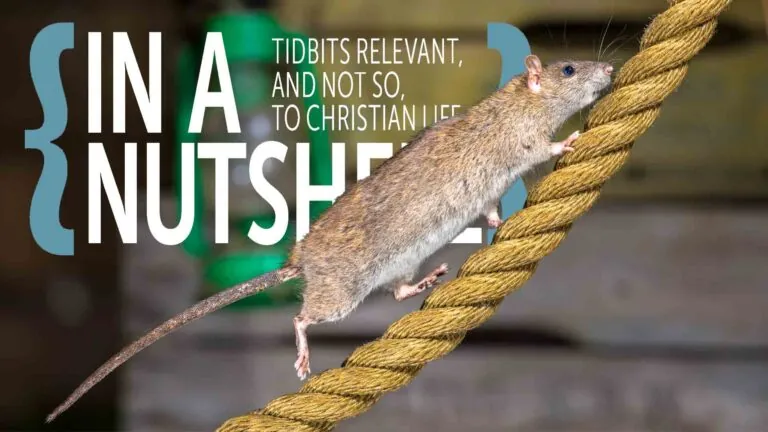
…one evening during family worship at the dinner table [while] his father read Scripture and guided family prayers, Watts spotted a mouse climbing up the bell pull and began to giggle. Rebuked by his father, who asked him why he was laughing during prayer, Watts replied:
There was a mouse for want of stairs
Ran up a rope to say his prayers.
His parents, amazed at the boy’s ability to rhyme in his head without writing the lines down on paper, encouraged his rhyming – for a while. As children will do when encouraged, Watts began rhyming all the time. Annoyed by the incessant rhyming, his father forbade him to do it – and he meant it. Isaac soon forgot and fell back into rhyming. Taking him over his knees, Watts Sr. prepared to lay into his son’s backside with the switch. Then young Watts rather unconvincingly cried:
O father, do some mercy take
And I will no more verses make.
Why there should be a high bar for teachers
“A student is not above his teacher but everyone who is fully trained will be like his teacher.” – Luke 6:40