










Transparent heart icon with white outline and + sign.

Life's busy, read it when you're ready!

Create a free account to save articles for later, keep track of past articles you’ve read, and receive exclusive access to all RP resources.

White magnifying glass.

Search thousands of RP articles

Helping you think, speak, and act in Christ.

Open envelope icon with @ symbol

Get Articles Delivered!

Helping you think, speak, and act in Christ. delivered direct to your Inbox!

A A
By:

The beauty of 52 Sundays

or why we gave two years to bringing the Heidelberg Catechism to video… and more

*****

There is something disarming about the Heidelberg Catechism. It doesn’t begin with abstract definitions, but with comfort. Our only comfort.

Many of us have encountered, or experienced ourselves, a quiet guilt about “not knowing enough theology,” as if faithfulness were measured primarily by intellectual mastery. The Heidelberg resists that posture. Designed to be digested slowly over the course of a year, it teaches with patience. It repeats itself intentionally. It understands that formation takes time.

And it certainly took time to capture that on film.

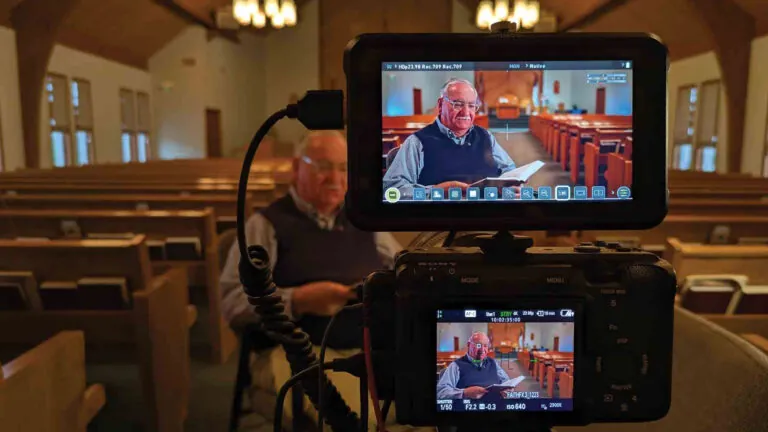
Today, we find ourselves standing at a moment we honestly didn’t know how to imagine back on July 13th, 2023 when our organization, Faith to Film (FaithToFilm.ca) first took on this project. Every Lord’s Day of the Heidelberg Catechism now has a completed video. Fifty-two videos. Twenty-six pastors. Multiple denominations. One catechism. A full, freely available teaching resource on ReformedConfessions.org that did not exist before, but now it does.

Why we started
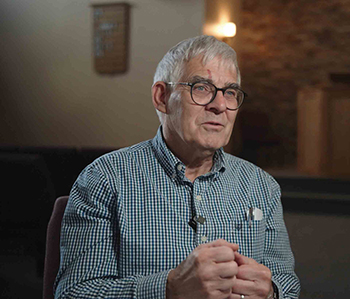
Pastor Hans Overduin took on Lord’s Days 15 and 23.

Too often, Christian content is forced to choose between depth and visual excellence. We didn’t think that tradeoff was necessary.

The Reformed confessions, in particular, seemed like an area crying out for this kind of care. Written centuries ago, they articulate truths that remain deeply relevant today. Truths with direct application for people wrestling with today’s fears, today’s doubts, and today’s hope. The church has never failed to recognize their value. They remain central to catechesis, preaching, and discipleship. And yet, the digital representation of them has not sufficiently reflected the clarity, weight, and beauty of the truth they contain.

We wanted to do something about that.

Our broader vision continues to be a single digital home for the Reformed Confessions where learning is layered. A video for introduction. A quiz for reinforcement. Extended material for deeper study. Illustrations that help concepts land. A place where churches can confidently send their people, knowing they will be met with clarity, pastoral care, and theological integrity.

Not to replace traditional catechesis, but to supplement it and to provide access for those who may not have the same proximity to teachers or resources, whether new converts, families, or believers in other parts of the world.

The Heidelberg Catechism felt like the natural place to begin.

We are deeply grateful to the twenty-six pastors who lent their voices to this work. Though they serve in a range of congregational settings, they spoke here in one voice, bearing witness to the unity the Heidelberg Catechism has long provided to the Reformed church. Their participation reflects a shared commitment to teaching what has been confessed, received, and faithfully passed down through generations.

The long middle
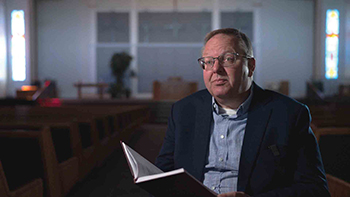
Rev. John van Eyk addressed Lord’s Days 11 and 13.

What we didn’t fully anticipate was just how long this patient approach would take. Don’t be mistaken, we understood the importance of moving slowly. We simply wanted the fruit of patience immediately. After all, two and a half years is long enough for enthusiasm to fade. Long enough for schedules to clash, funding to stretch thin, and momentum to feel fragile.

This is why we are so grateful for everyone who supported this work.

There is also a unique weight to the nature of this work. We regularly found ourselves asking difficult questions: Are we honoring the gravity of these truths? Are we preserving the warmth that Ursinus and Olevianus intended? Are we being careful, not only with words, but with images?

There is a real challenge in visually representing biblical and theological concepts while maintaining a healthy reverence for God’s name and character. Navigating that tension was no small task.

So yes, it is true that this has been a challenge, but it’s hard to stay stressed when the very content you are producing is a balm for your own soul. Sitting there, mouse in hand, editing a video on Lord’s Day 1, and being reminded that you are “not your own, but belong body and soul, to your faithful Savior, Jesus Christ.” Time after time the words of the pastor on screen would cut straight through the producer mindset and hit the believer’s heart.

It really is a profound thing to experience. To realize that the very truths you are trying to broadcast are the same truths holding you together while you do it.

Ready for you to use
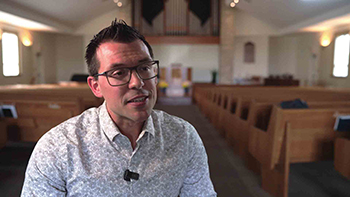
Pastor Mark Wagenaar tackled Lord’s Days 52 and 22.

At this point, the Heidelberg Catechism series is no longer a project we are working on, but a free resource the church can now rely on. Go to ReformedConfessions.org, watch the videos, sit with the illustrations, and work through the questions. It is our prayer that it finds its way into your homes, classrooms, membership instruction, or quiet personal study.

We pray that, in the steady rhythms of teaching and repetition, God would use this work as He has so often used catechesis: to form believers who know what they believe, why they believe it, and how that belief shapes their lives before Him and before one another.

Above all, this moment draws our attention away from ourselves and back to the God who preserves His truth across centuries, cultures, and mediums.

As we look forward to the development of the remaining Three Forms of Unity, we rest in the knowledge that the weight of this work does not fall on us. We are not the reason these words endure. We are witnesses to the fact that they do. “The grass withers, the flower fades, but the word of our God stands forever” (Isaiah 40:8).

Kyle Vasas and David Visser are a part of the team at Faith to Film which, in addition to ReformedConfessions.org, has done video series on Calvinism and Essential Truths, and is in the planning stage for one on office bearer training. Check out all their work, and how you can support it, at FaithtoFilm.ca.

Enjoyed this article?

Get the best of RP delivered to your inbox every Saturday for free.


Red heart icon with + sign.
Church history

The necessity of creeds and confessions

Many years ago, ten Christian men got together and decided to start a church. For several weeks they met together every evening to discuss what they believed to be the essentials of the Christian faith. As they charitably reflected and discussed these matters, they discovered that everyone had a slightly different view on what constituted the essentials. They began to despair as they realized that their deliberations were not yielding any fruit. Out of frustration, Mr. Unity asked a simple yet profound question, “Brethren, on what basis will we come together as a church? What exactly is it that we believe concerning God and the Gospel of Christ Jesus, our Lord?” Mr. Calvin, the leading thinker of the group, pondered the question for some time as he gently tugged at his beard with his eyes closed. Suddenly, Mr. Calvin responded, “Yes. That’s it! We must put in writing what we believe the Scriptures teach concerning God and the Gospel of Christ Jesus, our Lord! What is it that we can all agree upon? What is it that we all believe the Holy Scriptures teach? What is it that we together confess with heart and mouth? Of course, there will be more work to be done. We will need to write a few procedures on how we will deal with conflict, choose leaders, worship, but for now, let us put in writing exactly what, as a church, we believe. Let us put in writing our official position on those issues that will form the basis of our life together as a Christian church.” Mr. Luther, the man who struggled with his salvation – “How can God love a wretched sinner like me?” – immediately responded to Mr. Calvin’s suggestion. “Mr. Calvin,” said he, “Your proposal is great. Is it acceptable to you and to you, my dear friends, if we begin with the existential question, What is your only comfort in life and in death?” Mr. Luther continued, “As you know, I often struggle with comfort and I need to be reminded daily of the greatness of my Savior.” Mr. Calvin and the others agreed, and so the hard work of writing a confession began. Mr. Ursinus was the first to speak. He opened his Bible and turned to Romans 8:35-39 and said, “Brothers, I believe that our greatest comfort is that we belong to Jesus Christ. Therefore, I propose the following answer, My only comfort in life and in death is that I am not my own but belong to my faithful Saviour Jesus Christ.” Everyone agreed. Mr. Olevianus spoke next. He said, “My dear brother, what you say is true, but more can be said.” With his already opened Bible he turned to 1 Peter 1:18-19, which he read aloud and then said, “We need to add the following, ‘He has fully paid for all my sins with his precious blood.’” Before he could finish, Mr. Unity interjected, saying, “I like the sound of it. ‘My only comfort in life and death is that I am not my own but belong to my faithful Saviour Jesus Christ. He has fully paid for all my sins with this precious blood.’ I really like the sound of that. Deep. Rich. Biblical.” Several others in the group nodded their heads approvingly and said, “Yes,” or “Amen.” Then Mr. Trent spoke up. “Hmmm… I like where we are going with this statement, but we need some more precision. We all agree that the devil is in the details and I’m worried that we might be giving the wrong impression. I fear that some of the weaker brethren might conclude that since Jesus has done everything for us, they might not be concerned about living a faithful life. Why don’t we make a slight change, an ever-so-slight change? How about this? ‘My only comfort in life and death is that I am not my own but belong to my faithful Saviour Jesus Christ. He has paid for my sins with this precious blood.’ By eliminating the words ‘fully’ and ‘all’ we can affirm the necessity of works and merit. To have comfort in this life, we must not only trust in Jesus: we also need to have confidence in our works and the work of the saints.” Much discussion ensued, but Mr. Trent was unable to convince anyone of the merits of his position. The group was almost ready to vote on the final wording: What is your only comfort in life and in death? My only comfort in life and in death is that I am not my own but belong to my faithful Saviour Jesus Christ. He has fully paid for all my sins with his precious blood. However, Mr. Arius, the gentle, kind, and soft-spoken grey-haired man, stood up and pleaded with the brethren. He said, “Dear brothers, I am concerned that we are giving too much weight to our interpretation of Scripture and not enough consideration to Scripture itself. The Bible says that Jesus is the son of God. Hence, he is not God himself, but the son of God. Therefore, we must say, with the Apostle Paul that our only comfort is in God, the Father of our Lord Jesus Christ (2 Cor. 1:3). Please, brothers, let us not divide over man’s words. Let us be content with Scripture itself, which clearly teaches us that Jesus is not God and not our greatest comfort.” Though Mr. Arius spoke with sincerity, compassion and pastoral sensitivity, the group could not adopt Mr. Arius’ interpretation of Scripture. Not even Mr. Trent could agree with him. When the time came for the ten brothers to vote, they voted on the following motion: Whereas the following question and answer reflects our interpretation of Holy Scripture, which is our highest and only infallible rule for faith and life: What is your only comfort in life and in death? My only comfort in life and in death is that I am not my own but belong to my faithful Saviour Jesus Christ. He has fully paid for all my sins with his precious blood. Resolved: This question and answer is our official understanding of Scripture. It is our confession of faith; it is our position paper on comfort; it is our doctrine; it is part of the “pattern of sound words” that Paul calls us to follow; All pastors, elders and deacons in our church must sincerely receive and adopt this confession as containing the system of doctrine taught in the Holy Scriptures. The motion passed 8-2, with Mr. Trent and Mr. Arius voting in the negative. Mr. Trent decided to join a church that regarded Scripture and Tradition as co-equal authorities, denying Sola Scriptura and Mr. Arius joined a local cult that denied the deity of Christ. Rev. Garry Vanderveen blogs at Show, Don’t Tell where a version of this first appeared. It is reprinted here with permission. FAQ Do confessions undermine the authority of Scripture? No. Confessions are a common/shared interpretation of Scripture, which is the highest and only infallible rule for faith and life. Can confessions undermine the authority of Scripture and create dead orthodoxy? Yes. The ungodly suppress the truth in all kinds of ways, so it is entirely possible that one masters the Confessions and the Scriptures, yet hates Christ. Can confessions create lazy Christians, Christians who love God but do not study his Word? Yes. I have experienced the following exchange several times. Me: Why must we obey the commands of God? Other: Because God has saved us we must obey his commands as an expression of gratitude. Me: Are there any other reasons? Other: No. This is the reason the Heidelberg Catechism gives. Although the Heidelberg Catechism provides a biblical answer it is not the only biblical answer. The Bible says that since we are united to Christ, we must live his life (Rom 6:10-11; Gal. 2:20). Since Christ obeys the commands of God, we who are united to Christ must obey them because this is who we are. Can one have a saving relationship with Christ and reject confessions? Perhaps. However, as soon as someone summarizes the Bible on any given matter, he is offering a “confession” of sorts. Unless someone recites the whole Bible from Genesis to Revelation in response to a question about the Bible, one is involved in confessional activity. Should the church embrace old confessions? Yes. Absolutely. Without a doubt. The truth of God’s Word is not new, nor is the Spirit’s work of opening our eyes to the truth of his Word a recent occurrence. God’s Word endures throughout all of history – it never changes (Isaiah 40:8); and, the Holy Spirit continues to sanctify his church into that unchanging truth (John 17). Should the church write new confessions? Yes. Every age has its particular challenges and questions, and the church must address them. How should a church write a new confession? Since a confession is an official interpretation of Scripture by the church, confessional writing should involve many churches. What happens when a church doesn’t subscribe to a written confession? In such cases, the church usually succumbs to the tyranny of the loudest, most powerful, and persuasive member(s). When there is no objective confession that the church embraces, someone will rise to the top and impose his or her confession upon everyone else....