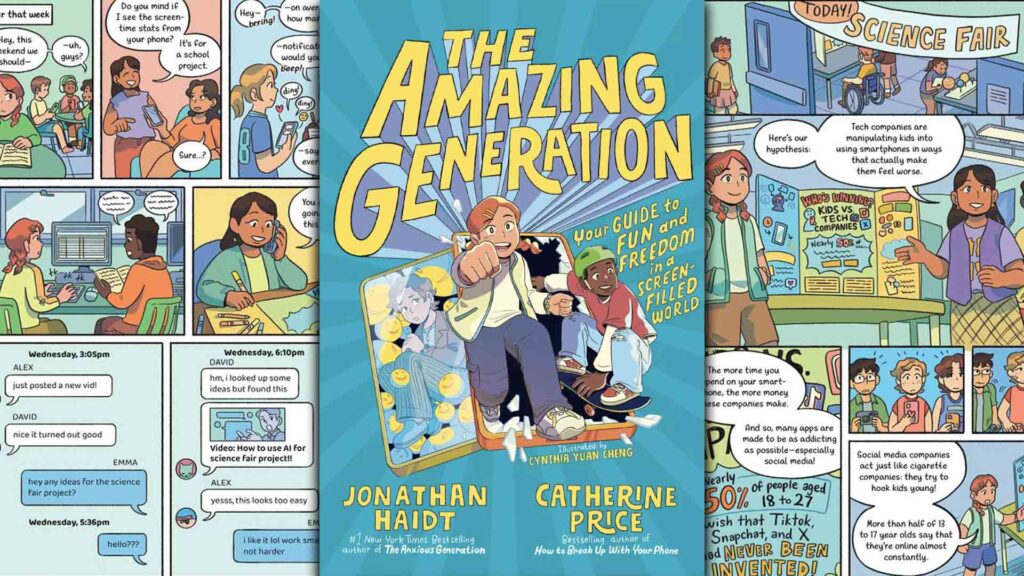
by Jonathan Haidt and Catherine Price
2025 / 236 pages
Rating: Good/Great/GIFT
The old blue rocking chair is the most comfortable chair in our house, and my husband and I have built a useful strategy around it. If we casually leave a book on the table beside it – the kind of thing our kids should read, but may not pick up on their own – our kids will eventually flip through it and very possibly read it.
That’s how we enticed our two middle-schoolers to check out The Amazing Generation, co-written by Jonathan Haidt (of The Anxious Generation fame) and Catherine Price (author of How to Break Up with Your Phone). This is a positive and helpful book that encourages young people to choose the richness of real life over a shallow, screen-focused existence.
Our kids were skeptical about the book at first, and I couldn’t really blame them. The messaging is a little over-the-top – to quote the book, “Don’t let the evil tech wizards hack your brain! Be a rebel instead!” – and is likely to earn some eye-rolling from the target tween/teen audience. Fortunately, much of the content and presentation is compelling enough to keep pulling readers back in. More importantly, it’s hard to argue with the authors’ very convincing arguments that, for example, most apps are “addictive by design,” and many tech companies are very aware that their products are hurting kids.
The book is cleverly designed as half informative guide, half graphic novel, with the graphic novel following six kids through a year of their lives. Predictably, the three “low-tech” kids have all kinds of interesting experiences and adventures, developing skills and having fun with their friends, while the three tech-dependent kids’ lives are clearly less rich and fulfilling. That said, the kids’ behaviors ring true – for example, fixating on recording and posting an experience rather than actually living it meaningfully – and will likely hit uncomfortably close to home for many readers, young and not so young.
The informative part of the book is designed to grab and hold middle-schoolers’ attention, with fairly short sections of text interspersed with features like “Meet a rebel” (profiles of real young adults who have, in some way, rejected tech), stats and facts, quotes (often quite outrageous or ominous) from prominent tech-company executives, and real-life musings from teens and twenty-somethings about their experiences. Some of the latter are quite impactful – e.g., “I missed out on my entire teenagehood because of social media and my phone” – while others are helpful and encouraging: “I would tell my younger self to get off social media and go make some memories.”
The information in the book is also solid (as one would expect from the two authors), and would be interesting for almost any age. For example, the book describes the addictive “dopamine triggers” (like bright colors, unpredictability, and rewards) that are built into many apps, which are easily recognizable, and which in fact mirror the design of slot machines. This type of information can help kids identify when and how they’re being manipulated, and hopefully help them become less susceptible to that manipulation.
The overall message of the book isn’t to abandon technology entirely, but rather to “Use technology as a tool – don’t let technology use you,” and “Fill your life with real friendship, freedom, and fun.” (These are the two tenets of “The Rebels’ Code.”) The balance suggested feels reasonable; for example, kids are encouraged to limit and wait to use certain technologies, not to become full Luddite “rebels.” The book also suggests lots of realistic alternatives, and strategies for going low-tech even when kids feel like they’re the only one (including asking their parents if they can blame them for limits and restrictions, to save face in front of their peers).
My only quibble is that the book ultimately encourages fairly self-centered motives for choosing a life of real, non-screen experiences, like learning new skills, having fun, and developing good relationships. Late in the book it mentions that you can also feel good by “doing things that matter” – “things that help other people… or make the world better,” but the point feels like an afterthought.
Overall, though, this would be a great conversation starter, and is a book that has enough substance to be worth a read for both the older and the younger members of the family… even if you have to use the “comfortable chair” trick to get them to open it in the first place.