Transparent heart icon with white outline and + sign.

Life's busy, read it when you're ready!

Create a free account to save articles for later, keep track of past articles you’ve read, and receive exclusive access to all RP resources.

White magnifying glass.

Search thousands of RP articles

Helping you think, speak, and act in Christ.

Open envelope icon with @ symbol

Get Articles Delivered!

Helping you think, speak, and act in Christ. delivered direct to your Inbox!


Most Recent


The Rest


Red heart icon with + sign.
News

Saturday Selections - March 28, 2020

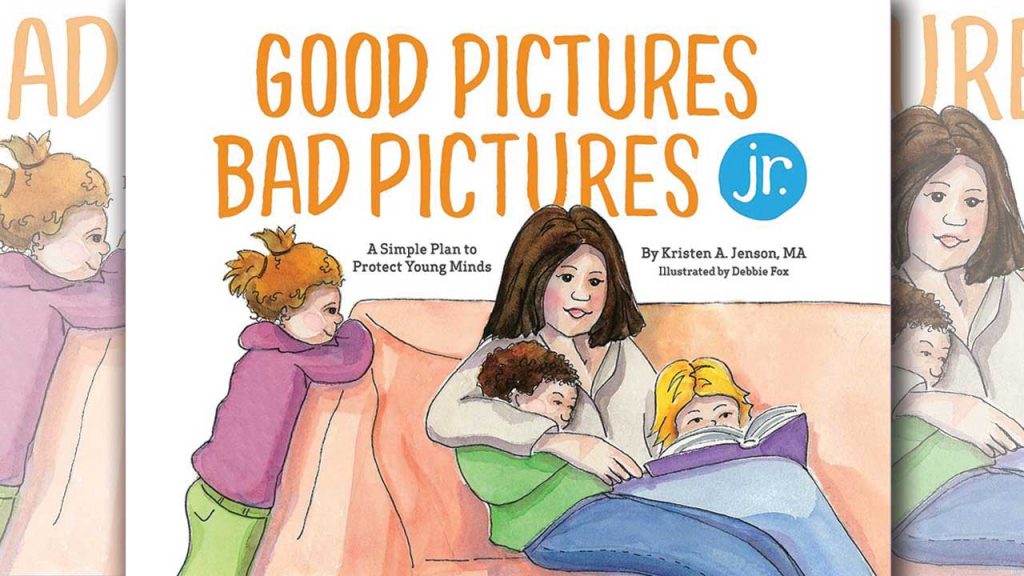
John MacArthur on the coronavirus crisis (17 minutes) While the coronavirus quarantine led to the canceling of the Ligonier conference, it freed up some time for one of the featured speakers to address how Christians can respond to this crisis and use it as an opportunity to witness to how the Gospel is good news to us, as well as to any who respond to Christ in faith. Tips for talking to your kids about sex I once heard a pastor share what he called "The Law of First Explanations" – that one reason parents have to be the first to talk about sex with their kids (and be the first to talk with them about any other important topics) is because our kids will sift all subsequent information they get on that topic through the filter of the first explanation they get. Parents will often notice the impact of this law when they come in second (or third, or fourth...) because now, whatever we have to say, is going to be tested against the filter of "But my teacher said..." or "But my friends all think..." But it works in our favor too, when we act early. Or, as the article author puts it, "Better a year too early than five minutes too late.” In addition to the article above, a helpful book series – one you can read along with your daughter or son, with different books for different ages – is the "Learning about sex for the Christian family" series put about by Concordia Publishing House. Getting creative... When government restrictions made it impossible to gather inside our church buildings, one congregation came up with a creative way of still meeting together at their usual time. This past Sunday, the Christ Community Church in Blaine, WA met outside, singing and listening to the sermon from inside their cars, assembled in their parking lot. Teaching our kids how to manage their devices Tim Challies titled this article "When Parents Feel Like We Are Mostly Failing Most of the Time" because, when it comes to helping out kids figure out how to use their phones, tablets, and computers to best effect, we know we aren't doing it right. There's plenty of reasons for it, not the least of which is as trailblazers in this area (this is not something our parents could teach us how to teach our kids) we are bound to get it wrong. But that also means there is plenty of ways to improve. So, for the love of our kids, let's be the parents and take that leadership role. And Challies has some wonderful help to offer. How the coronavirus has revealed what's core to Roman Catholicism An Italian pastor explains how the Catholic Church's response to the coronavirus is revealing what's core (and consequently what's deficient) in their doctrine. In related news, the Pope has said that, due to the crisis, Catholics can confess their sins directly to God...at least until they can reach a priest once again. Choice42 with another tool for the pro-life toolbox (1 minute) There is a truth about the unborn that needs to be shared – that they are every bit as valuable as you and I because, just like you and I, they are made in the very Image of God (Gen 1:26-27, 9:6). And there are also lies that need to be knocked down – many, many lies. And as she shows here once again, Laura Klassen, and her crew down at Choice42, are among the very best at knocking down those lies. ...

Red heart icon with + sign.
In a Nutshell

Tidbits – March 2020

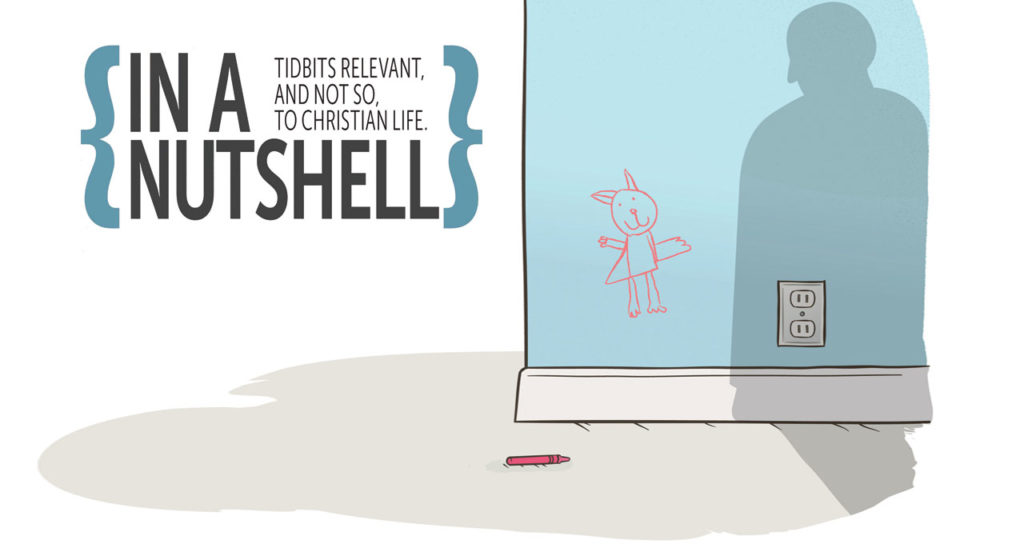
It’s so easy to get things wrong While doing evangelism, Christian apologist Ray Comfort will often ask his conversational partner a series of quick trick questions. The goal is to provoke a little humility by highlighting how easy it is to get things wrong. So take this quiz (or better, yet, give it to a friend...who can take a joke) and then look at the bottom of this page to see how well you really did. How many of the unclean animal did Moses take onto the Ark? What is the name of that raised print that deaf people use? Spell the word shop. What do you do when you come to a green light? It's noon. You look at the clock, and the big hand is on the three, and the little hand is on the five. What time is it? You are the driver of a train. There are 30 people on board. At the first stop, 10 people get off the train. At the next stop, 5 people get on the train. Here is the question: What is the name of the driver of the train? Spell the word silk. What do cows drink? And here’s one Comfort doesn’t use, but should: What mouse walks on two legs?   I don’t know. Mickey Mouse! What dog walks on two legs?   Goofy? Right! And what duck walks on two legs?   Donald Duck! All ducks walk on two legs! Troublemaking Bruce Jenner, who now goes by the name of Caitlyn, was an Olympic decathlete in the 1970s, and his personal best in the 400-meter is still better than any woman has ever run. If feelings can determine a person’s gender, then why doesn’t Caitlyn own the women’s 400-meter world record? Lies and statistics, and spanking... Every now and again the mainstream media will splash news of the very latest spanking study, which will report that spanking is "linked to aggression, antisocial behavior, mental health problems, cognitive difficulties, low self-esteem, and a host of other negative outcomes." That study will then be used as evidence that spanking needs to be banned. But if we look beyond the headline we'll find that whatever the latest study might be, it makes two fundamental errors. First, it will label as "spanking" anything physical that a parent did as a punishment for their child. That a child who is regularly beaten by his drunken father will have problems at school, is presented as evidence that a child who sometimes gets three smacks to his behind will also have trouble at school. Second, despite knowing that correlation does not imply causation, the press will report as if this is the exception to the rule, instead of looking for any sort of possible alternate explanation for the findings. What might an alternative explanation be? If I were a betting man I would put all my fortune down on this: were we to do a study of children who crayola the hallway wall, and then go outside to make mud pies so they can feed them to their napping, open-mouthed big sister, we would find that they are more likely than their peers to get spanked. In other words, it might well be that spankings don't lead to these "negative outcomes" but rather that a child's disposition to negative outcomes requires a parent to spank them more often. As any parent with two or more children can tell you, one of their kids will require more discipline than the others. And it isn't the especially good one. Get ready to be reviled "Pastors need to teach their people about how to handle with grace being looked down on more then ever before. I heard of John Stott reflecting that as a young man at Cambridge when people said ‘O he's a Christian,’ what they meant was that he was a goody-two-shoes. But now to be called a Christian means that you are viewed as a morally-deficient person, because you have not swallowed the gay agenda.” – Dr. John E Benton, Evangelicals Now, July 2012, on how the world will change as gay marriage becomes the norm. More troublemaking Our culture is insane, as is on clear display with what they think about sexual education. To put that insanity on better display here’s an idea from frequent RP contributor Rob Slane that lays out a couple of pointed questions a brave troublemaking Christian could ask university professors or sex-ed teachers. "I imagine a teenager in a sex education lesson asking the following question: 'Miss. Assuming I take precautions, would it would be safer for me to have 3 partners or 300?' No brainer of course, and even the most progressive of teachers would have to admit that 3 is 'safer' than 300. Simple mathematical probabilities this one: the lower the number, the 'safer the sex.' "In which case a really mischievous teenager – a true rebel you might say – might ask the following question: 'Miss, is it safer to only have 1 partner for life, or multiple? And if it’s 1 – which it is – and if this is a safe-sex lesson – which it is – why do you not advocate it?'” Faint heart never won fair lady “Many a man has known a great woman, yet did not win her because, out of fear, he failed to pursue her.  Every man understands this, both the brave man who has risked it all (and won or lost) and the timid man who did not dare.  The battle to take the great action required at these ‘make it or break it’ moments is won or lost privately, deep in the heart.” – Patrick F. Fagan Answers for "It’s so easy to get things wrong" Moses didn't take any animals on the ark; Noah did. Deaf people don't need special raised print; Braille is for the blind. You certainly don't stop. We told you, it's noon. Remember, you are the driver of the train. While calves might drink milk, cows drink water. ...

Red heart icon with + sign.
Sexuality

Propaganda disguised as Sex Education

In 2009 Dr. Miriam Grossman (a medical doctor) released a book that explains the problems and agenda of the modern sex education movement: You're Teaching My Child What? A Physician Exposes the Lies of Sex Ed and How They Harm Your Child. Though it is an American book, it provides a lot of material that is helpful for people in other English-speaking countries. Grossman explains the underlying motivation behind many school sex education programs, and explains how this motivation leads to the deliberate distortion of sexuality information given to students. The organizations and their agenda First of all, it’s very important to know about the main organizations involved in promoting sex education. Many of us have heard of Planned Parenthood, the US’s biggest abortion provider. Another key organization is the Sexuality Information and Education Council of the United States (SIECUS). Both Planned Parenthood and SIECUS are motivated by anti-Christian ideals. Grossman writes, These organizations are still animated by the philosophies of the infamous sexologist Alfred Kinsey – whose work has been debunked – the birth control and eugenics advocate Margaret Sanger, the feminist Gloria Steinem, and Playboy founder Hugh Hefner. These twentieth-century crusaders were passionate about social change, not health. Their goal was cultural revolution, not the eradication of disease. Because of the cultural aspirations motivating these organizations, the materials that are produced for sex education classes are not just about the nuts-and-bolts of human biology. They are deliberately designed to encourage behaviors that are condemned by traditional Western morality. As Grossman puts it, Sex education is about as neutral as a catechism class. And like a catechism, the “information” and “guidance” offered is designed to inculcate particular beliefs in young people. In short, “Sex education is not about health – it’s a social movement, a vehicle for changing the world.” Alfred Kinsey Dr. Alfred Kinsey, the infamous sexologist mentioned by Grossman, was a prominent American researcher of the 1940s and 1950s. He produced groundbreaking studies on the sexual behavior of men and women in the United States. These studies claimed to demonstrate that the vast majority of people engaged in some form of perverse sexuality, such as fornication, adultery, homosexuality and more. On the basis of his studies, and the supposed normalcy of these behaviors, massive cultural and legislative changes were undertaken in Western countries. These changes were justified by Kinsey’s science. But there was a big problem. Kinsey’s so-called “science” wasn’t science at all. His research was deliberately skewed to generate results that would justify his left-wing social beliefs. Kinsey wanted to overthrow traditional morality, so he conducted his “research” in such a fashion as to produce results he could use to undermine conventional views about sexuality. Kinsey’s fraud didn’t get properly exposed until the 1980s when Dr. Judith Reisman (currently at Liberty University School of Law) carefully scrutinized what Kinsey had done and published her results. Unfortunately, outside of conservative circles, Dr. Reisman’s research has not been widely disseminated. She deserves a Medal of Honor or something like it. Anyway, it’s important to realize, as Grossman points out, “In the upside down world of sex education, the ideology of Alfred Kinsey has been enshrined.” SIECUS The Sexuality Information and Education Council of the United States (SIECUS) was founded in 1964 by Mary Calderone, who had been a director of Planned Parenthood. Grossman writes that the focus of Calderone’s newly launched organization, which was, by the way, founded with seed money from Hugh Hefner of Playboy fame, was not to treat or prevent disease. Like Kinsey, she was crusading for social reform. Her book for parents reads like a primer for his views, and quite a few Kinsey disciples had eminent positions with SIECUS Hefner subsequently provided additional funding as well. That is to say, SIECUS received financial support from the sale of pornography. In short, much of the impetus for modern sex education in public schools is provided by organizations with a clear left-wing ideological agenda. Dr. Grossman’s experience For twelve years Grossman was a student counselor at UCLA (University of California, Los Angeles). She dealt with hundreds of students in their late teens and early twenties who had contracted a sexually transmitted disease (STD). She found that they had received sex education at school, but had not been warned about the harmful consequences that were likely to result from sexual activity. Grossman is not opposed to sex education as such. She is opposed to ideologically-driven sex education that deliberately withholds information from students in order to advance a political and cultural agenda. Pheromones and oxytocin Grossman is particularly sympathetic towards the numerous young ladies she counseled who have been harmed by premarital sexual activity. Recent medical research has helped to establish that women are especially influenced by male pheromones (a pheromone is a chemical produced by one person that can be perceived by other people) and the hormone oxytocin. Male pheromones “have psychological effects on women, like increased attention and a feeling of well-being.” Oxytocin, known as “the cuddle hormone,” is released in women who have physical contact with a man. Among other things, oxytocin promotes social bonding, leading (potentially, at least) to a certain degree of attachment to the man. The gist of all this is that young women who engage in premarital sex are likely to develop emotional attachments to their partners that can potentially cause intense emotional pain. Grossman believes this information should be shared during sex education so that girls can be forewarned about the likely emotional stress they will face from sexual activity. At this point, however, “These biological truths are omitted by the sex-ed industry because they fly in the face of the ideology animating their very existence.” Another important scientific finding involves the development of the cervix. Before a girl turns twenty, a region of her cervix called the “transformation zone” has a covering of cells that is only one layer thick. As she ages, the covering becomes 30 to 40 cell layers thick. But until then, there is little protection from viruses or bacteria. In other words, teenage girls are especially vulnerable to STDs, much more so than boys. Grossman writes, Based on this finding alone – something gynecologists and pediatricians have known for at least twenty years, girls should be advised to delay sexual behavior. Yes, delay sexual behavior. Anal sex Another area where sex educators fail to properly inform children has to do with the dangers of anal sex. These educators seem to encourage students to engage in any form of sexual behavior they desire (as long as the partner is willing), and anal sex is considered to be one of the legitimate behaviors to explore. Grossman points out that there is an inevitable “ick factor” in any discussion of anal sex. Anal sex inevitably and unavoidably involves contact with feces. However, she quotes a prominent sex education website as claiming that “negative attitudes about anal sex” sometimes result from a “disgust about feces” but “more of it is often based in homophobia and heteronormativity.” In this view, since anal sex is a common behavior of homosexuals, people who think it is gross are likely to be homophobes. Since homosexuality is good, anal sex must be good too! From a Christian perspective, this is obviously complete rubbish. Because of the strong support for homosexuality among sex educators, there is unwillingness among them to tell the truth about anal sex. Grossman has no such reservations and points out that “feces are filled with dangerous pathogens: salmonella, shigella, amoeba, hepatitis A, B, and C, giardia, campylobacter, and others. These organisms and others can be transmitted during anal sex or oral-anal contact.” From a health perspective, anal sex is dangerous (not to mention gross and disgusting). Grossman makes an appropriate biological conclusion: “Unlike the vagina, nature put a tight sphincter at the entrance of the anus. It’s there for a reason: Keep out!” Sexually Transmitted Diseases Another aspect that is improperly taught has to do with STDs. Sex educators do discuss STDs and how to prevent them. The emphasis is on how to avoid STDs, and failing that, how to get treatment. But Grossman says sex education curriculum does not discuss the emotional consequences of getting an STD. Many people who contract an STD get very distressed as a result of their diagnosis. But this is of little concern in sex education. Grossman writes, Educators often mention the hardships of living in a sexist and homophobic society, but rarely describe how devastating it is to discover blisters “down there,” to worry about cervical cancer, and to learn that these viruses might stick around – for a long, long time. All STDs are completely avoidable. Anyone who delays sexual behavior and finds a mate who has also waited will be free from STDs as long as they are faithful to each other. In other words, obeying the Bible in this area of life results in the avoidance of all STDs. Grossman argues that all of the negative effects of STDs should be taught. But this is not the focus of the sex educators or their websites: Instead of sounding an alarm about health risks – the association of oral sex with cancer of the tonsils, for example, or the epidemics of HPV and syphilis among gay men – kids get a hefty dose of leftist indoctrination and recruitment. On these websites, the enemy is not genital infections; it’s our oppressive, heterosexist society. Conclusion The controversies over sex education in North America will continue. This is all part of the ongoing culture war. Dr. Miriam Grossman has done parents a huge favor by analyzing the materials produced by the sex education movement and comparing them with modern medical knowledge. From a modern medical perspective (i.e., a genuine scientific perspective), the best thing for people is to save themselves for marriage and then remain faithful to their spouse. Does that sound familiar? Of course it does, because that’s what the Bible teaches. The science clearly demonstrates that monogamous heterosexuality is the healthiest sexuality for human beings. But as Grossman notes, that’s “information our daughters and sons never hear, because it challenges the institutionalized ideology and – gasp – confirms traditional values and teachings.” A version of this article first appeared in the June 2016 issue....

Red heart icon with + sign.
Book excerpts, Parenting, Sexuality

5 frank quotes from Jonathan McKee's "Sex Matters"

Jonathan McKee’s Sex Matters is a frank book meant to help us parents teach our kids about the touchy topic of sex. To give you a good idea of what can be found inside, what follows are five good quotes from this great book. And check out our review here. Is it wise to be so up front when talking with our kids? "I've never met a parent who engaged in conversations with their kids about sex too much. Not one. Ever. But in my over twenty years of youth ministry, and a decade of writing and speaking to parents, I've met thousands of parents who have done the exact opposite and looked back in regret....The world is full of explicit lies. Sadly, very few people are telling our kids the explicit truth. But we need to. I need to. You need to. If we don't, our kids will look for the answer somewhere else..." “Sin can be fun…for the moment” “ White defined two types of sexual ‘happiness’: the animalistic thrill-of-the-moment happiness you can experience when you are promiscuous (sleeping with whoever you want) and a deeper, longer-lasting, more fulfilling happiness when you are monogamous (have one partner for life). Which do you think sounds better in the long run? Can a monogamous person experience both the quick thrill of sex and the longer lasting happiness?” Don’t look for loopholes “Some people still try to find a loophole. Maybe porn is okay, right? Because then we aren’t actually have sex with anyone else. We’re just sort of…pretending to have sex! During the time Jesus was walking around on earth he encountered some people like this. They were thinking, So long as I don’t have sex, it’s okay. I’ll just think about it in my mind! Jesus himself decided to address this, calling it lust and labeling it just as bad as adultery ….(Matthew 5:27-29) Jesus wasn’t pulling any punches here. If you’re thinking about it, you’re no better than someone who is doing it.” On fleeing temptation “Fact: Dentists have recommended that a toothbrush be kept at least six feet away from a toilet to avoid airborne particles resulting from the flush….How many of are going to store it right next to the toilet by the toilet paper roll? ….Most of us will probably store our toothbrush about twenty feet away if possible…. There is a principle here: If we discover danger to be within a certain proximity, we avoid that proximity completely. Why don’t we do that with sexual temptation?” The “process” is designed to be continued “Any teen who has been alone with someone they are attracted to and allowed the process to start knows that it is like trying to stop a forest fire after a drought! So why is it so difficult to stop? Because it’s not supposed to be stopped!”...

Red heart icon with + sign.
Children’s non-fiction, Parenting, Sexuality

A book for children, to help prevent sex abuse

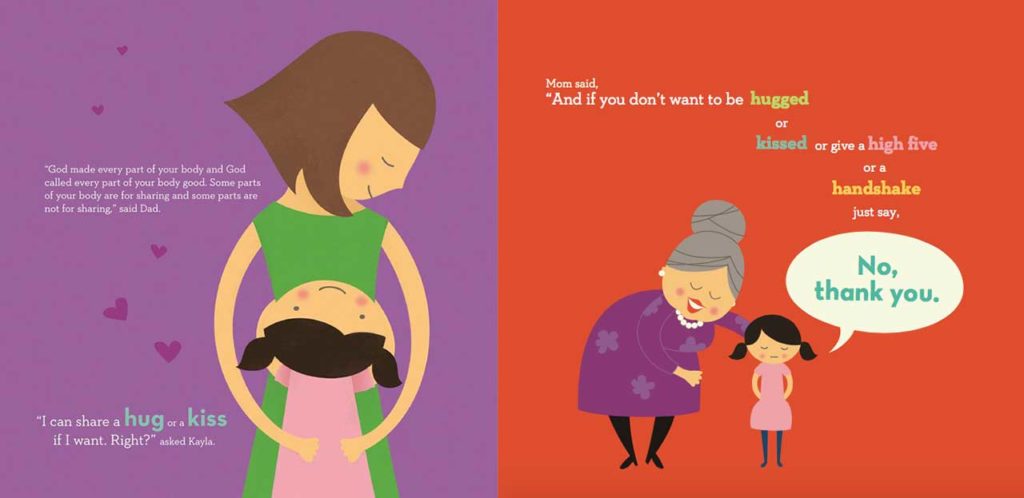
God Made All of Me: A book to help children protect their bodies by Justin S. and Lindsey A. Holcomb 32 pages / 2015 Rating: GOOD/Great/Give God Made All of Me is a picture book written for young children to teach them about their bodies, and Who made them, and how to protect their bodies from sexual abuse. It’s a parent/caregiver book as well – right at the front, before the children’s section begins, there is a page that is directed to parents/caregivers where the authors state their goals and reasons for writing this book. The book also ends with a couple pages for parents/caregivers with 9 ways to protect their children from sexual abuse. The bulk of the book happens between these notes for parents. It is a story of a family with young children, and it starts off with quoting Genesis 1:31 “God saw everything He had made. And it was very good.” This quote is the springboard for the conversation that happens between the children and the parents in the book in regards to the children’s bodies. The book also quotes from Ps. 139 and Ps. 28. Using this dialogue between the children and parents, the book goes through different scenarios the children may find themselves in and gives ways for the children to respond in such circumstances, all with the premise that God made their bodies special and so no one is allowed to touch them. I highly recommend this book for young children aged 8 and under. It deals with a topic that, as parents, we don’t always know how to talk to our children about, yet it is so, so important that we do. In fact, I find this book so valuable that I now include it as a recommendation every time I train people in how to prevent child sexual abuse. What a blessing then that God has used these authors to write this book to help us out. I love that the whole book is based on God, His creation of us, and His Word. I also think it very wise of the authors to have it written the way they do: a dialogue between parents and their children, including different situations children may find themselves in. Although I found some of it a bit repetitive, my children did not. But then again, what child doesn’t like a book repeated?! If you have young children, I encourage you to get this book. You will not regret it. Michelle Helder has done presentations in Southern Ontario (and one in Lynden, WA) on what parents can do to best prevent sexual abuse. In a 3-hour workshop, she facilitates and leads discussions, using the Stewards of Children video and an interactive workbook. If you are interested in contacting her to do this very valuable workshop with your group, contact the editor for her email information....

Red heart icon with + sign.
Adult non-fiction, Book Reviews

Sex Matters

128 pages / 2015 Sex Matters is a book intended for Christians – McKee provides answers from the Bible and explains the Bible’s message using research and real life examples. Jonathan McKee wants to make it easier for parents to talk to their kids about sex, and to that end he’s written a book for parents to give to their teens, which addresses the two common questions, “Why wait?” & “How far?” WHY WAIT? Why wait? McKee takes over 20 informative pages to explain the statement, “God has given the gift of sex to enjoy in marriage.” And in addition to making the biblical case, he shares how research shows that this command is in alignment with how human beings function. HOW FAR CAN I GO? How far can people go, and when should they stop? McKee’s answer rests on the rather obvious observation that once the process is started it is designed to be continued. That is why it is so difficult to stop, a fact that has been known for millennia. So his advice? Don’t start the process; don’t do anything you would not do in front of your grandmother. WHAT DOES FLEEING SIN LOOK LIKE? Sex outside marriage is a huge temptation, especially in our media-saturated culture, and it is the one temptation the Bible repeatedly tells us to flee. McKee explains clearly what fleeing temptation means for girls and how it is different for guys. Christians need to understand the truth, recognize natural consequences, and establish safeguards, and parents need to help their teens do these things as well as to encourage them to take responsibility themselves. McKee also covers the dangers of porn, questions about masturbation, and the effects of abuse. Over and over he turns to the gospel, reminding young people that Jesus offers a fresh start for everyone, whether you have sinned or been sinned against. He also encourages young people to remain pure by pointing out that a few years of self-discipline can be traded for a lifetime of awesome connecting without baggage after marriage. Who in their right mind would choose anything else? But the trouble is that we are sinners and that disobedience seems so attractive. Finally, McKee offers some practical suggestions: Marry earlier. Be careful what you listen to and watch, what you wear, who you are alone with, and where you go. Beware of the dangers of the Internet and install safety systems. CAUTION I will add one caution. Sex Matters is a book for teens exposed to our culture and, as such, it can be explicit. When parents wonder if the book itself could cause more problems than it solves, McKee’s response would be that our culture is explicit, and that equipping our teens requires us to be forthright. So do pre-read this before giving it to your teen to see if it meets your expectations. CONCLUSION McKee’s Sex Matters is a valuable book (especially in conjunction with More than Just the Talk, which he’s written for parents). It is unabashedly Biblical – so much so that our huge public library refused to buy it – but it deserves a place in home, church, and school libraries and would be a blessing to any community that has it in its public library. What’s more, it is short (only 122 pages), easy to read, and contains discussion questions at the end of each chapter. I highly recommend it. This is adapted from a review on Tea Time with Annie Kate and used with permission. The original can be found here....