Transparent heart icon with white outline and + sign.

Life's busy, read it when you're ready!

Create a free account to save articles for later, keep track of past articles you’ve read, and receive exclusive access to all RP resources.

White magnifying glass.

Search thousands of RP articles

Helping you think, speak, and act in Christ.

Open envelope icon with @ symbol

Get Articles Delivered!

Helping you think, speak, and act in Christ. delivered direct to your Inbox!


Red heart icon with + sign.
Theology

Does 1 Corinthians 6 mean Christians can never appeal to the courts?

When Charter rights appear to be violated, what can a Christian do? ***** Does being submissive to the ruling authorities mean that a Christian cannot seek their day in court? Would going toe-to-toe with the government in a court of law be a form of insubordination, or show a lack of respect and submission to the civil government? Or can Christians take the government to court? Does the Bible give us any guidance on this question? Some Canadian constitutional context Court action, in a constitutional democracy, is a legitimate form of government interaction. Within the modern constitutional state, there are three branches that hold each other in check: the legislature (makers of the law), the executive (those who carry out the law) and the judiciary (those who review the application of the law). This separation within the civil government is described in our constitution as “the separation of powers.” No one man is lawmaker, police officer, judge, jury, and executioner. We divide power, and for good reason: power tends to corrupt fallen man. All of the civil government in Canada is limited, by law, and is under the law, particularly under the Charter of Rights and Freedoms. Does the Charter govern you as a citizen? No, it doesn’t. It is the highest law in Canada, but it only limits the power of the civil government. So, judges, lawmakers, and police officers, together with the Charter, are a package deal, and together make up “the civil government.” The Charter of Rights and Freedoms was added to our constitution in 1982. It owes some – though not all – of its language to the Christian legacy of limited state power. (If you want to read more of the legacy, I shamelessly recommend chapters 2 and 4 of A Christian Citizenship Guide, 2nd Edition, which explains it in detail.) The preamble to the Charter states that: “Canada is founded upon principles that recognize the Supremacy of God and the Rule of Law.” This “Supremacy of God” clause is supposed to be a reminder to our lawmakers that they are under the ultimate Lawgiver. (Even if they don’t believe in God, they should at least be able to recognize that they aren’t God!) But note as well the reference in the Charter’s preamble to the rule of law. That echoes the Belgic Confession, article 36, which in turn echoes Deuteronomy 16 and 17 – we are to be governed not by the whims of kings and tyrants, or bureaucrats for that matter, but by laws and statutes. And everyone is under the law, including the king, the prime minister, the premier, the police, the bylaw officer, and any other government employee. The Charter of Rights and Freedoms is, in some ways, a product of Christianity’s influence on law in the West. So, what are some things the Charter guarantees? In Canada, according to the Charter, everyone enjoys fundamental freedoms like freedom of religion, conscience, expression, and association, certain democratic rights and mobility rights, certain legal rights and more. These are not absolute rights; the civil government can restrict them in certain, limited circumstances. But, when the civil government imposes on Charter rights like freedom of peaceful assembly, the burden in law is on the civil government – not citizens – to demonstrate that the restrictions are justifiable in a free and democratic society. But what good does this do us in light of everything we know from Scripture about submission to the governing authorities? So what if we have legal rights – aren’t we called to just submit to the government? What does 1 Corinthians 6 teach? Our tendency as Christians is to be suspicious of using the judicial branch due to the misapplication of 1 Corinthians 6, where Paul seems to be telling Christians not to go to the secular courts. "If any of you has a dispute with another, do you dare to take it before the ungodly for judgment instead of before the Lord’s people? Or do you not know that the Lord’s people will judge the world? And if you are to judge the world, are you not competent to judge trivial cases? Do you not know that we will judge angels? How much more the things of this life! Therefore, if you have disputes about such matters, do you ask for a ruling from those whose way of life is scorned in the church? I say this to shame you. Is it possible that there is nobody among you wise enough to judge a dispute between believers? But instead, one brother takes another to court – and this in front of unbelievers!" However, this passage applies to two private individuals, particularly, two members of the church, and the passage urges settling the matter before going to an “ungodly court.” In the case we are considering here, the “ungodly court” and the other entity in the legal dispute are of the same nature – both government bodies. What we are doing is much more akin to Paul’s own appeal to Caesar in Acts 25 than to Paul’s urging to avoid court. Further, the 1 Corinthians 6 passage must be seen in the context of internal church strife: in the church the wisdom of fellow-members or church leaders should prevail over the need to go to court, assuming that these “wise men” dealing with the matter will deal with it in a just, calm, and wise manner. The brothers challenging each other on a judicial matter should be humble and spiritual enough to accept the wise counsel of fellow believers rather than sue each other. A court challenge of the government’s allegedly unjust actions or laws is not within the scope of what Paul is talking about in 1 Corinthians 6. In Canada, then, a judge is allowed, or even duty bound, to curb the injustice of a higher civil power for the protection of the people under his oversight. In our current context, the Canadian civil government is split into three arms (the "separation of powers"), as explained earlier. Thus when a Christian challenges government action in court (or defends himself against government action in court) it should not be seen as a lawsuit in the sense that we hear about from time to time – a vengeful opportunity to get rich over against an equal opponent. Rather, we are simply approaching one of the three branches of the government and asking the magistrate to do its God-given duty to call the other branch to account, and to remind it of what exactly its obligations are under the Constitution and what its obligations are with regards to justice and righteousness. But what about Romans 13? But what about Romans 13:1-7 and 1 Peter 2:13-17? Don’t these passages demand submission to the governing authorities? Yes, the general rule of Scripture is that Christians are subject to the governing authorities. But in order to make a proper application of this rule, we have to understand how our civil authorities govern. How citizens interact with governing authorities looks different in a constitutional democracy (where the constitution is supreme even over judges and premiers) than in an ancient absolute monarchy. In a participatory democracy, it isn’t only the premier who gets to decide what the law requires. In fact, lawyers and judges, and police officers and citizens should all know what their rights and responsibilities are in law. We are all equally under law and ruled by law. This legal reality is a blessing of Christendom. The Magna Carta, which enshrined this concept over 800 years ago in English law, is rooted in Christian culture. Ambiguities, over-reach, constitutional violations, inequal application of the law, all of this needs to be winsomely exposed, and Christians ought not to shy away from this. It is good and right to point these injustices out. Furthermore, the judiciary is also part of the civil government. When a citizen appeals to a judge to clarify whether or not the actions of the government are constitutional (i.e. legal), then this shows respect for the government and her institutions and uses the law to our advantage. Paul – who wrote Romans 13 – does this multiple times, when he uses his Roman citizenship status to avoid being flogged (Acts 22:22-29), then again when he demands that the local magistrate personally escort him and Silas out of jail after their rights had been violated (Acts 16:37-40), and again when he appeals to Caesar (Acts 25:10-11).  Daniel’s example Consider also Daniel’s example. It’s a striking story: King Darius signs a law that says, for 30 days, if men are going to pray, they can only pray to Darius and no other. Daniel 6:10 says, “When Daniel knew that the document had been signed, he went to his house where he had windows in his upper chamber open toward Jerusalem. He got down on his knees three times a day and prayed and gave thanks before his God, as he had done previously.” Daniel acts immediately and decisively. And what is the charge against him? “Daniel pays no attention to you, O king, or the injunction you have signed.” In other words, “Daniel is violating Romans 13, O king! He’s a lawless man, O king. Throw him to the lions!” But what is the first thing Daniel says to King Darius, after miraculously surviving a night with the lions? “O king, I have committed no crime against you” (Dan. 6:22). (If there were any lawyers in the room, they would have interjected, “Oh yes you did! You broke the clear meaning of the law. You prayed to your God, and your God is not the king, and the law says explicitly and clearly that you can’t do that, and we have witnesses and …!”) But Daniel says, rightly, that by disobeying this silly law, this law which does not align with God’s law, he commits no crime against the king. In other words, obeying the law of God, even if it clearly breaks the law of man, is no crime. More than that, when citizens obey the law of God, they will be no threat to a ruler, Christian or not. John Calvin on legal action In Calvin's Institutes, in the chapter on the Civil Government, Calvin outlines several factors in favor of pursuing litigation: He writes: “Judicial proceedings are lawful to him who makes right use of them; and the right use… is… without bitterness, urge what he can in his defence, but only with the desire of justly maintaining his right; and…demand what is just and good.” Later, in the same subsection, Calvin writes, “When we hear that the assistance of the magistrate is a sacred gift from God, we ought the more carefully to beware of polluting it by our fault.” This then, speaks of a specifically Christian approach to litigation: that we “feel as kindly towards opponent… as if the matter in dispute were amicably transacted and arranged.” Later, Calvin also rejects the idea that Paul absolutely or universally prohibits litigation in 1 Cor. 6; rather, an interpretation of that text is to apply to brothers inside the church. Even so, Calvin speaks very highly of the Christian duty, as private individuals, to respect the civil government. Nevertheless, he does discuss briefly the role of other parts of government, which is very applicable to the question of whether Christians in a constitutional democracy can also challenge government action or laws in court. He writes (quoting from a modern translation): “there may be magistrates appointed as protectors of the people in order to curb the excessive greed and licentiousness of kings… I would not forbid those who occupy such an office to oppose and withstand, as is their duty, the intemperance and cruelty of kings. Indeed, if they pretended not to see when kings lawlessly torment their wretched people, such pretence in my view should be condemned as perjury, since by it they wickedly betray the people’s liberty of which, as they ought to know, God has made them defenders.” Asserting legal rights is not (necessarily) insubordination Asserting Charter rights is not insubordination. As a Canadian citizen, you bear Charter freedoms. Making your case in court, as the law entitles you to do, is a lawful exercise of your office of citizenship. So there may be situations where both the civil government and the Christian citizen must justify their actions, the former in a courthouse and the latter before God. What should make Christians distinct from their neighbors is not whether we speak up about our freedoms but how. Our tone of respect, our posture of prayer, and our spirit of submission sets us apart. And not only our tone, but also our philosophy of freedom and submission will shape a distinctly Christian approach to speaking up. Will we advocate for outright defiance, or make our case calmly and reasonably, according to law? I reject the passivism of being totally and silently subservient to the State. This is not biblical (Ex. 1:15-21; Dan. 3:8-23; Dan. 6:5-10; Mark 12:15-17; John 19:11; Acts 4:18-20; Acts 5:17-42; Acts 16:37; 2 Cor. 11:32-33). But I also reject the revolutionary spirit of obstinate civil disobedience. Two examples Let’s consider two examples. Pro-life billboards First, a couple years ago, one of the Ontario ARPA chapters raised a few thousand dollars to put an ad on London city buses that simply said “Canada has no abortion laws.” About a month or so into the contract, due to mild pushback, the city pulled the ads down, without explanation, without notice or opportunity to reply, and without compensating the local ARPA group for the remaining two months of the contract. We wrote to the city, explaining that what they had done was unconstitutional, and asked them to reinstate the ads. They refused. So, together with ARPA Oxford, we took legal action. And we won! It cost time and money, but the city apologized for what they had done and ran the ads again. A few years later, the City of Hamilton refused to run an ad from another local ARPA chapter, this one simply stating, “We stand for women’s rights. Hers, hers, and hers too” – with the final “her” referring to an ultrasound image of a baby. Again, we are taking the City of Hamilton to court, because their silencing of citizens’ participation in an ongoing political and moral debate is repugnant. Standing up for freedom through the courts shows respect for our laws, and for political or legal institutions. This is not about freedom of expression to say whatever we want to say, whenever and however we want to say it. It is the freedom to communicate a message that ought to be shared, without censorship. Dining but not the Lord’s Supper A second example: during the first summer of Covid, a Reformed church presented a re-opening safety plan to a government bureaucrat working within the local health authority. The document indicated that the church planned to recommence with the sacrament of holy supper. By this time restaurants were open again, and churches were gathering at 30% capacity. What was the reply of the local government employee? Without any sense of irony, he told the church that sacraments were “off the table.” Could the bureaucrat point to any law, order, or regulation that prohibited the sacrament? No. It was merely his opinion that allowing the church to celebrate the sacrament was too risky. That is unjust on its face, and a church would do well to challenge such a decision. A church that decided to celebrate communion anyway would not be the one acting illegally. The one acting illegally is that particular bureaucrat. Conclusion Like Paul, Christians ought not to shy away from appealing to the courts of law for redress. It is good and right to contend with injustice. May God preserve the rule of law in Canada for the sake of the gospel witness of the church. André Schutten is ARPA Canada’s Director of Law and Public Policy and General Legal Counsel (ARPACanada.ca)....

Red heart icon with + sign.
Adult fiction, Book Reviews

Winterflight

by Joseph Bayly 1981 / 216 pages Rating: Good/GREAT/Give In this dystopian novel, Joseph Bayly takes us to a not-so-distant future in which abortion for disabled children is mandatory, euthanasia is compulsory soon after 75, and Christians are so confused about Romans 13 they think God wants them to submit to even these demands. When Jonathan and Grace Stanton’s six-year-old son Stephen falls off his bike, they don’t know what to do. The fall was minor, but their son has hemophilia and he needs treatment. But the law says he shouldn’t exist: had his condition been diagnosed prenatally the State would have required that he be aborted. Stephen survived only because he mother never visited a doctor during her pregnancy, and when the time came a friend helped her have a home birth. Now the Stanton’s wonder what the State might do, even six years later, if they bring their son in to see a doctor. Do they dare find out? Winterflight was written over 40 years ago, but it got my heart racing – it all seemed far too probable for my liking. Abortion is already being used to “cure” genetic disabilities like Down Syndrome and while it isn’t mandatory, pressure from doctors and culture are such that in some countries 98% of Down Syndrome children are killed before birth. When it comes to killing the elderly, we don’t demand their deaths at 75, but we are already exploring the cost savings that can be had from their early departure. In countries where euthanasia has been legal longer, there are regular reports of involuntary killings. In Canada, attempts are already being made to make involvement on some level mandatory for all doctors. But what hits closest to home is Bayly’s portrayal of the confused Christian response to these government abuses. When Grace’s elderly father is told he must report soon to be euthanized, their misunderstanding of Scripture has them thinking that they need to obey the governing authorities even in this, since those authorities are appointed by God (Romans 13:1). But at the same time, in saving their son, the Stantons show that on some level they do understand we must sometimes defy the State. Is their confusion realistic? We’d never march ourselves off to the local euthanasia clinic just because the government demanded it. But why would we resist? Do we understand on what biblical basis we could reject such demands from the “governing authorities”? During World War II there was confusion on this point among some good Reformed Dutchmen. Among those who joined the Resistance, some felt guilty about it because they were worried that in acting against the Nazis they were resisting God’s chosen rulers. The confusion persists today. Even as we know the government shouldn’t mandate euthanasia – even as we recognize that there are limits to their power – many Christians will still turn to the government asking it to solve our problems. We understand the government has limits, and yet we’ll also ask them to do more and more. We are double-minded.. And that’s what makes this book such a fantastic read – the discussion it’ll prompt is one we need to have. Cautions There are just a couple cautions to note. First, there is a small bit of language – I think “damn” might be used two or three times. Second, without giving away the ending, when the book was first published some Christians misunderstood the ending as being prescriptive – they thought the actions of the book’s confused Christians were what we should do. So it’s important to understand that’s not so. These are confused Christians, under enormous pressure, acting in a confused way and the author is not endorsing their actions. In fact, the book is primarily about warning us not to do as they do. Conclusion This is a fantastic dystopian novel, as prophetic as they come, and certainly unlike any other Christian fiction you’ve read. The topic matter is weighty, but because there’s nothing graphic this could be appropriate for as young as early teens. However the younger a reader might be, the more they’ll need a guide to steer their interaction with the story, and particularly the not-at-all happy ending. It would also make great book club material, with fodder for some fantastic discussions....

Red heart icon with + sign.
Theology

Whom Do You Serve? Sphere Sovereignty and the need for limits on power

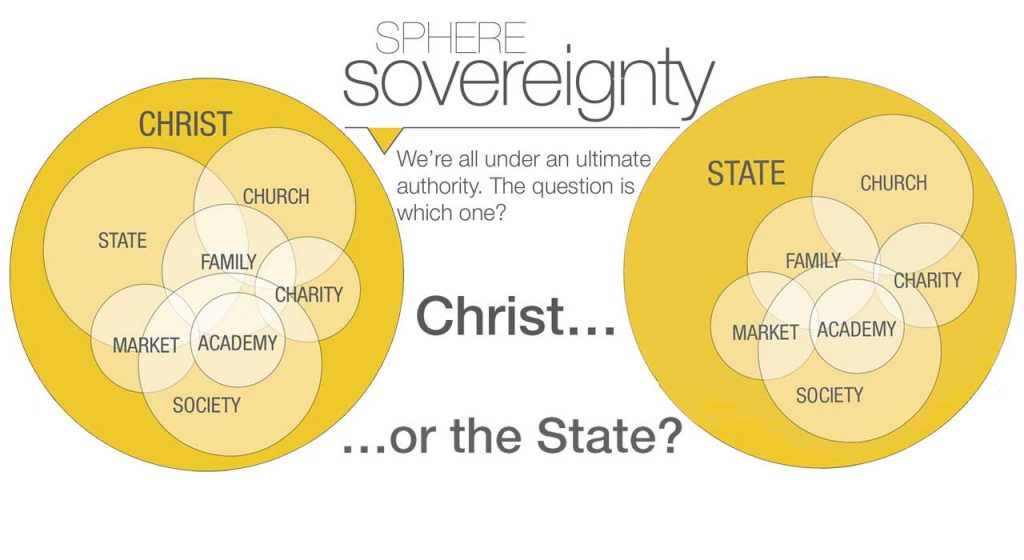
Children are often told to obey many different folks. Listen to your mom and dad. Listen to the policeman. Listen to your teacher. Listen to the pastor. Adults too are encouraged to obey various authority figures. Which raises a question: what happens when demands of the State and demands of other authorities clash? Whom do we obey? The Dutch philosopher, theologian and prime minister Abraham Kuyper developed a system of thought to assist in understanding the authority structures in the world. The system is called “sphere sovereignty” and it helps answer the question, “Who do we obey when various demands on us and our behavior clash?” GOD OVER ALL Kuyper argued and demonstrated from the Bible that God has created in society a number of different institutions or spheres, each with their own respective roles and responsibilities. Three of the most important institutions created by God are: the CHURCH– starting with Adam, and continuing through Noah, Abraham, the people of Israel and the New Testament church the STATE– whose role is set out in various places including Psalm 72 and Romans 13 the FAMILY – begun with Adam and Eve In the Bible, God gives each of these spheres a distinct task and role. So, for example, the sphere of State is sovereign in matters properly within its jurisdiction as given and defined by God. Some of those matters would include criminal law, national defense, and maintaining a fair and impartial justice system. The sphere of Church (or synagogue/mosque/temple/monastery, etc.) is sovereign over areas within its jurisdiction: theology and doctrine and church discipline and membership. And within the sphere of family lies responsibility for issues of child education and discipline, religious instruction, sexual ethics, moral development, etc. In the graphic accompanying this article, you’ll notice other spheres: a larger sphere of Society and smaller spheres which are each sovereign in their own right: the market, the academy, charities and the individual. Academics will argue over how many separate spheres there might be, but while the number and boundaries of the smaller spheres is a source of debate, there is agreement about the obvious biblical basis for the first three. God has instituted the Church, the State and the Family and invests each with its own specific sphere of authority. There is, of course, some overlap from sphere to sphere. Fraud can’t be limited to the market sphere; it requires the State criminal law power to protect the consumer. Physical assault of a child can’t be limited to the family sphere; it requires the State criminal law power to protect the child. Restorative justice can’t be limited to the State sphere; it requires the family sphere and the church sphere to mend broken relationships. However, there are also boundaries between the spheres. These boundaries are critical. History has taught us that great harm can be done when one sphere takes over the role of another. For example, problems abound when the State interferes in church doctrine issues. This was the greatest problem during the bloody Reformation era. The State used the sword to enforce church doctrine, which was a total abuse of its power, and a violation of the principles of sphere sovereignty. A modern example would be the Ontario human rights tribunal ordering a Roman Catholic bishop to explain himself to the Tribunal for not allowing an openly gay man to serve as an altar boy (this occurred in Peterborough, Ontario in September 2009). A similar violation of the boundaries between the spheres happened when the Ontario Minister of Education, standing outside the Ontario Legislature, declared that Christian schools could not teach that abortion is wrong, since such a teaching was “one of the most misogynistic actions that one could take.” (That statement was made by Minister Broten in October, 2012.) And in the not too distant past, churches and families tried to keep certain criminal acts (child abuse, for example) quiet and internal, when it ought to have been reported immediately to the State. Having shown the boundaries that exist between these spheres, we need to turn our attention to the key of Kuyperian sphere sovereignty: over each and every sphere reigns Christ as sovereign. Kuyper’s famous saying applies here: “There is not one square inch in the whole domain of our human existence over which Christ, who is Sovereign over all, does not cry, ‘Mine!’” As a Christian country, we once recognized this, and it wasn't even that long ago. The preamble to the Charter of Rights and Freedoms (added to our Constitution in 1982) still states, “Whereas Canada is founded upon principles that recognize the supremacy of God and the rule of law…” Recognizing the supremacy of God is necessary in public policy because, when we fail to do so, someone or something else will take God’s place as supreme authority. THE STATE/LAW OVER ALL For example, take a look at the concept of sphere sovereignty through the eyes of our former Chief Justice, the Right Honorable Beverley McLauchlin. We can see in some or her statements a recognition that there are some spheres in life which are distinct: the sphere of society, spheres of religious communities and families and the sphere of the State. But we should take careful note of where, in her mind, the State sits in relation to the other spheres. In a speech delivered in October 2002, Her Honor stated that: the rule of law exerts an authoritative claim upon all aspects of selfhood and experience in a liberal democratic state… influenc local, community, and familial structures. The authority claimed by law touches upon all aspects of human life and citizenship… It makes total claims upon the self and leaves little of human experience untouched. These “total claims” on us as legal subjects, she said, “flow from a conception of authority rooted in the sovereign .” Invoking Kuyper, one could paraphrase what the Chief Justice said in this way: “There is not one square inch in the whole domain of our human existence over which the Law, which is sovereign over all, does not cry, ‘Mine!’” Admittedly, Her Honor does believe that Law must carve out space for religious communities to live according to their particularities. However, it’s Law (and the State, as the authors of the Law) who makes space and accommodations for religion. For our chief justice, law remains the supreme authority. So there remains a tension between the Law of the State and religious precepts, familial obligations, and individual responsibilities. THE ROAD TO TYRANNY Without something (or, more properly, Someone) over all spheres, tension breaks out between the spheres, and a struggle ensures to see which sphere will reign as supreme. Now, of all of the spheres (the State, the Church, the Family, the Market, etc.) which has the most power? Quite obviously, the State does. As the Apostle Paul once wrote, it “bears the sword.” It has unlimited financial resources, it has coercive powers, it writes the laws, and it has lethal force. So, if God is removed as sovereign, who becomes sovereign? The State does. This is absolutely evident in every officially atheist country from the last century: the USSR, China, North Korea, Nazi Germany, Fascist Italy. When the State raises itself above God, then God becomes a problem for the State. And know this: as the State replaces God, or makes itself god, then it naturally also begins to compete with the family, substituting itself for the family. (It’s no coincidence that the leader of North Korea is referred to as “father.”) And when we, free citizens in a free country, begin to think that the State will provide everything for us, not just national defense or a fair justice system (as it ought to) but also total healthcare, education, food, clothing and shelter, unemployment wages, settlement of petty disputes with our landlords and employers, and on and on, then we are looking to the State not just as god, but also as savior. Lord Acton once wrote, “Power tends to corrupt and absolute power corrupts absolutely.” That dictum is true for all of mankind because of our innate sinfulness and our covetous lust for more. This may be why the LORD never allowed all three offices of the Old Testament to be vested in a single person, though there were exceptional cases where a single person was both a prophet and a priest. Think, for example, of the punishment of King Uzziah when he tried to act as priest and burn incense before the Lord (2 Chronicles 26). Applying this anecdotal evidence for division of power to our civil government, we see a three-fold division of power there too, between the judiciary, legislature, and executive. The Canadian Constitution holds all three branches of government in check – each have power to limit the powers of the other. But if that balance is ever upset such that one person (or one small group of people) becomes lawmaker and law interpreter and law enforcer, we will have tyranny. Expanding out from the Biblical offices and expanding out from civil government, we see that there is a natural protection against tyranny in the dispersion of power. Lord Acton also wrote, “Liberty consists in the division of power. Absolutism, in concentration of power.” So we see that for mankind’s good, God gives some power to the church, some power to families, and some power to the State. But if the ultimate power concentrates (as it is tending to do these days) in one of these spheres, we also have tyranny. One example would be in the realm of education: God gives authority over education of children to parents, with the church assisting parents in that calling historically. But in the last century, the State took over, first from the church, and now more and more from parents, such that even the most intimate and personal educational material is being taught by State bureaucrats, often without parents knowing (think of some of the graphic sex education curriculum for grade 3 and 4). REMINDING OUR NEIGHBORS OF GOD'S PLACE One of our responsibilities as Christian citizens in a free country is to keep the State in its proper place, and to remind fellow citizens of what their responsibilities are apart from the State. This is where you come in. Use the graphics in this article to show your friends and colleagues that we all must be under some ultimate authority. The question is simply, which one? Are we willing to submit ourselves fully to the State? Isn’t the Lordship of Christ infinitely better? We must remind our fellow citizens of what their responsibilities are apart from the State, and explain to them the effect of subjecting everything to the ultimate authority of the State – it means losing the freedom to live as we ought to live. Failure to understand this important concept means subjecting our institutions, our businesses, our families, our churches, subjecting even our very selves to the sovereign will, not of God, but of the State. So, to answer the question I posed at the beginning of this philosophical discussion – who do we obey when demands of the State and demands of parents or pastors or professors conflict? The answer is: it depends. It depends on whether the parents or the professors or the pastors or the State are authoritative in the sphere in which they are making the demands. This approach to understanding the very limited authority of the State should not be interpreted as a proposal for anarchy. I once swore an oath of allegiance to the country I love, my Canada, an oath which I stand by to this day. I pray for her leaders every day. I strive to obey all her laws. But here’s the rub: when those in power begin to legislate in areas over which they have no jurisdiction, my trust in the government plummets. And when those in power dare to legislate in such a way that I must either obey the State’s law or violate my conscience, then I say loudly with the Apostle Peter, “I must obey God, rather than men.” One key to a free, prosperous, democratic society is for the State to back off from taking authority unto itself that was not its to begin with, to not arrogate unto itself powers which are not its own. When the State learns restraint, we can and do enjoy freedom. When our society and culture recognizes a Sovereign high above the State, as we once did, then we certainly will enjoy freedom. This article first appeared in the November 2014 issue under the title "Whom do you serve? Sphere Sovereignty and the need for limits on power." Illustrations were created by Lynn VanEerden. André Schutten is the Director of Law and Policy for ARPA Canada. POSTSCRIPT: QUESTIONS TO CONSIDER While sphere sovereignty is a helpful tool, like any other tool it has limitations. For example, while the first three “spheres” of Church, State and Family are quite clearly instituted by God, we could have endless debates about just how many other spheres there might be. In Canada we could list the federal government as one sphere, and the provincial governments as another, but what about towns and cities? Do they get their own sphere? Is Academia a sphere? What about the Market? Also, while the spheres are a helpful concept, defining the exact borders between each of them is hard to do. So the author wants to emphasize that this is not meant to be the Reformed paradigm through which Christians ought to view the world, and he welcomes feedback on the ideas expressed here. What is helpful about this model, and how might it be improved? André Schutten talks about the sphere of the Church as separate from Family and State. Where does a mosque, synagogue or temple fit in? God instituted the State, the Church, and the Family, but did He institute the mosque? We don’t think the State should interfere with mosques, synagogues and temples so they do seem to exist in a separate sphere apart from the State, but is that separate sphere grouped with the Church, or is it, perhaps, under the Family? Or might it be something else entirely? In Western countries it often seems the State that is trying to take Christ’s supreme position. What might the interloper be in countries like Saudi Arabia or Iran? And if a libertarian were going to make their own sphere sovereignty model, who would they put in place of Christ? ...