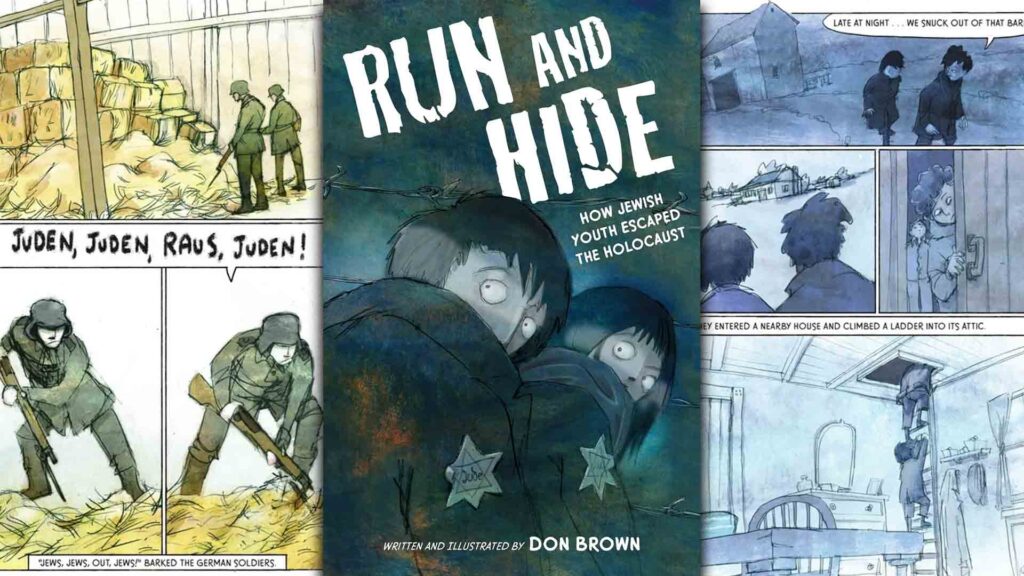
by Don Brown
2023 / 190 pages
Rating: Great
Don Brown gives us a new wrinkle on a story we thought we already knew. When he shows us the Holocaust through the eyes of the thousands of German Jewish children who survived, we feel the horror again.
He starts with the rise of Hitler, his failed coup attempt in 1923, the nine months he spent in jail writing Mein Kampf, and his final rise to power in 1933. The persecution started immediately, with Jewish businesses boycotted and Jewish civil servants fired. The first concentration camp, near Dachau, was started already in 1933, to imprison Hitler’s political opponents, and Jews too. While tens of thousands of Jews fled the country, a half million stayed behind. They thought these difficulties would pass. Then, on November 9, 1938, the horrible truth became plain. Thousands of Germans destroyed Jewish businesses, burned their synagogues, invaded their homes, and beat Jews, murdering 91. This was known as Kristallnacht – German for “night of the broken glass,” for all the store windows that were broken.
That’s the first 40 pages, covering what German Jews overall had to endure. The next 140 pages look at just the children, who were so often left to fend for themselves after their parents had been hauled away. What might be most shocking to young readers is how unwilling other countries were to help. The United States refused. Great Britain was one of the few, allowing some charitable groups to take in Jewish children, so long as they didn’t become a liability to the British taxpayer.
But what of the parents? No. The children were sent alone, on their own. Jewish parents, desperate to save at least their children, sent them off, not knowing if they’d ever see them again.
But that was a way out only for a select few. Many other Jewish children fled on their own, hiding in fields, sometimes getting discovered by Nazis and their collaborators, other times by more sympathetic men and women. But even the ordinary people who wanted to help were often too intimidated to risk doing – getting caught helping the Jews could leave you suffering their fate.
Thankfully, some did help, and Brown shares stories of helpful adults who snatched away Jewish children away even as the Nazis were rounding them up. Young women would bravely accompany the children on trains, escaping Nazi notice. Some children slipped across the border to neutral Switzerland.
But many more did not escape. They were caught, sent to concentration camps and murdered. As Don Brown ends his book, for a “fortunate few Jewish children, the war had been a time of narrow escapes, close shaves, near misses, tight squeezes, long odds, and…. a miracle.” But for the nearly 90 percent of Jewish children who didn’t escape, “their oblivion was… a Holocaust.”
Caution
There is remarkably little blood shown. Only a few panels. Brown’s artistic style is not super realistic, so that also takes a lot of the edge off the violence he depicts, and he frequently has the most violent moments happening just off frame – we see Jews lined up in one panel, then see the Nazis shooting rifles in the next, but he doesn’t show us the horrific results. Still, the topic is unavoidably grim. Thousands were saved. But millions were killed. So, this wouldn’t be suitable for an elementary school library.
Don Brown is not a Christian, and that comes out briefly on the very last page of the book in his written conclusion in which he highlights how mass murder continues today. He then highlights the Cambodian killing fields of the 1970s, and the 1994 Rwandan genocide. He also details wars in which tens of thousands have died, like the Iran/Iraq wars of the 1980s, and the Syrian civil war that started in 2011, and Russia’s war on Ukraine. But when he continues on to hate crimes in the US, he lists among the victims, transgender and homosexuals without noting that the damage being done to them is being done in the name of love –young readers need to understand it is affirmation that drives a kid struggling with their gender to cut off body parts in a desperate attempt to become what they can never be. It’s a single line, but a mar on an otherwise very good book.
Conclusion
We all know about the Holocaust, right, so who needs yet another book about it?
Well, the thing is, I don’t know that we really do know about the Holocaust. Six million murdered is such an unfathomably large number that it doesn’t really resonate. It’s not that we doubt it. It’s just that it’s impossible to really comprehend. But it’s important we try… lest we think it something that could only happen then and we fail to recognize how the same sort of depersonalization can happen today. It’s happening most horrifically with the unborn, whether that’s via the 100,000 abortions committed in Canada each year, or the unknown tens and maybe hundreds of thousands more murdered via IVF.
But this depersonalization is not limited to the unborn. Portraying your enemy as sub human is a common enough political tactic. For example, if you were to speak against transgenderism and the harms it does, you’ll be debased, not debated, and dismissed as filth not worth talking to. That’s a tactic, of course – because they can’t debate the facts, they attack the person instead. But that’s part of what we need to remember: when politicians have nothing of substance to offer, what they’ll offer instead is a boogeyman to blame. The most recent example? The Liberals couldn’t run on their horrible track record in the 2025 election, but found in Donald Trump a boogeyman they could get the country united against. We’re still falling for this blame game today.
So this is an important book our high schoolers should read, to see how ordinary people can be manipulated and silenced, and how ordinary folk may be pressed to become either heroes or collaborators.