









Transparent heart icon with white outline and + sign.

Life's busy, read it when you're ready!

Create a free account to save articles for later, keep track of past articles you’ve read, and receive exclusive access to all RP resources.

White magnifying glass.

Search thousands of RP articles

Helping you think, speak, and act in Christ.

Open envelope icon with @ symbol

Get Articles Delivered!

Helping you think, speak, and act in Christ. delivered direct to your Inbox!

A A
By:

No jail for man who admits to killing his partner

“An Ottawa man who pleaded guilty to manslaughter in the death of his ailing husband has been sentenced to two years less a day of house arrest for an act the judge called ‘in every respect an assisted-suicide mercy killing.’”

So began a news story from the CBC, which went on to explain that Philippe Hébert, 74, killed Richard Rutherford, 87, on April 15, 2022. Rutherford was struggling with health challenges and a recent cancer diagnosis, and Hébert was tired and stressed by Rutherford’s condition, compounded by fears that Rutherford would be isolated due to Covid restrictions.

At the sentencing hearing on February 17, Justice Kevin Phillips explained the light sentence by noting that Rutherford wanted to die.

“Phillips said despite the killing being ‘close to murder,’ Hébert was honouring the ‘last wish’ of his husband and friend. Rutherford had the mental capacity to make that decision, and given his medical condition it was understandable, the judge said.”

The CBC story, and others like it, painted a picture of how Hébert was a model citizen and was surrounded by supporters in the court room.

In law, as in journalism, words matter a great deal. In this case, the reader is led to feel understanding, and perhaps even gratitude, for Hébert’s willingness to honor the “last wish” of his partner.

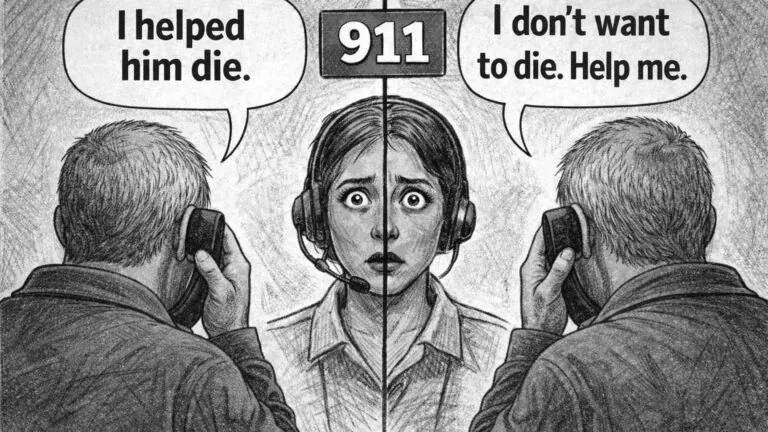
But if we avoid the euphemisms and speak the plain truth, a very different picture emerges. According to the National Post, Hébert woke up to find that his homosexual partner Rutherford was crying. Hébert claims that Rutherford couldn’t go on living and wanted him to help him end his life. In response Hébert promised he would end his own life after killing Rutherford. According to Hébert ‘s testimony, he used an incontinence pad to suffocate Rutherford, then attempted to end his own life, and called 911 for help. As a result, Rutherford is dead and Hébert gets to carry on living at home, without the burden of Rutherford’s care.

Of course, with Mr. Rutherford now dead, we have no idea whether he actually asked to be killed.

Decisions and media coverage like this only further erode the sanctity of life. When Canadian law treats murder as medicine, then how can society be all that critical of someone who takes it upon himself to deliver that “treatment”? When killing-is-caring is logically extended, what protection does it give to others who are vulnerable and may be seen as a burden to their caregivers?

There is only one line that can be drawn here: that no one should murder another (Gen. 9:6) because our lives are not our own, but entrusted to us by our Maker. That will be too Christian for many, but then we can challenge them to offer any other standard that can hold scrutiny. What other line can they propose that won’t be struck down as by a court because it unfairly limits others? If it is compassionate to murder someone suffering from cancer, why isn’t it compassionate to offer the same “treatment” to someone suffering from depression? By what standard – once God’s law is abandoned – can any one be denied this inexpensive, immediate, and sure cure for suffering?


Enjoyed this article?

Get the best of RP delivered to your inbox every Saturday for free.


Red heart icon with + sign.
Pro-life - Euthanasia

Ontario shows why euthanasia “safeguards” can’t work

A lengthy article in the Winter 2025 edition of The New Atlantis, titled “A Pattern of Noncompliance,” shows how Ontario isn’t strictly enforcing its euthanasia regulations. The provincial “Office of the Chief Coroner” is in charge of monitoring how euthanasia killings are committed and from 2018 onward they have, “…thus far counted over 400 apparent violations — and have kept this information from the public and not pursued a single criminal charge, even against repeat violators and ‘blatant’ offenders.” Ontario’s Chief Coroner, Dirk Huyer, admitted back in 2018 already that: “we see a pattern of noncompliance, we see a pattern of not following legislation, a pattern of not following regulation, and frankly we can’t just continue to do education to those folks if they’re directly repeating stuff that we’ve brought to their attention.” So what penalty have the “non-compliers” had to face? As journalist Alexander Raikin reports, one of the most severe cases of non-compliance involved a euthanizer who brought the wrong poisons, which didn’t work, but did, according to Huyer, cause tremendous suffering. What penalty was imposed? The euthanizer will no longer be allowed to kill people, but he maintained his medical license. And the case was never referred to the police. The lack of compliance was evident even early on. In a report on Ontario’s first 100 euthanasia killings, 39 percent of the euthanizers skipped a notification requirement. They were supposed to notify the pharmacist of the purpose intended for the drugs requested, and they just didn’t. Euthanizers either didn’t understand the regulations or couldn’t be bothered with them, but either way it underscores the ineffectiveness of such regulations. The point Christians need to highlight is that it doesn’t matter what “safeguards” are included with euthanasia legislation, they won’t work. They can’t work, because the only real line that can be drawn is the God-given one, that our lives are not our own, but are entrusted to us by God, and that the taking of any life is a violation of His command, “Do not murder.” Our culture has tried to draw other lines, but they are drawn in shifting sand and are constantly being ignored or wiped away by the next cultural shift. So yes, our legislators have made a distinction between the unlawful killing of a human being, codified as murder, and the lawful taking of a human life, described as euthanasia (and abortion). But what would it be then, if someone committed euthanasia unlawfully? It’s hard to avoid the conclusion that any unlawful taking of a life must be a murder. But that’s not a conclusion they are willing to come to. Why? Well, how many doctors do you think would be willing to do a procedure that, if they ever didn’t do it quite right, would send them to jail for murder? Not many, right? Which means that whatever the regulations or “safeguards” in place, if they were strictly enforced, it would have a chilling effect – doctors would be reluctant to consider killing for their living if it could cost them their freedom. That, then, could put an end to euthanasia altogether: it wouldn’t matter if was legal if there was no one willing to inject the poison. So, for euthanasia to be both legal and available, the government will always be motivated to overlook irregularities or neglected safeguards. And since the victims are dead, there isn’t going to be much of an outcry either. Careless with matters of life and death – that’s the natural outgrowth of a godless culture. It’s only when we turn to God’s unchanging law that we can find a standard that can’t be bent and can’t be ignored with impunity....