










Transparent heart icon with white outline and + sign.

Life's busy, read it when you're ready!

Create a free account to save articles for later, keep track of past articles you’ve read, and receive exclusive access to all RP resources.

White magnifying glass.

Search thousands of RP articles

Equipping Christians to think, speak, and act

Open envelope icon with @ symbol

Get Articles Delivered!

Equipping Christians to think, speak, and act delivered direct to your Inbox!

A A
By:

Moth and rust resolutions

Do not lay up for yourselves treasures on earth, where moth and rust consume and where thieves break in and steal, but lay up for yourselves treasures in heaven, where neither moth nor rust consumes and where thieves do not break in and steal. For where your treasure is, there will your heart be also. (Matt. 6:19-21)

I’ll wait to have a child, she said,
Until this year, next year,
Is past. The winters whiled away.
But when she craved a son,
The day was gone. The day was done.
And when the evening stole
Across the sky. She heard God say,
I need your soul. Your time’s passed by.
You cannot stay.

I’ll marry me a farm, he said,
And insulate it well
With rustic country charm, he said.
But when he’d drawn his plans,
Borrowed the money, read the banns,
The evening sunset stole
Across the sky. He heard God say,
I need your soul. Your time’s passed by.
You cannot stay.

I’ll juggle with my tax, he said,
No need to call it cheat,
For everyone is lax, he said.
He filed his neat return,
But did not get it back. The burn
Of sunset evening stole
Across the sky. He heard God say,
I need your soul. Your time’s passed by.
You cannot stay.

Tomorrow I will play, he said,
But father’s busy now,
I have no time today, he said.
His child walked out the door.
A glance, a twinge of guilt, no more,
And soon the darkness stole
Across the sky. He heard God say,
I need your soul. Your time’s passed by.
You cannot stay.


Please hold your twilight, Lord, for I
Am not quite ready yet to

***

The Bible tells us in Deuteronomy 23:21-23 that we should be careful to do what we say and do what we believe. We demonstrate our reverence, respect, and love for God by a daily walking in His path. However, the sad truth is that promises are often broken, not just by our neighbors who might not attend church, but also by Christians who have made a public profession of faith.

Our lifespan is short and we do not know how many days are left in which we may serve God; we do not know how many days will be given to us to acknowledge openly the love we say we have.
Lincoln’s mom

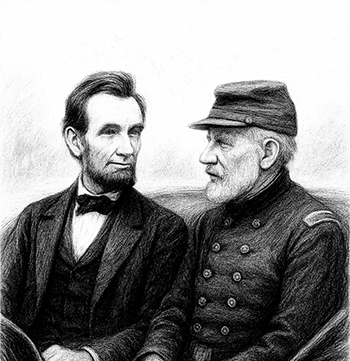
There is an anecdote about Abraham Lincoln and a vow. Lincoln, who was the 16th president of the U.S. (1861-1865), once drove a lengthy distance in a carriage with one of his colonels. During the drive, this colonel took a bottle out of his pocket and offered the president a drink of whiskey. Lincoln politely refused. Reaching into his shirt pocket, the officer then offered Lincoln a whopping, beautiful cigar.

Smiling, Lincoln responded by telling a story. “When I was nine years old,” he began, “my mother was extremely ill. She was on her deathbed and called me to her side. Some of her last words asked me to promise that I would never drink or smoke. I said that I would not and I have kept that promise. Would you advise me to break it at this time in my life?”

Abraham Lincoln’s response was a godly one. At that time, he had no idea that he would be assassinated soon and that his soul would be required of him by his heavenly Father. Had he broken his word to his earthly mother, it would also have been a broken word to his heavenly Father.

To turn to our patient God, and to do His will, is a requirement for all those endowed with the breath of life. It should be a daily prerogative. God gives to everyone on earth many chances to turn from earthly ways to heavenly ones.

Sinatra’s way

Frank Sinatra (1915-1998) was a popular American singer and actor. Humanly speaking, he was quite famous. Many people hummed along to his signature song, a song by which he was known and a song which claimed that he was in charge of his own life, his own decisions. Entitled “My Way,” the song appealed to the self-assertive. Some of its words were:

Regrets, I’ve had a few,
But then again, too few to mention.
I did what I had to do and saw it through without exemption.
I planned each charted course,
each careful step along the byway,
And more, much more than this,
I did it my way.

Frank Sinatra’s life, his moth-and-rust way, by the grace of God, lasted a little longer than eight decades. He’d been married four times, had three children, and had an adoring public before God spoke and said, “This is now the end of your way, Frank. I need your soul.”

Frank died of complications associated with dementia, heart and kidney disease and bladder cancer. Before he died, he summed up his way, his personal faith, in these words:

“First: I believe in you and me … I believe in nature, in the birds, the sea, the sky, in everything I can see or that there is real evidence for. If these things are what you mean by God, then I believe in God. But I don’t believe in a personal God to whom I look for comfort or for a natural on the next roll of the dice. I’m not unmindful of man’s seeming need for faith; I’m for anything that gets you through the night, be it prayer, tranquilizers or a bottle of Jack Daniel’s … Well, I believe that God knows what each of us wants and needs. It’s not necessary for us to make it to church on Sunday to reach Him. You can find Him anyplace. And if that sounds heretical, my source is pretty good: Matthew, Five to Seven, The Sermon on the Mount.”

Frank Sinatra’s last words, spoken to his wife, were: “I’m losing.”

God, in His love, gave Frank Sinatra plenty of opportunities to turn to Him for salvation during his long, four-score plus, earthly travel. Not being God, we cannot judge the final moments of the singer’s life. But this truth is sure, once he died, blue-eyed Frank, ready or not, faced God in final judgment and God rendered a verdict on him, as He will render it to each human being. He will render each judgment with holiness and justice. But there are no second chances and there are no other ways than God’s way.

Jesus in 2026

Although it is appointed for man to die once, and after that face judgment, as it says in Hebrews 9:27, it is also good to remember the comfort of John 5:24.

“Very truly I tell you, whoever hears My word and believes Him who sent Me has eternal life and will not be judged but has crossed over from death to life.”

Perhaps this coming year of 2026 will be the year in which we will hear God say to some of us, “I need your soul. Your time’s passed by. You cannot stay.” It is good to reflect on this and to contemplate seriously whether or not our daily resolutions will pass muster; whether or not they are infused with love for and faith in Jesus.

Enjoyed this article?

Get the best of RP delivered to your inbox every Saturday for free.


Red heart icon with + sign.
Dying Well

Will you die well?

We spend a lot of time preparing for things. Every day we prepare for school, work, or whatever else may be on our plate. We ensure we brush our teeth, get dressed, are well nourished, and aware of what is on our calendar. We fill our vehicles with fuel and ensure they still have insurance. We like to be prepared, especially if something big is coming our way. But something really big is coming our way, any moment now, and many of us aren’t actually prepared for it. You are going to die. Are you ready to die? More than that, will you die well? When we face things we don’t like, our western culture tends to resort to one of two methods. The first is to minimize it, living as if it isn’t a big deal, and the second is to try and control the situation. Evasion #1: Minimizing In recent decades, death is purposely being hidden. The days of wearing clothing to show you are mourning the loss of a loved one has long passed. Instead of being buried, 77% of deaths in my home province of BC result in cremation. After all, cremation is simple – it doesn’t require a casket, a plot in a graveyard, a funeral, a headstone, or even much of a wait. The body is simply “gone” with just some ashes remaining. Funerals have also been replaced with “memorial gatherings” or “celebrations of life” where a few words are spoken, pictures shared, and some drinks are poured. During and post-Covid, even many of these empty practices have been abandoned. With fewer children and broken families, many Canadians are approaching death realizing that they won’t be leaving much of a hole in anyone’s lives. Sure enough, when they die their rooms are emptied, the walls are painted, and the next tenant moves in shortly after. Did anyone even notice? We can point to culture, but how are we preparing for the prospect of our own deaths? A former pastor of mine shared that he prefers to preach at a funeral over a wedding. At a funeral people are usually listening – thirsty souls needing spiritual water. At a wedding most people are distracted, waiting for the message to wrap up so we can carry on with the other plans. The problem is that much of our lives can be characterized by distractions from what really matters. When it is our funeral, we won’t have any time left to pay attention. We are either ready or we aren’t. Evasion #2: Pretending to be in control Since humanity is not able to escape death, it is becoming common to do what we can to control it by ending life on our own terms. Since “assisted death” or MAiD was legalized in 2016, the numbers have jumped as much as 30 percent each year since. Well over 50,000 Canadians have already been killed this way. The National Post recently shared the story of Dr. Ellen Wiebe, who grew up in a Christian home and has killed over 400 people in BC. She calls her work “incredibly rewarding” stating that “it’s the last thing I’ll give up.” Why is it so important? “It’s about honouring people’s wishes, empowering people to have control over their own lives.” Again, Christians can face the same temptation, in at least two ways. First, many religious leaders claim that “MAiD” is a blessing to be embraced, as it allows people to die without facing more pain. And, without “assisted death” even being considered, other Christians do everything they can to fight against God’s clear plan to let our earthly life come to an end. We seek to control our death through every medical option available, or by becoming bitter at God for interfering with our hopes and plans. Dying well God has made it clear to us that minimizing death, or trying to control it, are both foolish. Since our first parents ate from the tree of knowledge of good and evil, death has been unavoidable (Gen. 2:17). And even if a doctor and the government are willing to end our lives, every one of us will still stand before God to give an account (2 Cor. 5:10-11). So if we want to live and die well, we need to understand life and death from God’s perspective, not our own. The Apostle Paul gives us the answer so beautifully in Ephesians 1 and 2. I urge you to stop reading this article and go to your Bible to Ephesians 1:1-2:10 right now. It will likely be some of the most valuable time of your day. Did you notice how many times Paul wrote about being “in Christ” and “in Him”? What God makes very plain to us in these verses is that if we want to die well, we need to die in Christ. Left to ourselves, death will have the victory over us. It doesn’t matter if we attended a Reformed church all our lives, were well respected by others, and are surrounded by a large and loving family. As Paul shares in Ephesians 2:1: “And you were dead in the trespasses and sins in which you once walked... following the prince of the power of the air...” We were dead, even if our hearts were still beating. Thankfully the message doesn’t stop there. In verses 4-8 we hear the Gospel. Let it sink in: “But God, being rich in mercy, because of the great love with which he loved us, even when we were dead in our trespasses, made us alive together with Christ – by grace you have been saved – and raised us up with him and seated us with him in the heavenly places in Christ Jesus, that in the coming ages he might show the immeasurable riches of his grace in kindness toward us in Christ Jesus. For by grace you have been saved through faith. And this is not your own doing; it is the gift of God...” When we die in Christ we are saved from eternal death by Christ’s death, and can look forward to being raised to eternal life, just as Christ did. That is why, in his letter to the Philippians Paul was able to testify, “For to me, to live is Christ and to die is gain” (Philippians 1:21). As Pastor Jonathan Parnell shared in his article "Die Well" on DesiringGod.org “Death is gain because when all is lost, we still have all we ever really wanted, and now we have him in a deeper, richer experience that, as the apostle Paul says, is ‘far better’ (Philippians 1:23).” To live in Christ means to surrender everything to Him. Not control, or fight or hide, but surrender. “I am not my own but belong, in body and soul, to my faithful Savior Jesus Christ” (Heidelberg Catechism, Lord’s Day 1). Paradoxically, living well means dying to ourselves – even dying everyday (1 Cor. 15:31), so that we can experience abundant life – eternal life in Christ. Victory in Christ When we are in Christ we don’t have to minimize death, or try control it. We can rest in God’s good plan for our life. This doesn’t take away from the fact that death is our enemy. It stings. I’m “only” 43 but have felt the pain of death acutely many times. I’m not looking forward to experiencing it even more in my remaining days. Yet it makes all the difference in the world to understand that in Christ, death doesn’t have the final word for my loved ones or myself. Because He died for us and conquered the grave with His resurrection from the dead, “death is swallowed up in victory” (1 Cor. 15:54). It is now a gateway to life. Real life. Eternal life. “Thanks be to God, who gives us the victory through our Lord Jesus Christ” (1 Cor. 15:57)....