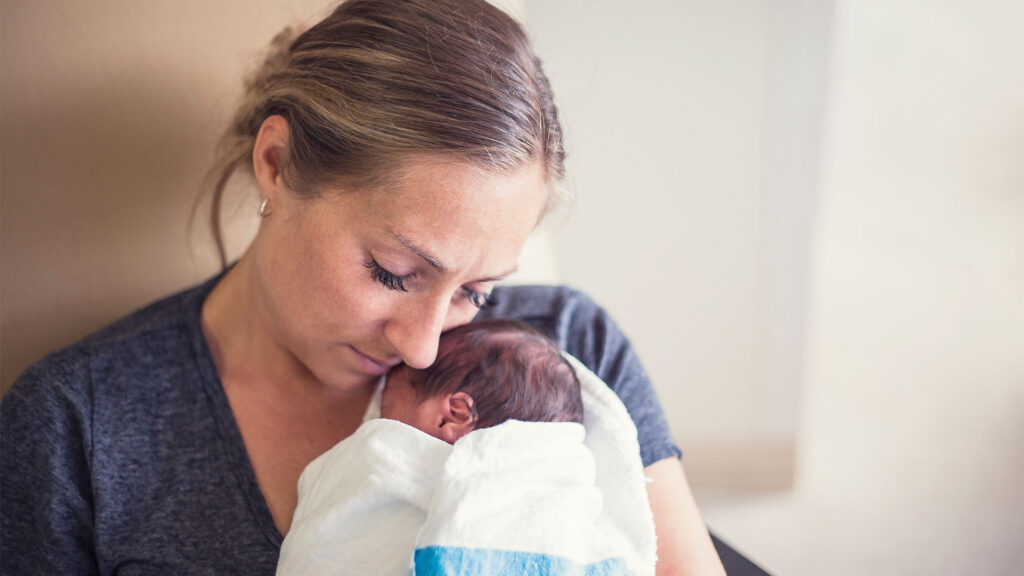
I was deeply ashamed. “I just want to go back to before,” I said to my husband, burying my face in his shoulder. I’d been so excited for this baby and now that she was here, I’d never felt so lost, so disconnected from who I was, so anxious and miserable. I lay awake at night for hours with my heart pounding, unable to sleep in case my baby needed me. And at the same time, I couldn’t adjust to being needed so deeply and constantly.
“You don’t want to go back,” my husband told me. “I know you don’t. Because I can tell, you’re happy.”
I pulled back and stared at him. “I’m happy?” I was crying all the time, desperate for some stability in the current chaos that was our life.
“Yes,” he said, and the strange thing was, he was right.
Because now, when I go back and look at pictures of that time, of the crazy first few months with a newborn daughter, I see my calm, serene face gazing down at my baby, or smiling into the camera. I was happy to be a mother, and I was also so disconnected from myself that I couldn’t feel that happiness. I didn’t think I felt happy at all.
It might seem a bit cliché to write about motherhood, or maybe a bit presumptuous, so soon after having my first baby. But after having gone through it I found we don’t talk about it enough.
It makes sense in a way, since it’s impossible to put into words before you go through it. And there is an element of not wanting to scare other women. But most of what is written is about the objective, factual motions of having a baby – the sleepless nights, the changes in your body, the lists of supplies the baby will need. There is less written about the experience of having your identity overturned and changed into something else, into something we assume should come naturally but instead often develops in us with time and experience. That big word – motherhood.
How do you go through something hard that’s simultaneously such a blessing? What is it like to go through an experience that strips everything out of you and takes you apart, only to put you back together in a way that feels like you’re more fully yourself?
There’s a word I never heard until recently, a word, matrescence, that means the process of becoming a mother. It’s similar to the word adolescence, which is the process of forming your adult identity, or in other words, an in-between stage between childhood and being a grown-up. When I heard “matrescence,” I loved that there was a word for it, a word that is less a black-and-white before-and-after (once you have a baby you’re suddenly a mother), but rather a word that demonstrates it’s a process and a journey, and you might not be “there” right away. At the same time, it’s about becoming yourself in a new way, not becoming somebody totally different and alien to yourself. I was afraid I had lost touch with who I was but that wasn’t true – I was still myself, but myself in a different way.
I have to note that this piece of writing is one hundred percent my experience. The experience of “becoming” is different for every woman (and I’d imagine fathers would have their own too). I don’t want to say this is what anyone should experience, but I want to share my journey for those who may experience similar things, to know there are others out there that feel like they do. And to share some insight for others who aren’t mothers, into what at least one experience was like. In a culture where motherhood is becoming less and less common, talking about it matters more. Because the mundane realities of sleepless nights don’t express the wonder of the experience, and yet that is what is primarily noticeable from the outside.
So with that said, here are a few aspects of my experience.
“It takes a village”
 I felt like an awful mother those first weeks. I felt like this baby who cried constantly could not love me. I felt like my daughter was a stranger I’d expected to know and understand and yet I somehow didn’t. Like I’d never received the mother instinct I was supposed to be born with.
My husband gently contradicted me, batting away each negative thought as they rose up in me. But more than that, he insisted I talk to other mothers. I was sure I was the only woman in the world who felt this way. But he was sure I wasn’t.
I wanted to retreat into the internet, to anonymously compare my feelings to women who posted online, to predict my experience from the challenges they asked questions about. I’ve always been hesitant to be vulnerable. I feel sure that my shortcomings will lead others to judge me, and when it came to motherhood, I was terrified that mothers who seemed to have it all under control would know how I was failing. It felt safer to anonymously browse the internet. But my husband insisted the internet was not reality.
He was sure that other women felt like they were floundering too even if I thought they had it all together. So I spoke the words, face-to-face, to other women that I was having a hard time.
“Thank you for your questions,” one friend told me after I’d bombarded her with queries about her experience in her first weeks after giving birth. “I’d almost forgotten about what that time was like. It’s good to remember how it felt.”
Other women admitted in hushed tones that they had also been anxious, that they also hadn’t known how to cope. For some, our conversation was a space to speak what they’d experienced out loud, to admit to someone else that they hadn’t had it all together way back when. And I could hear that no one had done everything “perfectly,” the way my ideals insisted, shaped by what doctors had told me and what I thought other mothers had done before me.
I had been ashamed to accept help because I thought I was falling short if I couldn’t do it on my own, but to find out others hadn’t done it all by themselves either freed me. I asked for help, and got it.
And when I asked for help, I finally had the time to see my daughter – to really sit and watch her, lying on her blanket in the sun with her legs kicking in the air and her little hands just starting to reach out to what was in front of her. She had felt a bit like a stranger when I’d first met her, though I’d carried her inside me for nine months, a stranger I was oddly and fiercely protective of for some reason. It was strange to be so protective of someone I was still getting to know, to feel so rightly needed by a little being whom I’d barely met. But as I found the time to watch her, I found out who she was. Her personality pushed up through her newborn surface, emerging and proving she was her own person though she seemed so dependent on me. Her eyes widened at the world around her and I began to see how new it must all be to her. I didn’t have to push myself to take her hand and show her everything. I wanted to show the world to my daughter.
As I got to know her, I began to know myself again as well, that I was still myself, yet transformed into the person who was her mother. I saw the world with new eyes. I hadn’t been sure I could be happy as a mother, but little by little I could feel that I was happy.
“It takes a village,” is the cliché about raising children, and so many nowadays are raising children without a village. But in the Church, we have more than a village, we have a body.
“For the body does not consist of one member but of many…. If one member suffers, all suffer together; if one member is honored, all rejoice together.” (1 Cor. 12:14,26).
And yet we so often cannot speak to each other about what we are feeling. We are afraid to let others see under our polished surfaces. And yes, not everyone will respond well when we share. But I will never forget the ladies who came around me from within the Church and reassured me that they had experienced similar feelings. If we never try to share, we will never find those who do.
It’s utterly terrifying to be vulnerable. But my baby, so utterly vulnerable herself, needed me and more than just me. In my own strength I was not enough. I needed others, I needed God, and I needed help to see how to lean on God’s strength. The body of Christ came around me and reassured me that I was not alone. And then I could reach out and help my baby, and through my baby, help others.
Motherhood as a service
 When I was pregnant, strangers started talking to me. “Congratulations! How many months?” they said, or, “When are you due?” I’m used to feeling somewhat invisible as I move through the world, but as my belly grew, I no longer faded into the crowd. And since I was excited, I enjoyed the excitement of people around me, even as I marveled that the thought of a birth could make so many people smile like that.
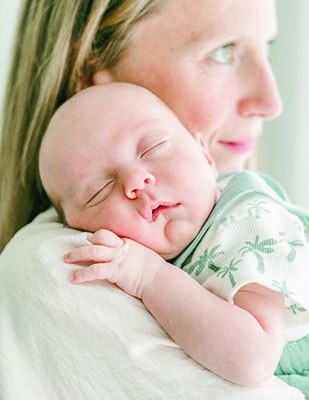
And now that my daughter is here, I am still visible, dragging our stroller and diaper bag and car seat wherever we go. And if I manage to enter a room quietly, my daughter announces herself – I’m here too, look at me! And then a wonderful thing happens – wonderful to me, at least, as a person who was always afraid others were annoyed when she took up too much space or spoke too loudly. People’s faces soften at the sight of a baby, they pause and smile, and somehow their cares are lifted for a moment as her tiny hands reach out to them.
If I’d known before how simple it was to make people happy when you have a baby, that I could just show up with my daughter and make them smile, I would’ve been surprised. Maybe it’s the culture around us that complains about babies crying on airplanes and in restaurants that trained me to expect others to be annoyed with my baby. But almost always, she brings joy just by existing near them. And I wonder, what other small ways of bringing joy to others have I overlooked?
“I really needed this,” more than one person told me, as my daughter snuggled her face into their chest, or held their finger in her hand. Seniors’ eyes tear up with the memory of their own children, once so young. People who had a tough day find a moment of peace, a moment to let out their breath while holding her. Because a baby means hope.
It’s not always easy to get out of the house. There’s a lot more to take. There’s a lot more germs to face. I don’t know how my daughter will react. But so often when I go out, it feels worth it.
I never thought becoming a mother could be a way to serve people I barely knew.
Radical shift
The happiness motherhood brings is impossible to put into words. It’s easier to talk about the complexities of breastfeeding, the difficulties of getting your child to sleep, or how long a single day can feel with a newborn who needs you every moment. No wonder most of our cultural conversation about motherhood revolves around objective realities like this. It’s easier to give advice about what car seat to buy than to explain how full your heart feels even while your eyes are scratchy with tiredness. It’s not something I experienced before I became a mother.
And yet I know I would’ve bristled a bit if a mother had told me I could never understand her love before I’d given birth, as if she were suggesting I was not a fully realized person because I wasn’t a mother. No, it’s not a necessary experience in life. And yet I have to admit, to my single self’s chagrin, that I had no idea. And I have to admit now that I would never have been able to explain my joy to my former self anyway.
I bring this up because the natural disconnect between those who aren’t mothers and aren’t sure what the fuss is all about, and the mothers who insist they love every minute even though they look like they don’t, has been increased in our culture. Young people don’t know why they should have children, and I don’t know how to tell them that it’s a life-changing experience that’s worth it.
It’s worth it. If you’re not sure, I can’t tell you what it’s like or why, despite feeling stretched in ways you’ve never felt before, you will be glad you did it, but I’m trying as best I can to contradict the narrative that life with children is a misery.
God “fills your cup”
There’s a lot of advice out there about filling your cup, or in other words, about taking care of yourself so you can take care of others. And it’s true that some advice to new mothers is so self-sacrificial that it’s unhealthy and unsustainable. It is good as a new mother to do things that bring you joy and comfort – spending time with your husband without the baby, or getting out for a bit with good friends, or just taking an unhurried bubble bath. But you can do these things for yourself and still feel stretched out.
 In the beginning, I did take time for myself here and there. But I always knew I had to go back, and I still felt like what I had to do was beyond me. I was terrified at how I wanted these breaks to last forever, and I felt like that must make me a bad mother.
It turns out that filling your own cup can’t help you wrap your mind around who you’re becoming, though it does help you connect to who you are in the moment. To become comfortable with the person you’re becoming, the person you don’t quite know yet, you need to lean on someone who already knows what you can be. You need to lean on God.
I’ve always struggled to fully trust in my relationship with God. I tend to think God gives me hard things that I don’t like to make me grow, and that I need to just endure them. But I forget I can trust He will bring me good, and often this good can even feel good. He is not out to make me miserable, as I tend to mistrustfully be afraid He is.
So it was hard for me to turn to God in my matrescence. He’d blessed me with a daughter and I felt like He’d be angry that I thought it was hard. I felt guilty that I had thoughts that I wanted to go back to before. And the guilt stopped me from bringing all my struggles to God. My mistrust led me to think He wouldn’t help me with them, that I should be doing better and be happier all on my own.
But I did have to rely on God. I’m still learning when it comes to this. But I can pray in the middle of the night for strength to take care of my baby. I can even pray things get easier with her – and things did eventually get easier. I’m not a better Christian, or a better mother, if I suffer more. I can be happy. I can believe God wants me to be happy in the blessings He gives me.
“You anoint my head with oil; my cup overflows. Surely goodness and mercy shall follow me all the days of my life.” (Ps. 23: 5-6)
Trust the process
Motherhood keeps changing. One moment I’m dealing with cluster feeding, the next moment I’m figuring out how to feed solids. And I know my daughter will continue to grow and face new challenges and I’ll have to navigate that. By accepting that I’m in the middle of becoming, rather than having attained a goal, I find I adapt to the shifting waves of change better. I don’t know it all. I’m learning, just like my baby is.
After all, my identity is not in being a mother, and it certainly is not in all the things that felt like my identity before I became a mother (whether jobs, interests, abilities, connections or possessions). My identity is in Christ.
“For in [Christ] the whole fullness of deity dwells bodily, and you have been filled in him,” or as the NIV says, “brought to fullness.” It is through Christ that we find ourselves and the full potential of who He truly created us to be. It is through Him that we can even go beyond ourselves and our frail human abilities.
It’s scary to let go of who you thought you were. It’s terrifying to do hard things and feel like you’re bad at them, or failing at them, or that you just don’t have it in you to do them. It’s even worse to do this without relying on the God who knows you, who can tell you that you are not losing yourself because you are centered in Him.
Instead of clinging to what I knew before, I learned to let go and go through the process, to trust God and discover that I was still myself even though I had grown into something I never could have imagined for myself. It was not the stereotype of “good mother” that I’d had before I became one. It was not what the world told me a good mother looks like, or the ideal in my head of what I should be like. Instead, it looks like a vulnerable woman who needs lots of help from her family in Christ and from God, and at the same time, one who connected with the joy she truly had within herself all along. It’s wonderful to become a mother.