















There is a balm in Gilead
To make the wounded whole;
There is a balm in Gilead
To heal the sin-sick soul.
Some times I feel discouraged,
And think my work’s in vain,
But then the Holy Spirit
Revives my soul again.
There is a balm in Gilead
To make the wounded whole;
There is a balm in Gilead
To heal the sin-sick soul.
If you can’t preach like Peter,
If you can’t pray like Paul,
Just tell the love of Jesus,
And say He died for all.
*****
By Marilynne Robinson
2004 / 256 pages
Rating: Good/GREAT/Give
Reformed Christians often assume – generally accurately – that anything produced by the culture around us is motivated by rebellion against God’s word. Our recognition of our culture’s hostility to God makes it seem very strange that a recent Pulitzer-Prize-winning novel should have a title, a cover, a setting, a main character, and themes that are compelling to Reformed Christians. Perhaps it should not be so surprising when we think about the background of the author, Marilynne Robinson, who – like the main character – attends a Congregationalist Church in Iowa. After all, since Congregationalism arose originally in England partly as a Calvinist response to the corruption in the state church in England, there should be some harmony between Robinson and Reformed people. Is there balm in Gilead?
Cover gives more than a clue
First, let’s look at that title, and the cover. Gilead, Iowa, the hometown of the main character – John Ames, a Congregationalist minister – was heavily involved in the abolitionist movement that sought to bring freedom to black slaves in America before the Civil War. Black slaves themselves would have often sung the spiritual “There Is a Balm in Gilead,” which was based loosely on a couple of verses in Jeremiah (8:22, 46:11) that are “about the presence in Gilead of a messiah, a word very similar in its origin to the meaning of balm, or purifier” (Wikipedia). Wikipedia says further that “Christians believe that the balm, the messiah, appeared in Gilead in the person of Jesus Christ and for that reason the term has come into spiritual meaning in the English language, including its songs and literature.”
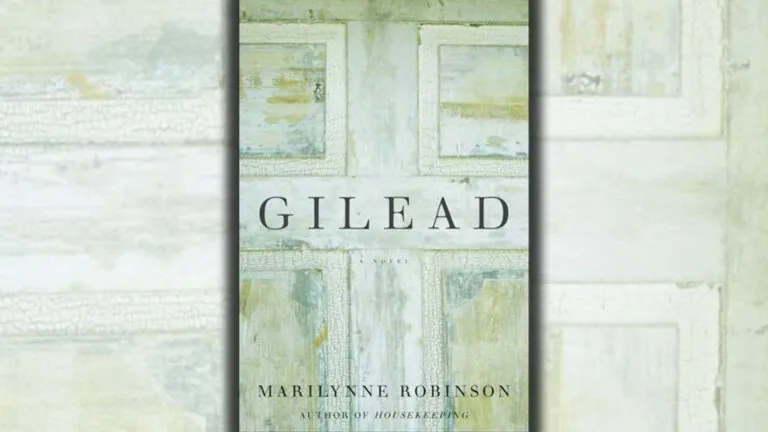
The cover of the edition that I read of Gilead confirms that view of the “Balm of Gilead.” It shows a portion of a door panel – probably from the old church in which Reverend John Ames preaches – in which the crosspieces between the wooden panes of the door form a cross. In this sense the balm of Gilead certainly appears to be identified on the cover as the gospel of Christ.
Real balm for real woes
Reverend John Ames certainly is in need of balm, of comfort, both for himself and for others. The conflict in the novel centers not so much on whether Christ is that comfort (as Lord’s Day 1 of the Heidelberg Catechism tells us), but whether we can feel His comfort in the Gilead of our difficult daily lives. Many of us perhaps find it easier to believe in Christ’s comfort in the abstract than to apply it in the concrete gritty details of sometimes strained family relationships and the aging of ourselves and others. John Ames reveals his struggles with his loneliness and envy of others’ large families after losing both wife and newborn son at a young age. Then at seventy-six, deeply in love with his second, much younger wife, who has borne him a son, he suffers from the knowledge that his heart is dangerously weak. The entire novel is his letter to his seven-year-old son, so that if John Ames dies suddenly, the son will have some understanding of his absent father. The minister reveals that his father and grandfather, also preachers, have also felt a need for comfort in the face of what they perceived as the barrenness of Gilead. His grandfather, an abolitionist before and during the American Civil War, is broken finally by the fact that neither the people of Gilead nor his own son (the narrator’s father) shares his burning passion for justice for the slaves. John Ames’ father has nearly the opposite concern in his reaction to his own father’s involvement in abolitionist violence, and becomes a strong pacifist. John Ames himself struggles with just how to integrate his own convictions into his preaching without doing violence to his calling or the word of God. Both he and his father also struggle with how to relate to and remember John Ames’ spiritually strayed brother Edward. Finally, and most importantly, John Ames struggles with how to deal with another prodigal, the son Jack of his Presbyterian minister friend Boughton.
What makes this central conflict more poignant is the fact that the young Jack Boughton is actually originally named after John Ames. Jack’s return to Gilead after more than twenty years away continually strains Reverend Ames’ spiritual resources. Reverend Ames does not know whether to forgive Jack (who has never offended him personally in any meaningful way), to warn others against him (without any certain knowledge of Jack’s intentions), or to minister to him in some way (even as Jack seemingly mocks Reverend Ames’ Calvinist beliefs). One of the ways Reverend Ames’ struggles are shown is in his difficulty with getting sufficient sleep. He feels both that he needs to pray more to sleep well, and that he needs to sleep more to pray – and love – properly. When we suffer emotionally or spiritually (for ourselves or others), we feel these same strains and tensions.
Well-expressed wonder
Part of what sustains Reverend Ames in all his troubles is his keen sense, over and over, of the beauty of life (even in the shadow of death) and of the joy awaiting us in heaven. Here are just two samples of such a poetic appreciation of both this life and the next:
I have been thinking about existence lately. In fact, I have been so full of admiration for existence that I have hardly been able to enjoy it properly. As I was walking up to the church this morning, I passed that row of big oaks by the war memorial – if you remember them – and I thought of another morning, fall a year or two ago, when they were dropping their acorns thick as hail almost…. [T]here was such energy in the things transpiring among those trees, like a storm, like travail…. and I thought, It is all still new to me. I have lived my life on the prairie and a line of oak trees can still astonish me. (56-57)
Boughton says he has more ideas about heaven every day. He said, “Mainly I just think about the splendors of the world and multiply by two….” So he’s just sitting there multiplying the feel of the wind by two, multiplying the smell of the grass by two. (147)
Although Reverend Ames copes with life (and his approaching death) through a simple gratitude for God’s creation, dealing with Jack Boughton is not so easy. The end of the novel shows some of Reverend Ames’ tensions resolved by his willingness (worked by God’s grace) to do two things – to risk himself emotionally by loving (rather than simply tolerating) the prodigal, and to then leave that prodigal to God’s working. After Jack reveals a secret about his own past that Reverend Ames cannot pass on even to the young Boughton’s father, Reverend Ames finally blesses Jack with the same blessing that we receive from Numbers 6:24-26 in church. Since Jack is leaving Gilead, Reverend Ames cannot, of course, tell the effect of his benediction, but significantly, the novel ends with echoes of two earlier themes. First, Reverend Ames stresses to his son his belief that Gilead is, in all its backwater barrenness, a beautiful place in God’s creation:
To me it seems rather Christlike to be as unadorned as this place is, as little regarded. I can’t help imagining that you leave sooner or later, and it’s fine if you have done that, or you mean to do it. This whole town does look like whatever hope becomes after it begins to weary a little, then weary a little more. But hope deferred is still hope. I love this town. I think sometimes of going into the ground here as a last wild gesture of love – I too will smolder away the time until the great and general incandescence. (246 -247)
Finally, Reverend Ames changes his attitude to prayer and rest in his fading life. Instead of praying for the peace that will give him better sleep, or sleeping so that he can pray more properly, he looks forward confidently in the peace of Christ to refreshment in both prayer and slumber:
I’ll pray that you grow up a brave man in a brave country. I will pray you find a way to be useful. I’ll pray, and then I’ll sleep. (247)
Two cautions
Two cautions: First, I realize that the hymn at the beginning of this article could be seen as Arminian, depending on whether you interpret the line “He died for all” as violating the idea of limited atonement spoken of in our Canons of Dort. In the same way, the novel’s treatment of prodigals like Ames’ brother Edward and Jack Boughton could be seen either as naïvely universalist (“In the end, God loves everybody…”), which is wrong; or as simply hopeful (“Who knows what God may do in the lives of the straying sheep, even when we have lost contact with them?”), which is right.
Secondly, Marilynne Robinson distances herself from what an interviewer calls “fundamentalists” by stressing the complexity of Scriptural interpretation. Some of her minister narrator’s applications of the Old Testament, or of Protestant theology, may strike readers as rather strained. In the same interview, she also criticizes some of those who apply their faith to politics in what she feels is a “coercive and exclusivist” way. It is not clear to me what her attitude to Reformed participation in politics might be. Thoughtful readers and listeners can draw their own conclusions.
In the end, thoughtful readers can indeed draw not just conclusions, but some real insight into the nature of Christian compassion, from a novel that makes its readers both think and feel deeply.
Works Cited or Consulted
“Balsam of Mecca.” Wikipedia. http://en.wikipedia.org/wiki/Balsam_of_Mecca. (June 7, 2008.)
Robinson, Marilynne. Gilead. New York: Farrar, Strauss, and Giroux, 2004.
“There Is a Balm in Gilead.” THE CYBER HYMNAL. http://www.hymntime.com/tch/htm/t/i/s/a/tisabalm.htm. (June 7, 2008.)
“Writer Marilynne Robinson on ‘Gilead.’” February 8, 2005. Radio interview on Fresh Air by Terry Gross with Marilynne Robinson. NPR. www.npr.org/templates/story/story.php?storyId=4490635. (June 7, 2008.)
This was first published in the September 2008 issue.