Transparent heart icon with white outline and + sign.

Life's busy, read it when you're ready!

Create a free account to save articles for later, keep track of past articles you’ve read, and receive exclusive access to all RP resources.

White magnifying glass.

Search thousands of RP articles

Helping you think, speak, and act in Christ.

Open envelope icon with @ symbol

Get Articles Delivered!

Helping you think, speak, and act in Christ. delivered direct to your Inbox!

Apologetics 101, Pro-life - Abortion

Apologetics 101: Stay on message

Step 1. Figure out what you’re really trying to say
Step 2. Don’t let anyone or anything distract you from saying it

*****

Scott Klusendorf is a full-time pro-life apologist, which means he gets screamed at a lot. One of the more common squawks goes something like this:

“You aren’t pro-life; you’re just pro-birth! You want to tell women what they can do with their bodies, and don’t give a rip what happens to the kid after it’s born!”

How would you respond? God tells us that sometimes silence is the best response. He warns us that trying to be heard over a red-faced, spittle-spewing, murder-marketer’s screams will only make us look just as foolish (Prov. 26:4).

But what about when the accuser really wants a response? What about when there is a listening audience gathered round? How should we answer then?

We could point to the pro-lifers we know who donate to, or volunteer at, pregnancy centers. We could list everyone we know who’ve adopted or fostered children. And for good measure we might mention the way our churches care for the elderly and the sick, and the unemployed, and just generally show love for our born neighbors too. If we’re feeling feisty, we might even go on the offensive and ask, “How much time and money do you donate to care for others?” knowing that the typical critic is doing nothing or next to it.

That’s an answer that might shut them up.

But it’s not the answer Scott Klusendorf gives.

He goes a different direction because he understands the abortion debate is largely one of truth versus, not simply lies, but evasion. The other side doesn’t want to debate whether the unborn are precious human beings like you and I; instead they sidetrack the discussion to any other topic. They’ll talk about how poor some mothers are, and how unwanted some babies are. They’ll attack men for daring to speak on the issue. In the latest pro-abortion stunt, groups of women will parade around in red dresses patterned after victims’ attire in a dystopian novel about political leaders who get away with ritual rape. The accusation that loving unborn babies is akin to rape is as bizarre as it is repugnant.

But as much as insults hurt, they don’t do the same damage as suction machines. That’s why our focus has to be on the unborn, and sharing where their worth comes from. As much as abortion advocates want to sidetrack the issue, we can’t let them divert us from highlighting how our country’s smallest citizens are being murdered.

How do we stay on message? By absorbing the insult. If they want to argue that pro-lifers don’t give a rip about children once they are born, we can grant their point and play a game of “what if…” Klusendorf’s response to attacks goes something like this:

“What if I was the cold-hearted jerk you’re making me out to be? What if I was the worst human being in the world? How does me being a jerk have any impact on the humanity of the unborn?”

When Kristan Hawkins, president of the Students for Life of America, was asked why pro-lifers weren’t offering solutions for the foster-care crisis she played the “what if” game too. What if the accusation was true? What if pro-lifers were only concerned with the unborn? She asked her accuser: “Are you upset that the American Diabetes Association doesn’t fight cancer?” She continued:

“There is no other act of violence that kills more people every single day in America and across the world, than abortion. There’s nothing wrong with me fighting, and spending 100% of my time doing it. Just like there’s nothing wrong with the American Diabetes Association putting 100% of their money, their research and time behind curing Juvenile Diabetes…. The reality is, you don’t really care what I do. That I support children in third world countries. Or that I might be volunteering in a soup kitchen....  It’s just an argument to stop the actual discussion from happening, which is that abortion is a moral wrong and it should be stopped.”

There’s an old joke about a pastor who, in his sermon’s margins, wrote: ”Point weak here; thump pulpit harder.” The world has no strong points, so they have to pound the podium till they bleed, shrieking their insults to try to drown out the Truth. They don’t want to have the debate.

We can’t let them distract us from it.

As the Westminster Shorter Catechism explains, we’re on Earth to glorify God and enjoy Him forever. When we make His glory our first concern, we won’t sweat it when someone attacks our name – that won’t stop us from talking about God’s Truth. When we’re enjoying His love we won’t worry about having the world’s approval – that can’t stop us from defending unborn children made in His image. And when we recognize the world only hates us because they hated Him first (John 15:18) we will rejoice in the good company we are keeping.

This article was first published in the May/June 2019 issue of the magazine.

Red heart icon with + sign.
Pro-life - Abortion

An amazing, horrible, inspiring, heart-breaking, simply massive display!

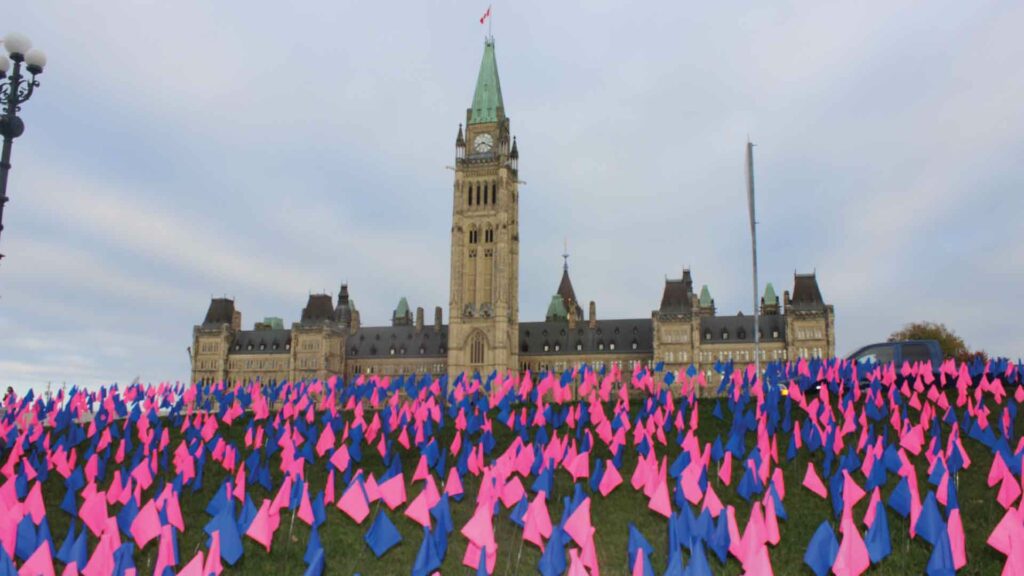
This blast from the past appeared in the magazine 10 years ago in the October 2014 issue. ***** Some injustices are on such a sheer scale as to be beyond comprehending. That's how it is with abortion in Canada - the number of dead are so large as to seem unreal. What does it mean that the equivalent of a city the size of Chilliwack, or Red Deer, or Brantford are killed each year? When we hear that more than 300 children a day are killed, does that number mean something tangible and understandable to us? It probably does not – the sheer scale of this evil is just too enormous. Our mission, then, was to make the incomprehensible understandable. So on the morning of October 2 the staff of ARPA Canada and more than 80 volunteers headed to Parliament hill to plant 50,000 pink and 50,000 blue irrigation flags on the front boulevard. Each flag represented a child who had been killed by abortion in the last year: 100,000 preborn children are killed each year in our country. Background This idea of a massive flag display came from my sister, who showed me pictures of some flag displays like it in the United States. The visual impact was impressive. I brought the idea forward to my colleagues. The largest display that we could find in the USA involved about 65,000 flags. Would we be able to pull off 100,000? How would we get permission, who would pay for it, and what impact could it have? When we first approached Parliament with the idea, we were denied permission. It took multiple tries and a lot of communication from our Legal Counsel Andre Schutten before permission was granted. However, we were not allowed to put the flags into the main lawn that is right in front of Centre Block and the Peace Tower. We had to use the front boulevard. After looking at this closer, we realized that the boulevard had benefits which the front lawn didn’t. It extends much longer, is angled towards the busy Wellington Street, and can’t be missed by most of the MPs and public in the area. Finding close to 100 volunteers who could commit to a full day wasn't easy, especially given that we decided to keep this project as quiet as possible because we did not want a counter-protest to get all the attention and distract from the powerful message. Thankfully, about 40-50 brave youth and adults travelled from southern Ontario and as far as Alberta. Another 30-40 from Ottawa came as well, representing both Jubilee church and other ARPA friends from Ottawa’s broader pro-life and Christian community. A strong majority of the volunteers were youth. We are thankful that their parents allowed them to skip school for a day and we are confident that this was an educational experience they won’t forget. The Day-of ARPA staff met at 5:30 am, driving in Bruce Deboer’s now famous 15-passenger van, decked out in pro-life graphics and weighed down with 100,000 flags. We dropped the flags off in bundles of 1,000 pink and 1,000 blue, based on our previous calculations for lawn coverage. At 6:45 the volunteers all met at the Centennial flame, in front of the Peace Tower. Campaign director Mike Schouten explained the procedure for the day, Grassroots director Bruce Deboer detailed the logistics of filling the lawn evenly with the flags, and I led the team in devotions, reading from Psalm 72 which prophetically speaks about our King Jesus Christ and his regard for the vulnerable. Verses from this Psalm are appropriately carved in the Peace Tower that was towering above us. The volunteers spent the next 1.5 hours inserting flags into the grass, and when the flags were all up we all donned pink and blue t-shirts and brought out the large banners explaining what the display was about. Thankfully, no counter-protest was present and none formed all day. We spent the day handing out colorful cards which explained the cause and pointed to the WeNeedaLAW.ca website. At 11:00 we held a press conference, accompanied by Members of Parliament Stella Ambler and Harold Albrect. It was an intentional decision to not expand the group of MPs – the goal was that the focus stayed on the grassroots Canadian public calling for justice, not the MPs. But having a respected male and female MP still made it clear to the media that there was a lot of support for what we are doing from within the walls of Parliament. We continued to distribute the information tracts and talk with the MPs and public until 4:00 pm. The consensus was unanimous – this was an amazing day. But what impact did it have? Impact #1: Visual Before the flags were all up I looked down the boulevard and was caught off guard by the sea of flags. It was literally awe-inspiring and heart moving – far beyond what I expected. By the time they were all up, anyone who came to Parliament Hill not only noticed it, they were blown away. From construction workers who were making renovations to one of the Parliament buildings, to the MPs and staff, to the media, all were visibly moved. The sheer beauty and size of the display led many to ask, “what is this all about?” As soon as we explained it represented 100,000 abortions, it was clear that the message hit home. “Wow” was a constant sentiment we heard. For example, early in the morning a TV cameraman from one of Canada’s leading national stations came by. He started filming what he saw, turned back towards his office but then stopped, pulled out his camera again and did more filming. When we approached him to ask if he would like to arrange an interview he exclaimed that the visuals of this were so staggering that it did not even need words. He quipped that his editor would not appreciate the fact that he took far more footage than usual – he couldn’t help himself. Impact #2: Parliament We were able to interact with dozens of MPs and Senators. Many of them intentionally came out to us to talk, often expressing their immense appreciation and awe. They had never seen anything like this before. As a result, some pro-abortion MPs, like NDP leader Thomas Mulcair, came by to ask what was going on and how we got permission to do this. And pro-life MPs were emboldened. They started tweeting pictures of it, leading their colleagues to do the same. One MP had told me the day before that he was not comfortable promoting the display and wasn’t sure if he would publicize it. But when he saw it, saw his colleagues promoting it, and saw how peaceful and positive it was, he did at least three tweets about it. MP Harold Albrecht did an extensive in-studio TV interview with Sun New, about our display. He sounded like an ambassador for WeNeedaLAW and noted that he was so proud to see how civil and positive we were, engaging on such a sensitive issue. Towards the end of the day I stood outside of Centre block as the MPs were leaving after Question Period. Dozens streamed out and, judging from their responses to our information card, every single one knew what the display was about. One MP commented to us that early in the morning the MPs in the Parliamentary restaurant were going to the windows, checking out what we were doing as we were setting it up. Another MP said that he was in the elevator with four other MPs and they were asking what it was all about, giving him an opportunity to share exactly what it was about. Another MP, who we didn’t know prior, was caught off guard by the display as she stepped out of her office. I had a chance to walk with her from her office to Centre Block. By the end of the walk, she asked for pictures of her among the flags and volunteers so that she could share it with her constituency. One MP was so encouraged by the flags he asked if he could give a video message to our supporters, thanking them (you). You can find that on the WeNeedaLAW.ca website. Watch it and be encouraged. Impact #3: Media, conventional and social Early in morning the story had already been picked up a large local radio station so commuters were hearing about it every half-hour on the news. It was featured in two different shows on Sun News (the interview with Harold Albrecht as well as a separate in-studio interview with Mike Schouten). Both of these featured extensive video of the display and our press conference. They were very positive – almost to the point of being a lengthy endorsement. Other TV cameras filmed the display throughout the day, though it is hard to know where this went. We are beginning to see glimpses of it spread throughout the Internet. For example, it was Yahoo News’ featured “photo of the day,” as well as being one of the pictures of the day for BBC News website. Outside of the mainstream, the story was picked up by the largest pro-life sites in North America as a lead story. But one of the biggest impacts was via social media. Our supporters, including many of you, shared the pictures far and wide – reaching tens of thousands of people from every corner of Canada within hours. One of our volunteers who lived in Ottawa commented to me that she helped with the flag set-up but then had to go to her university class. She told one of the other students what she was dong early that morning on Parliament Hill. That student happened to be on Facebook at the time and showed her a picture of the display on her feed. Although she was not aware the display was even happening, she was made aware thanks to people who shared the pictures to all their friends. It was so exciting to get emails and text messages from our friends and supporters from around the country. They were seeing the pictures and cheering us on. Impact #4: For the volunteers Perhaps the most rewarding aspect of the entire display was the impact it had and will continue to have on the volunteers. Many of the people who helped us had never done anything like this before. Yes, they were aware of the issue and have talked about abortion with family and friends. But it is something completely different to stand on a busy street in downtown Ottawa, wearing a bright t-shirt and engaging passersby about the delicate issue. One lesson that stands out above most others from my career is that talking and writing about an issue is nothing like having to directly bring that issue to a secular audience. Many of the women walking by have had abortions. Others were experts and professionals. We were 12-year-old students and 67-year-old seniors, and many of us had never done anything like this. When we take our convictions to the next level – action – it results in changed hearts and minds and gives us the courage and experience to keep doing this the rest of our lives. This makes it easier to apply our faith to other issues and people, including outside of the political realm. As our society becomes increasingly secular, this is so important. I was moved by the stories from the volunteers who shared the conversations and their responses to people going by. Their parents, pastors, and teachers must have done a good job educating them because they demonstrated grace-filled and truth-filled responses to the difficult questions and challenges. For example, one pro-abortion man challenged a couple of young teen volunteers to stop “imposing their religion” on women and society. By the end of the conversation he said, “you sure know your stuff!” Never once during the day did I see any of the volunteers acting disrespectfully or responding inappropriately – keep in mind that many were young teens who were skipping school. This was noticed! One MP who we had never interacted with us before was so impressed with the conduct that he joined us after the day was over and made a speech, standing on the edge of the centennial flame fountain, expressing how impressed he was with the witness of the volunteers. Moving forward ARPA has made 5 separate display packages, each with 10,000 flags, with the purpose of having them move through Ontario, Manitoba, Alberta, and BC, reaching towns and cities throughout Canada in the years to come. We are looking to you to make use of these! They include banners, information tracts, and t-shirts. And it comes at no cost! We are encouraging that they be used beyond the Reformed community. They can be shared with all pro-life groups. Contact ARPACanada.ca for more information. We thank God for the freedom, the means, and the level paths that he provided to turn one idea into a strong voice for justice for our preborn neighbors. ...

Red heart icon with + sign.
News, Pro-life - Abortion

What does Pierre Poilievre think about the unborn?

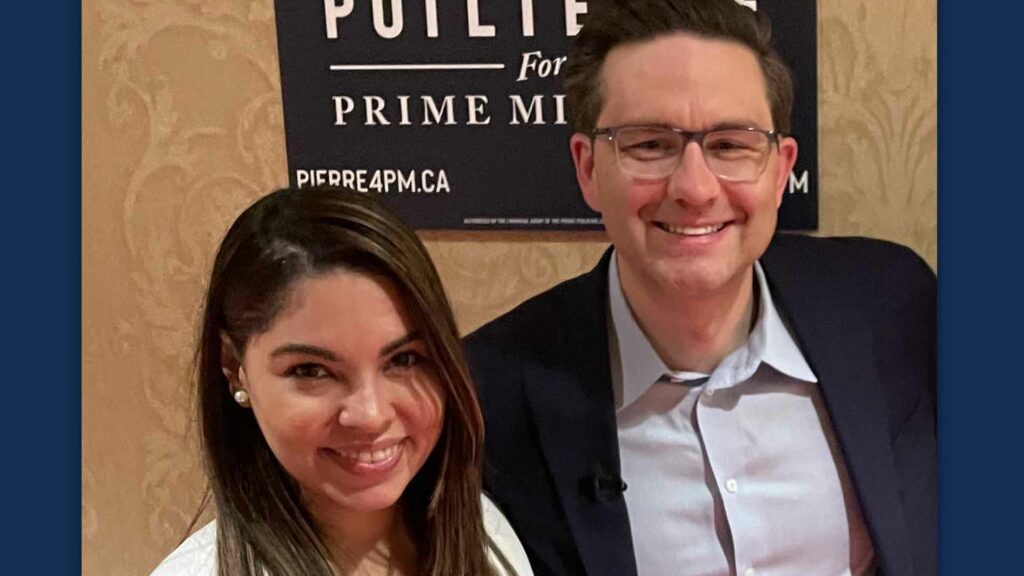
In a Dec. 11 profile published by le journal de québec, the wife of Conservative leader Pierre Poilievre talked about the couple’s attitude toward the unborn. Anaida Poilievre told the newspaper (in French): “We are pro-choice. We decided on this. I am a woman from Quebec, I grew up here. And it’s part of my values.” But one of Canada’s most prominent abortion defenders, Joyce Arthur, doesn’t think Poilievre is really on her side. She argued back in the summer of 2022 that while Poilievre had declared himself both “pro-choice” and “pro-choix” at the French-language leadership debate earlier that year, his voting record indicated he was “anti-choice.” So which is it? Is Poilievre somehow against the slaughter of the unborn, even as he has verbally defended a mother’s right to murder her child? The voting record that Arthur points to shows Poilievre voted for a number of bills which did seek to protect the unborn. But these were protections that pro-choicers should have supported too… if they were, in fact, pro-choice and not simply pro-abortion. Poilievre voted for bills that would have made it a crime to kill or harm an unborn child that the mother wanted to keep. He also supporting penalizing attempts to coerce a woman into having an abortion she didn’t want. Even if we were, for the sake of argument, to adopt the pro-choice notion that a mother’s decision is what makes an unborn baby valuable, then one could be entirely pro-choice (or “pro-choix”) and still support these bills. That same voting record also shows that Poilievre voted against a pro-life bill that would have banned sex-selective abortions. So, Arthur doesn’t make a compelling case for Poilievre to be anything other than what he, and his wife, have said he is. That said, Poilievre’s Conservatives still welcome pro-life MPs – the only party in Parliament to do so – and he himself has voted for some of the private member's bills the party’s pro-life MPs have offered that would have protected at least some unborn children. As leader he is courting the pro-choice vote, but he is still looking for the pro-life vote too. So any interaction pro-life voters have with him will need to be done with our eyes wide open. Photo is adapted from the original here by Wikipageedittor099 and is licensed under a CC BY-SA 4.0 agreement....

Red heart icon with + sign.
Pro-life - Abortion, RPTV

Pro-life legislation attempts in Canada

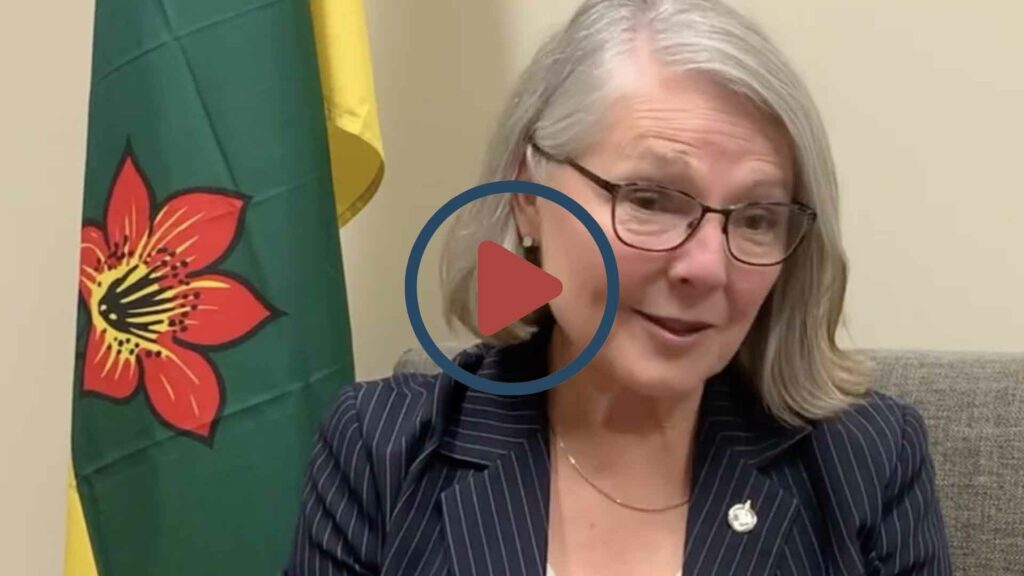
TRANSCRIPT Welcome to Reformed Perspective. I'm Alexander Ellison. Since the Morgentaler Decision in 1988 there has been no abortion law in Canada. The Supreme Court struck down the existing law, stating that it hindered equal access to abortion. However, it's essential to note that the Court's decision did not endorse the absence of federal legislation on abortion, or protection for pre-born children. In fact, it affirmed Parliament's right to create new legislation. In response to the Morgentaler Decision, Brian Mulroney's Conservative government attempted to draft a compromise abortion law in 1990. Despite efforts to balance pro-life and abortion advocate perspectives, Bill C-43, which permitted abortion only if a physician deemed it necessary for a woman's health, passed in the House of Commons, but was later defeated in the Senate. Since then, Member of Parliament Cathay Wagantall has championed change by introducing three private member's bills, each aimed at recognizing and upholding the inherent value of human life. Cathay Wagantall: So, I'm Cathay Wagantall and the Member of Parliament for Yorkton-Melville which is a riding along the Manitoba border, a couple hours north of Regina, our capital. It's 42,000 square kilometers and it's rural and I've been a Member of Parliament for eight years now. The first was – we called it Cassie and Molly's Law – protecting pregnant women and their pre-born children. An individual named Jeff from Windsor had reached out. I think at one point in time he had become friends with folks at ARPA Canada. It was actually Mike Schouten who introduced me to the possibility of doing a bill in relation to what happened to Jeff when he lost his partner Cassie who was 7 months pregnant at the time. They weren't together anymore, but they were still in a very good relationship and had named Molly Molly and were ready to raise her together in their homes about a block apart. And was attacked in her home by someone who knew both of them and it was horrific. What Jeff didn't expect, and was thoroughly blown away, was that there was no recognition of Molly. So Cassie and Molly's Law was to protect pre-born children by basically bringing in a law that gave serious criminal charges for also either injuring or taking the life of a pre-born child. That bill used words like "pre-born child" which is in the Criminal Code but not in this context. And so it, of course, raised the angst of the House, well pretty well every other party, who are very very anti- pro-life legislation, and are very pro-abortion. So that's the direction that they wanted to take this bill, which they did. But I was very fortunate that my colleagues all supported it, except for two and one abstained for various reasons. But that being said, it did wake the House up to the fact that there was someone there who was willing to bring those issues to the floor. When I do trade shows or anything like that, I always have petitions. So I would have one on Firearms – I live in rural Saskatchewan – one on palliative care, and one on life issues. And I realized that although people want abortion to be available, they have this idea that it's already a law in Canada and it's minimal. So when I brought forward the next it was a sex-selection abortion bill, that basically should be illegal. And God is really good; He times things often to assist with what He's put you there to do, and at the same time a poll came out that made it clear that in Canada Canadians are not as divided on this issue, is what it said, as honestly, the media and politicians want you to think they are. What it did is it showed that the majority of Canadians want access to abortion, but as you dug deeper with their questions they totally want a law against sex selective abortion, late term abortion, they want more pregnancy counseling centers, not less, and they want doctors to have to share with their patient exactly what the dangers and and potential complications are of this type of surgery, which is not required in Canada. I mean, I've had my gallbladder out; I spent half a day at the hospital being told a number of things, and that does not happen in this case. So I brought it forward and people would come to sign my petitions and they'd go "I believe in access to abortion, I'm a nurse" or whatever, and I'd say "Oh, so you're okay with sex-selective abortion?" and they said "No." And then I explained the dynamics that are in Canada right now, where besides North Korea we're the only country without any laws. And they would sign my petition. So I realized that although was not going to pass in the House, and this is one of the challenges of this area, is that you have to win in different ways until it becomes something that can happen within our government, and because of the way the House is set up right now, the only political party that you can be a part of, that does not insist that you have to be pro-abortion is the Conservative Party. So you know you're not going to win a vote in the House. But it's important that we always keep these things in front of Canadians. I believe that as legislators we have a responsibility to respond to culture, but we are also responsible for shaping what our values are in Canada and this is part of that. So again, of course, the bill didn't pass and it was very vital if you ever want to go and listen to some of the speeches it's very clear that there's a lot of anger, and and an attempt to make those of us that are pro-life look like terrible people. Yeah, it's the House of Commons. But we made headway because across the country people woke up to realize that in Canada we we don't have these laws. As Wagantall mentions with the current political climate it's challenging to get parties with hard stances on abortion to side with pro-life bills. A policy analyst with ARPA who has worked on these pro-life bills explains why she says they take the incremental approach: Anna Nienhuis: Yeah, so we take an incremental approach just because of the legal reality in Canada. Right now there is no abortion law, so there is no legal protection for any pre-born children, and there's this polarized debate that kind of pits the pro-choice and pro-life side against each other, so we work to find common ground where Canadians can agree so that we can protect some pre-born children while we work for that cultural shift to be able to protect them all. This past spring Wagantall had the opportunity to introduce another private member's bill. Cathay Wagantall: I have to admit that after the third election I said, okay, Lord, I'd be okay if I didn't have another private member's bill, and He said no, nope, that's not how it's going to be, so I did get an opportunity again this last time around – number 62 or 63 – and I brought forward the violence against pregnant women act which is similar to Cassie and Molly's law but far more targeted. It didn't bring in any sentencing or anything like that but what it did is said that if an individual has committed this crime and that crime has been recognized by the courts and this person has been found guilty then the judge must consider that a child was also physically harmed or murdered as an aggravating factor and what that means is they absolutely must take that into account when they're sentencing and there's only about a handful of, circumstances where aggravating factors are required, but this is about violence against pregnant women and violence against women is a priority of this government and something that they want to champion that they're about. And, of course, I was able to indicate that well if that's the case then they definitely should be supporting this bill and again they took the same approach they always do, which is attack in the House of Commons. Then the Prime Minister, and a number of women Liberal Members of Parliament did a Twitter attack on me, and of course they tried to make it sound like this is all about abortion. Again, it's a hidden attempt, all that kind of thing. And it was amazing because, right across the country, people responded to that with their comments with saying here's the actual feedback on this bill – it's two sentences long and it's about women who want to have a child – and they really lit into them for taking advantage of this in the way that they did. Now, again, of course it didn't change the vote in the House unfortunately. They're representing – everyone else in the House of Commons is representing – about 16% of Canadians who are on the extreme perspective of abortion at any time for any reason. So it was exciting. It was exciting. Fortunately my leader was very supportive, as was our whole caucus. So we feel like a number of other issues around , and circumstances where this government is offside with Canadians because they're not out there representing the true perspectives, they have their own ideology and their own purposes, and their own attempts to use an issue as a wedge issue, that they're losing the ground to do that. Having a child is the most impressive thing that a human woman can do, is have those children. And there are many women who would love to have children that can't. And we need to, at the very least, continue to push for the fact that this is something on which women are being misled. They're being misled to think that they can't afford or they can't handle it. We're women; we can handle anything. And sometimes a bad choice is made, but that doesn't mean that you have a bad choice and you follow it up with another bad choice. So it's important to me that we celebrate life, and the beginning of that is we're knit together in our mothers' wombs (Ps. 139:13) and it's a spiritual experience and a privilege to be a mom and to have a child. Thanks for watching this week's episode. Please feel free to like this video and share it with family and friends. For Reformed Perspective, I'm Alexander Ellison in Ottawa....

Red heart icon with + sign.
News, Pro-life - Abortion

Pro-life flag proposal gets town talking about worldviews

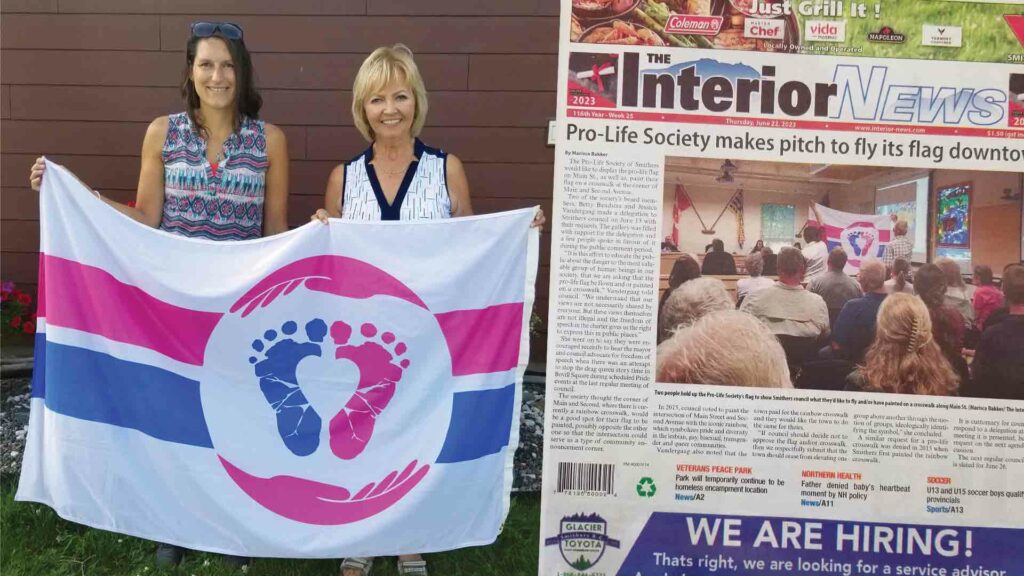
A proposal by the Smithers Pro-Life Society for their community to fly a pro-life flag was unanimously rejected by their town council, but not without exposing their worldviews and getting the entire community talking about life and freedom and what to do when worldviews conflict.  An unlikely catalyst Along with many other communities located towards BC’s west coast, the town of Smithers has embraced a very secular ideology, which it understands to be “progressive.” As a part of its recent “Pride” celebrations, the town welcomed a drag queen story reading for children at the public library. Not impressed, over 800 members of the community signed a petition to express their concerns. Jessica Vandergaag, a board member of Smithers Pro-Life, was in attendance when the town council responded to this petition. “The councillors reiterated over and over how inclusive and diverse our community is and that the public square was for ‘everyone.’ Their words rang through my head all evening.  A thought came to mind – why not ask for the pro-life flag now when we can hold them to their words of inclusion and diversity? While they still remember the words they said!” Since the town flies rainbow flags on its main street, Smithers Pro-Life was planning to request next year that a pro-life flag be hung as well. But with the town council’s declaration that the public square is for everyone, now seemed the time to act. In the same month Vandergaag, along with board member Betty Bandstra, stood before Smithers council, backed by a crowd of supporters in the gallery. They requested that the town hang the pro-life flag or paint it on a crosswalk in the same intersection as the rainbow crosswalk. Vandergaag proceeded to give an impassioned speech to Council, explaining that “the pre-born remain the group that is most ignored, even though it has the highest death rate, 100,000 killed per year in Canada.” After quoting the mayor’s and councillors recent comments about welcoming different perspectives and worldviews, Vandergaag had the pro-life flag held up, and she made the case that the most vulnerable deserve public recognition “because it is through the awareness of human rights abuses that empathy is developed and public opinion is changed.” A confused response What was the town council going to do? How could they turn down a request for a symbol that shows inclusiveness for vulnerable citizens, with so many in the community demonstrating their support? The local newspaper gave the story its front page, providing coverage that was surprisingly fair to Smithers Pro-Life. Council put the request on their next meeting agenda, and the pro-life community showed up once again, filling the gallery to show their support for the initiative. Each council member spoke, and their words exposed the impact this proposal had on their hearts and souls. They were emotional and passionate… and also confused. One council member, Genevieve Patterson, who identified herself as both pro-choice and Christian, was in tears as she shared her story of multiple miscarriages. She explained how she had three pregnancies where the baby had died after the first trimester, requiring her to have a D&C procedure, to remove the baby. She went on to call the D&C her “abortion” and said that “I am grateful for my right to choose. It saved my life.” She added “As a Christian woman, and a leader in my community, I will never use my relationship with God to rationalize my political beliefs, as I believe my relationship with God is just that – my own.” Although everyone should sympathize with her experience, it is a fallacy to compare what she went through with abortion, as an abortion involves purposeful action to end the life of a preborn child. The pro-life perspective would adamantly support her in her D&C. And although she professes to keep her faith separate from her political beliefs, her pro-choice stance made it very clear that her beliefs dictated her political beliefs. The one member of Council who is known as a Christian and a member of a local Reformed church also voted against the flag. He explained that the feedback he read about the proposal included the concern that: “there will be women in our town, who might have had an abortion, not because they wanted to but because life circumstances forced them to such a decision. The presence of a pro-life flag or crosswalk could be very triggering.” He could understand why they would conclude that. His other comments made it evident that his main concern was about how people from both sides of these issues talked about the other side. Somewhat ironically, the only Council member who showed support for the proposal explained that he was an atheist, and had opposed the original rainbow crosswalk proposal on the grounds that it would raise one ideology or group over others. He sees this current proposal as proof that he was correct, and voted against it for the same reason as the rainbow crosswalk. He said he wanted to see a new proposal to not allow the town to make any more symbolic statements like the rainbow crosswalk, though he wouldn’t remove that crosswalk now because he isn’t in favour of removing symbols. Gladys Atrill, the town’s mayor, started her speech by reflecting that “residents of Smithers have challenged council in the past two weeks with big issues: issues about who we are, what we believe, our worldviews, what is OK in public, what symbols we should consider.” She proceeded to contrast the rainbow flag, and its alignment with the Canadian Human Rights Act, with the pro-life flag, which contradicts the reality that abortion is legal in Canada. “As such, I’m not in favor of placing symbols in public places that relate to health procedures since there are many that are viewed as controversial….. Miss Vandergaag linked her strong faith in God to her pro-life belief. Others hold different views, that abortion is a medically-necessary procedure and that women have the right to self-determination.” Mayor Atrill failed to recognize that the right to life is foundational to all other rights and is included in the Canadian Charter of Rights and Freedoms, which the town is bound to uphold. She also failed to recognize that many things were legal and even celebrated in the past which we are ashamed of today (including how women were not recognized as persons under the law). The fact that something is recognized by law doesn’t make it right. To add to this, the mayor had no issue imposing her worldview (the right to abortion), over Vandergaag’s and others who are pro-life, within the same minute that she claimed that “The debate over abortion belongs at other tables than this one.” From town hall to town square After the town’s unanimous decision against the pro-life flag, the local media covered the story again. And this sparked a conversation that has carried on in the following weeks. In July, a local radio station invited Vandergaag and Bandstra, along with the drag queen story hour host, to an hour-long discussion about the pro-life flag proposal. Although she was nervous about taking part, she reflected after that “the conversation went well and I really felt at the end that God gave me words and guided me through quite the monologue.” She added that the others who took part expressed thanks to her and Bandstra for the civil conversation and the councillor in particular seemed “quite moved” by it. “I really pray and believe that even if it is not aired, that God did some planting there between the six of us.” Reflecting on the whole ordeal, she commented “while the result was not as we hoped, we do believe it to be a positive experience in the grand scheme.” She proceeded to give one example. “I was contacted by a former co-worker, whom I had no idea was pro-life, wondering what the result from Town Council was. Her family was visiting from Ireland and it was a topic of their conversation. I shared that it had been voted down and she expressed her sadness. I was touched that she contacted me and that conversations about it were still happening over a month later!” Not only do these conversations bring attention to our preborn neighbours, they also break through the veneer of “inclusivity” and “equality” that our secular leaders often champion, without having to defend. It was rather obvious that the council members only welcomed some perspectives, and these were ones that aligned with their own worldviews. The antithesis is as real in 2023 as it was in the Garden of Eden. Vandergaag “absolutely recommends” others to do this in their communities, both because of the conversation it creates and as a voice for the preborn who are otherwise not heard. But she also advised that it be done as a “delegation request” rather than simply a letter request. This is a request to address town council in person about a matter that important to a citizen or group, before a decision is made. “Letters can get passed by but a delegation request gets you extra time to present your request and the town council has to act on it with a motion in the following meeting.”...

Red heart icon with + sign.
Pro-life - Abortion

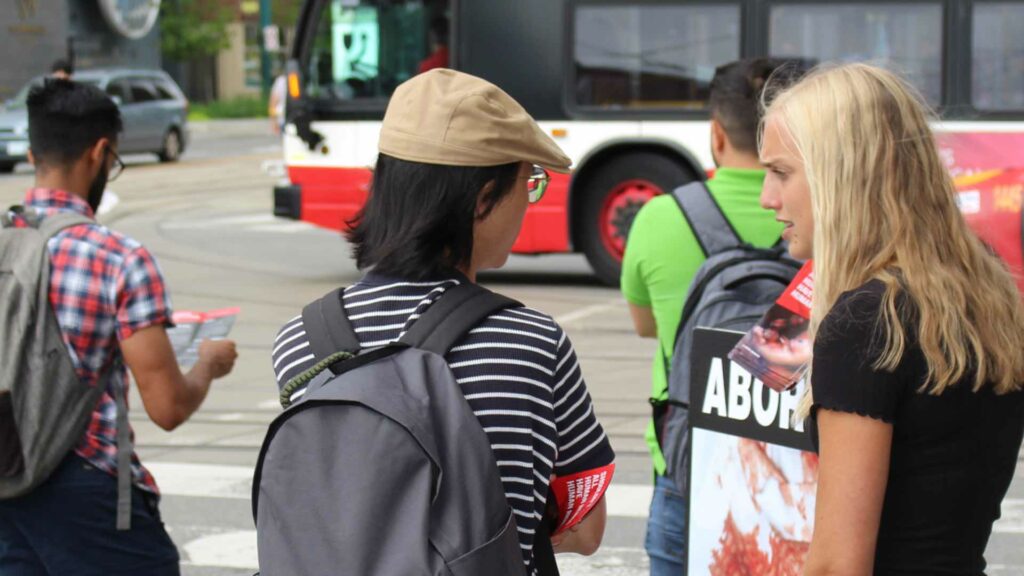
A day in the life of a pro-life intern

A summer internship gives young people an opportunity to build friendships and grow in courage while speaking up for the unborn **** It’s 5:30 AM. My alarm clock goes off. Groggily, I turn it off and roll out of bed. It’s time to get up, go out, and start working to save babies. An hour later finds me driving to today’s postcarding location. I chat with Kim – one of our summer interns – about each other’s weekends. It crosses my mind how if it wasn’t for this awful issue of abortion, I probably never would have met Kim. I hate abortion – but I’m glad I know Kim. Getting the truth out We get out of the car, grab stacks of postcards, and set out. I walk up to the mailbox of the first house and put the postcard in. Back to the street and then up a second driveway. Up and down, back and forth, spreading the truth. It’s a bloody, gory, awful truth, but it’s truth nonetheless, and that’s why we spread it. People need to know. Babies’ lives depend on it. As we enter one neighborhood, children start coming out of their homes. Boys and girls, sleepy-eyed and yawning, lugging backpacks that seem almost as big as they are. I watch them trudge to the bus stop, the number of them growing. We’re here because there should be more of them, I think to myself. For every three children walking to the bus stop, there should be one more. I imagine a fourth child for every three and am struck by how those children did exist – they were just killed before they had a chance to wait for the bus on a sleepy weekday morning. Several hundred houses later and we meet up with the rest of our team. Next on the schedule is a “Choice” Chain; here, we hold signs showing abortion and engage pedestrians in conversation. Afterward, we debrief as a team, sharing conversations that culminated in changed hearts and minds. It’s always encouraging getting to talk to a culture and to watch people shift their views on abortion. It’s encouraging to be with so many young people who are a part of making that change. At the end of the day, we unpack our supplies and everyone heads off to their own homes. I’m about to go home myself when I hear something. Back in the room where we keep our supplies, on the floor amidst scattered postcards, I see Kim, crying. I sit down, put my arm around her, and stay. She keeps crying. “Whose idea was this?” she sobs. Now I’m crying too. “Whose idea was it to kill babies?” We sit. We cry. We look at the postcards around us and think of all the babies who died today. Just two girls, surrounded by so much evil, so much death. Afterward, I can’t remember exactly what else we said to each other, just that there was brokenness, and grief, and longing for a better day. Anger and courage Later, I reflect on the supply room, the postcards on the floor, and crying with Kim. I think of a quote by Augustine: “Hope has two beautiful daughters; their names are Anger and Courage. Anger at the way things are and Courage to see that they do not remain as they are.” As I pack lunch and pick out clothes for the following morning, I pray and I plan for courage. Courage to face another day filled with the tragedy of abortion; courage fuelled by the hope we have as we see the results of our efforts in our country day after day; courage as we lean on each other, cry together, and work together.  I hate abortion. I’m glad I know Kim. The Canadian Centre for Bio-ethical Reform is a dynamic pro-life group working to end the ongoing slaughter of 300 unborn Canadian children that happens every day in our country. They are offering a unique summer job opportunity to come help them in this fight. You can learn more about this paid position at EndTheKilling.ca/internships. Deadline to apply is March 18th. Devorah Gilman worked for the Canadian Centre for Bioethical Reform from 2013-2019 (Picture courtesy of CCBR). ...

Red heart icon with + sign.
Pro-life - Abortion

No place for pro-life cynicism

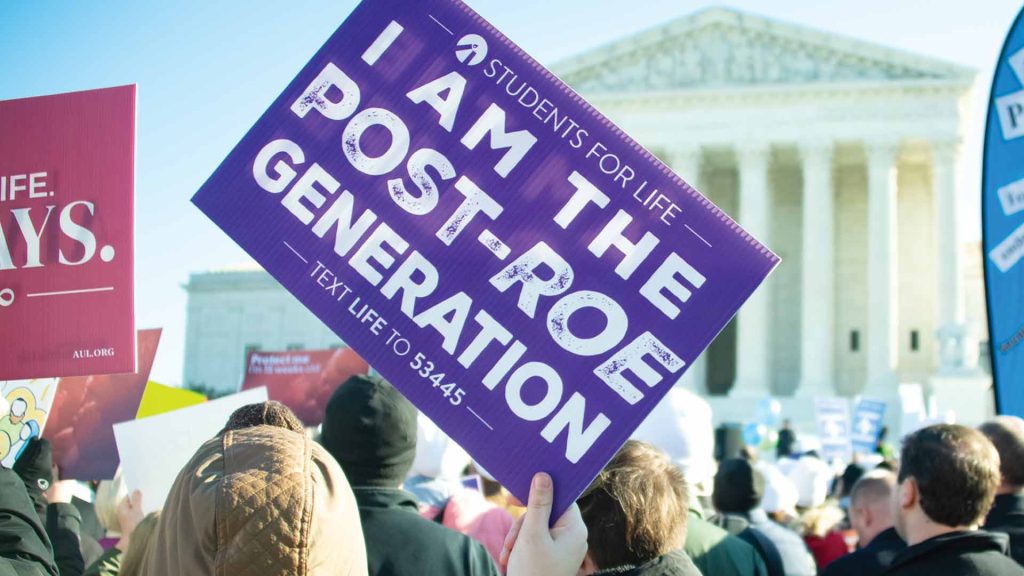
Roe’s reversal shows us what God can accomplish for and through His people.  ***** “In the days when the idea of a surprise pregnancy was only an abstraction, I had never suspected that I could feel fierce love for an embryo. I wanted to discuss my mixed-up feelings with Jon, but I didn’t know how, especially since it was clear that his mind was already made up…. Whatever else I might be able to do for our child, I knew I could never force Jon to love it. Of all the pains that await us in this world, I most desired to protect it from feeling unwanted.” This is how Jess explains her rationale for why she had an abortion. The embryo was loved but unwanted; protected from future emotional pain, but killed. Jess’ story captures so well our culture’s cognitive dissonance regarding life in the womb. We know full well that a pregnant woman has a growing, developing human being in her womb. But we legally allow that human being to be dismembered or poisoned for any reason the mother chooses. Here in Canada, we allow that fate right up to birth. The pro-life movement exists because we see this tragedy, we seek to expose the cognitive dissonance, and we strive to save lives. There are those who are deeply cynical of pro-life work. I’ve had many express to me how futile they think pro-life activism is in a pro-choice culture like Canada. Why the skepticism? Should we really believe that things will only get worse when it comes to abortion laws? That opinion certainly isn’t based on historical trends. Legal slavery was ended, we don’t legally subjugate women anymore, and many oppressive regimes have been defeated. Just because a mountain is difficult to climb, and we can’t see every part of the path from where we stand, doesn’t mean that the mountain is insurmountable. Look south of the border and ask, how many thought Roe v Wade would be overturned in our lifetime? Yet, that happened in June 2022 when the U.S. Supreme Court released their Dobbs decision which found: “The Constitution does not confer a right to abortion; Roe and Casey are overruled; and the authority to regulate abortion is returned to the people and their elected representatives .” This incredibly huge win means that now individual states are free to enact near-total bans of abortion! Examining how this came to be and recognizing the power of God’s hand in human political affairs, is an encouragement and call to action for Canadians who also want to see pre-born children in Canada protected in our lifetime. The state of affairs pre-Roe Unlike Canada, where criminal law is passed federally, in the U.S. criminal laws are passed by the individual states. Alongside Canada and many European countries, there was a growing trend in the U.S. toward legalizing more abortions that started in the 1960s and continued in the 1970s. What I didn’t know until reading the Dobbs decision was how slowly that movement was happening in the U.S. In fact, in 1973 when Roe was decided, 30 states still prohibited abortion at all stages. Well over half the country banned abortion, regardless of the age of the pre-born child. With one fell swoop from the U.S. Supreme Court that all changed, requiring states to allow abortions before the pre-born child was viable – a standard that was preserved and modified in the 1992 Casey decision. Now, in 2022, that decision has been reversed. The pro-life movement in the U.S. has exemplified tireless work toward this day, always striving to produce quality legal literature, educate the public, and continue to work one step at a time. Of course, it wasn’t just the effort of the pro-life movement that brought us to this point. Had Justice Ruth Bader Ginsburg retired during President Obama’s tenure, President Trump would not have had the opportunity to appoint three Supreme Court Justices. Those three justices were needed to overturn Roe. We can praise God for granting growth and in His providence providing favorable circumstances for this huge victory. It clearly was God’s blessing, along with the faithful labor of many, that resulted in this success. But we don’t immediately go back to where we were. We don’t see 30 states banning abortion at all stages. Ground was lost in the decades since Roe, not to mention millions of lives. All to say, this ruling is a victory, but it still comes with mixed emotions. There is still so much more that needs to be done. Yet, as Canadians we can take encouragement from the victory and take note of the work yet to do resulting from the Dobbs decision. Dobbs and freedom An abortion supporter carrying a "Freedom is for every body" sign that is inadvertently pro-life, sharing a message we desperately want the other side to understand. What did Dobbs decide? If you believe one of my law school classmates, “The decision also opens the door to forced abortions. Either way, your uterus belongs to the state now.” How could someone as intelligent as this guy come to such a strange conclusion? It comes from a very deliberate framing of the abortion issue by abortion proponents. We’ve known this for quite a while – we call ourselves pro-life because we want to emphasize that unjustifiably taking a human life is wrong. Abortion advocates call themselves pro-choice because they want to emphasize that mothers ought to be free to make choices. This was described in another abortion case in the United States, this one from 1992 and referred to as Casey. Incidentally, Casey was also overturned by the new Dobbs decision. In Casey, Justice Kennedy said, "At the heart of liberty is the right to define one's own concept of existence, of meaning, of the universe, and of the mystery of human life." The awful extension of having this liberty to define the mystery of human life is that mothers have had the freedom to define pre-born human beings out of existence, therefore making them discardable. The Dobbs decision addresses Justice Kennedy’s definition of liberty head-on by trying to clarify that it is a good thing when, at times, there are limits on liberty. Such a definition of liberty cannot plausibly be absolute, the justices say in Dobbs, because “while individuals are certainly free to think and to say what they wish about ‘existences,’ ‘meaning,’ the ‘universe,’ and ‘the mystery of human life,’ they are not always free to act in accordance with those thoughts.” Liberty with such an individual source cannot be absolute. The state has a role in limiting it. Was my classmate right then? If the State can infringe liberty, does this mean that states are now able to force abortions? Certainly not by the logic in Dobbs. Liberty is important and does require a justification to be impinged. The justification is present here because according to Dobbs, “Abortion destroys what those decisions call ‘potential life’ and what the law at issue in this case regards as the life of an ‘unborn human being.’” That is, you have the freedom to do so much, but you don’t have the freedom to take a life. It’s quite something to see the U.S. Supreme Court say this regarding abortion. Forced motherhood The pro-abortion side is insistent that this is an unjustifiable limitation on women’s freedom, sometimes utilizing the term “forced motherhood.” The idea is that abortion restrictions are forcing women to become mothers by not allowing them to end a pregnancy. Early feminists were also concerned about forced motherhood, but they had a very different concept of what that meant. In their view, the motherhood was forced if the sex was forced. The problem was never the child who resulted from the sex – the problem was the man who did not respect the woman. And certainly, the child should not forfeit their life to alleviate the parents from the consequences of their actions. So much of the language has been twisted when it comes to discussing abortion. When a woman chooses whether to give birth or whether to have an abortion, the choice is not whether or not to become a mother. Once pregnant, the freedom to choose to be a mother is, in the words of C.S. Lewis, “Free, as a man is free to drink while he is drinking. He is not free still to be dry.” Once pregnant, a woman is a mother – she cannot choose otherwise. It isn’t the law that forces that choice, it’s biology. She can end her pregnancy by ending the life of her child, but that does not rewind the clock back to before she became a mother. Sex comes with the potential for procreation. Once procreation has occurred you can kill the resulting life, but that just makes you the mother of a dead child. Are women doomed then? It turns out, the answer is no. In fact, when women are denied the choice to end the life of their child, they don’t generally view motherhood as forced. In The Turnaway Study, researchers looked at women who went to an abortion clinic but were denied having one because they were past the gestational limit in that state. They found that women’s choices changed. Within a week after being denied an abortion only 65% of women surveyed still wanted one. By the child’s first birthday this was down to 7% and five years later it was only 4%. Remember, these are women who chose abortion. These aren’t women who just thought about abortion, these are women who made it to the abortion clinic, despite travel expenses and the logistics of actually getting there. The wanted or unwanted response to the pregnancy faded. The bond between parent and child persisted. Children are a gift No one is suggesting that pregnancy and raising children are easy. But it must be admitted that our abortion culture has fixated on the difficulties. Legal scholar Erika Bachiochi sums it up this way: “Pregnancy, with all its risks and demands, is seen primarily as a burden when viewed from the perspective of the unencumbered, autonomous male. Seen from the perspective of most women, and the men who love them, childbearing is a great gift.” Throughout all human history, mankind – men and women – have viewed the risk and hardship of pregnancy to be worth it. For those of us who believe what God tells us in the Bible, we understand that this great gift is one that comes from our loving, sovereign Savior (Psalm 127:3). Children are entrusted to the education and care of parents but are not property to be disposed of at will (Ephesians 6:4). All parents fail to some extent, but the further promise for us and for the countless pre-born children at risk of losing their lives to abortion is that even if “my father and my mother have forsaken, but the LORD will take me in.” (Psalm 27:10). That is the ethic the pro-life movement continues to exhibit and teach to our abortion-minded culture. The Dobbs decision demonstrates it, and it’s up to us to continue that work here in Canada. There is no place in this work for cynicism or for giving up when we serve a God who works great and mighty wonders for and through his people. Tabitha Ewert is We Need a Law’s Legal Counsel and a member of ARPA Canada’s Law and Policy team. Top picture credit: Rena Schild / Shutterstock.com...

Red heart icon with + sign.
Documentary, Movie Reviews, Pro-life - Abortion, Watch for free

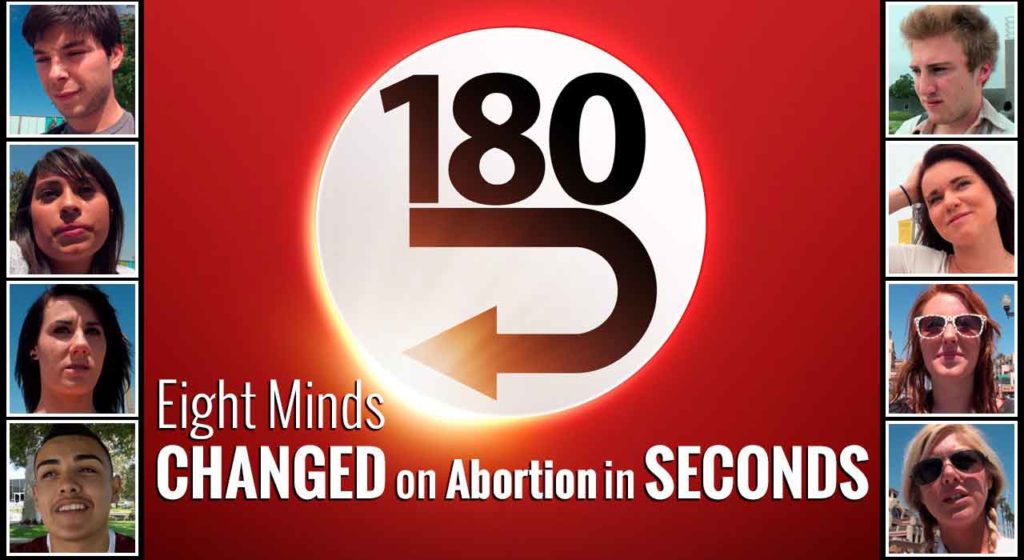
180: from pro-choice to pro-life in minutes

Documentary 2011, 33 minutes Rating: 7/10 The trailer for 180 showed people being interviewed on the street declaring their support for “a woman’s right to choose.” But then each of these interactions was fast-forwarded – anywhere from 30 seconds to a few minutes - to the conclusion of the interview where each of these same people then declare they have changed their mind and are now pro-life. Wow! So what prompted this sudden and dramatic switch? In the 33-minute documentary interviewer Ray Comfort makes use of an illuminating comparison to the Holocaust and follows it up with this clarifying question: “It’s okay to kill a baby in the womb when… ?” What Comfort is doing is confronting people with the incoherence of their own views. Though our culture is becoming more and more calloused to evil, most still don’t believe it is okay to kill human beings...and yet they make an exception in the case of abortion. When Comfort asks them to explain what circumstances make it permissible to kill a baby, each of his interviewees is brought short. They don't want to say we can kill a human being simply because they might grow up poor. Or because they are unwanted. Or because they are inconvenient. Their conscience convicts them with the knowledge that these are not good reasons to murder someone. By asking his pointed question Comfort makes them realize that they have never really thought through the issue of abortion before. It is worth noting that Comfort's approach will not work with any who have hardened their conscience, and who, fully knowing it to be a baby, have no objections to murdering it anyway. But for the ignorant or confused, what Comfort presents is incredibly clarifying. The documentary does have some graphic content – specifically pictures of Holocaust victims, and aborted children – so it is not appropriate viewing for the very young. For the rest of us, this is a fantastic film that can inspire us to clarify the abortion issue for the many millions who are pro-choice only because they are confused. To date, it's been viewed by over 5 million. You can watch it below, or by visiting 180movie.com. In 2019 Comfort and his team released a sequel, 7 Reasons in which they address 7 of the more common justifications for abortion. You can also watch it for free, right here. EDIT: YouTube just added an age-restriction to the video, so it's not displayable below, but can be viewed by clicking on the link below "Watch on YouTube" or by clicking here. ...

Red heart icon with + sign.
Pro-life - Abortion

Not without a fight: the history of the pro-life movement in Canada

Pro-life activists perform an important role in society. They help to remind people about what is perhaps the most pressing political issue in our country, namely, the legally-sanctioned killing of unborn children. This killing is often justified as being the consequence of a "woman's right to chose." In Canada, exterminating the unborn is considered to be a "human right" supported by all levels of government and all of the major political parties. But this phrase, "a woman's right to choose," is simply a euphemism for the killing of unborn babies. It's a clever choice of words to hide the reality of abortion. Of course, abortion is a worldwide phenomenon, not a specifically Canadian one. All of the Western countries allow abortion, although Canada is unique among them in having no legal restrictions on abortion whatsoever. But it is helpful to see the abortion controversy in its international context. The Canadian pro-life movement has not been successful in stopping abortion in Canada, but the same is true of pro-life movements in the USA, Australia, and elsewhere. It's not that Canada's pro-lifers have failed to find the right tactic - some silver bullet that would put an end to the killing. Rather, the Canadian situation reflects a worldwide embrace of abortion by cultures that want to separate sexual activity from its consequences. A history of the abortion fight in Canada demonstrates that the Canadian pro-life movement has been very adept, thoughtful, strategic and thorough in their various attempts to stop abortion. But despite the movement’s best efforts, it was not able to stem the tide. It began in 1969 In Canada, the push to legalize abortion came on strong during the 1960s. Towards the end of that decade, Parliament was looking into the matter, and in 1969 the Liberal government of Pierre Trudeau passed a bill easing the Criminal Code restrictions on abortion. Although the new law did not completely decriminalize abortion, it made abortion more easily available. Hospitals could each have a therapeutic abortion committee (TAC), and the committee could approve an abortion after three doctors confirmed that a pregnancy would likely endanger the life or health of a particular woman. Women seeking abortions were normally approved for the procedure. The pro-life movement in Canada emerged in response to the 1969 law. By the mid-1970s there were dozens of pro-life groups across Canada. The main national organization was the Alliance for Life headed by Dr. Heather Morris. In 1973 the pro-life groups gathered a petition of 352,000 signatures requesting a stricter abortion law. This petition was presented to Prime Minister Trudeau. Then in 1975, the Petition of One Million campaign managed to get over a million signatures on a petition opposing abortion. Yet, despite this tremendous effort, it was not successful in leading to any legislative change. Two key figures In 1978 a new pro-life group called Campaign Life was formed. It represented the more conservative and militant segment of the pro-life movement and continues today as the leading pro-life organization in the country. In the national debate about adopting a Charter of Rights in 1981, Campaign Life's legal counsel, Gwen Landolt, accurately predicted the negative consequences that would result from the Charter. Another major pro-life figure was Joe Borowski, a former Manitoba cabinet minister in that province's NDP government of the early 1970s. In 1978 Borowski launched a court challenge to Canada's abortion law, arguing that it violated the Canadian Bill of Rights which guaranteed the right to life. There was considerable legal wrangling over whether Borowski even had the right to launch such a challenge, and it wasn't until 1983 that his case was finally heard. By this time the Charter of Rights had been adopted, so his challenge was modified to argue that the abortion law violated the Charter's guarantee of the right to life. Borowski lost later in 1983, but he continued to press his case and the Supreme Court of Canada agreed to hear it in 1988. Morgentaler starts fighting In the meantime, another significant case was winding its way through Canada's courts. From the early 1970s on, Henry Morgentaler, the leading abortionist in Canada, was in and out of the courts for violating the terms of Canada's abortion law. Morgentaler opposed the abortion law because he thought it was too restrictive. The law only allowed abortions to be performed in hospitals, whereas Morgentaler wanted to be able to perform them in abortion clinics. He was ultimately successful in operating a clinic in Quebec where public sentiment strongly supported abortion rights. When Morgentaler opened a clinic in Toronto in 1983 (the first abortion clinic in English Canada), he was charged with performing illegal abortions. He fought this charge all the way to the Supreme Court of Canada which heard his case in October 1986. Pro-lifers were very active during this period. In some locations across Canada, pro-lifers were able to get elected to local hospital boards and shut down that hospital’s TAC. Thus the hospital would no longer be able to perform abortions. This was an especially effective tactic in the Maritime provinces. There were also numerous protests and demonstrations in front of Morgentaler's Toronto abortuary. Occasionally some pro-life activists would attempt to block the steps leading to the "clinic" and would be arrested. An organization called Choose Life Canada was formed by Baptist minister Ken Campbell, and it managed to set up its office right next to the Morgentaler facility. This office was called The Way Inn and it was in a perfect location to dissuade women from proceeding with their abortions. January 28, 1988 Then, on January 28, 1988, the infamous Morgentaler decision was handed down by the Supreme Court, striking down Canada's abortion law and consequently eliminating all legal restrictions on abortion in the country. However, this decision did not create a "right" to abortion in Canada. Instead, the law had been struck down for violating the procedural fairness required by the Charter. Thus the way was left open for Parliament to enact a new law restricting abortion. Pro-life organizations could likely have intervened in the Morgentaler case but had chosen not to. They were active in supporting Borowski's case and did not think they had the resources to also be involved in Morgentaler's. At the time, Gwen Landolt argued that this was a mistake. As usual, she was right. The mistake became clear to all when the Supreme Court heard Borowski's case in October 1988, months after the Morgentaler decision. Borowski was challenging the very abortion law which had previously been thrown out in the Morgentaler decision. So, since the law had already been thrown out, in March 1989 the Supreme Court ruled that the case was moot. The pro-lifers lost again. In the wake of the Morgentaler decision, pro-life groups organized a massive letter-writing campaign urging members of Parliament (MPs) to pass a restrictive abortion law. But there were deep divisions even within the governing Progressive Conservative caucus of Prime Minister Brian Mulroney, so despite some attempts, nothing was accomplished. The infamy of 1988 – when free trade trumped life A federal election was called for the fall of 1988, and pro-life groups were very active in trying to elect pro-life MPs. However, the central issue in this election campaign was the proposed Free Trade Agreement with the USA, so the abortion issue did not really receive a lot of attention. Nevertheless, some new pro-life MPs were elected. Many pro-lifers were becoming increasingly frustrated by the lack of any legal restrictions on abortion in Canada and therefore became involved in an American-based organization called Operation Rescue led by a theologically charismatic minister, Randall Terry. The "rescuers," often in large numbers, would use their bodies to block the entrances to abortuaries so that women could not enter them. It was hoped that this would prevent abortions from being performed. The police, of course, would move in and arrest the rescuers. Most of this rescue activity took place in the first half of 1989. When is moot not moot? By the summer of 1989 the courts were back in the center of the abortion fight. In July an Ontario court and a Quebec court each issued an injunction preventing a woman from having an abortion, both at the instigation of former boyfriends. The Ontario injunction against Barbara Dodd, however, was quickly overturned by the Ontario Supreme Court so she went to the Morgentaler clinic for an abortion. But in the other case, the Quebec Superior Court upheld the injunction against Chantal Daigle, and two weeks later the Quebec Court of Appeal also upheld the injunction. This latter decision went so far as to declare that unborn children had a right to life! Can you imagine?! Anyway, Canada was now in the midst of a full-fledged national crisis. The achievements of the pro-abortion camp were severely threatened by the Quebec Court of Appeal decision. An emergency session of the Supreme Court of Canada was called, and organizations from both sides of the abortion debate were granted intervener status, including Campaign Life and REAL Women of Canada. During the court proceedings, Daigle's lawyer announced that she had gone to the US and had an abortion there, making the case moot. Despite being moot, the Supreme Court proceeded to strike down the injunction against Daigle. This makes for a very interesting contrast. When Joe Borowski's case became moot, the Supreme Court refused to deal with it for that reason. But when Chantal Daigle's case became moot, the Supreme Court decided the issue anyway. It appears that the Supreme Court is willing to proceed with a moot case, but only as long as doing so will further the pro-abortion cause. This is "justice" in Canada. A law both sides hated In November 1989 the Mulroney government introduced Bill C-43, a new proposed abortion law. It made abortion a criminal offence, except where the pregnant woman desired to have one for reasons of physical, mental, or psychological health. Although the pro-abortion camp opposed the bill because it technically criminalized abortion, many conservative Christians saw the loopholes in it as basically enshrining abortion on demand. People such as Ken Campbell, Ted Byfield of Alberta Report, and Gwen Landolt of REAL Women opposed the bill on these grounds. Some other pro-life organizations, such as the Evangelical Fellowship of Canada, supported the bill for pragmatic reasons, arguing that it was better to have a faulty law with some restrictions on abortion than no law whatsoever. Despite strong opposition from both the pro and anti-abortion camps, the bill passed the House of Commons in May 1990. However, it still had to pass the Senate, so opponents had another chance to block it. The Senate vote in January 1991 was a tie, and ties count as a loss by Senate rules. Thus the abortion bill failed and Canada remained without any legal restrictions on abortion. This is still the situation today. We have work to do The pro-life movement has remained active since that time, but no Canadian government has even attempted to bring in an abortion law since the failure of Bill C-43. The pro-life movement in Canada has lost all of its major battles. In this respect, it looks like a failure. But viewing it that way would be a mistake. As mentioned earlier, the abortion fight is a worldwide phenomenon and even the USA, with strong conservative Christian and pro-life movements, basically has a situation of abortion on demand. If the American movement, with its prominent and powerful Christian activist groups, and sympathetic politicians (including President Bush and most Republican congressmen), can't hold back the pro-abortion tide, can we really expect the Canadian pro-life movement to do any better? The fact is that Canada's pro-lifers have fought valiantly, using the best means at their disposal. Getting over one million signatures on a pro-life petition in the mid-1970s is quite an achievement. (Remember, they had to do this the old-fashioned way – they did not have the Internet.) But the petition was ignored. Working for the election of pro-life MPs is a reasonable strategy. But every government caucus has contained some pro-life MPs, and yet look at the situation we are in today. The pro-life movement has tried to use the courts to protect the unborn, with Joe Borowski being the best example of this. But with a judiciary dominated by abortion supporters, this didn't work either. And as a last resort, courageous pro-lifers joined Operation Rescue to use their own bodies to block entrances to abortuaries. And what did they get? Fines and jail time. So it hasn't been for a lack of trying. The pro-life cause will ultimately prevail and abortion will be outlawed in Canada once again. But it will be a long road, and it will be easy to become discouraged in the meantime. The struggle against abortion needs to be seen in its worldwide context so that the setbacks on this issue in Canada are seen as part of a pattern of setbacks for the pro-life movement around the world. It may be an embarrassment that Canada has no legal restrictions on abortion, but many other Western nations also have high abortion rates so they aren't much different from Canada, really. Their pro-life movements have also "failed" in this respect. It's not like the pro-life movement is simply missing a winning strategy, and once that strategy is discovered the pro-life side will finally prevail in Canada. The situation is much worse than that. The culture of the Western nations, at least among the controlling elites, is a basically pro-abortion culture, and there will need to be a change at the cultural level before the law is changed. Canada and the other Western countries need to be re-Christianized. Failing that, it's likely that abortion will continue unabated. Michael Wagner is the author of “Leaving God Behind: The Charter of Rights and Canada’s Official Rejection of Christianity,” available at Merchantship.ca. This article first appeared in the January 2008 issue....

Red heart icon with + sign.
News, Pro-life - Abortion

On mandatory vaccines and “My body, my choice”

Don’t we live in strange times? Thousands of people are calling on governments all over the world to mandate vaccines for everyone twelve years old and older. These same people are often the loudest proponents of the principle: "My body, my choice!" How does that make sense? If the argument for allowing women to end the life of their unborn child is based on the false principle that their bodily autonomy trumps all, how can they also argue for the government to mandate the insertion of all kinds of chemicals into one’s body? Shouldn’t it be: my body, my choice? Absolute autonomy – the rule of one’s self – is also the rationale against conversion therapy, and it is the rationale for stripping parental rights in all kinds of areas, but this is probably most damaging when parents want to resist their child’s wishes for sex alignment therapies and surgeries. Because we must let everyone do with their bodies as they wish, without limit, and without any opposing opinions offered. Does it not strike you as extremely ironic, and terribly inconsistent, that the warriors for abortion, conversion therapy bans, and for stripping parental rights – all in the name of autonomy – are the same warriors arguing for mandatory vaccination? (Might this be an irony we can point out, to the benefit of the unborn?) Of course, Christians do not claim, “My body, my choice”, nor do we claim that we are autonomous selves. Rather, we understand that our bodies are temples of the Holy Spirit; that we belong body and soul to our faithful Saviour. We also know that we have been given stewardship of those bodies, to care for them as best as we know how. That means that while some of us may get vaccinated to God’s glory, others will refuse to do so to God’s glory. Some will argue: "Because my body is a temple of the Holy Spirit, I will not get vaccinated" while others: "Because my body is a temple of the Holy Spirit, I will get vaccinated." That’s okay. We do not all have to agree. But Christians should be agreed, it seems to me, to be against mandatory vaccinations. We need to have the freedom to act according to our own conscience when it comes to weighing the consequences of receiving, or not receiving, the vaccination; we need freedom to make the best decision in how we serve the Lord with our body. Chris deBoer is the Executive Director of Reformed Perspective Foundation. ...

Red heart icon with + sign.
Pro-life - Abortion

Can a politician be personally, but not politically, pro-life?

Sometimes we're limited to just two options. Two thousand years ago Jesus told us, "Whoever is not with me is against me" (Matt. 12:30a). But even when the options are one way or the other, it seems our fallen nature to want to go another way.  This past week my daughter was told that for dessert she could either have apple sauce or not have it. She chose ice cream. There was no ice cream in the house, and she knew it. Yet she still chose the non-existent Door #3. Illogical? Definitely. But she has a built-in excuse for reasoning like a child. But what's our excuse? Canadian Christians want a third way In Canadian politics Christian politicians – and their Christian supporters – have proposed that when it comes to abortion, there is a third position possible, somewhere in the middle of pro-life and pro-choice. This came up again during Canada's 2015 federal election. A political activist phoned NDP candidate and Christian pastor K.M. Shanthikumar, and secretly recorded their conversation. The activist pretended to be pro-life, and a recording of their conversation (conducted in the Tamil language) was handed over to the Toronto Star, which published a translated excerpt: Caller: So, for abortion, you are against? Shanthikumar: Yes, I am against that. Caller: Gay marriage, abortion? Shanthikumar: All that. What is not in the Bible, what the Bible is against, I am against. After the phone call was made public  NDP spokesman Brad Lavigne noted that Shanthikumar had previously signed a declaration in which he said he accepts the party position on abortion and marriage. Shanthikumar also offered reassurances that despite the phone call, he would support the current party policies: " is my personal life. My personal life is different from party line, because when I stand by the party I have to stand by the party….All I said was whatever the party I will stand by that." What middle ground is possible? It’s hard not to sympathize with the pastor, who was clearly set up. However, his "personally pro-life" but politically pro-choice position makes no sense. Either the unborn are clumps of tissue, or they are precious human beings. So what middle ground could possibly exist between the pro-life and pro-choice positions? Maybe this NDP candidate was only pretending to support his party's pro-abortion stance. Maybe he was saying whatever he needed to say to get elected, and if he won then he'd actually stand up for the unborn. That's our best-case scenario: that he is a liar. Liar or monster The worst-case scenario? He’s a monster. The only reason to be pro-life is because you know the unborn are human beings. If he is privately pro-life, but as a politician he is going to be pro-choice, then this is a fellow who will, for political gain, support the murder of those he knows to be precious human beings – he is promising to vote in favor of what he would know to be the killing of 100,000 children a year! The world pretends we can believe one thing and do another – that’s what it is increasingly demanding of Christians. But God says our deeds reveal what we really believe (James 2:18, 2:26). Thus there is no way that someone can be privately pro-life and publicly anything else – what we know in our hearts we must profess with our mouths. As the PG-rated (for bloodless violence) video below shows, even the world gets that "personally pro-life" is a morally bankrupt position. ...

Red heart icon with + sign.
Pro-life - Abortion, Science - General

The wonder of the womb

If you haven’t seen any of the YouTube videos of Dr. Kristin Collier talking about the unborn, you've missed out. This Christian physician and University of Michigan Medical School faculty member has been speaking at universities around the USA, sharing scientific evidence about the interconnection between mothers and babies in the womb. Let me share a few of the highlights. The placenta: a cooperative project Many of Dr. Collier’s presentations have focused on the amazing miracle of the placenta. Often referred to as the “afterbirth,” it is actually the vital organ inside of which a baby grows. Dr. Collier states, “In a mother’s womb following conception, God is building between mother and child an anatomic masterpiece, a relational organ. The placenta is therefore considered a fetomaternal organ because it is made by both the baby and mother (and Providence). The placenta is the only purposely transient organ in humans and is the only single organ that is created by two people in cooperation. Through the placenta, mother and prenatal child interface. In one organ we see the function of what is usually performed by multiple organs and systems. The placenta provides the function normally assumed by one’s lungs and kidneys and additionally has metabolic, thermo-regulatory, endocrine and immune function.” In other words, when the baby is merely 6-7 weeks old inside the mother, he or she is contributing by assisting the mother in building the placenta. This is an important proof that even at that very early gestational age, this is not just a blob of tissue, but a co-worker in the process of life. Microchimerism: an interconnection Dr. Collier has also shared how analysis of DNA, taken during prenatal screening tests, shows that there is another sort of profound interconnectedness between the prenatal child and the mother. “We know that genetic material from the prenatal child crosses through the placenta and can be found in the mother’s circulation. The interaction at the level of genetic material between mother and prenatal child is illustrated in what is called ‘microchimerism.’” Microchimerism is the presence of a small population of genetically distinct and separately derived cells within an individual. Dr. Collier goes on to say: “The growing baby sends some of her cells across the placenta into her mother in a way that we are only beginning to understand. These cells migrate to various sites of maternal tissue and integrate into them. They then assume the function of the surrounding tissue and begin to function as such. Microchimeric cells have been found in various maternal tissues and organs, such as the breast, bone marrow, skin, liver and brain. “Early and late effects of these cells have been hypothesized. Some of these cells appear to target sites of injury and may help mother heal after delivery by integrating into a Cesarean section wound and helping to produce collagen. Fetal cells may be involved in the process of lactation by signaling the mother’s body to make milk. Others have been thought to help protect a mother against breast cancer later in life. This process likely involves negotiation and cooperation between mom and baby at the cellular level. Researchers are in the early stages of attempting to understand the full function of these cells, which may have important implications for the immune status of women.” To summarize, cells of their children remain within women throughout their lives, helping the mother, and also perhaps explaining the connection that mothers feel with their children - and their lost children. “Human beings carry remnants of other humans in their bodies. These cells become integrated into maternal tissue and are active and working in ways that we are just beginning to understand. Think about mothers who have lost both prenatal and postnatal children, and how they have longed for their children still to be with them in some way. Now we see that in fact, they are.” Babies: a superb design by our Creator God Psalm 139 rejoices in how God forms children within the womb. Learning how these babies participate in building their own placenta reinforces the truth that these are little people growing in there. And discovering the wonderful ways in which mothers and babies are, and stay connected gives us cause to rejoice in the superb designs of our Creator God. And this is why Dr. Kristin Collier is determined to share this knowledge throughout the world. You can learn more in the doctor's wonderful 16-minute presentation below. ...

1 2 3