










Transparent heart icon with white outline and + sign.

Life's busy, read it when you're ready!

Create a free account to save articles for later, keep track of past articles you’ve read, and receive exclusive access to all RP resources.

White magnifying glass.

Search thousands of RP articles

Helping you think, speak, and act in Christ.

Open envelope icon with @ symbol

Get Articles Delivered!

Helping you think, speak, and act in Christ. delivered direct to your Inbox!

A A
By:

Carried

Listen to me, you descendants of Jacob,
all the remnant of the people of Israel,
you whom I have upheld since your birth,
and have carried since you were born.
Even to your old age and gray hairs
I am he, I am he who will sustain you.
I have made you and I will carry you;
I will sustain you and I will rescue you.
(Isaiah 46:3-4)

Surely he has borne our griefs and carried our sorrows; yet we esteemed him stricken, smitten by God, and afflicted.
(Isaiah 53:4a)

*****

Around the year 1000, on a low-lying mountain and near to a trade route, a castle was built. Named Weinsberg Castle, it was situated in what is known today as Baden-Württemberg, Germany. Along the right bank of the Rhine, the area abutted Germany’s largest continuous forest, the Black Forest. It also boasted beautiful valleys and small lakes. Fruit was grown in these valleys and the region had a delightful profusion of vineyards. Weinsberg is, after all, translated as “wine mountain.” The rich, well-drained soil on its sides, plunges roots solidly and deeply downward to seek water. The vines, consequently, produce well-nourished grapes. Truly a wonderful piece of property and a pleasure to visit.

The Castle of Weinsberg does not stand on that mountain any longer, although if you were to pass along a nearby road, you could climb up and visit its ruins. There is a story about the importance of power, wealth and fame touching Weinsberg. It is a good story!

Feudal feuding

In the 1100s, two rival families in Europe were engaged in a feud. The names of these two families, were Welf and Hohenstaufen. Rather like the American Hatfield vs. McCoy disagreement, ongoing power struggles and quarrelling had long taken place in the Weinsberg Castle area. It was not always comfortable or safe to live in the shadow of this beautiful fortress. The Castle of Weinsberg, and its small surrounding town, belonged to the house of Welf, with Welf VI as its head. Conrad III was the head of the Hohenstaufen faction.

In 1138, anger came to a head for the two families due to the fact that Conrad III had just been elected the new Holy Roman Emperor, rather than Welf VI. Bloodshed rather than reconciliation loomed on the horizon. It appeared as if Conrad III, who laid siege to Weinsberg Castle in 1140, might triumph. But the small town and its castle stood firm. The house of Welf were an obstinate lot who refused to buckle, much to Conrad’s irritation.

Seemingly, relief appeared on the horizon for the Welf family. A relative was marching to their aid with an army at his side. However, the tide turned as this army was crushed by Conrad.

The siege of Weinsberg continued and turned out to be a brutal and protracted affair. Conrad III’s forces employed a range of tactics to wear down the city’s defenses. His army, comprised of heavily armored knights and skilled archers, surrounded the city, totally cutting off the castle’s supply lines, and blocking escape routes. Despite the defenders’ valiant efforts, the relentless pressure eventually took its toll, and the once-formidable walls of Weinsberg Castle began to crumble.

The Welfs, whose ancestry could be traced back to Charlemagne (747-814), the first Holy Roman Emperor, were a proud family. By all rights, they should have conceded the battle. But they did not.

Conrad, angered by their obstinacy, vowed that he would make Castle Weinsberg an example to all his enemies. He sent this ultimatum to them:

“Unless you surrender, I am going to demolish the city, burn your houses and put you all to the sword.”

A boon granted

The citizens were, at this point, filled with terror and despair. Supplies were scarce and starvation hung in the air. The men of Weinsberg, knowing that further fighting was futile, sent a reply to the angry besieger. They asked for a pardon. But Conrad was inflexible at this point. He had been offended by the length of the siege, and it had rubbed him the wrong way. Then he received another message from the castle:

“We are not afraid to die and we are ready to continue fighting. We are even prepared to see the castle destroyed and our houses burned; but we are not prepared to see our women die. So, we beg that their lives be spared and that they be allowed to leave the castle.”

Conrad granted this request. And, perhaps suddenly struck by some compassion, he permitted an extra boon for the wives as well. Not only would he allow them to leave the castle unmolested, but he would also give them approval to carry out their most precious possession. But he stipulated that this possession had to be carried by them – carried without the help of carts or animals.

When Conrad’s message was read out loud in the town square, all the men nodded soberly. They agreed to his conditions and were happy their wives would be spared.

The Weinsberg women, including Welf VI’s wife, Uta, had also been listening to the message. Uta, at the time of her marriage to Welf, had been one of the richest heiresses in Germany. A wealthy, respected woman, she left the square solemnly, Conrad’s message ringing in her ears. Then she assembled with all the women of Weinsberg. Together they gravely and rationally conferred with one another, and they came to a decision about what they would carry out – about what their most treasured possession was.

Total agreement

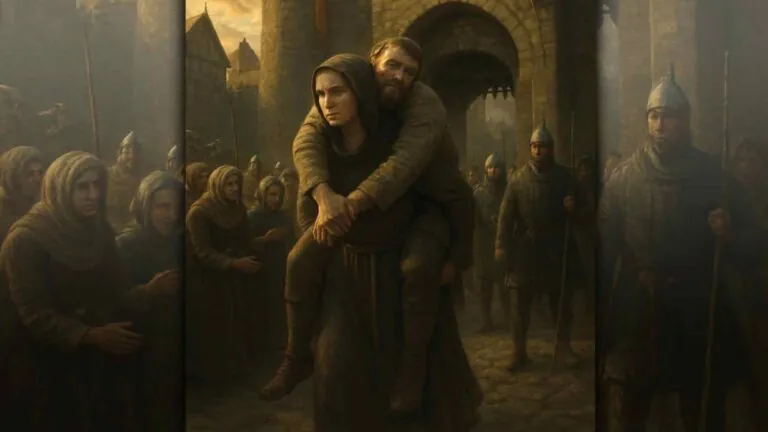
The next morning, the gates of Weinsberg Castle were thrown wide open for the departure of the duchess and the other women, who would take, so it was thought, money and provisions for the journey ahead to safe territory. But Conrad III, and his army, were taken aback at what came through the gates. The first woman to appear was the Duchess Uta, and, on her shoulders, she bore her husband, Welf VI. Behind her came all the other women. Some of them, like Uta, carried their husbands; others carried parents, children, or sickly relatives on their backs.

Disregarding jewelry and personal safety, but counting loyalty and love for their husbands and others as their most precious possessions, the women bore fellow citizens on their shoulders. It was not an easy physical feat and it was one that might have been unacceptable to Conrad. As a matter of fact, Duke Friedrich, Conrad’s brother, commented disapprovingly that such things should not be allowed. The king, however, with a certain amount of admiration, showed favor to the women’s cunning, and replied that it would not be fitting to change one’s royal word. He honored his agreement despite the fact that he had not foreseen the result.

The siege ended peacefully and the castle was later renamed Schloss Weibertreu, which means “castle of women’s faith,” symbolizing the bravery and loyalty of those women.

Another man

Although this story warms hearts and illustrates bravery, affection and compassion, there is a story, another story, which is greater and filled with more grace and love for saving family, than even these women were able to give.

This other story involves a man who, although he was of princely dynasty, did not have a particularly regal appearance. He was not popular either. The truth is that he was mocked by most. He was neither respected nor wanted. He did not impress his opponents. As a matter of fact, you could go so far as to say that he was despised and rejected by people. Yet, despite his high disapproval rating (even his few friends forsook him), this man walked freely, alone and of his own accord, towards a battlefield. This battlefield was a vineyard and it was called Gethsemane. Filled with dying branches, it was being besieged by the “god of this world,” by the “prince of the power of the air” – by the most hideous and evil host that ever was on earth. Incredibly, the man’s goal was to fight a battle by himself against this horrendous horde. Why? So that he could carry his family to safety away from this murderous throng.

In the darkness of the blackest of nights, the besieging army, carrying torches, spears and staves, met the solitary man.

And the man, walking boldly towards them, asked this opposing army a question. Twice he asked the same question: “Whom do you seek?”

When he was told that he was the one whom they wanted, the man answered by giving these amazing words of creation, redemption, and comfort: “I am he. So, if you seek me, let these men go.”

The voice of that man, the voice of Truth, echoes and resounds: “Let these men, let my people, go.”

Ecce Homo.

What the Man said then, is true today and will be true tomorrow. Jesus knows His people. They are part of His family. They are the branches in His vineyard, and He is the vine. They are a people freed, a people let go and they are His own. And He knows them even though they might be old and have gray hairs. His care extends beyond time and He carries them with love and purpose, even through extremely difficult and besieged times. He bears them in their griefs and He carries them in their sorrows, carries them to a heavenly mansion which He has prepared for them.

Enjoyed this article?

Get the best of RP delivered to your inbox every Saturday for free.


Red heart icon with + sign.
People we should know

Chang Shen: grace to persevere

Like as the armèd knight Appointed to the field With Thy Word will I fight And faith shall be my shield. Anne Askew (1521-1546) ***** The Christian Daily International reported, at the end of December 2024, that two pastors had been murdered in Colombia. Both were shot by criminals who hated the preaching of God’s Word. The Morning Star News reported that same December, that authorities in Sudan barred Christians who’d been internally displaced by war, from conducting Christmas services. This news agency also shared that, in that same month, Hindu extremists in eastern India stripped and beat a Christian woman. Tying her to a tree, they tortured her till she lost consciousness. And the Emergency Committee to Save the Persecuted and Enslaved documented that 14 Christians were killed following a 2024 Christmas carol service in Nigeria. As it has always been Is there something new here? Not really! The history of Christians being persecuted for their faith, is an age-old history. Beginning with Abel, and traversing towards the ancient Roman Empire, it is a fact that martyrdom has always been present. Although more common under certain rulers than others, it has never really been absent. During the Middle Ages, for example, and with the rise of Islam, many Christian communities were subject to discrimination, violence and death. The Catholic Church’s Inquisition took many lives and this persecution swept through the Reformation era. Putting names and faces on these remarkable saints who withstood lies about the Bible, and who testified until their last breath, is helpful and a reminder that the Church is a flesh and blood body of believers – real people who form the essence of Hebrews 11. Anne Askew, a faith-filled woman whose poem is quoted at the top of this article, was one such martyr during the Reformation. The number of saints we will see the other side of this life, is large. As a matter of fact, we cannot even count them. John, in Rev. 7:9-10, proclaims: “…I looked, and behold, a great multitude that no one could number, from every nation, from all tribes and peoples and languages, standing before the throne and before the Lamb, clothed in white robes, with palm branches in their hands, and crying out with a loud voice, ‘Salvation belongs to our God who sits on the throne, and to the Lamb!’” The Boxer Rebellion A little closer to our time period are the Chinese Christian martyrs of the early twentieth century. Specifically, the time period of November 1899 through to September of 1901, were days in which many Christians were killed. This short time span was the time of the Boxer Rebellion. Chinese nationalists, known as the Boxers, fanatically rose up during this almost two-year time period, to protest western influence in China. At this time, many countries had spheres of influence in China, including Russia, Japan, the US, France, Britain and Germany. There were conflicts: the First Opium War, the Second Opium War, and the First Sino-Japanese War. Each war caused western powers to have more control over trade. In China, a feeling of resentment grew against the West, and against the western missionaries. The term “boxer” was actually first used by missionaries to refer to young Chinese men who were skilled in the martial art of boxing. These young men called themselves “The Righteous and Harmonious Fists” and they were especially hostile to Christian and western influences. As a matter of fact, they dubbed Christianity the religion of the foreign devils. Wanting to preserve their own pagan religion, a black magic ritual was performed on these young men which left them foaming at the mouth and which sometimes included human sacrifice. A potion smeared on them by “priests,” was supposed to render them bulletproof. The country’s dowager empress was persuaded to issue an imperial decree waging war on the foreign powers, which also emboldened violence against all foreigners. In the long run, an Eight Nation Alliance – consisting of Germany, Japan, Russia, Britain, France, the United States, Italy and Austria-Hungary – fought against and defeated the Chinese Imperial Army. It has been estimated that 136 missionaries were killed during this two-year time period and that 33,000 Christians were murdered. One of these Christians was a man by the name of Chang Shen. A blind heart sees Chang Shen was a man who lived in Manchuria, in north-east China during the mid to late 1800s. Although married, he treated his wife brutally, was unfaithful, and eventually drove his wife and his daughter from their home. He also gambled, and stole whenever he could, and was not liked by many in his neighborhood. When he was stricken blind in his mid-forties, his fellow villagers told him it was a judgment of the gods, because he obviously deserved to be blind. Miserable and dissatisfied, Chang traveled hundreds of miles to a missionary hospital, because he had heard that people who went there had received their sight back. When he arrived at the entrance to the hospital, however, he was told that every bed was occupied. In God’s mercy, the hospital evangelist took him in and gave him his own bed. Chang’s eyesight was, in God’s providence, partially restored. When he heard the Gospel story for the first time in his life, the eyes of Chang’s heart were also opened and he received Christ with joy. “May I be baptized?” he pleaded. “Go home, and tell your neighbors the Good News of Christ,” the missionary replied, “and tell them that you have changed because of Him. I will come and visit you where you live, and if you are still following Jesus, I will baptize you then.” When the evangelist arrived at Chang’s home about five months later, he found that there were hundreds of people who wanted to hear the Gospel. Consequently, he baptized Chang with great joy. When Chang went to see a local native doctor to continue care for his eyes, that doctor, not being skilled, undid what the missionary hospital had been able to partially remedy. Chang became blind – and this time permanently. Despite being sightless, the reborn man traveled from village to village, and God granted that his words did not fall upon the ground empty. Hundreds of hearts were won for the Lord. Chang praised God even when dogs were set upon him and when hateful mouths spit on him. He learned much of the New Testament by heart, and was able to cite many chapters from the Old Testament as well, and other missionaries following in his tracks were able to establish many churches. Willing to die When the infamous Boxer Rebellion began, Chang was spreading God’s Word in Taipinggou, Manchuria. Because local Christians were worried that Chang would be one of the first to be targeted by the Boxers, they hid him in a mountain cave. As they were doing this, a city close to Taipinggou was overrun by the militant Boxers who immediately rounded up fifty Christians. “You are simpleminded to kill these fifty men,” a resident of the city told them, “because for every one you kill, fifty more will rise up as long as Blind Chang is alive. But if you kill him, then you will truly kill Christianity.” “All right,” the Boxer leader replied, “take me to this Blind Chang and we will spare the fifty men here.” There was a long silence. No one wanted to be the Judas to betray Chang. Finally, when it appeared that the Boxers would kill the fifty Christians, one man slipped away and went to see Chang in the cave where he was hidden. Hearing the man out, Chang responded: “I’ll gladly die for these men. Please take me to the Boxers.” When Chang arrived in the village, the Boxers had left for another village but had vowed they would return. Chang was bound by the village leaders and was taken to the temple of the god of war. Then he was commanded to worship this pagan god. “I can only worship the One living true God,” he testified. “Then believe in Buddha,” they insisted. “I already believe in the one true Buddha, even Jesus Christ.” “Then at least bow to the other gods.” “No, I cannot do that. Turn my face toward the sun.” Blind Chang said this because he knew that at this time of the day the sun was shining toward the temple and his back would be to the idols. Obligingly, the village leaders did turn him around, and he knelt down and worshiped God. When the Boxers came back three days later, Blind Chang was put in an open cart and driven to the cemetery outside the city wall. As he passed through the crowds of people who lined the road, he sang. Jesus loves me, He Who died Heaven’s gate to open wide; He will wash away my sin, Let His little child come in. Jesus loves me, He will stay, Close beside me all the way; If I love Him when I die, He will take me home on high. The blind man’s voice rose and reached not only the hearts of the people he passed, but also the throne of God’s grace. At the cemetery, he was led to a place where he had to kneel. Three times Blind Chang cried out before he was decapitated: “Heavenly Father, receive my spirit.” Refusing to let the Christians bury his body, the Boxers forced them to pour oil on his remains and burn them. Fearful that the blind man would rise from the dead, they were certain that he would take revenge on them. Afraid, they fled the scene of their horrific crime and left that village. In this way, the Christians in that place were spared further persecution. Conclusion Everyone who believes in the Lord Jesus Christ is bound to face some sort of harassment or trouble in his life. 2 Timothy 3:12 tells us that all who desire to live a godly life in Christ Jesus will be persecuted. Charles Spurgeon said, "Christians are not so much in danger when they are persecuted as when they are admired." A good point to ponder. Whereas admiration and prosperity cause us to forget that all we have comes from the hand of God, distress truly causes us to rely wholly on God, to grab hold of the corner of His garment, and to hide in His Word....