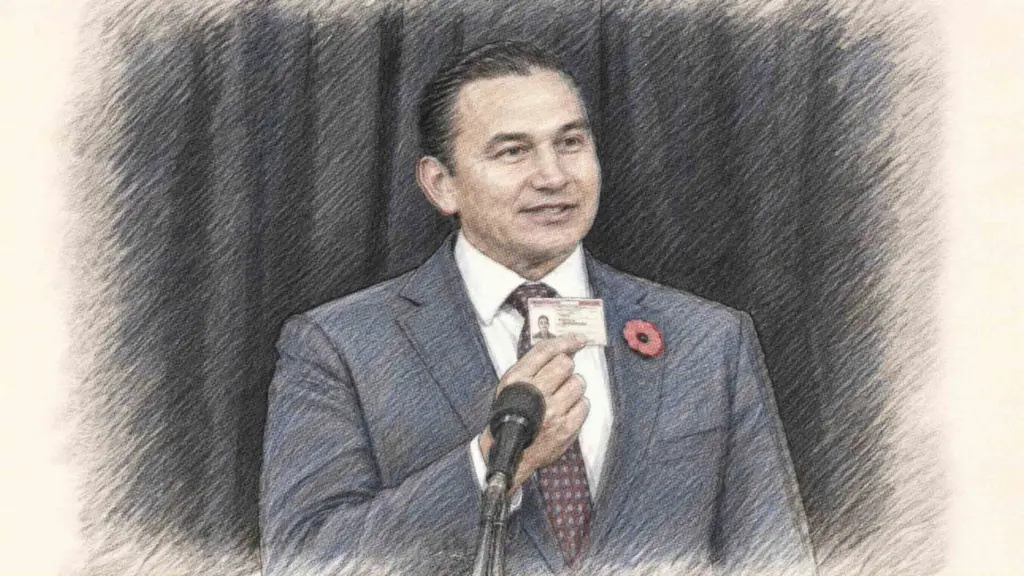
At a gathering in Ottawa on last Monday that included Premiers, the Prime Minister, and leaders of Canada’s First Nations, Manitoba Premier Wab Kinew made headlines by calling for the end of the Indian Act. Mr. Kinew stepped in front of media covering the event and pulled out his own Status Indian card.
“This is a status card, and it says your friend Wab Kinew is an Indian within the meaning of the Indian Act… I’m not sure if that lines up with your vision of Canada, that we still have a race-based form of identification in this country, but this is a reality…. I think it’s time to abolish the Indian Act.”
Within the day, Prime Minister Carney signalled his support for the change.
“I am committed to a process that moves Canada beyond the Indian Act, and I am directing my ministers to work in partnership with First Nations to chart that path together.”
Canada’s Indian Act dates back to Confederation in 1876. The current massive 82-page version regulates the lives of Canada’s indigenous peoples from cradle to grave. For example, the reserve system it created forbids private property ownership, which prevents many indigenous Canadians from being able to own their own land. And without property it can be difficult to obtain the mortgages or loans needed to start a business.
Approximately 374,000 Indigenous people live on reserves, as of the most recent 2022 census.
As Mr. Kinew alluded to, the law has long distinguished Canadians solely on the base of race. It has rightly been called paternalistic because the assumption is that Indigenous peoples need to be controlled by the government, rather than having the same opportunities and responsibilities as all other Canadians.
And after well over a hundred years, there is little fruit to show for the law. Unemployment on reserves is four time higher than the national rate, only 30 percent of youth living on-reserve graduate from high school on time, and life expectancy on-reserve is a staggering 13.6 years shorter than non-indigenous Canadians. Walking the streets of a reserve can feel like stepping into a third-world nation.
Although many Indigenous leaders oppose the Indian Act, there has been hesitation to abolish it because of worries that doing so would impact funding for housing, education, and healthcare, as well as decrease government responsibility towards them generally. In other words, the Indian Act has created a climate of dependency. In 1969, the Liberal government introduced the “White Paper” to abolish the Indian Act and treat Indigenous peoples equally under the law. This was strongly opposed, and abandoned.
Sadly, since then Canada’s political response to the plight of Indigenous peoples has largely been to carry on with the same-old: maintaining the Indian Act, dolling out more money, and promoting a culture of dependency.
As Steve Corbett and Brian Fikkert explain in their book When Helping Hurts, the goal of poverty alleviation shouldn’t be to see our standards of wealth applied to others, but instead,
“to see people restored to being what God created them to be: people who understand that they are created in the image of God with the gifts, abilities, and capacity to make decisions and to effect change in the world around them; and people who steward their lives, communities, resources, and relationships in order to bring glory to God.”
This is no less true for Canada’s Indigenous peoples.
Picture is a ChatGPT sketch up of Premier Wab Kinew showing his Status Indian card.