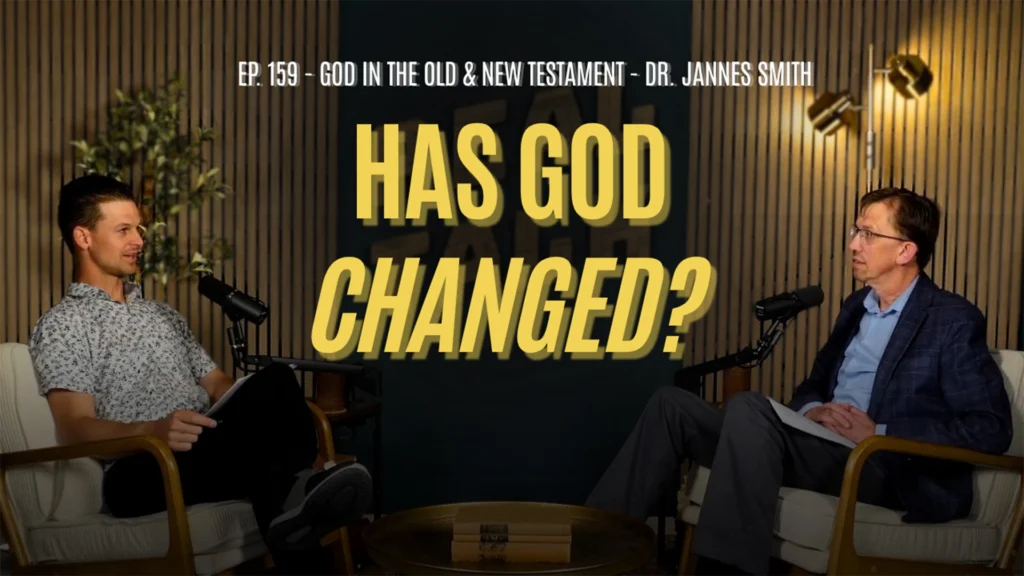
This episode can also be found on your favorite podcast platform: Spotify, Apple, Podbean, Amazon Music or on our website. Be sure to subscribe to our YouTube channel and our podcast profiles so you can be notified when new episodes are released. Please note that the transcript below was automatically generated and lightly edited so it may contain some errors.
Opening
One of the most common objections to Christianity is the claim that the God of the Old Testament seems different than the God of the New Testament. In one we see judgment and wrath; in the other, grace and mercy. So has God changed, or have we misunderstood who God is? Joined again by Dr. Smith, this episode we’re exploring the character of God throughout all of Scripture. We’ll discuss why people are tempted to separate the Old Testament and New Testaments, what the Bible teaches about God’s unchanging nature, and why it’s good news that the God who flooded the earth is the same God who hung on the cross. A big thanks to our friends at Nearalta for making this conversation possible. Be sure to check them out at nearalta.com.
Intro
The world’s changing fast, but what questions should we really be asking? You’re listening to Real Talk, a podcast presented by Reformed Perspective, where we take God’s Word and apply it to the nitty-gritty of life. Buckle up for real questions, real answers, and real direction. This is Real Talk.
Tyler Vanderwoude
Doctor Smith, thanks for joining us again. Appreciate your time and you doing this. We had you, I think last time we were talking was on Zoom. I just pulled it up on my phone. I got Episode 131, which was nine months ago or so. And we titled it “Answering the Answering the Old Testament’s Hardest Questions”, and then we thought of more. So we thought we’d get you back, and it’s a privilege to be in the studio with you.
Dr. Jannes Smith
Yeah. If those were the hardest ones, then these should be better, right?
TV
Yeah, yeah, yeah. These are real easy. So we’re planning two episodes. We’re recording them on the same day, but they probably won’t release even maybe back to back. But the plan is to talk about God in the Old and New Testament, and then to do a deep dive on some of the hardest verses that we could find from the Old Testament, talking about things like slavery and polygamy and some of these hot button issues that people point to in the Old Testament. So, stay tuned for that episode. But today, or on this episode, we want to talk about God in the Old and New Testament, and are we worshiping a God that has changed or has revealed Himself as different in the two Testaments, I guess. So, of course, we lean on our Old Testament scholar here, and yeah, hopefully we can understand this a little better. So, thanks for putting, I think, a lot of time already into this episode. So, in sitting down with us, so let’s just start there. Has God changed?
Dr. JS
Yeah, yeah. I appreciate that, and thanks for your kind introduction as well. I think on this one, I want to start by saying we’re talking about God here, and it’s one thing to answer difficult questions from the Old Testament and to be able to study a passage and to say, “I think I know what this passage means.” It’s a bit of another thing to try to grapple with who God is in in a responsible kind of way. I mean, I look at myself and I’m a flawed and finite creature, and here I am talking about a God who is immense and infinitely greater than I could ever conceive of. I think it was Anselm of Canterbury who once said that God is that than which nothing greater can be conceived. And you and I are temporary specks in the universe that He made and that He manages every day. That’s a little bit of perspective.
TV
Yeah, that’s a pretty wise first answer, I guess.
Dr. JS
Well, all of that to say, for me to say something responsible about God is a is a tall order, and it’s a it’s a humbling thing as well. This is the God whom we worship, and this is the God whom we’re accountable for. So this is not just a blase topic of-I mean, none of the topics of the Bible are blase, of course, but when you’re talking about God, you’re talking about the Creator of the universe, and you’re doing so as creatures who depend upon Him.
TV
So should we even be doing this?
Dr. JS
I think so.
TV
Do we have a responsibility to try to understand, or should we be so humbled that we dare not ask these questions?
Dr. JS
Well, to the extent that the answers are found in the Bible, and God has given us the privilege to be able to know Him and the and the calling to serve Him. We’re allowed to know God and we’re allowed to say whatever we can in a responsible manner about what God’s Word teaches. So I don’t think that the doctrine of God is something that we shouldn’t even touch. The doctrine of God is very important doctrine of Scripture. So we can go there.
TV
So, how do we understand God in the Old Testament, and does that, I guess, jive with how we feel about God or how we understand God in the New Testament? I mean, I guess there’s a lot of cultural sayings that happen, like about who God is, or you know, God is love. This this type of thing around us in the world, in in the broader Christian world, I guess, does that jive with what we see God reveal about Himself in the Old Testament?
Dr. JS
Yeah, it’s an interesting question. I think it’s a pretty common thing, actually, for people to have this kind of sense in their minds that God in the Old Testament is someone different than God in the New Testament, and I think in part it’s an impression that’s created just by the fact that the Old Testament itself, as literature, is somewhat different from the New Testament as literature. Even if you just think about historical coverage for a minute, when you go to the New Testament and you look at the at the narrative portions, the Gospels and the Book of Acts, you’re covering a fairly short span of history, from say 5 BC to about 65 AD, 70 years or so, and it takes place during what’s called the Pax Romana, the peaceful time period of the Roman Empire. So you get very little in the way of warfare. You get a stable society where everything is peaceful. And as a thought experiment, just imagine if the New Testament Book of Acts went a little bit further, say 5 years or so to 70 A.D. when the Roman armies come and they besiege Jerusalem, and 1000s of people are killed, and there’s untold suffering and the destruction of the temple and of Jerusalem and so on, I suspect that if the New Testament had covered that historically, we’d be asking some hard questions about the God of the New Testament. How could God allow something like this to happen? Is God cruel? Is God vindictive? And those kinds of questions that we typically reserve for the Old would be asked of the New. So it’s in part a question of historical coverage. When you look at the Old Testament, by contrast, it spans centuries, and there’s a lot of warfare, there’s a lot of disease, and there’s a lot of destruction, and so people naturally ask those kinds of questions more of the Old Testament just because of what’s covered.
TV
We’re also, I guess, shown, like we’re told why that war is happening. I guess if you, if you, I mean, five years even to the fall of Jerusalem, but if you expanded the New Testament to today, essentially, which would still not be as long as the Old Testament, in terms of time coverage, and then understood if you had an explanation as to why the World War happened, would we, would the explanation be a lot more like the Old Testament in terms of God punishing this nation with that nation. Is that still a reality, or do and we just lost that understanding of how the world actually is?
Dr. JS
Yeah, I think we see the New Testament age through the lens of the New Testament, right? So then you have Christ coming, and you have a fairly peaceful society in which Christ does His earthly ministry, and so the confrontation with the hard stuff doesn’t happen as much in the New Testament age. But you’re right. I mean, the reality of the human experience through the centuries hasn’t changed all that much. The kind of suffering that you see in the Old Testament age is something that you still see today in terms of disease and warfare and so on. Yeah, but there’s more to it than that as well. I think part of it has to do with the genres that are found in the Old Testament, the kinds of writings that you find there that are not there in the New Testament. So let’s take the laws of Moses, for instance. You get God giving laws and attaching penalties, and sometimes the penalties are quite strict, and it’s the kind of material that you don’t really see in the New Testament so much. So that can create the impression that the God of the Old Testament is a strict lawgiver, whereas God in the New Testament is not a strict lawgiver because you don’t see laws there.
TV
Right.
Dr. JS
Yeah, I think that that one is kind of a false impression in a way. The Hebrew word for law, Torah, actually primarily means instruction, so we should then see God as an instructor, and I find that fascinating because God in the wilderness is leading His people to the promised land as an instructor, teaching them about Himself. And teaching them about how to live in relationship to Him. That’s actually not so different from Jesus in the New Testament walking around the promised land with His disciples and with the crowds and saying to them, “This is who God is, and this is what life in the kingdom is like.” There’s actually a fair bit of overlap that we miss because we’ve labeled this thing ‘law’.
TV
You’re right. It does just feel different. Like it feels like is that it almost like Jesus’s life almost feels more pastoral in terms of like because he’s walking along with, I mean also the apostle, I would say. like it feels more like a walking alongside the church. I guess the context is it somewhat cultural that like we can kind of see our model of church, and I mean our world’s a lot more framed after the Roman world than it is after the ancient Israelite world. Yeah, like is that part of that feel that we’ve since so we separated ourselves from how God instructed His people back in the in like ancient Israel through the desert.
Dr. JS
Maybe so. It may have something to do with the Greco-Roman world because a Hebrew word like Torah, which means instruction, gets translated into Greek with a word like nomos, which means more like law, which then in turn gets translated into Latin with a word that means law, and then makes it into our English language with a word that means law. So there’s a there’s a kind of a literary tradition that’s associated with that. But I would never see the laws of the Old Testament as, you know, the kind of a law code that a lawyer might have on his shelf, or the kind of a law code that Hammurabi gave, or something like that. It’s a combination of historical narrative, and yeah, divine instruction about how to live in relationship with the Lord. Over and over, God says, “I am the Lord.” In other words, you have to do this because it tells you something about my character and who you are to be in relationship with me. So there’s when you think law code, you think of something that’s almost cold and impersonal. Whereas the Pentateuch is anything but that, it tells us something about who God is and how good and gracious He is.
TV
Yeah, it’s a different context, right? Because God is interacting more directly with His people through men like Moses, even directly speaking to the people. Like, does that feel different to us in in a sense that like we don’t have that same type of interaction, and so we… like even after Christ comes, the Holy Spirit is poured out on Pentecost. I guess that we just assume a different paradigm in terms of how we think about the interaction with God. We have the Bible, and so do we then imagine God treating us differently, like, or treating the world differently in terms of like you think about the judgment of the nations in in the Old Testament, and it’s clearly laid out like in God that like the punish or the time for the you know the depravity of this nation wasn’t completed, but then it is completed, and then there’s punishment that comes. God uses Israel to punish some nations, and uses some nations to punish Israel. And to us, it’s like, oh, okay, that makes sense. I see there’s wickedness, but then as soon as we get to the New Testament, we don’t immediately think, well, Persia displaces you know these guys because they’re evil, and then they’re displaced by these people because of that.
Dr. JS
There is definitely a transition there. Like when you think about what the New Testament, what the Old Testament says about the nations, you often have prophets bring oracles of destruction to those nations. The nations are going to be held to account because of the way that they treated God’s people, and because of the way that they persisted in idolatry and did not turn to the Lord, whereas you come to the New Testament, and there is a bit of a shift there in the sense that Christ has come, and the gospel now has to go out to the nations. In the Old Testament, the people of Israel are the special people of God. In the New Covenant context, you have a broadening of focus where the gospel now goes out to the nations as well, and Jews and Gentiles can worship together in the same church. There’s also a shift in the sense that in the Old Testament context, the vision was that the nations would come to Jerusalem and worship God there. In the New Testament, the vision changes. The gospel goes out to the nations, and churches are being planted in all of these different places all around the world. But it is all part of the same story. God is telling one story of salvation from Genesis through to Revelation, and God is revealing Himself as the same God there. I do think that there’s one other aspect to the Old Testament that makes it feel a bit more as though God is yeah a bit more difficult or something like that in the Old Testament, and that is like the imprecatory Psalms. You think of the Psalms where people are calling down curses upon their enemies and calling on God to come in judgment and cut their enemies down. You don’t have imprecatory Psalms in the New Testament, and what you do have is passages where Jesus Christ prays for the soldiers who put him on the cross, and Stephen asks for forgiveness for the Jews who are stoning him to death, and then people can quickly come to the conclusion: Okay, there’s a difference between God in the Old Testament and God in the New. But I wouldn’t exaggerate that. When you look at the New Testament a little bit more closely, Jesus isn’t always gentle there. I think of a passage like Matthew 23 where Jesus pronounces woes against woe to you, scribes, Pharisees, teachers of the law, and then he lays it into them and condemns them, and the idea of calling down curses upon the enemies of God doesn’t entirely go away either. I think of the Apostle Paul in 1 Corinthians 16, where he says, “If anyone does not want to serve the Lord, let him be accursed.” Or in Galatians 1, where the Apostle Paul says, “If anyone brings you a different gospel than the one that we preached, let him be accursed.” That’s unequivocal language and it’s more language that you find incidentally, but it is language that is in line with the imprecatory psalms of the Old Testament. So there’s a risk that we get a bit of a caricature. The Old Testament God is like this, and the New Testament God is like this. Whereas once you study it a little bit more thoroughly, then you realize, no, it’s actually the same God throughout.
TV
Yeah, because God’s character doesn’t change through it. Like, there’s still evidence of God’s love in the Old Testament. Is that just not… Is that us just not focusing on it? Like not finding those pieces and choosing to look at God commanding people to go to war, some of the harsh judgments, like you know, when God says to wipe out the nation and or devote them to destruction, that type of wording, like no, the apostles aren’t really being commanded to devote anyone to destruction.
Dr. JS
No, they’re not.
TV
They said shake your dust off your sandals. Feels a little more gentle, but God’s character… is that just us honing in on different pieces or just choosing our focus?
Dr. JS
Yeah, I think in part it’s a difference between the role of Israel as a nation in the Old Testament, where they had civil laws and had a certain amount of like a national character, where they had their own laws and had their own justice system, whereas in the New Testament, under the Roman Empire, they didn’t have those same rights as an independent nation anymore. But there’s more to it than that. It is interesting. Think of a command like “Love your neighbor as yourself.” When Jesus says that in the New Testament, he’s actually quoting directly from the Old Testament, Leviticus 19:18, God says, “You shall not take vengeance or bear a grudge against the sons of your own people, but you shall love your neighbor as yourself. I am the Lord.” And so the Lord adds that little bit, “I am the Lord”, as if to say that when you show love to your neighbor as yourself, you’re actually reflecting my character because I’m a God who is love, I’m a God who does that. And there’s other passages like that, Proverbs 25, where Solomon says that you have to treat your enemy well. If your enemy is hungry, give him bread to eat. If he is thirsty, give him water to drink, for you will heap burning coals on his head, and the Lord will reward you. And even in the laws that we talked about earlier, Exodus 23, God says to His people, “If you see your enemy’s ox going astray, bring it back to him.” So the laws are there that speak about love, even for your enemies. What we typically associate with the New Testament is there in the Old already.
TV
Is it again the context that they’re living in a nation that is set apart, and then in the New Testament, the Christians are dispersed through all nations, and so God doesn’t use Israel or God uses Israel to judge nations, and it’s more of a community of… like if I if I read that in the Old Testament, your if your enemy’s ox, I almost think of like, oh, there’s either a sojourner living near you, or you just don’t like your fellow Israelite.
Dr. JS
Yeah.
TV
So, enemy to me doesn’t exactly mean you know Emperor Nero, who you’re living under his thumb in Rome, say. Is that a different context then? Since in the New Testament the promise is open to Gentiles, the covenant flows there as well. Or again, is that just us choosing to think of applying it that way? Because we could we can apply that text to ourselves as well. I mean, not that we have oxen, but if we did.
Dr. JS
The general principle of treating your enemy well and treating your enemy as a friend and showing choosing to show kindness and love to someone who has shown nothing but hostility and hatred to you, it’s something that was present in the Old Testament in the form of a law, and again, as I mentioned before, the people of Israel had laws by which they were governed, whereas in the New Testament age they lost kind of the yeah their national character as a civilization with their own laws who had the right to determine how they were going to live to a certain extent that changes, but the broader notion of God being the God of His people and the idea of the kingdom of God persists in the New Testament and is a unifying theme right through from the Old Testament to the New Testament.
TV
Interesting. So it’s more a context, like because there is no elders of the people, I guess, in the New Testament, to uphold the Old Testament law.
Dr. JS
They had a Sanhedrin, so they did still use their laws and they enforced them to the degree that they could, but they did not have total freedom in that regard. They were also under the authority of the Roman authorities, and had to live within that context.
TV
But the attributes of God don’t change.
Dr. JS
No.
TV
So I mean, we could talk about like holiness, justice. I mean, those are like they feel more Old Testament to me. Mercy, love, but again, they’re those are everywhere.
Dr. JS
I think so because this whole notion that you have a distinction between an Old Testament God and a New Testament God actually goes back to an old heretic by the name of Martian, who was a member of the Church of Rome, and in his time he said there’s a difference between the God of the Old Testament, who’s vengeful, and the God of the New Testament, who is kind and indulgent. And Martian said, what that means is that we have to get rid of the books of the Old Testament because they’re no longer relevant for a Christian church. So he cut out the Old Testament. He also then ended up having to cut out books of the New Testament, which reflect the character of the Old Testament God. And so he was left with a version of the Gospel of Luke and a number of the letters of the Apostle Paul, and that became his Bible.
TV
An interesting approach.
Dr. JS
That is an interesting approach, but I think to a certain extent we do that subconsciously sometimes by creating this kind of bifurcation between the God of the Old Testament, who is vengeful, and therefore we don’t have to pay as much attention to the Old Testament anymore, which is fulfilled in Christ anyway, and the God of the New Testament, which is reflected in the character of Jesus Christ, who is loving and kind, and so on. So we end up doing the same thing.
TV
I think that’s true. Like, if we had to open in devotions for some event, like how often do we flip in the Old Testament? It’s flipped to a prophet. I mean, there’s a lot of warnings, and I mean, in the prophets specifically, the Psalms kind of have everything in there. The Psalms are probably one of the more common places to go, or the wisdom literature. I think that’s just you know easier to relate. But you know, often flipping to the law is, yeah, it’s probably less common than flipping to some of Paul’s letters, where it’s more, yeah, I guess more encouraging, more speaking of God as yeah a rock and a you know like our you know a loving God to us. But yeah, understanding like God’s love through the Old Testament is something that I think maybe we don’t dwell on enough. Like, do we do we understand God’s mercy and His grace enough in the Old Testament? Like again, it’s over such a long span of time. We’ve had conversations on this podcast that have changed my view on that, even with even terms of church discipline, showing from the Old Testament how patient God is, but that’s not often what we, again we think we start thinking of a vengeful God and like that’s how our world characterizes God. Like, yeah, like do we see that God is any more loving to His people in the New Testament than in the Old?
Dr. JS
Perhaps we do in the sense that Jesus Christ comes and He is the manifestation and the and the revelation of the deep love of God. God so loved the world. That passage, that well known passage from John 3:16 really comes to light with the coming of the Lord Jesus Christ, but I think that the problem arises in that we seem to have a perspective whereby love means that you have to be kind and you have to be nice to people, and that justice is not really part of that, and it’s a view that in the end doesn’t really satisfy. I think that if you have a perspective where God is love, and therefore we find ourselves attracted to passages in which God is portrayed as kind and merciful may satisfy us in times when life goes well, but it doesn’t really satisfy us so well in the harder times of life. If you were to talk to victims of injustice and abuse, who feel powerless because it feels as though there is no one on their side. Love means that there’s someone there for them who protects them from abusers and who protects them from people who treat them horribly, and is someone who is with them no matter what. Or you might think of persecuted Christians who have gone through horrible traumas in which they have seen their loved ones killed and their properties taken away. They can really identify with the need for a God of justice because they need justice, and so for them, a God of love is someone who actually brings justice in their behalf. So perhaps, to a certain extent, the perspective that a god of love is a God who is just, kind, and merciful, and indulgent, but is not just and vengeful and angry is a reflection on how good life is for us most of the time.
TV
Yeah, that’s hard for us to always embody or like to live in that. It’s also hard for us to again be humbled enough to like understand that we’re talking about God in these conversations, and that like who are we even to, and that like mercy is something we don’t deserve, and our and the like justice is what we should be expecting, and so that yeah, I don’t know. I feel like it’s become more like we’ve become more entitled with it. Like we expect the love, we don’t expect the justice. We expect love and mercy, but we don’t expect, you know, the holiness of God to be like revealed to us. Yeah, because I don’t know if that was the same in the Old Testament. Like they yeah I don’t know. They saw vividly a lot of again we’re looking at a big history, and we’re being told about wars and things, but they would see like they would have seen God’s justice poured out in a lot of ways. So does that like with the coming of Christ, does that change the way that God does punish the nations, or the way God does treat us? Like even though outpouring the Holy Spirit, how does that change, or does that change God’s view of us?
Dr. JS
There is something immediate, like when you read the preaching of the apostles in the New Testament age, there was something very immediate about their message. Christ has died on the cross. We are now in the last times. Judgment Day is coming, so get ready because Christ is going to return. There’s a passage in Acts 17 where the apostle Paul says to the people in Athens, the times of ignorance God overlooked. So there was a time when idol worship God overlooked, but the time of overlooking things like that has now passed. Judgment is coming.
TV
That sounds even worse for us.
Dr. JS
Well, that’s the thing. That’s the thing. There, there’s actually a degree of accountability that comes with fuller revelation, I think.
TV
We’re not at the end of the story now, and so it’s like if you were in, if you were in the Newest Testament reading the New Testament,
Dr. JS
But I think all of that goes to show again that God hasn’t actually changed all that much. The God of justice that was there in the Old Testament is the same God of justice who is still there in in the New Testament. It’s not as though God has changed, and the Old Testament itself actually teaches that quite clearly. One of the passages that comes to mind is the passage where God reveals His name in Exodus 3, and He reveals His name as I am, I am who I am, which then in the third person becomes Yahweh, the God who is. So He is the God who is who He is, and is not going to change. So there’s a certain constancy and trustworthiness about God, which is a tremendous comfort for us as well. We know that the God that we’re dealing with is a God who has always been who He is and will always continue to be that. There’s a passage in Malachi 3 where God says, “I, the Lord, do not change; therefore, you, O sons of Jacob, are not consumed.” You think about the logic of that. At first, God says something about Himself. He says, “I, the Lord, do not change. I’m the one who always keeps my commitments, I’m always faithful to the covenant. Therefore, you, O sons of Jacob, are not consumed.” And then, in the context, if you look at the context there, it’s actually a warning of the coming judgment that you people are changeable all the time. You’re constantly breaking the covenant. You’ve got a long history of covenant breaking. The only reason that you’ve survived to this point, and the only reason that you’re going to survive, is because I don’t change. But at the same time, there’s got to be a reckoning one day because a relationship ultimately doesn’t work if only one party keeps the commitments.
TV
An interesting passage. Yeah, and that’s like God is patient and God is kind.
Dr. JS
Yeah, and that’s why Christ has to come to be able to step into the sandals of Israel and to be able to display the perfect obedience that God was expecting from His people, and at the same time to die the death that they deserved, so that justice could be done.
TV
Yeah, yeah. If we reflect on what’s like the judgment to come, it’s like, are we wrong to look at something like the flood as, I mean, obviously that’s a judgment of the world, but we like to focus on that’s the wrath of God being poured out quite literally with water, like on Earth, and yeah, I don’t know, like it’s if you describe the flood to someone, the grace with saving eight persons, Noah and his family on the Ark almost seems like a footnote to the wrath. Is it going to feel like that on the last day?
Dr. JS
Well, the flood doesn’t come right away in Genesis 3, right
TV
Right, and the fire doesn’t come today.
Dr. JS
That’s exactly right. God is patient. He doesn’t bring judgment right away. He gives opportunity for repentance. So when Adam and Eve fall into sin in Genesis three, God actually gives many generations for people to actually turn to Him and to come to know Him. But things keep going from bad to worse, and people persist and harden their hearts in rebellion and disobedience till God comes to the point where He says, “I regret that I made mankind on the earth. I’m going to bring the flood.” Now we can go on a little tangent here because you talk about the fact that God doesn’t change, and yet He says things like, “I regret. How does that work? And that’s not an easy one. There are passages like that sprinkled throughout the Old Testament where God says that He regrets something that He did, not just with making mankind on the earth, but also, for instance, making Saul king. “I regret that I made Saul king”, and then he decides that David is going to become king instead. So, does God change? Does He change His mind? Does He change His perspective? Does He say, “Oops, I made a mistake there. I shouldn’t have done that.” I don’t think that that’s the point of those passages. When God says, “I regret that I made mankind on the earth. I don’t think he’s saying I should never have started down this road. I think what he’s saying there is when I look at how mankind is behaving, that’s not at all what I had in mind for how mankind should behave.
TV
That’s regretful.
Dr. JS
It grieves me deeply. And at a certain point, I’ve got to intervene. And same with King Saul. When you look at how King Saul turned out as a king, God at a certain point says, “Okay, this is not a king that acknowledges me as the supreme king. He’s a king who wants to do his own thing and doesn’t take God all that seriously. For things to go better for Israel, I need to intervene and appoint a better kind of king. So, I think that when it comes to the notion that God does not change, what that means is that God is constant and faithful, and is trustworthy. But it doesn’t mean that God is somehow dispassionate or inflexible or unmoved by people. He is affected by things that happen. He listens to prayer. When people repent, he takes that repentance on board and shows mercy. So God not changing doesn’t mean that he says doesn’t matter if you pray. This is the plan we’re sticking to it.
TV
Right. Well, you look, you see it on the positive end with Jonah and Nineveh. And prayer, like they repented and God, I guess, relented, which is similar to that. Like you almost feels like a he changed his mind. Well, it says like he… But then, yeah, I guess it’s not. It’s not that God didn’t know what was going to happen, or but yeah, then the power of prayer is still very real.
Dr. JS
Absolutely, and that’s the fascinating thing about the Old Testament as well. I think about the Book of Psalms, for instance. When people go through hard times, they don’t shake, shrug their shoulders in resignation and say, “I guess that was the plan all along. All we can do is just go through it.” No, they actually protest against God and they say, “God, this isn’t right. Do something about.” And God listens to that kind of prayer.
TV
And David, like in some of the Psalms, is appealing to God, saying, “Like, what will the nations think of you in this? Because I am your, you know, I am your servant or whatever. Like that kind of feel. Yeah, that’s true. Are we right then to bring God’s character to Him in prayer, like that, in that sense, like because you are unchanging, this is what you have promised. Like you do see that in places, but that seems like a very bold approach. I would say it is.
Dr. JS
It is a bold way to pray to hold God up to His own character, up to what He says about Himself. But you see, the people of the Old Testament doing that all the time. It’s not as though they say, “Lord, save us, because we deserve that.”
TV
That might be how we pray now.
Dr. JS
Well, we shouldn’t, in any case.
TV
Well, we shouldn’t for sure.
Dr. JS
No, but the people do say, “Lord, this is the kind of God you are. We don’t want the nations to think that you are weak and ineffectual and untrustworthy. So save us to hold up the character of your name, because that’s who you are.” And so it’s a salvation then that gives glory to God, and that raises up the glory of His name.
TV
Yeah, you would almost expect them to address God differently. If in the Old Testament God was different, like God, if God was more, yeah, more vengeful, I guess you would expect a little more despair out of the Psalms than hope and that appealing nature, like appealing to God’s attributes, but is it dangerous for us to then, I guess, cherry pick like certain texts from the Bible and say, because of this this particular text, God must be like this, like how do we understand, or how should we, you know, go about understanding God as in His full character, all His attributes?
Dr. JS
Yeah. Well, maybe we should talk about a few of those. Yeah. I mean, I start with the one that God is everlasting, and at a very basic level, that means that God has always been there. He was there before creation already, and He’s always going to be there. That’s never going to change. So that in itself prevents us from cherry picking in any case, because God is always there, and He’s not just who He is based on certain individual verses, but He’s who He is as revealed in the whole of Scripture. Another aspect to his everlastingness is that people can never do anything to God. His existence doesn’t depend on what people can do to him. Sennacherib thought that the destiny of God was somehow dependent on Him as a supreme conqueror. He says at a certain point to King Hezekiah when he’s besieging Jerusalem, “Where are the gods of Hamath and Arpad and Sepharvaim and Samaria? Were they able to deliver their peoples from their hand? No. What makes you think that the Lord is any different?”
TV
That’s a tense moment.
Dr. JS
That is a tense moment yeah, because in a way, he’s holding all the cards. He’s beseeching Jerusalem. So he’s in a position where he can make an arrogant claim like that, and what he’s saying there is all those cities that I just listed are cities that I actually destroyed. Just look at my track record; their temples are gone; they’ve become swallowed up by the Assyrian Empire, and so is Jerusalem going to be. Well, then God proves him wrong first by responding with a scathing oracle from the prophet Isaiah, telling about the greatness of God, and then the angel of the Lord wipes out the Assyrian army and sends them packing, and Sennacherib goes home with his tail between his legs. Now, in that case, in that episode, the temple actually survives, but you fast forward a little while, and the Babylonians come, and they do destroy Jerusalem, and they do destroy the temple. So what then? I find it amazing to read the Book of Lamentations, which is written in the aftermath of the destruction of the of the temple, and you get to Lamentations 5, and here’s what it says: “Our heart has become sick for Mount Zion, which lies desolate; jackals prowl over it. But you, O Lord, reign for ever; your throne endures to all generations.” Now you talk about counterintuitive. God’s temple is gone; His people are in exile, and yet His people are still able to pray to him, and they say your throne endures forever when there’s not the least bit of physical evidence to back up that claim. And the prophets do the same thing. When the prophets talk about the exile, they say it’s proof of God’s sovereignty. The fact that God’s people have gone into exile does not prove that God is weak and is unable to defend His people. It actually proves that God is sovereign over all of the nations because He raises up the empires and He brings them down again. I think that we often make the mistake of concluding that when we’re weak, that must be evidence that God is weak. And Scripture teaches over and over again that the reverse is the case. When we’re weak, it actually brings God’s power into sharper focus.
TV
Yeah. Wow. Yeah. God is not bound by the thing. While you were while you were explaining that about the temple, I was thinking about the ark as well. When it goes to the Philistines, it’s captured. There’s an element of like, oh, God’s presence is leaving, but then God’s not leaving. God doesn’t, like now there’s like mighty, mighty works done in to the Philistine cities, like because of the presence of the ark. But then it doesn’t mean that God was at all distant from His people. There’s always a, there could be a hand of judgment or a hand of. Oh yeah, there’s always like God’s always there. But like yeah, that’s a bit different than how even the Romans, I guess, would have viewed their gods, like the whole pantheon, like all that kind of like, yeah, it was all part of society. Like it controlled all the different elements. I guess Egypt would have been similar. Like, there’s a lot of that kind of ethos around how gods are viewed. I’d have to think about how that works today. Like how that you know we’re a lot more, we’re a lot more disconnected from those ideas of how gods exist in our world.
Dr. JS
Yeah, and that’s to be honest with you, that’s where the Old Testament gives us a tremendous amount of revelation when it comes to, for instance, the holiness of God. What does that actually mean that God is holy. I think one popular connotation that we attach to that is that holy means kind of being set apart. It doesn’t really get to the heart of it. Holiness is more about being in the presence of God. I find it interesting, for instance, that the book of Genesis never calls God holy.
TV
Really?
Dr. JS
Yeah, never. No. But when you get to Exodus, Leviticus, and Numbers, the word holiness is found over and over again, and I think that the reason for that has to do with the fact that God has an audacious plan in the book of Exodus. Not only is he going to lead the people out of bondage, but he’s going to live with his people. He’s going to put his tent smack dab in the middle of their tents. Now, how’s that ever going to work? A whole, you know, someone who is God being in the midst of a sinful people. How is that ever going to be possible? It’s for that reason that God instructs His people in holiness. They need to understand the measures that need to be put in place in order for it to be possible for God to be with His people. That’s going to require holy spaces, a space for God. It’s going to require holy sacrifices. Atonement needs to be made. It’s going to require holy offices. There need to be priests and Levites who are set apart and who can minister to the Lord in a special way. There’s going to have to be a festival calendar. There’s going to have to be instruction in how to live in the presence of God, so you get instruction in holiness all over the place in the in those books in the Pentateuch because God is going to live in the midst of His people. Now that doesn’t change in the New Testament when you think about Jesus Christ. His earthly ministry doesn’t speak about his holiness all that often, but he is called the Holy One of God, the Holy One of Israel, and by his perfect life, he showed himself to be someone who was without stain, without corruption of any sort. He laid down his life and he provided the atoning sacrifice, and then he entered into the holy presence of God, and from there he has sent his Holy Spirit to work in our hearts and to make us holy, so that we can be in the presence of God, too. So when you look through the scriptures from the Old Testament to the New, you get this one big theme of holiness. It started with holiness in the beginning. Sin came, and God has been working ever since to restore holiness.
TV
Wow! Yeah, yeah. It’s one story, like one path. Yeah. If we think about that, I’m always curious about how the covenant kind of works through that. That’s probably not something I put on our sheet of questions here but in terms of like God’s God showing Himself as one being and the Ark of History being one story, like God’s promises in the Old Testament don’t disappear but deepen, like in the covenant. How do we understand that? Like, I mean, obviously that you we speak of like I mean, God walked with His people in the garden and then afterward interacted very closely with the patriarchs and then he lived with his people in Israel, and then, like, how does that covenant thread pull through, like, to us?
Dr. JS
Yeah. Well, it definitely is a thread that pulls through. So you have various covenants in the Old Testament, but in the in the book of Jeremiah, there is a promise of a new covenant that is coming, and when Christ institutes the Lord’s Supper meal, he says, “This is the new covenant in my blood. So the language of covenant persists all the way through the Old Testament and into the. And so we, as Christians today, can speak of ourselves as members of the new covenant in Jesus Christ. There are changes, yes, but those changes are always expressed in terms of things that have been there before. I think of when Jeremiah talks about the new covenant that is coming, he says that in that new covenant the law will be inscribed on your hearts. So the law is still there, the inscribing of the law is still there. The tablets have changed. It’s no longer tablets of stone. It’s direct and immediate writing on our hearts by the Holy Spirit of God. So you’re right to say that there’s a deepening there, but there is certainly a line of continuity rather than a break between the old and right.
TV
But we’d be wrong to say this is the like to put different names to that. Like this is the covenant of love that was the covenant of fear or of judgment, or like we speak of old and new covenant, like Christ is the new covenant in my blood. Are we able to then separate those into like you know chapter 1, chapter 2, or you know are we are we should we not go down the road of trying to say this is a different type of covenant in terms of its character than because God’s character isn’t different?
Dr. JS
Yeah, it’s a tricky thing because there are certainly distinctions between the old and the new. There are certain laws in the old covenant age that have been abrogated with the coming of Christ, right? But the underlying message of those laws still holds true. So there’s a message about God in those Old Testament laws, and about the Christ who is coming in those Old Testament ceremonial laws as well that holds true in the New Covenant age. I mean, you’re bound to have labels of one kind or another because the only way to talk about things in in a meaningful way is to attach labels to them, but you have to be careful with the labels that you choose that you don’t introduce separations that are unwarranted.
TV
Right. So then, like if we speak of because yeah, there’s things that are fulfilled when Christ comes. He fulfills part of that old covenant, and then establishes a new, but the character – like we have to be sure to understand God’s character,
Dr. JS
Yes, and that character of God in the Old Testament is revealed in Christ in the New Covenant as well, and still holds true for God in in the New Covenant as well. So we’ve talked about holiness, but there’s other ones that could be mentioned as well. We’ve talked about everlastingness, but you could also think, for instance, of justice and mercy. Now we tend to think of those as kind of contrasting things: just meaning being strict, mercy meaning being lenient, but in Scripture those two concepts of justice and mercy are actually more synonymous than we might think, because God, as a God of justice, is constantly on the lookout for people who are being treated unfairly. He is a God who cares for the strangers and the sojourners, who provides for the widows and the orphans, and who wants his people to view justice in that same way. God gets angry when the powerful and the rich abuse the poor and the weak. One of the examples that comes to mind is Psalm 72, where we read about what the Davidic king should look like. He should be somebody who upholds the cause of the poor and the weak, and kings in old in the Old Testament age, justice was a big part of their task. So people who felt like they were being wronged and hard done by would seek an audience with the king and would plead for justice. And when you think about a king’s role, it might be awfully tempted for, tempting for, a king to be self-serving and to say, well, look, I’m going to use my power and my resources to enrich myself on the backs of the poor and the weak. But God is a different kind of king. He is the kind of king who stoops down and has concern for the poor and the weak and the lowly and the needy, and he wants the kings in his service to do likewise. Now there you have a picture of Jesus Christ, who does exactly that. He comes as the son of David, but he walks around Israel as an ordinary man. He doesn’t pretend to be in any way greater than those around Him, He takes on the burdens of the poor and the sick and the lonely and the weak, and He lifts them up. It’s fascinating that He does that, especially on the Sabbath day, because the Sabbath day is a day when burdens should be lifted and people should be given rest, and so that’s the day on which Christ does exactly that. He lifts burdens, and then He gets accused of working on the Sabbath, which is which is ironic because he’s actually lifting burdens on the Sabbath.
TV
Interesting.
Dr. JS
Yeah. So in Christ, we see the most fulsome picture of the justice and mercy that God had envisioned all through the Old Testament,
TV
It’s one, it’s again, it’s just one story. You look at all these attributes. It’s one story. Are we are we inclined to just focus on attributes that we like that we like to think about. I mean, I think that’s probably common in our culture.
Dr. JS
Yeah, I, I, I suppose we do.
TV
Would that have been the same in the Old Testament? Would they have been trying to ignore justice or ignore holiness in order to make God what they wanted God to be.
Dr. JS
I suppose so. I suppose so. And it’s symptomatic of disobedience that you want to have an easygoing life and not be subject to rules and regulations and keep your standards low, and so you tend to associate mercy with low standards, which is not what mercy is.
TV
Yeah, you’re misunderstanding all the attributes, yeah, that’s true.
Dr. JS
And we really lose out, I think, when we when we emphasize one attribute of God at the cost of another. I think we tend to focus on certain ones and ignore other ones altogether. When it comes to some of the what are called the communicable attributes of God, those are attributes that we at least have some sort of sense of. We know what goodness is. We know what justice is. We know what mercy and patience are. If we overemphasize one of those, then we end up with a caricature like Martian had that God is kind and indulgent in the New Testament, and that He is vengeful and cruel in the Old Testament. The other risk is that we end up with a God who is answerable to our standards of what a God should be like, rather than we being answerable to his standards as the standard setter.
TV
Yeah and then, do we are we allowed? Like, I mean, this kind of brings us back to the beginning of the conversation. But are we allowed to question? I mean, we’re allowed to dive into God’s attributes and try to understand Him. But, like, how humble should we be when we consider the potter asking the or the clay asking the potter how you know, “why is this….?”
Dr. JS
That’s a very good biblical analogy there. Yes, exactly right. We almost put ourselves in the position of the potter where we say, well, God, we think that God should be more like this, yeah, and we think He should be less like that. We run the risk that we’re trying to form God in our image of who God should be, and that’s a complete role reversal because God is the potter and we are the clay, and He’s busy forming us into His image, and that’s an image that doesn’t just include people who are merciful and compassionate, but people who have a keen eye for justice.
TV
Yeah, and then like to explain events in our lives, like I think there was this was something that was mentioned on one of our RP calls, but the maybe it was Jon or Mark who mentioned RC Sproul. Actually, you were there, Mariah. You know, don’t talk to Mariah very often off camera, but she was at a talk where it was somebody asked a question like, “How could God have, you know, how could God allow this to happen?” Regardless of what it is, and the answer is like, “How dare you? How dare you even ask?” And so then, like, in those moments when we’re tempted to say, how could God do X or Y or let this happen? Like, how do we ground ourselves and like go back to scriptures to understand like what should we remind ourselves of?
Dr. JS
Yeah, I think that there’s two things. The one is that God is infinitely greater than we are, and that He is sovereign, and that we are His creatures, and that in that sense we have no business questioning God’s purposes because He is good and He is who He is. But the second thing that I would keep in mind here as well is that God actually allows us to challenge Him. You find that in the Book of Psalms, you find that in the book of Job, the kinds of prayers that you find in Scripture are not always prim and proper. They can be rather strident and demanding, and God allows His people to approach him in this way. There’s a little book that was written by Craig Bartholomew, who’s an Old Testament scholar, he wrote a little commentary on the Book of Job, and the title that he gave it, or his publishers gave it, I’m not really too sure, is “When You Want to Yell at God”. Now, you listen to a title like that, and in in our better moments, we think, “Well, that’s kind of disrespectful. That’s not really appropriate.” Yelling’s never exactly polite, let alone yelling at God. But when you think about it from the perspective of somebody who’s going through times of desperation and times of terrible suffering, I don’t think that the answer is to say you shouldn’t talk like that, you shouldn’t ask questions like that. God doesn’t do that either. He doesn’t shut people down and say you shouldn’t you shouldn’t pray to me like that. No, He allows people. Now He does sometimes put people in their place. I find it amazing how he comes to Job and says, “All right, Job, you’ve been questioning me. How about you gird up your loins and I ask you some questions for a while”, and then it goes on a long list of questions, chapter after chapter. Where were you when I laid the earth’s foundations? Where were you when the mountain goats were giving birth to their young? Do you have any clue what you’re talking about? And then Job comes to the end of that, and he says, “Yeah, I spoke about matters of which I had no clue.”
TV
Right.
Dr. JS
So there is a humbling aspect to that, but the whole book is given to us, not just God’s questions at the end, but also Job’s questions throughout the book, and there is an extent to which that is should be a model for our prayers as well. When you look at the book of Psalms, “My God, My God, why have you forsaken me?” is not just something that Jesus said on the cross, but is a quotation from Psalm 22:1, where David said it first.
TV
Does that does it require a right attitude?
Dr. JS
It does.
TV
Like, because if you come to God with a, although yeah, although you do see a bit of an expectation, um, in some of those psalms, like, um, but I guess they’re grounded in God’s character…
Dr. JS
But God would rather have us come to him with our desperate questions and our pain and grief, and perhaps the yelling that comes along with that, and vent that all to him, than that we give up on God or ignore him and shut him out of our lives, because we’re actually addressing the God who gave us suffering, the God who is in charge of everything, including all the adversity, and we’re saying to God, Lord, how can you do this?
TV
But then the tendency is, or I guess we have to be careful that when we come to God like that, we don’t then run away, but then sit and wait like Job did for an answer.
Dr. JS
Yes, absolutely right.
TV
Because you can go to God with frustration or the hard things about life, but if you’re not willing to accept it from His hand, like you also see in Job, like everything came from God. God is given, God has taken away, blessed be the name of the Lord. Right. That’s I guess, just go read Job. Maybe that’s what we should all be doing.
Dr. JS
Yes, that’s it. And some of the more confronting psalms as well. I’m reminded of something that Old Testament scholar by the name of Walter Brueggemann once said. He said we there’s a category of psalms that we call the Psalms of Lament, and he says that’s actually not the best word. We should be calling them psalms of protest. Lament reminds us more of sadness, but there’s more than grief in these psalms. There’s actually a certain measure of protest where there’s a tone of Lord, you are a good and gracious God, and you are all powerful. How could you allow this to happen? Lord, don’t sit there in the background and do nothing. I’m appealing to you. Do something. Make this right.
TV
Hmmm. But then that’s coming to God again with His character in mind.
Dr. JS
Yeah, it is
TV
And not our own
Dr. JS
And I say this with some caution because I have to be careful not to generalize. But we need to be careful when it comes to prayer that we don’t give the people the impression that our prayers have to be safe and theologically correct, because then people might end up bottling up things that they really should be giving over to God, because they’re too scared to pray, right? Because they’re worried that they might not be saying it right.
TV
Oh man, we could do a whole another podcast on that. That’s a good. That’s a good topic.
Dr. JS
All of this to say that it’s another case in which the God of the Old Testament is not so different from the God of the New. The way that the psalmists were able to pray to God in that manner is a way in which we can still pray to God, and even more powerfully so because God has fulfilled His promises in Jesus Christ. So when we suffer today, we can address God in our times of suffering too, and try to view that through the lens of what God is accomplishing in Jesus Christ and reminding God of that between quotation marks.
TV
Wow. Well, before we get to some, you know, our second episode here, where we’re gonna dive into some real hard, I guess specific things in the Old Testament, have we missed anything? Do you feel about God’s unchanging nature across?
Dr. JS
I think that maybe there is one thing that we should get back to a second, and that is Martian’s view that the God of the Old Testament is a vengeful God, whereas the God of the New Testament is more kind and indulgent. Our tendency as Christians might be to say, “Marshan, you’re wrong. The God of the Old Testament is not vengeful. He’s kind and loving and indulgent too.” I don’t think that that quite gets you out of the out of the quandary, because what you’re doing then is you’re avoiding passages which do speak about God’s vengeance. So maybe that’s one that we should talk about a little bit. What does it mean that God is a God of vengeance? There’s an Old Testament scholar in Holland by the name of Eric Pales, who wrote his doctoral thesis on the vengeance of God, can you imagine?
TV
Oof.
Dr. JS
That’s a heavy topic. And he also wrote a little companion volume called “Shadow Sides: The God of the Old Testament”, in which he goes through some of these darker and harder to understand qualities of God that come out here and there, and one of those is on God’s vengeance. And he looks at a few passages, and he makes some interesting observations. One of the passages that he looks at is Leviticus 26. That’s the chapter where God lists the curses of the covenant that will come upon His people if they persist in disobedience, and God says at a certain point there that He will avenge Himself upon His people. He will not allow persistent disobedience to go unchecked. He’s going to step in and do something about it. But Pales then also points out that most of the passages that have to do with God’s vengeance actually show God taking vengeance in behalf of His people. Deuteronomy 32 is one of them. That’s the song of Moses, a song that the people actually had to memorize. God made them learn it. It’s quite a dark song because it talks about this is what’s going to happen when people go astray, so God made His people take ownership of that by memorizing the song, and the song ends with God saying that when they do go astray and they do end up in captivity, God is actually going to take vengeance on their enemies as well and restore His people. One of the clearest examples is the book of Nahum, one of the minor prophets, and Nahum begins in a rather striking way. Nahum’s a prophecy against Nineveh, which is the capital city of the Assyrian Empire. They’re the ones who brought the northern kingdom into captivity, and so on. And they treated God’s people horribly. Here’s how Nahum starts. He says, “The Lord is a jealous and avenging God. The Lord is avenging and wrathful. The Lord takes vengeance on his adversaries and keeps wrath for his enemies.”
TV
That might be the culprit text right there.
Dr. JS
Right there! And then it continues. The Lord is slow to anger and great in power, and the Lord will by no means clear the guilty. And then a few verses further, the Lord is good, a stronghold in the day of trouble. He knows those who take refuge in Him. Now we listen to that and we think that’s crazy. That’s completely contradictory.
TV
Right.
Dr. JS
But in the mind of Nahum and from the perspective of Scripture, that’s actually all right. Wrapped up in who God is, He’s a God who takes vengeance upon the enemies of God’s people in behalf of His people, and thereby shows His goodness to them. And I would also add this, and this is again against Martian as well. This idea that God is a God of vengeance doesn’t go away in the New Testament, right? Yeah, and I think it’s actually kind of funny because a couple of places where it shows up is in the letters of the Apostle Paul, which were parts of the Bible that Martian actually accepted.
TV
He had to accept something.
Dr. JS
Even his trumpeted Bible speaks against him in that regard. So, a couple of passages: 1 Thessalonians 4:6. Paul warns Christians not to wrong their brothers because if you do that, you will find that the Lord is an avenger in such cases. And the other one is Romans 12, where Paul writes, “Beloved, never avenge yourselves, but leave it to the wrath of God, for it is written, “Vengeance is mine; I will repay,” says the Lord”, quoting from Deuteronomy 32, the song of Moses again.
TV
So do we see, like, when we read that in the Old Testament, does our mind immediately go, “Well, yeah, that vengeance is going to come, but it’s going to come on Earth, and it’s going to come soon.” Or like, I mean, again, we’re talking about a longer time span. But you see, like a prophecy, like Daniel, that we can we can map out all the things that he’s prophesying, essentially. Um, but then like we see like oh, and God said I will bring wrath, and then He brings it, and then you’re like oh well, see, told you. But then now, like if I read something in the New Testament, and I say well, God will repay, you know, or will bring this wrath. I think about the final judgment. Well now, I don’t. I don’t immediately think, or, or I don’t. Maybe I don’t even, I don’t even dare assume that I know how God is going to bring that judgment. So, like for instance, like God turns His face away from a nation in the Old Testament. You say well, hey, look, see, He said He would do it, and then He did it here, and you can just flip forward a few chapters, and then it happens. Obviously, that can be centuries, even in time. But I don’t necessarily dare say, well, God has left the nation of, you know, China or Iran, or and then I wouldn’t dare say, like, you know, Trump’s military campaign is God’s wrath being brought on Iran. Like, I, I can’t, there’s no prophecy that I can point to that would say, “Well, see.”
Dr. JS
I know.
TV
But is that not, is that still a reality? I’m just not willing to say that, or in a place to say that.
Dr. JS
Yeah, you are right in this sense that in in the Old Testament you find very specific prophecies that are geared to towards particular nations.
TV
And so you can see like you see the, you see the prophecy of wrath, and then you see the horror of the wrath. Now we see horrors, and we know that there’s judgment, but we don’t…
Dr. JS
It’s a bit of a difficult thing for us to read the newspaper or read the news online today and to say, see what’s happening there is evidence of God’s judgment.
TV
It’s like who sinned him, or his parents?
Dr. JS
Yeah, it’s a risky thing but I would also not say that all judgment is reserved to the end of time, and here I think of Lord’s Day 4 of the Heidelberg Catechism, which says that God will judge both in this life and in the life to come. So there are still instances today where God does judge. The comforting thing I think that we can that the comforting message for victims of injustice is that God is a God of justice, and one way or another, whether it be in this life or in the life to come, God will bring justice to those who need it. And then, perhaps the most comforting thing that we can bring from this unity of the Old Testament God and the New Testament God is that we can look at God’s track record through time as people living today, we can take comfort from all of the scriptures and say, “Look, ever since the beginning, God has been saying that He will bring about justice for His people, and just look at how often He’s done it. He’s not going to stop. He’s going to keep doing this.”
TV
Yeah, and that’s like the most comforting thing, like God’s consistency, God’s unchangeability. Like that’s, yeah, that’s a that’s a big comfort.
Dr. JS
Yeah, it is.
TV
So, but now we got to talk about some really tough ones in the Old Testament.
Dr. JS
Okay.
TV
Like, yeah. So wow. I mean, there’s just so much here. I would, I would encourage people to you know sit tight till we get to the next episode release of you know we’re gonna go ahead now and dive into some really hard things of God’s nature from the Old Testament and our understanding of them in the New Testament, but thanks everyone for listening, and thank you, Dr. Smith. Really appreciate your wisdom on this and helping us understand God’s nature and the way that we can hold to both God and the Old Testament and the New Testament. Appreciate it. Thanks everybody for listening, and keep having Real Talk.