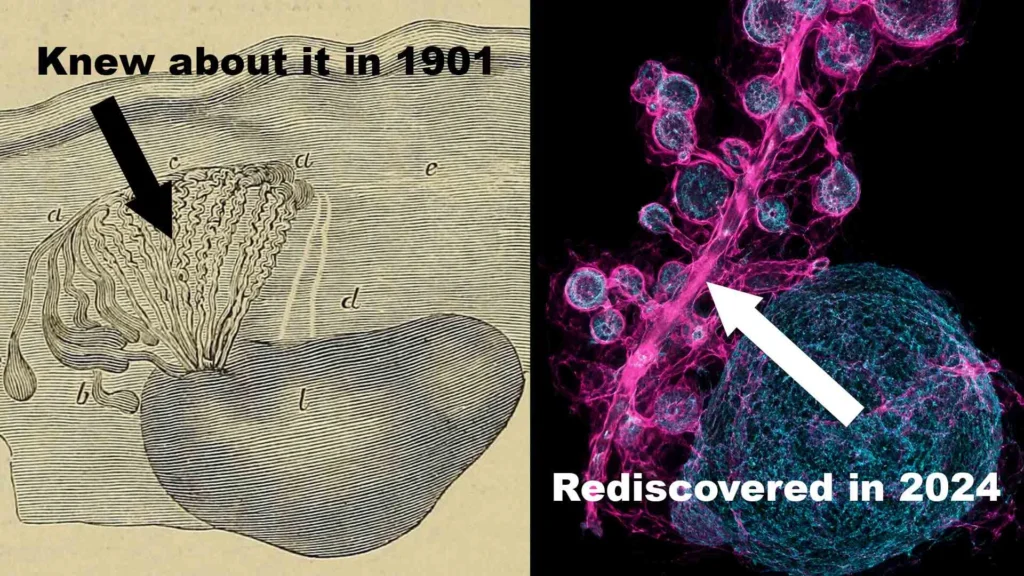
A female organ you’ve never heard of went viral this past September. Why? Because the story of how it got forgotten for a century is being circulated in the media and social media as evidence of sexism.
The rete ovarii is a small network of tubules and cords attached to women’s ovaries, and it was first discovered back in 1870. It initially made it into the anatomy textbooks, but, as Dr. Dilara Anbarci explain in her 2024 Duke University paper “Rediscovering the Rete Ovarii”
“it has disappeared from recent textbooks, and often is dismissed as a ‘functionless vestige’ of the adult ovary.”
Sure enough, a 1901 copy of Gray’s Anatomy has it, but when I paged through the 2014 edition I couldn’t find it. Its erasure from the textbook is seen by some as evidence of sexism because a corresponding structure in men, the rete testi, didn’t get the same erasure and, consequently, has been studied. Meanwhile the rete ovarii has only just been discovered to have some sort of function. While more study is needed, it turns out to be a fluid excreting organ.
Sexism may have been involved in this organ’s erasure, but there was certainly another factor. This is another example of how evolutionary assumptions impede scientific investigation. Christian scientists are going to presume function and genius because we know we’re looking into the blueprints of the Greatest Engineer. But evolutionists are investigating what time and chance has happened to come up with, and for them dead ends, or “functionless vestiges” of our earlier evolutionary stages, are expected. So that’s what they found… and it stopped anyone from really looking into the rete ovarii for a century.
Illustration is from the 1901 edition of “Gray’s Anatomy” combined with a ChatGPT sketch up of how the rete ovarii was imaged in 2024.