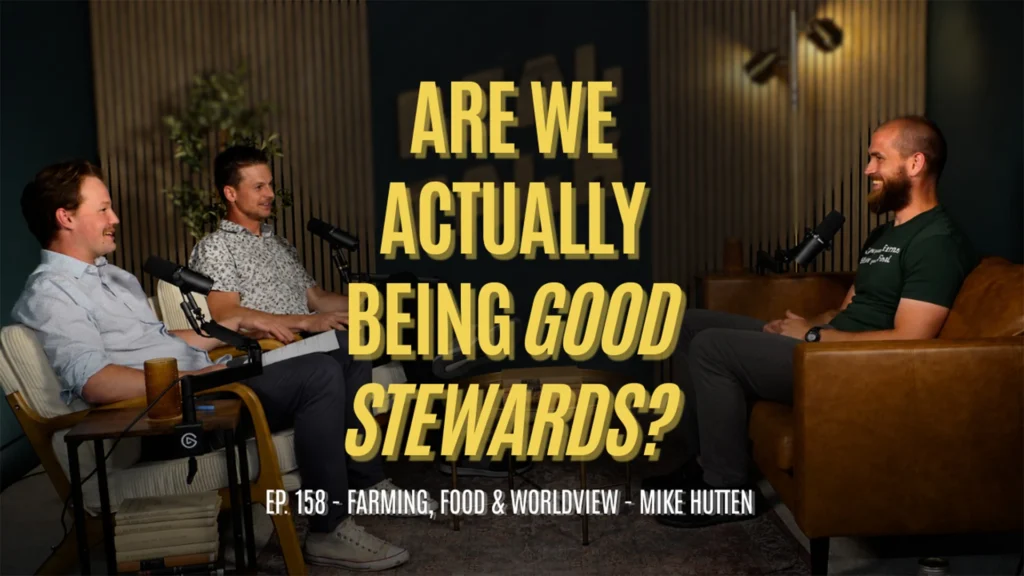
This episode can also be found on your favorite podcast platform: Spotify, Apple, Podbean, Amazon Music or on our website. Be sure to subscribe to our YouTube channel and our podcast profiles so you can be notified when new episodes are released. Please note that the transcript below was automatically generated and lightly edited so it may contain some errors.
*****
Opening
What does farming have to do with a worldview? More than you might think. In this episode, we’re joined by Mike Hutten from Good Ground Farms to explore regenerative farming, stewardship, and God’s purpose for creation. Together, we’ll discuss what it means to exercise dominion in a way that reflects the Creator, not exploiting the earth nor abandoning it, but faithfully subduing and cultivating it for His glory. We’ll talk about modern agriculture, regenerative farming, the pursuit of efficiency, and how Christians should think about caring for the world God has entrusted to us. Ultimately, this conversation is about more than just food or farming. It’s about displaying the glory of God in the way we steward His creation.
A big thanks to our official sponsor Trivan for making this conversation possible. Be sure to check them out at trivan.com.
Intro
The world’s changing fast, but what questions should we really be asking? You’re listening to Real Talk, a podcast presented by Reformed Perspective, where we take God’s word and apply it to the nitty-gritty of life. Buckle up for real questions, real answers, and real direction. This is Real Talk.
Tyler Vanderwoude
Welcome back, everybody. Mike Hutten is with us today, and Mike was with us on episode 29 was the most recent time. So this is four or five years ago, something like that? Back when we were, I don’t know how many podcast studios we’ve had since then. Lucas has had half a dozen, and I’ve had half a dozen, and but that goes way back to our beginning days before Mariah, I believe, who’s our amazing producer. So that was like back when we didn’t know what we were doing, and we’re only slightly better than that.
Lucas Holtvluwer
We had a lot of food out in the table.
TV
I do remember we didn’t eat any of it though, to be fair.
LH
It was all after. Yeah, we were too busy talking. That’s right. Yeah, no one wants to hear us munching into the mics.
TV
We talked about what is freedom, I think back then.
LH
That was a different one, I think?
Mike Hutten
Yeah, was that sounds about right. We were talking about stuff like that.
TV
Yeah, like the Christmas one that we did was three hours of just who knows gibberish.
LH
Yeah, but yeah, this one will be this will be more refined, I think.
TV
But we had Mike on way back when because he was a good thinker. So we were like, well, you were doing your podcast too, right? Way back when? So that’s before you started what you’re doing now with the farm.
MH
That’s right.
TV
So, but yeah, welcome back. This is cool.
MH
Thank you. It’s good to be here.
TV
Yeah, it’s fun. I don’t get to sit here with Lucas very often, so pretty sweet to be in the studio and do all this in person.
LH
Like the old times.
TV
Yeah. So today we wanted to talk about your regenerative farm and more broadly, we wanted to talk about the ethics around it, of food, where the world’s gone with health and wellness and all that stuff. And you think deeply on this stuff because you’re a, you know, a farmer with a moral compass. Can I call you that?
MH
I’ll take it. I don’t know if I can say I think deeply about it, but I think about it. So we’ll see what comes of this.
TV
But the thinking about it led you to start the farm, right?
MH
Yeah, absolutely.
TV
Okay, so, so I guess we want to start away from the farm and start talking about what, I guess, what kind of led you that direction. So, like, what are what are the things that you noticed about the world of food, the world of health that like kind of raised alarm bells, and like, where have we gone as you know modern people in that, in that the arc of you know used to farm ourselves and worry about our own healthcare and here we are today?
MH
Yeah, that’s a pretty big question. I can talk about sort of my path with that. I started as a conventional large-scale poultry farmer raising chickens in barns, and over the course of several years, kind of entirely changed my convictions around agriculture to the point that I have divested from chickens, and I’m pursuing a local farming model where I’m producing fresh food for local markets, raising animals almost entirely outside, which seems to be very backwards compared to modern day agriculture. But I am doing it kind of from a principled stance, and of course hoping to also turn a profit on the farm as well.
TV
That sounds secondary. So okay, I mean that makes sense. Does seems more cruel to have animals outside than inside.
LH
What led you to do to go down that road though? Was there a moment for you, or it’s just a series of things?
MH
Yeah, there’s a series of things that, looking back, like they seem so random and scattered, but looking back, I can see providence moving through to lead me down this path. It started with a book that one of my friends had given me about Lord of the Rings and Tolkien’s worldview, and I had not watched Lord of the Rings, I had not read Lord of the Rings prior to that, but he was really excited about this book. So I was like, “Well, I kind of have to read it.” So I read it, and I was fascinated, and I continued to read all of the Lord of the Rings and watch the movies, and then read the books to my kids because I loved the worldview that comes out in it. But in that book, there’s a reference to a farmer named Joel Salatin, and the reference in that book was this farmer had written a book entitled “Everything I Want to Do Is Illegal”, and here I was in conventional poultry and just farming away, doing my normal thing, and I was like, “Why does this farmer? What like, how does this work? Is he like a criminal farmer, or is he?”
TV
It was drugs.
MH
He was growing cannabis before it was legal. But I like. I was like, okay, who is this guy? Why does he want to do illegal things? What’s the story here? So fast forward something like nine months. I was bored. I decided to pick up one of his books, and I found that he espoused a much more traditional way of farming, raising animals outside, diverse systems all integrated together. If you picture a farm, maybe how it would be in the late 1800s, he was kind of modeling that in a in a modern context, and he describes how our modern way of life is so different than what was historically normal. He’s a devout Christian. He comes at… he has written a book for Christians about this. So I found his understanding of agriculture fascinating, and it really struck a chord with me, and then it was a matter of okay, I like this idea. Can I work towards it in my own context?
TV
Was it more morally consistent, do you find? Like the way he his worldview was put together?
MH
So that’s a that’s a big question, but yes, I ultimately yes. I find that I found that the way he was understanding farming and understanding God’s creation and the purposes of farming within God’s creation were more consistent than the than how we’re farming now. There is a worldview in farming, and a lot of farmers, I don’t want to knock down any farmers, any Christian farmers working in the conventional system, doing their thing. I don’t want to knock them down, but there is a worldview behind agriculture that perhaps not a lot of people are aware of, and it’s, for the most part, the worldview that’s guiding normal agriculture today is not a Christian worldview.
TV
Well, yeah, just throw that at us then. Yeah, why not? I’m curious how this starts like at health. Like, I want to, I want to, like, if I go online and I’m like, I see some power shake or something. I don’t even know that. But like, if you see some kind of like health food product, like you’re like kale is a superfood, and then sugar is, uh, you know, evil. Or like,
MH
Yeah, poison.
TV
Yeah, like that’s poison. This is amazing. Like, how do we understand where you’re going to go with like with the farming side of it, and like, is conventional farming feeding into a worse diet across the board. You look at like American diet recommendations or whatever. That’s all kind of been flipped on its head the last few years.
MH
Yeah.
TV
What am I looking at when I’m seeing all this?
MH
Right. So there’s two almost conflicting understandings of diet. Government promoted understandings of diet right now. So there’s the MAHA movement in the states, and Robert Kennedy is pushing kind of, I wouldn’t say he’s pushing it, but there’s a, I mean, Joel Salton was one of his advisors. And I’m not saying that Robert Kennedy is taking everything Joel Salton says and just putting it into policy, not at all, but they are… there is a bit of a moving away from conventional agriculture. On the flip side, in Canada, when Trudeau was still in power, he redefined the Canadian nutritional guide to be much more plant heavy. It was a really significant reworking of the nutritional guide.
TV
Plants and bugs.
MH
I don’t know if you worked bugs in there. I’d have to look closer at it.
TV
Insect protein, they call that.
MH
Yeah, that’s right. But there is a lot of confusion around health, diet, what’s good, what’s not. A lot of it seems to be motivated by politics, and it is. But that’s also the state of culture that we’re in, right? Culture is so confused. Culture is confused about everything, even simple questions that, or simple questions from 200 years ago, which could be readily answered by everyone, we no longer have answers to. Perhaps the most obvious in in our current context is trying to define the boundaries that AI should be used within, and what’s the benefit of a human relationship versus an AI relationship, and I think there’s a lot of people in in society that can’t answer that question because we no longer see the value of humanity, right? And if we can’t see the value of humanity, then I mean, we’ve lost our way. We’re really confused as a society, right?
LH
Yeah, for sure. The first principles kind of thinking like that’s not very common anymore. But like, I think a lot of us just kind of go along with the flow sort of thing, and you just you buy the food in the supermarket and you just get what you get, whatever. Now there is a shift, like you say, the whole MAHA movement back the other way, which is probably quite a positive shift in general. I don’t know all the specifics of it, but on the first principles side of things – so when you were kind of getting into this first, and you’re looking at a guy like a Joel Salatin and whatnot, and kind of what he brings to the table, especially from a Christian perspective, like what were some of those principles that you found to be so consistent, and then led you to make a change, well, in your employment kind of situation, and kind of set you on that path towards regenerative farming.
MH
Yeah, that’s a great question, and I think this is a thread that we can draw through a lot of societies in question right now, or a lot of society’s questions. A lot of that confusion can be basically cut down with this one principle: What is God’s design? Right? So we can look at food-producing systems and say, “Well, what is God’s design for His creation?” And that’s a that’s a very substantial question that I don’t think is ever really considered in agriculture. We just assume if we stick a seed in the ground, we’re going to grow a plant, and we can use that plant for food. We can give it fertilizer, and the plant will grow better, and everything’s good. But what is God’s design, as we can see in His creation, and because it’s in His creation, it’s part of it. It shows his character, right? It shows what is true, what is good, what is beautiful. And then, can we take those principles of God’s design and develop a food production system out of it? And that’s the that’s the ultimate question: What is God’s design that I find drives? Now, not everyone in regenerative agriculture, states it that way, but that’s the ultimate question of regenerative agriculture.
LH
What is God’s design?
MH
What is God’s design?
LH
And is God’s design inherently sustainable?
MH
Sure.
LH
Yeah, that might define your view of the end times, to be honest. But we’ll get into eschatology some other time.
TV
Like, are there regenerative farmers who don’t frame it like that? Like, are they just doing it because, say, it’s easier way, or like there has to be a stewardly element to it? Who are the people involved?
LH
Is it like environmentalists and then Christians? Are those like the two camps instead of that?
MH
Pretty much. So it’s very interesting. I went to a conference in the states. My guess is at that conference, and this is a big regenerative agriculture conference. My guess is probably of 50% of the presenters and attendees are Christian and pretty outspoken Christians. On the conference floor, on the trade show floor, topics or conversations about faith came up almost as quickly as conversations about agriculture, but you bring that back to a Canadian context. We just don’t seem to have the same level of faith in our society, and it’s a lot of hippies, a lot of environmentalists who are promoting the movement.
TV
Is that a distrust of the government? Is that why those that the people who aren’t Christians? Is that what that is? Like a prepper kind of mindset?
MH
Well, I don’t necessarily think it’s a prepper mindset. There is that as well-a distrust of government and wanting to secure your own food systems…
TV
Kind of getting off the grid and being like leave me alone.
MH
But there’s also a very strong environmentalist movement, and that’s tied into the like the extreme environmentalists trying to decrease greenhouse gasses, trying to promote animal diversity and decrease the effects that humans have on the environment. So that’s sort of the secular purpose or secular reason to promote regenerative agriculture. But then within the Christian regenerative farmers camp, it’s well, how can we glorify God in agriculture the most?
TV
Can we can we define regenerative? Because like keep talking about regenerative farming, but we should probably tell our listeners like what that is. If people aren’t familiar with farming in general or conventional farming, like what’s that and what is regenerative farming and how is that actually? Because we can, and then I want to. We should talk about stewardship and how that actually works its way into this model. But give the listeners a like – what are you doing different than the guy up the road?
MH
Sure. So conventional agriculture it produces something like 95% of the food that’s available in North America today, and globally as well. It produces most of the food. It’s characterized by what’s called a monoculture. A monoculture is very simply-it’s done for efficiency, and it is growing a full field of just corn, or growing only chickens in a barn at very large numbers, or only pigs in a barn. That’s a monoculture. Just a single species, whether it’s plant or animal, in a space, and usually it’s also characterized by a single buyer market, and that’s pretty important. If you are growing corn, you sell it to one person. There’s nobody competing for your corn crop, so you’re a price taker. You take whatever price that buyer gives you. You can’t find another market. It’s characterized usually by heavy dependency on chemical interventions, whether that’s chemical nutrition, chemical fertilizers, or pesticides and herbicides, because you’re trying to facilitate the growth in that monoculture. It’s usually characterized by lack of diversity. So, if you go, especially to the largest examples of a monoculture, you go to the grain fields out west, where you have acres on acres, miles on miles of just one crop. Combines will start in the south and just move north with the with the sea-, or start in the north, move south. Which way is it going? I don’t know. With the seasons, to just harvest with the changing weather, right? Beasue it’s just the same crop over and over. There is so little animal diversity in those areas, like you, you just you don’t even find birds, because there’s nothing to sustain them. Now, regenerative agriculture is trying to produce food in a way that mimics natural patterns, and that’s the difference. That is what regenerative agriculture is in a nutshell. So, what it looks like is instead of a monoculture, we use polycultures. Polycultures are integrating animals and plants often, and having a diversity of animals or plants in a given space. Oftentimes, that can be there can be a variety of ways to do that, but you might be, for example, having beef cows on pasture followed by chickens on pasture-that’s just one simple example of a polyculture.
TV
And you would do that simply for, like, you do that for the animal, or you do that for the land?
MH
For both.
TV
Okay.
MH
And we can get into the benefits, but the basis for the principle is in nature. We don’t find monocultures in nature. Nature is always a ecosystem. Always with a variety of species.
TV
Diversity is our strength. Is that the…?
LH
Thank you, Justin.
MH
Yes, that’s very good. I can get into that but… So diversity working towards the same goal, and that’s essential, right? Diversity has to be working toward the same goal, and then indeed is it is a strength. But if you have diversity working towards different goals, you end up in a intention.
LH
Speaking of goals, then, so then the monocultural agriculture would be the goal is profit driven, primarily?
MH
Perhaps or efficiency driven.
LH
Efficiency driven, right? Which efficiency to lead to profit.
TV
Well, you might you’re a price taker, so that’s a business podcast.
MH
It’s really interesting how if we start talking efficiency or profit, farming isn’t very profitable right now. There’s a lot of government support propping up agriculture to keep farmers going. So efficiency, profit-it’s-it’s actually difficult to make arguments for conventional agriculture from that perspective.
TV
So how do we get – how do you get there then? Like, why did we end up where that’s conventional?
MH
Yeah, that’s it’s another significant question. There’s a lot of factors coming in. I kind of this morning I sat down and mapped out a bunch of reasons, and we can go all the way back to basically enlightenment level thinking with someone like Francis Bacon…
TV
I thought you were just gonna be like Trudeau or whatever.
MH
No, we’re going way back. So Francis Bacon, I don’t know if you guys have really know what he said. I just the only reason I know is because I listened to a podcast about him recently. He was very Machiavellian, which means he was very manipulative. He said he was Anglican, but the way his philosophy actually worked out was that we could manipulate nature for our own ends, according to our own design. We could use this use science and the scientific method to basically extract from nature whatever we want. And there’s a quote about I think almost torturing nature for her secrets, which is pretty remarkable for someone who said he was a Christian. And then we can move forward to more scientists, kind of going into the 1800s. A man named Justus von Liebig. He was a plant biologist, and he out of his research, there came the idea that plant growth can be distilled down to three elements: nitrogen, phosphorus, and potassium, which is NPK fertilizer. And if you apply the right amounts of NPK fertilizer, then your plant will grow and it’ll be fine. Which is a gross oversimplification.
LH
Materialist.
MH
It’s very materialist, exactly.
TV
That’s how we treat our lawn, right? Right. It’s like fertilizers got three numbers.
MH
Yeah, yeah. Never mind whatever other micronutrients there might be. So those two guys really-they weren’t the only guys, of course, but that’s how thought went from the enlightenment. That’s how it developed. So we have ultimately a very materialist assumption that the world is physical, and biology is just a series of chemical reactions..
LH
Just to manipulate for whatever we want.
MH
Right, and I mean, a lot of a lot of modern day scientists still think the same way that we are just a bunch of chemical reactions. We have no free will. Where that’s just modern science, right? And a guy like Justice von Liebig and also Louis Pasteur really brought those ideas into our agricultural systems, so that we view agriculture, plant growth, animal growth as basically chemical reactions that we can manipulate for our good, and that is the worldview behind modern day agriculture. There’s a recipe for growing plants and animals, and yes, there’s variants brought in by the environment, by soil, by whatever pest pressure, but that’s the essence that we’re dealing with physical things, materials, and it ends up being similar to factory production. A lot of farmers don’t like to hear that conventional agriculture is the factory farm, but there are a lot of similarities, and that’s something that we have to deal with. So that’s sort of the science worldview side. We can get into the chemical development side, which is fascinating. This started in World War One, World War Two, where you have nitrogen being used for explosives rather than nitrogen for crops coming from things like compost and soil microbes and stuff like that. That’s how nitrogen used to feed plants. There’s a couple scientists, Haber and Bosch, I think their names were. They developed a system, very energy intensive system, to take nitrogen out of the air, so that they could they could get elemental nitrogen very easily, or it was expensive. It used a lot of energy, but it was still fairly easy to do. And then they, during the wars, that nitrogen was used to create explosives. And then at the end of those wars, they the factories that were producing this nitrogen, of course, had a surplus, and they had to find a market for it. So, using von Liebig’s assertions, they develop fertilizer out of it.
LH
It’s also exploding world population too. At that point, like going, like getting to the billions.
MH
Yeah. So it’s not all bad because those people had there was a need as well. And it’s similar with the herbicides and pesticides. I documented a few, but a lot of the origin of those herbicides and pesticides that are currently used in conventional agriculture come from a chemical weapon origin, and actually a lot of them started the yeah.
TV
I think you sold everyone already.
LH
So what farmers market can I buy stuff at?
TV
Your corn has exploded this year.
MH
So I have some stories. I won’t look them up now, but Nazi Germany developing nerve gas and stuff like that. Similar chemical compounds, I think they were called organophosphates, are used currently for pesticides to decrease aphids and stuff like that in vegetable crops, which is like I mean these compounds, very similar compounds, were used to kill Jews in concentration camps, right? And now we’re using diluted versions and slightly modified versions to kill pests in our farming.
LH
Okay, well that paints it with a very emotional, moral brush, right? But like it’s probably a useful technology, still.
MH
Right, exactly. So I don’t want to be sidetracked. I don’t want that to be the moralistic argument against conventional agriculture.
LH
We’re not saying Nazi corn, and therefore we have to go to the farmers’ market.
MH
No, exactly. It’s just recognizing how these things developed to get to where they are today.
TV
So you got to see a similar arc with. Medicine, then, like a lot of this stuff has to go back to a root. Like, I mean, some of it goes back to Nazi Germany.
LH
I think it’s just big pharma and all that stuff too, right?
TV
But like, these things do develop like side by side, I suppose. Right.
MH
So what I, yeah, exactly. What I don’t want to do is say this is the origin and this is and therefore it’s bad. Yeah. Right. Because a lot of these technologies do have a purpose. I mean, the Haber-Bosch method for taking nitrogen out of the air-it gave us available nitrogen fertilizers. Right. So it’s not all bad. Interestingly, one of those scientists was also one of the main ones in Nazi Germany to develop nerve gas or different gasses for the battlefield. Anyways, the next kind of set of factors that allowed agriculture to develop to what it is governmental factors. So in Canada specifically, it kind of goes back to World War One, Depression era, World War Two, where during the wars there was need for vastly increased food production. So the government really promoted farmers pushing production, maximizing production. I think World War One almost doubled food production in Canada over the span of four years, which is pretty remarkable.
LH
Is that because Europe was not producing in the way it used to?
MH
Europe wasn’t producing; they had to feed troops. Of course, as soon as you’re sending food overseas, some of it’s going to spoil. So yeah, a lot of those factors really the government really promoted increased food production.
TV
Unless it’s like Fruit Loops, then if you send that over, that’s going to be great when he gets there.
MH
So yeah, exactly. And this is interesting because that’s oftentimes what was promoted grain production because grains are shelf stable and you can send them overseas.
TV
The wars just ruin everything, man.
MH
Well, they certainly are a factor, but you can understand why the government would do that, right? Oh yeah, there’s a need for food. But then what happens at the end of the war when all your farmers took out whatever they used debt or whatever it is to finance their farm expansion, and now there’s no more demand. Well, then what the government does is they use the government intervenes to stabilize prices and to…
LH
Insert Tony the Tiger.
MH
Well, yeah, the government comes in to bail the farmers out, basically, right? For real. The same thing happened in the Great Depression. The farmers were struggling to keep growing on fields that had been maximized during World War One, and the government comes in to bail them out. They set price floors. I think in the 50s, so there were price floors set so that if the global market couldn’t meet a certain price, the farmers could still sell their grain on that market, and the government would cover the cost. They would they would cover the
LH
Subsidize the difference.
MH
They would subsidize it. There was crop insurance heavily subsidized by the government. There were all these measures put in place that allowed the government to support conventional agriculture, and of course, as soon as you subsidize anything or support it, you get more of it. Right. So that really led to the promotion of, like, or it really led to the development of conventional agriculture to be what it is today.
TV
Right.
MH
Large scale monocultures very efficient, intense production of basically a small set of commodity food items. Most of it is corn, soybeans destined for animal food, and then there’s a lot of grains as well.
TV
You see, on the prairies. That’s all. It’s just wheat everywhere.
MH
Yeah, exactly.
TV
Yeah. So, if you if you think about like that arc of how we got here, and then I mean, you could again, you could do the same thing with medicine. Like, how do we as Christians think about that from a cultural mandate, like subdue the Earth perspective, because to me, if you were if I was living whatever 2-300 years ago and struggling with my vegetable garden, you said, “Hey, spray this thing on there.” I almost don’t care what it is. It’s like if my family’s going to eat better because you know because of whatever you gave me, and I was struggling before, I’m just gonna do it.
MH
Yeah.
TV
And then as a Christian, I would have framed that action as like, wow, what a blessing that God has allowed us to make this technology that now helps my potato production or whatever it is. Now you take that to its extreme, and you end up, I mean, maybe we’re not even at the extreme yet you can tell us that, but like now you are at this monoculture agriculture thing. But is that not subduing the earth, or are we have we over subdued the earth right at this point?
LH
Why is it not good? Like, is it is it not a sustainable model long term?
MH
So questions of sustainability – I find it’s such a buzzword now, and everyone’s either claiming that well, most people are claiming what they’re doing is sustainable, and what the other guy is doing is not. Sure, right, and it’s very hard. Like we simply can’t understand the complexity of creation to the point that we can determine what’s sustainable and not. And I mean, regenerative agriculture also recognizes that the complexity of creation is so much that we don’t actually know entirely what’s going on. We can just see patterns and work with those patterns. So the problems, a lot of the problems that regenerative folks will say about conventional agriculture: number one, it is continuously degrading soil, and that’s one of the biggest ones. The it’s the essential. The I can’t remember the numbers of topsoil, the amount of topsoil that’s lost every year with our current farming methods, and topsoil is a pretty hard thing to build, and if you’re constantly losing topsoil, you’re losing fertility in your fields. I don’t want to sound like an environmentalist here, but the environmentalists unfortunately do have a few things right, things like nutrient runoff that is causing all sorts of problems in waterways, in lakes and oceans. That is a real thing. I used to be pretty skeptical of it, but it is a real thing, and it’s killing a lot of stuff, a lot of fish, whatever else.
TV
Yeah, because nutrients are running into the fish? That sounds like a good thing.
MH
So it comes back to the NPK fertilizers that are being spread on the fields.
TV
Oh, I see. Okay.
MH
They’re a water soluble fertilizer, so as soon as rain falls, and if there’s runoff, which is what the streams and the rivers take up, there’s going to be fertilizer in that, and then that fertilizer goes down the waterways into your lakes, rivers, causes algae blooms. The algae will choke off all the sunlight. The oxygen it’ll kill all the fish.
TV
So that’s fertilizer getting into something that’s…
MH
That’s right. So that’s a real concern, and in some of the very large water bodies, it’s a very serious concern.
LH
Not only the fish too. Just quick anecdote. I got into beekeeping over the last couple years too, and beekeepers are like nuts about this stuff, or like all the pesticides and stuff they spray. Like if you talk to a lot of the people who are like really into that, they’re like they’re like the hippy environmental types, but they’re just like this is so bad for the bees, right? But like it’s always a question of trade offs, right? Like when I hear that, it’s like okay, like how many bees, how many fish, how many people are fed off this kind of stuff.
TV
Well, it’s what do you love? That’s what I always. It’s like if you like to fish, then that’s a problem for you. If you like a bee, then it’s a problem for you, right? So I like deer. So is it a problem for the deer?
MH
But that’s where that’s where I find our principle cuts through the noise because there’s a lot of people claiming things, and if you want to say, well, human flourishing should be our foremost concern. Yeah, I don’t necessarily disagree with you, except hey, we actually have to glorify God first, and we have to show His character in creation as much as we can, right? So, and this gets into stewardship. What does it mean to be a steward? Well, a steward, a steward doesn’t own the things that he’s taking care of, right? That’s the owner. That’s the definition. So as a steward, we are taking care of something that is not ours. So then it’s not our…uh, we don’t have the ability to define how to take care of it or what the end result should be. We have to follow the owner’s intentions. The owner’s God, right? What are his intentions for his creation? While his creation was given to us to show his beauty, his goodness, his characteristics, right? So we should, as we’re taking care of his creation, of his creation, we should be trying to magnify his characteristics as much as possible. The trout that dies in a lake because of an algae bloom, because of fertilizer runoff, that trout shows God’s characteristics, right? And so it’s not a small thing when we say, “Hey, fertilizer runoff is killing fish in this in this waterway.” That’s not a small thing. That’s diminishing God’s characteristics as seen in His creation, and that’s why it’s important. And I find that principle for me cuts through all the noise of environmentalism, of interest groups, of all the rest, and it says, okay, yeah, that’s actually the principle that we have to adhere to.
LH
I think that it just gets worked out in the specifics of each situation, though, right? Like you could say God’s design for a tree was to be maintained as a tree and to grow, but like it’s also a useful thing that we cut down as a resource. Right? So how would that principle apply in that kind of situation? Just to pick a basic one.
MH
So a tree is designed to grow. Yes, a tree has lots of purposes. Yeah, right. A tree can house animals. Trees in landscape really help biodiversity. They bring birds in. A tree can be used for wood. All of these things. Now, if we were to go into a forest and clear cut it, and say, “Hey, we’re going to use all this wood to build houses.”
LH
Yeah, we don’t plant any more trees.
MH
We don’t plant any more trees.
LH
Not sustainable.
MH
Right. All of that diversity, that animal diversity, that showed God’s character and His beauty and His goodness is gone, and we can’t see it anymore. So there are ways, I read a fascinating book, not a Christian book, but a fascinating book. I think called “The Secret Life of Trees”, which I’d encourage everyone. Really interesting.
TV
That sounds hippie adjacent.
MH
It is. It’s not a Christian book, but it goes into the ecosystem that trees create, and it’s fascinating. But then it also details some of the very sustainable logging methods that are possible that maintain the forest ecosystem, the diversity, but still allow us to take trees out and use them.
LH
But again, you probably, I don’t know for sure, but I’m guessing you sacrifice short term profitability in those more regenerative or sustainable logging methods, which would be similar to farming as well.
MH
Perhaps. There are people who say you don’t have to sacrifice short term profitability. There, like, there is one expert within regenerative agriculture who completely debunks that idea.
LH
Okay.
MH
I would have to defer to his expertise.
LH
Sure.
MH
But a lot more farmers will say yes, they did sacrifice some short-term profitability for long-term benefit, and that benefit it can be seen as an investment, but often that investment is the return on that investment comes over generations.
LH
Sure.
MH
So if you have a very long-term focus where you’re farming 100-acre parcel of land and you’re farming it regeneratively and you’re developing ecosystem diversity and soil health, then your kids and your grandkids will see that benefit, provided they continue to farm. So regenerative agriculture comes with a very long-term mindset.
TV
So this it gets to me to be like, it’s a valuation. Like you have to pick what you value. Like just take your tree example like if you cut a tree down well now it has it had birds living in, it has a you know like there’s a bunch of bugs, there’s a bunch of biodiversity around the around the tree you chop it down it’s all gone. If we were gonna say we just we’re gonna leave that log laying there well again it would turn into a different ecosystem but right we would say probably bad. Now, if you’re going to go build a house with it, then you’re saying, okay, well, we’re valuing that tree and the biodiversity and all that against this person needs a house. So you’re like, okay, well, I can make that trade off, even on a large scale, as long as maybe you do that forestry sustainably. But if I was like, I just love campfires a lot. You’d be like, okay, settle down, bro, with your campfires. Like at some point, the thing that you did by ruining this thing is no longer in our estimation worthwhile, and then we just disagree on that, like valuation. So at what point, like if I, if you’re in, like I agree, like forests are great, but if the whole world is a forest, you wouldn’t want that either. So that’s not subduing the earth. So if like if some indigenous tribe somewhere in the Amazon cuts 17 acres of trees down, I would be like, I’m not going to say anything. But if we went in there, me and you, and just cut the same amount of trees down, I’d be like, oh, there’s probably bad reasons for that. So, like, so at what point is it just a value equation?
MH
Okay, I think again, I’m going to bring us back to a principle. How are you glorifying God and His design for that? Right. So there’s largely two different ways, and we’ve touched on them already. But I wanted to find two different ways that are prominent with how we treat nature, and I’m specifically calling it nature instead of creation because most people who think about this are not talking about God’s creation; they’re talking about nature and nature absent the divine, the divine designer, right? So there’s two ways to interact with nature. One is to manipulate and extract from nature for our own comfort, our own purposes. We are, we determine what happens. Ultimately, we’re putting ourselves at the top there. The other way is that actually mankind is a blight on nature, and I would say that might be the dominant way of thinking now, where we actually have to remove ourselves from nature. We want to put ourselves in cities. We want to minimize man’s impact on nature, and that is clearly seen in a policy that was recently implemented in Canada, the 30 by 30 and 50 by 50 policy. I don’t know if you guys heard of this.
LH
No, no.
MH
I just recently heard of it. By 2030, 30% of Canadian land will be preserved, which means basically no human interaction with that land by 2050.
TV
Interaction?
MH
Yes. By 2050, 50% of the land will be preserved.
LH
It’s a federal piece of legislation?
MH
Yes, that’s right. Now it’s almost silly in Canada because 70% of Canadian land is crown land.
TV
I was gonna say, like, don’t we already kind of do that? Just that, just that it’s the 30% no one wants to go to. Right.
MH
The difference is that this would be legislation, and you can’t go in that land.
LH
So you can’t go camping, hunting, and exactly fishing.
TV
We probably have 30% of our land that you wouldn’t want to go in anyway, or you can’t go in.
MH
That’s pretty easy for Canada to do. Let’s be honest.
TV
Yeah. I was gonna say, is that just like are they just giving a PR win? Because like the Arctic Circle, no one’s even up there.
MH
Yeah, 100% But it reflects this idea that for nature to be perfect, we have to remove people from it.
LH
Anti-human.
TV
I mean, I love that. From a, I like to go in those places to hunt. Like, right. Those are the best places to explore.
MH
So, from kind of a little bit more of a philosophical understanding, the wilderness is chaos, and as Christians, we’re called to bring order to chaos. Right?
TV
That’s what my gun is for.
LH
Yeah, there you go. Ah, This is orderly. You’re laying on the ground now. Very nice. Let us quarter the order.
MH
But there’s a an idea of turning the wilderness into a garden, right? So wilderness is not actually the most. I don’t think it’s the most diverse or the most beneficial way that nature should stay.
LH
Oh yeah, no, right. It needs human interaction.
MH
It needs human interaction, and actually, we can improve on sort of wild nature’s diversity. We can improve on its productivity by interacting with it well. So I don’t necessarily see it as a set of trade offs. This you value campfires over diversity. I don’t see that. I see it as, okay how can we actually manage nature well for everyone’s benefit? And I have that perspective because I think God, in His infinite wisdom, has designed it that way, designed it for our interaction to show His glory and to encourage human flourishing, right? And if it all fits together that way, then we can interact with nature in such a way that that nature actually becomes a better place to be.
LH
Are you defining well as sustainable? I hate using it because it’s a buzzword, but like at least like it’s on equal playing field to how you found it, if not better. Like is if that’s the way I’m coming.
TV
But how do you define better?
LH
Better? More ecologically diverse…
TV
More gooder.
LH
Higher outcomes in terms of yield, perhaps, but that can’t be the primary.
TV
But yield for what? Like toward what?
MH
I’m going to again define it as showing God’s glory more. Right. But like you can walk outside and there is beauty in the songbird. Right. How often do you see a songbird? Not very often.
LH
Unless you’re into birding.
MH
Unless you’re into birding. So since I turned my field into pasture, I see a huge diversity of birds all the time and it’s still a productive agricultural space.
LH
Yeah, which is cool.
MH
And this story is it’s very common in regenerative agriculture when a farm is transitioned from conventional monoculture to a diverse regenerative farm, diversity explodes not just in what is cultivated, but all the other diversity as well. They see more animals, more birds, more plants that were not intended to be there but are actually beneficial. All sorts of stuff. That diversity starts, I would say, primarily actually in the soil, soil is not just a medium for growing plants, but it is a living ecosystem. It’s an organism, so there’s that diversity, I think, shows God’s glory. Every one of His created beings show His character somehow.
LH
Well, is that the primary driver then? Ecological diversity because it glorifies God, because it’s so complicated and interwoven, and it just points to a creator over it all-an
MH
An infinite creator.
LH
An infinite creator.
MH
Right. I think that would be a good starting point. I wouldn’t want to limit the definition to that.
LH
Sure.
MH
But we can, we can achieve. That with agriculture, with how we interact with nature, we don’t have to remove ourselves from nature for that. And in fact, when we remove ourselves from nature, we actually limit how well we can see that diversity. Of course, we do.
LH
Yeah, because we’re because we’re a player in the game. We’re God created us to be part of that. Well not just that bit to have a primary role in that in that space.
MH
So that, in a nutshell, is my worldview argument for regenerative agriculture.
TV
It’s yeah, it’s interesting. Like I, I just don’t know how to, I don’t know where like the line between like God’s also a God of like of creation, like innovation too,
MH
Absolutely.
TV
And so we are like, if I see a modern tractor, I’m not like looking at the old tractor, going like, “Well, that’s actually closer to…”, since that was less efficient and more like allowed more deer to eat off this land, and you know, I’m not like, oh, that’s better, necessarily, right?
MH
Right? No, absolutely.
TV
I don’t necessarily like if you were growing a vegetable garden and a deer came in your vegetable garden to eat all your stuff, you wouldn’t be like, oh, good for diversity. You’re like, right? You’re still like, get out of here. I’m trying to do something here.
MH
Yeah.
TV
So like, but you said like the garden, like that’s what we’re trying to we’re trying to cultivate things to be a garden, but the garden isn’t like just everyone do what they want. So I’m just saying, yeah, I still feel it’s like a continuum, like, but I guess can farming be a continuum, or do you have to kind of pick a lane? Like, do you got to go conventional or go your way, or is there somewhere in between that you can be like, like, like you went like just for context, you went all the way to like no chemicals at all, right? You say you farm with biology, yes, which I think that’s a great line, yeah. Which everyone’s farming with biology, just not the better biology than, but like, if you had your like, if you had this implemented across the board, would you just take conventional agriculture and just back it off a touch to away from that monocultural like setting, or is there no way to do that until you get to where you are on the other side of this, where it’s like you have to have a pig and a stalk of corn and a cow and a chicken, and they all have to do this little like orchestrated dance. Yeah, because it’s cool, it’s wonderful, and it’s better for the ground, but then like you’re just you have less efficiency, probably.
MH
Yeah. So there’s a couple of things that you said that I want to key in on. So, God is-I think you said God is a God of innovation or something.
TV
Yeah.
MH
Yes. Okay. So yes, I totally agree. We are made in the image of God. So we are co-creators. So we are supposed to be innovative, we are supposed to be developing things again for His glory, not for our own comfort or our own purposes, but for His glory. I entirely agree. I don’t think that innovation has to be avoided or absent in regenerative agriculture, but again, if we see the development of how conventional agriculture came to be what it is, there were a lot of forces pushing it all in one direction. So the normal everyday farmer, like you alluded to, if they were given a chemical fertilizer when their soils were getting depleted and they were given a chemical fertilizer and all of a sudden their yields went up 20% of course they’re going to use it totally makes sense but that’s part of a broader development that is influenced by a specific worldview right now it’s an interesting thing to consider what would it look like if the development had gone the other way? If we had been developing technology, agricultural technology for polycultures instead of a monoculture, for like mixing animals, different species of animals together in the same area, what would it look like? And it would be wildly different. Something like it’s like one or 2% of farmers are growing in an unconventional manner. It’s a very, very small number of farmers, and there’s already a lot of innovation. So regenerative agriculture doesn’t have to be….
TV
It’d be more interesting to drive past, I bet. Like you’d be seeing things instead of just like, ah, the wheat’s getting high.
MH
Yeah, there’s a lot, a lot of interesting stuff going on, and there’s a lot of a lot of innovation. And going to a conference, you see a lot of innovation. There’s a lot of really interesting stuff going on. It might not look like a 600 horsepower tractor pulling a giant cultivator through the field. It might look different, although I do think there is room for that as well. The bigger thing I would say is that I don’t want government to dictate how agriculture, agricultural development, like what direction it goes in. I don’t want the government to dictate that. I want like individual farmers to develop that and innovate and make adjustments and new things, right?
TV
Right. Well, if you’re saying less government, like I’m like, yeah, let’s do that. I mean, I live in Alberta, so less government the better.
LH
That is true. So, but if we think about like the problem that it’s trying to solve for regenerative farming, right? So, is the reason I’m gonna just keep coming back to the word sustainability. Like, is the reason the traditional, conventional agricultural setup is not a path that we should continue on without any sort of adjustment? Like, if let’s just say we just kept going, we kept doing the monocultural thing, the soil health will continue to degrade over time, and therefore we are not doing our job in terms of maintaining the earth, subduing it, growing, fulfilling all that kind of stuff. And that is not how God designed the earth to be used, because it should not be worse for the coming generations. Is that kind of like the big problem with the way things are going right now?
MH
That is the way a lot of guys in the regenerative industry see it.
LH
Would frame it, yeah.
MH
So there’s a lot of farmers who end up doing something regenerative or organic. They’re not the same thing, but who kind of go to that way of farming because the old way didn’t work, and they were running into problems. Fertilizer bills were too high, or the ground was just dead, and it wouldn’t grow crops. Or they ran into financial difficulties. Who… like, there’s all sorts of reasons, but a lot of them have started pursuing regenerative because they ran into some sort of financial hardship.
LH
And regenerative can work on a smaller scale. Whereas like conventional farming is just pushing bigger, bigger, bigger, bigger.
TV
Are those, is that why? Is it like the? Is it a manufactured kind of spot they end up in? Like where they’re like they have one guy taking like one guy giving them the price for what they need to raise. They’ve got a bill for the tractor. They’ve got gas prices just went up. Like, are those the things that cause them to make that decision, or is it like, well, now I tried to do that. I had all the resources and money to do it traditionally, but now my land just didn’t allow that to yield or whatever.
MH
They work hand in hand, right?
TV
So they eventually just kind of get squeezed into this…
MH
So I pulled some numbers from recent statistics for farm finances. In 2025, I want to say 10 billion dollars in farm revenue in Canada went to interest payments on debt. That’s the level of farm debt: 10 billion dollars in one year. Okay, so you can imagine if that’s just interest payments, never mind principal, never mind other expenses. If fertilizer prices go up, if and because they’re so energy intensive to manufacture those fertilizers, yes, fertilizer prices are going up. Then farmers just get squeezed more and more and more, and there comes a point where their land needs X amount of fertilizer, and they can’t buy that fertilizer. And so it’s like, well, we have to do something different.
TV
It sort of sounds like the government. Like our debt payments are too high. Sorry, no more services.
MH
Right. But then in the midst of all of this, the government is basically subsidizing and stabilizing prices to kind of keep farmers afloat because that’s the only way that we can keep producing this food. So almost by definition
TV
From the consumers.
MH
Well, exactly, exactly, just burdening the consumer more and more. Yeah, almost by definition, that is a failing system, right? It’s not a sustainable system.
LH
Can you just because it’s? I’m curious. Can you give a concise explanation of how the quota system works?
MH
Oof. Absolutely. I’m quite familiar with the quota system. I worked within it for a number of years. The quota system is essentially license enforced by the government to be able to produce poultry or dairy within Canada. If you don’t have that license, there are strict limitations to the amount you can produce. For dairy, it’s zero unless you’re consuming it in your own home.
TV
And you can’t sell it at all.
MH
You can’t sell it at all. For poultry, there, for eggs, for chicken eggs, chicken meat and turkey meat, there are strict limitations to the numbers you can produce per year. If you go above those limitations, the government will enforce them with every power they have. Now, supply management was put in place for a reason. That reason is again a government intervention reason. Food processors got too big and too powerful, and could source food from too many different locations. They could bully farmers into compliance. They could bully farmers with their prices. Farmers couldn’t actually run a sustainable farm with the prices that processors would give them, because processors could always go to someone else for their product, right? So then the Canadian industry got together and said, “Hey, we have to work together to make sure that we don’t get bullied by the food processors.” So that’s ultimately the reason for supply management. But the reason those processing companies got so big, powerful, wealthy in the first place that they could bully farmers is because again, it was government regulations on food safety that meant that they became so large. There’s only a few main food processors in North America…
LH
Who can pay for all the red tape to do that job.
MH
Yeah, exactly. So it’s again government overregulation that allowed these businesses to get to the size that they could bully farmers, that forced farmers to basically work together. Again, government regulation enforced that system. So to fight government regulate, to fight over regulation, you use more regulation. And again, of course, the government people in the government want power. That’s what they’re there for. Of course, they’re going to say yes, we will enforce supply management because it gives us more power. So you have a system where farmers are dependent on the government to stay in business. The consumer is dependent on the government, or thinks they are, for food safety and for price stability. Yeah, it’s all like the whole system is dependent on government intervention and enforcement.
TV
And ironically, like the food safety became a less and less lower and lower quality food.
MH
Right, and there’s all sorts of things that cause that. And again, it’s overregulation that that forced greater standards of food safety, which meant that actually food became worse and worse. The actual quality.
TV
Oh, no, we don’t want color in that chicken. That chicken’s too big for the shelf. Sorry Costco.
LH
So does the government control the price of what you sell the quota for? If you were to sell your quota, or the market does?
MH
The market controls that. Which means that the market for a lot of producers is the market is actually the quota because it’s a closed market.
LH
Also, he say yeah, there’s it’s like Bitcoin. There’s no more, right? Just to bring up Bitcoin. Yeah, because I was listening to Two Stewards before this, but shout out. Yeah, that’s interesting.
TV
Man, okay. I’m wondering about like the big question to me is like I understand the ethics behind it, the stewardship behind regenerative farming. I’ve talked to lots of people about doing it. I think it’s cool. I think it’s fun. Like I’ve got a couple acres, so we’ve got a garden, not a very good one, mind you. I hunt, like I understand that the nature of that. Like I think that’s a better model, but it’s like if you were going to, if the government was going to say, yeah, I agree with you, Mike. And then we were gonna just pivot. Like, what does that look like? And could we do that? Like, if we’re like nine, what are we 90 something percent, 98% conventional, 2% little guy? If we said over the next 100 years we want to make this move, what would that look like? And then what would that do? I guess you’d have to scrap all this government regulation. That would be a nightmare with quotas and all sorts of stuff. Like, is there a path to get there at all? Sure. Because the consumer will be affected. Yeah. You know, like there will be food safety regulation problems. There’s a whole ecosystem that needs to kind of grow around this, because you’re going direct to market.
MH
Yep.
TV
So guy with soybeans that can’t go direct to market.
MH
Right.
TV
So what’s the path there? Is there a path, or is it like we just need 100,000 mics to start it, and then we’ll maybe see it?
MH
So there’s a lot of ways to approach that. Number one, I don’t want the government to be as supportive of regenerative agriculture as they are of conventional agriculture, because that right away is going to affect it. It’s going to cause all sorts of problems. What I would rather see is decrease of regulation that is supportive of conventional agriculture, because that means regenerative agriculture will be able to have more
LH
Compete.
MH
Yeah, they’ll be able to compete. That’s right.
TV
So that means like if you got rid of quota, you could have chickens, but you can’t now.
MH
So well, that is that’s just one example. I could so in the states doesn’t have quota, and there are lots of producers raising 10s of 1000s of chickens on pasture. If you’ve never eaten a pasture chicken, it’s entirely different than a barn raised chicken. It’s like it’s not the same meat. It tastes delicious. Chicken actually has flavor. It’s supposed to have flavor.
TV
I thought that was what barbeque sauce was for.
LH
I’m gonna butcher mine next week.
MH
Yeah, there you go. But I don’t want to just focus on supply management. It’s also like there’s all sorts of overbearing regulations within food safety, food processing. That means small scale butchers have a very difficult time competing. So the small scale farmer trying to find a butcher to butcher their animals can’t find a butcher. There’s all sorts of stuff that make it very difficult for a small farm to actually be viable, but it would also there’s loads of differences. We’d have we’d have to have more people working on farms because it requires more manual labor.
TV
So that’s just job creation. The government should love that.
MH
Those are good jobs. We’d have to have more small farms, and small farms could be three acres, 40 acres, 100 acres. Those could be viable farms, financially viable farms. We’d have to have people who are less dependent on the government. We’d have to have a government that is less interested in controlling people. Large centralized corporations and systems are much easier for the government to control instead of a whole bunch of small diverse farms that are kind of in a web. The government has a really hard time controlling that, right? So the whole system plays to government control. The next question that often comes up is price. Well, regenerative or organic food is just too expensive. Now, I want to get into the actual cost of real food because within conventional agriculture, a lot of the costs are externalized.
TV
That’s the way the consumer likes it.
LH
That’s why Mike’s here today.
MH
Yes, because they see a cheap price in the grocery store. But where is that cost borne out? That cost is borne out in healthcare, which is publicly funded through our taxes. The cost is borne out in environmental degradation, which often the government picks up the tab to take care of that. The costs are borne out in in agricultural subsidies because farmers can’t make a living wage.
LH
Soil, yeah, soil health goes down. They need more fertilizer, right?
MH
Exactly. And the government subsidizes those things, whether it’s through crop insurance or whether it’s through actually like subsidization payments.
LH
Price floor.
MH
Right? So again, all of those things come out in our taxes. I would love to see the government tax us 10% less, and then everyone could afford regeneratively grown food, right?
TV
But all the other things you mentioned there are part of that bundle. Like, so like if food were to lead the way, like it’s just going to be more expensive for consumers, like because can you get healthcare expenses actually down as a government? Like I agree totally, tax us less, but they need to pay for something that they decide they need to pay for, right? Can we say the government like give us 10% less healthcare? Well, that’s just not going to fly necessarily. I mean, it’d be wildly unpopular.
MH
The point that I’m getting is at is that regeneratively grown food has been proven, and not necessarily across the board. I want to be careful here because someone could poke holes in this, but generally, regeneratively grown food is higher quality and more nutritious than conventionally grown food. If you’re having, if you’re getting better nutrition, your healthcare costs are going to go down.
TV
So you should opt in to buy that food and then get taxed 10% less. But then you’re required to use 10% less healthcare. Doctors like 90% medication.
MH
Well, that’s the challenge. We live in a context where we are taxed heavily, and budgets are tight, and not everyone can afford the price tag of regenerative food, even if it’s better or not. We have to stay within our context. My argument is before we before we focus on context. Yes, it is possible, but it would be an entire societal change to get us there. The government would have to change people’s attitudes. People would have to take responsibility for their health, which is a novel thing.
LH
That’s a growing trend, though. To be fair.
MH
Well, it is a growing trend. That’s right. And also, organically grown or regeneratively grown food is a growing trend as well because they go hand in hand. So society would have to change to get us there. Now, within our context, what can people do? That’s very dependent on personal circumstance. Some people value, and from every income level, the people who value regeneratively grown food or the highest quality food do seek it out and find it and are willing to pay the price. Now you could say. While they’re not sending their kids to Christian school, fair enough. And again, we have to we have to work within our budget and our context. If you had to choose…
TV
Sorry, Christian school kids, you get Fruit Loops. That’s it.
LH
You’re going to JCS, but you get Dunkaroos. Too bad.
TV
The kid’s like score. Didn’t learn anything today but I’m loving it.
LH
A cheese stick. Thank you.
TV
Can’t sleep at night, but it’s fine. It’s fine. More carbs, everybody.
MH
But yeah, recognizing context is very important. Recognizing what we can do is very important. For the average person, I’m going to go back to the principle: How can we glorify God? How can you, in your context, glorify God in your work because regenerative agriculture is my work. I’m doing my best to glorify God there, and that should be our guiding principle. How can you glorify God in your work first? In your callings, how can you glorify God the most? Show His character the most. Doesn’t matter what industry you’re in. That is the number one thing we can all do. The number one thing is not go out and buy regenerative food. Absolutely not. I want to be super clear on that because it just doesn’t work. The number one thing is glorify God, and then outside of that, hey, how can we make his character known in every aspect of our life? And then we’re getting a few steps removed from number one. But hey, if you can on for a Saturday dinner find your food at a local farmer’s market, well, great. Perhaps, hopefully, it tastes better, and it was it was grown by a local farmer who’s doing a good thing for his land and everything else, but that’s we’re several steps removed from the number one priority right now, right?
LH
So just being a steward of what you’re given, right? And making maybe making some of those tough choices. Like we have X amount of dollars coming in the family. Yeah. How do we spend it? Education, food, mortgage, whatever. All these kind of tougher decisions.
TV
I mean, you could just do it yourself. Like you’re doing chickens, I’m doing chickens. Like right, but this is, yeah. I’m curious about the land too.
LH
Like you need a bit of land though. Not a lot, but…
TV
This sustainability, the affordability, I guess, of this model. Like, how have you done with that in terms of like you essentially picked a piece of land, or you were did you own your land before you had this conviction of like this is how I want to go?
MH
Yeah. So my story is not a normal story. I’ll be totally honest. I was in poultry. I was in the supply managed industry, the proceeds from supply management allowed me to do what I’m doing now. Right, land is a huge constraint, because it is so expensive, especially in this area. Yep, it makes it very difficult for farmers to buy a piece of land.
TV
I know you’ve talked about like if, especially the areas that are closer to the cities and stuff that are growing end up being bought by developers, rented by a farmer for say 20-30, even 30-50, years. Some of these, yeah, where the developers doing real good at the end, yeah, or you know their grandkids. But like that land has basically been degraded by economic like factors, because if someone’s renting it, they don’t care… Kind of goes back to the beginning, like leave things better than you, you know, than you found them. Right, and if you rented a house, you wouldn’t hate your landlord so much. I thought it was your actual place.
LH
I thought it was own nothing, and you’ll be happy.
TV
Yeah, right.
MH
This whole this whole push of developing around cities and build bigger and bigger cities is all part of that same philosophy, right? The philosophy of removing ourselves from nature, and it ends up actually with land degradation, like you suggested, because you assume that your agricultural land is going to be developed, and we don’t really care about what happens to the land, especially over the long term, we’re in it for the short term. We’re in it for development money, all of those ideas. Again, if this whole regenerative idea was to really grow to a substantial portion of the food grown, we would have a totally different society. Like people would be spread out because you need so many farm workers on all these little farms. It’d be much more like a lot more villages, small local communities. It’d be a totally different.
LH
More how it used to be, though, right?
TV
So like that. Yeah, I love it because I’d love to go but live in that world. But like your property value of your home, like all our listeners, like that’s a lot, especially in Ontario. It’s a lot of what people lean on for their retirement, for like that’s their biggest investment, like that whole thing. I mean, you have been on Two Steward’s show, like that’s Brent. He’s doing real estate investment. Talking about this idea, but then relying on property values to, like, basically build wealth, right? So if you were going to say everyone go to a village, well, then your property-I mean, the property values in general just spread out. Like the value of everything kind of becomes higher, or well, more equalized, yeah, right. So you don’t have cities where it’s worth a millions of dollars, and then out in the farm you can go buy something for whatever. Well, even though that’s like you can’t even find that spot anymore.
MH
So I mean that that end result sounds good to me.
TV
Well, I agree.
MH
Right? But it’s very difficult to go from where we are now to that.
TV
See, I’m like growing things on my land now.
MH
Yeah.
TV
Hoping my land goes up in value so I can eventually sell it and buy more land further away. Which is like you’re playing both ends of that thing. Then you’re playing both sides of the system. So, do you see that the same way? Because if you do this work with the land and you have like now you have a fertile piece of land, but it’s a piece of land. Like it’s it can’t you can’t just pick that land up and go over there with it. So, how much do you have to believe in that piece of land and the sustainability of that one tract? Or is it like I’m just going to make this decision, and now I’m hoping that everyone’s going to follow suit, and like Beamsville’s going to be this you know, this fertile block, and then we’re gonna put a little or even the green belt.
LH
It’s the new Garden of Eden, haven’t you heard?
TV
Like, but it needs protection essentially, which means government intervention.
MH
So if you, I mean, I don’t know tons about real estate development and how that industry got to be where it is, but there are definite government forces that have caused basically land investment to be most people’s retirement.
LH
There’s degradation of the currency. Now we’re into the Two Stewards.
MH
We’re talking along similar lines now, absolutely. It all it actually all fits together. It all comes down to the same worldview, right? Yeah. Now, for myself, I I’m looking at as well. I have this piece of land. It’s not super easy for me to sell it and relocate and find a piece of land that’s better and closer to suitable markets. All the rest, I’m going to work with what I got. As simple as that. Not everyone can do that. That opportunity isn’t available to everyone. But that principle is work with what you have.
LH
I was just going to ask you about that. Yeah, like if you’re listening, like most people live in cities, just by definition of how the population spread out. Yeah. Like if you live in a suburb or something, like or even in the city proper, like how can you take some of the principles we kind of talked about today, like think about what God’s design is for nature and how it should operate for creation, right? Right, and then kind of apply that in their own backyard quite literally.
MH
Yeah, within a backyard, I know some people doing some really interesting stuff in a small city backyard. Yeah, whether it’s just like a small flock of egg-laying birds, not every community allows that because of bylaws.
TV
You should see the bylaw for Calgary. I think you’d have four birds, and there’s a 12 step program to get to gear four birds. It’s insanity.
LH
Go talk to your neighbors and do what you want.
TV
It’s got to be like a $12,000 investment to get four laying hens. It’s crazy.
MH
But even growing your own vegetables, at least do a little bit of it, and see it, and recognize the value in it, and recognize the beauty and the flavor, and all these good things that God has woven into creation. All of those things are possible in pretty much no matter what context you’re in. And then even stepping outside of food production and agriculture, again, like recognize God’s beauty, goodness, truth, all of His characteristics in all of His creation. It’s something that, and again, it’s because of worldview. Our agriculture has influenced it for a long time, I thought I had to go to the wilderness to kind of see God’s beauty, but actually, the wilderness is only like it’s only a taste, because if you go to a well managed piece of agricultural land that shows like a crazy diversity, is super productive, has all sorts of different organisms, plants and animals, on it. It’s a it’s a beautiful place. It’s remarkable. There’s a reason that a pastoral setting is what it is, and there’s a reason for the biblical metaphors of sheep on pasture and the shepherd managing his sheep. Right? It’s not it’s not a mistake that those metaphors are in the Bible. We’ve lost sight of it. We’ve lost touch with it because of a whole bunch of different forces which we’ve gone over because of how we see creation now. We have to remove ourselves from it to maintain its untainted purity. So we’ve lost sight of a lot of what those metaphors actually mean, but it’s worth bringing them back, and that’s kind of my goal.
LH
Yeah, everything’s so siloed, right? Right. So if you drive, I drive around, all you see is monocultures. Yeah, and then you get out into the wilderness, like, oh, this is crazy. Look how diverse this is. Look at all these different types of like birds and animals and fish. But you can have that on your own farm too if you kind of take that approach.
TV
Have you ever thought of yourself like you could start like a retreat, like sort of like a profit? You could be like, this is all a metaphor….
LH
You just let the beard go for another year and just…
TV
You could bring people over and be like, look at this cow and this chicken, and then they’d be like, wow.
LH
That is what a chicken is. Cool.
MH
Well, there is a tendency with, especially people who garden seriously for a long time, that they start to recognize the spiritual nature of gardening, and they don’t have to be Christian. We we’ve talked to people who are decidedly not Christian, but recognize that there is something spiritual about tending the earth. I think it’s supposed to be that way. God put us in creation to do that.
TV
That’s why a lot of yoga retreats are outside.
MH
And they’re usually not in the middle of forest either. There’s some sort of cultivated…
LH
Direct to the earth.
TV
A type of golf course monoculture, where it’s just like worms and geese or whatever.
MH
That’s right.
LH
Interesting. I liked, we’re probably getting close to wrapping up here, but the one suggestion I heard you guys talk about on Two Stewards when I listen to that one too was like how to get creative with this. So if you’re a young person, you’re like living in someone’s basement when you first get married, you’re renting whatever. But like lots of these like older I say older folks like whatever like 50-60s might have these nicer like country properties right back when it wasn’t so insanely expensive to get one of those things and they might have like 3 acres, 7 acres, 10 acres and they cut a lot of grass on all those right but that’s space that could be used for a garden or something or even a small pasture if you want to get some goats or whatever.
TV
I mow a lot of grass.
LH
You do mow a lot. It takes you what three hours to mow your grass.
MH
Put a couple cows out there, man.
TV
But I, I got. I think I have this. I’m in, I’m in Alberta. I think I need. I think I could do like a cow calf pair, but that’s all I like. I think that’s all the grass I’ve got. So then I’m like, now I’m into feeding it, and then I’m into spending money on it, and then it’s an economic question for me. And my neighbors probably wouldn’t love it. They wouldn’t have a lot of say because I think I’m allowed, but it, like, yeah, pigs in the forest. I thought about that one, but then I’m like, I hunt deer in my forest, so I’m like, I’m working with the diversity here. Like, I don’t know what a pig in my…
LH
Pork or venison?
TV
…under my tree stand is going to do. So there, there is it. Unfortunately, it becomes economic. That’s the thing.
LH
But you can get creative with it as well.
MH
You can get creative with it. That’s right. And if you think back, go back several hundred years, where you would have large landowners who owned large tracts of land, and they would have serfs or peasants working their land. And usually, that was actually a very beneficial arrangement.
LH
Find you a peasant.
MH
But that was a very beneficial arrangement because the peasants would work the land and get income from the land. They would manage the land for the owner. The owner would usually provide some sort of protection for them. We tend to think, oh, if you don’t own your own land, that’s like it’s not beneficial at all because we have this idea that land is an investment, which it historically is not totally normal. But working on rented land is a totally like it’s a very good way of doing it, getting value from a property that otherwise wouldn’t have that value, and it doesn’t take a lot of acres. You can run a profitable farm on less than an acre.
LH
Well, you could also just do it, learn how to do it for five years or something, find a model that works, and then maybe buy your own land.
MH
And that’s.. so, if there are people listening who are super interested in pursuing this, young people or whatever-that’s what I would definitely recommend. Find a farm that’s doing something similar. It doesn’t have to be exactly what you want, but understand the model, understand the amount of effort that it takes, the techniques, stuff like that-that gets you a head start, and then see if there’s opportunity. It’s pretty hard to – because our culture is so removed from this model – it’s pretty hard to just like jump in and do it…
TV
Could you have done it without having it subsidized by what you were doing before? Because like to me, I can raise a cow and a calf in my house, or I can learn how to. My vegetable garden’s horrible. We basically just grow like potatoes and onions because I can’t figure out how to grow anything else, and I don’t even know how to grow those. But like, if I want to put time into that, like I have a job, so something’s going to suffer. Like I can’t. So and so at one point, it’s like, okay, I spend an hour here, an hour there. I’d way rather raise a cow than sit at my computer. But like economically, I just have to be at my computer. That’s how I view it anyways. Maybe that’s wrong, but
MH
Yeah, which is understandable. So some people get their start by just doing it as a hobby, and it’s their thing. Like that’s their passion. That’s what they’re doing in their off time. They’re growing some veggies or whatever, and that’s great. You can get a start that way. But the other, like I said, the best way to do it in my mind is to work on another farm that’s doing it successfully. I didn’t have that opportunity because I came to this whole idea when I already had a wife and kids, and I had my own land. So I didn’t really have that opportunity very cleanly without uprooting my family for a short period of time, which I didn’t really want to do. And so, I’m moving forward with it, but it definitely is a challenge, and I’m making far more mistakes than I care to admit.
TV
Well, good thing we’re almost out of time because I was going to make you admit them all.
MH
But that is the reality, right? This this whole idea is we’re so far removed from it as a society that it’s really hard to just step into it. A lot of these techniques, things like composting and whatever else, these were very common techniques 100 years ago. That that’s what you did on a farm, and most people understood them. 50% of people worked on a farm or lived on a farm, so they just understood them and understand understood how to grow things, and it was kind of second nature. And now it’s like 4% of people grow up on a farm or work on a farm. Like it’s a tiny fraction of the population.
LH
Surprised it’s even that big, to be honest.
MH
It’s a very small fraction. So even modern day agriculture is not understood by people. And then trying to do something different, trying to do something that almost nobody does, is very, very difficult.
LH
Yeah, yeah. You’re in a misunderstood industry to begin with, and you’re in a small subsection of that. That no one really knows why it exists or what it is.
MH
Oftentimes, yeah, except for the people who really search it out.
LH
Then they know. And they know.
MH
And you do not have to convince them of any.
LH
No they’re in it to win it. So I guess maybe just to kind of pull a whole bunch of these loose strands together and make sure, like you know, it’s real talk. We got to make sure we’re having real talk here. Like, what is like the summary point takeaway for people if they’re like, listen, this like, cool, that was pretty interesting. I didn’t know a lot of that stuff. What changes in in our lives, in their lives, where you’re like, okay, am I just considering the source of my food more? Am I thinking about going to farmers markets? Like, what do you think are some good takeaways for people?
MH
Number one takeaway: see God’s character in your work, right, and in your life. That’s number one, hands down. God reveals Himself to us in His Word, through His Spirit in our hearts, and also through His creation, and specifically through our work in His creation, and that’s every task, every job has that somehow. So see that, see God in your work, and within that, everything else kind of falls under that, right? That’s the worldview. That’s the that’s the worldview answer in a nutshell. Within that, well, pursue God’s glory, displaying His character more. Whether that’s in the food that you eat, how you take care of yourself, how you raise your kids, how you interact with your community, your relationship with your spouse, all of those things fall under displaying God’s glory.
LH
Sounds good to me.
TV
Yeah, it’s a pretty good summary. I’ll be thinking about this while I’m mowing my extensive lawn for three hours. Yeah, I tried to let it grow wild. That didn’t go that good either. So no, have to put some more thought in.
LH
You’re gonna put a golf green in the back there. Cancel that plan.
TV
It’s okay. There’s diversity because I got a couple gophers that have been taken…
MH
I actually want to add one more thing because, of course, being a regenerative practitioner and that’s kind of what I’m aiming for and promoting. I don’t want to make it seem like people who are engaged in conventional agriculture are doing something wrong necessarily, I do think God can be glorified through that and through good work in conventional agriculture. It can be done honestly and it can be done well. So I just I don’t want to come down as dogmatic. A Christian can’t work inside conventional agriculture to the glory of God. I don’t want to come across that way.
LH
No, that’s fair, and I don’t think you have. But also, I think it’s fair to say, like, you took the time, you thought about it, first principles, and you’re like, I think there is a better way to do this. Not that God can’t be glorified in the older or traditional conventional way, right? But there is another way to do this, and I don’t know. Am I putting words to your mouth to say like it’s a better way of doing?
MH
I think it’s a better way. I’m convicted that way. I don’t think everyone has to be convicted that way. I think even small steps can be made towards that within a conventional context. But I am of the conviction that it is a better way and that’s ultimately why I’m doing it.
LH
Yeah, but it’s a mindset shift probably at first. You just got to get in that direction and then, yeah, it’s not like an on-off switch.
MH
That’s right.
LH
Cool.
TV
If I add anything else, I’m just going to open a can of worms so let’s wrap it up. Mike, really appreciate it. It was so fun to have you on again.
MH
Thanks for having me, guys.
LH
That was awesome.
MH
It was a good conversation.
LH
Yeah. Hope the listeners enjoy it, and yeah, keep having Real Talk, people. Catch you next time.