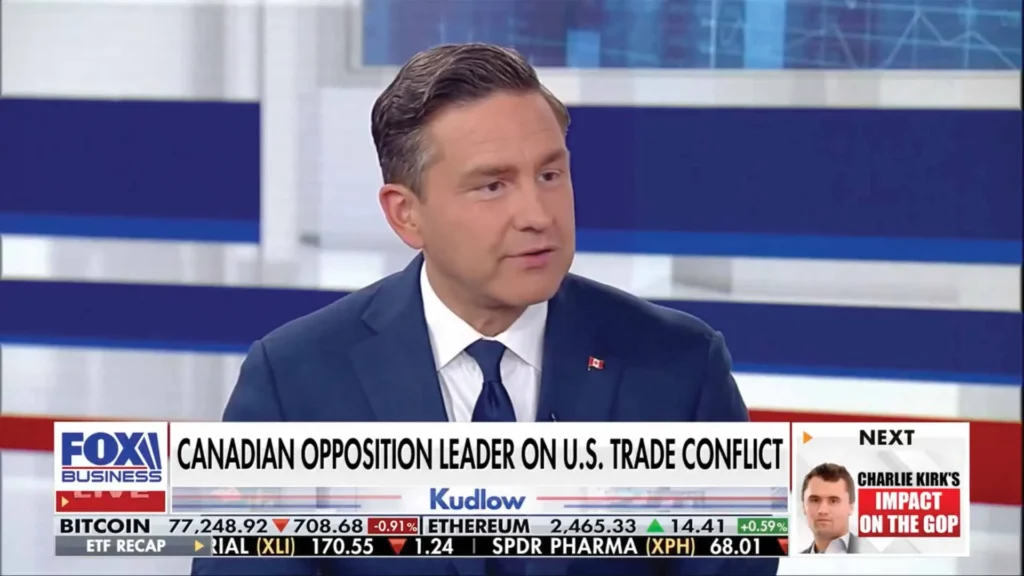
Pierre Poilievre marked the 25th anniversary of the Sept. 11 attacks by heading south and visiting the 9/11 Memorial Museum. While he was in New York, he also made in-studio appearances with FOX Business’s Larry Kudlow and on CNBC’s Squawk Box program to make the case against President Trump’s tariffs. This was a “Team Canada” tour, done with the knowledge and approval of the Prime Minister’s Office, so Poilievre left the partisan politics at home – when prompted to go after Mark Carney, his response was simply, “Look, I’m not going to attack my prime minister on foreign soil.”
Instead, he focused his argument on why it is in the United States’ best interest to eliminate their tariffs.
“We can save money and jobs for both our peoples if we can get back to two-way tariff-free free trade that will bring down the cost of living for Americans. It will grow paychecks on both sides of the border.”
US tariffs don’t just hurt Canada; they also hurt US consumers because Americans will have to pay higher prices on whatever Canadian goods they were using. Donald Trump ignores that impact, pointing to his home-grown producers who will benefit if they don’t have to compete with Canadian producers.
The problem with his approach becomes obvious when we expand on that logic. If US producers benefit from Trump’s tariffs on Canadian goods, then why doesn’t each state government follow through too, and implement tariffs on all out-of-state goods? Trump’s logic would say that should benefit their own in-state producers.
- So why doesn’t Colorado put a tariff on California’s avocados to help their local avocado producers?
- And why doesn’t South Dakota put a tariff on Alaskan-caught salmon?
The problems with tariffs are obvious here. We know that the inland state of South Dakota can’t catch wild salmon. The same is true in Colorado – it just isn’t a place to grow avocados. So tariffs here would just hike up costs for consumers without benefiting local producers because there aren’t any. But the point is, while tariffs sometimes help local producers, they always hurt local consumers – they always raise their costs.
The reality is, just as people have our own individual talents, countries also have their special abilities and advantages. Different countries can make some products better, faster, or cheaper than other countries. As Poilievre shared with Larry Kudlow:
“Canada is the world’s fourth largest producer of aluminum. Think of the best-selling truck for the last 49 years – the F-series…. And what goes around that? Canadian aluminum. …You get your aluminum from us. If you tariff Canadian aluminum you pay more for your F-150. I want the Ohio electrician or the Texas plumber to pay less for his F-150, and make more money for our aluminum workers back home. We can make your homes more affordable with our softwood lumber tariff-free. We’ve got the fourth largest supply of oil anywhere on earth…. We sell it to you at a discount; let’s get another pipe down to Texas, create more jobs for your refinery workers, lower gas prices for Americans. It’s all possible with tariff free trade.”
That’s the pitch Poilievre made to America: drop your tariffs to help yourselves.
And if we expand that logic, it’s also the reason Canada shouldn’t implement counter-tariffs no matter what Donald Trump might do. If the US president wants to hurt his own consumers, that’s not a good reason for our federal government to inflict the same pain on Canadian consumers. It makes economic sense here to do unto the Americans as we would like the Americans to do unto us (Matt. 7:12). Our government can’t control what the maverick American president might do from one day to the next but it can model what he should be doing for his own citizens but doing just that for our own: by allowing Canadian consumers to buy goods freely from wherever and whoever for the best price they can find.