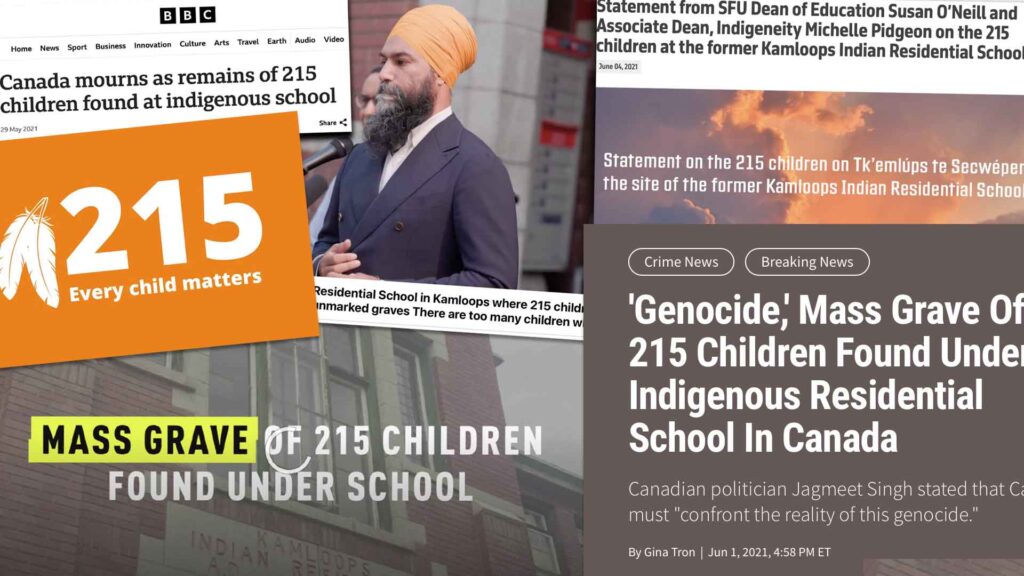
Allegations of mass graves outside of Canadian residential schools was one of the top news stories in the world in 2021. Ground-penetrating radar was said to have found evidence of the remains of as many as 215 children on the grounds of the former Kamloops Indian Residential School. But these soil anomalies have not been investigated since, and no exhumation has been done, and consequently, no actual bodies have been found. And today, for many Canadians, the lack of proof is seen as irrelevant.
The results from a survey released by Angus Reid this summer revealed that 63% of respondents would only accept the initial claim if further information from exhumation was made available. However, more than a third of respondents will accept these are unmarked graves, even if nothing is done to verify whether these are actually graves.
Among indigenous respondents, 44 per cent accepted the claim without more evidence. The numbers who don’t need evidence increases to 56% of young women, aged 18-34.
A few years ago, Christian apologist Abdu Murray argued that we have transitioned from a post-modern world to a post-truth world.
“Post-Modernism says there’s no such thing as truth, but Post-Truth mindsets say, ‘Truth is important, but only in so far as it feeds and satisfies my feelings and my preferences. So truth exists, but I don’t care unless it happens to conform with what I like.’”
How do we engage with a world that acknowledges that truth exists but is happy to ignore it? In his book Saving Truth: Finding Meaning & Clarity in a Post-Truth World, Abdu Murray concludes that “the answer is Jesus – the truth who is personal. He is the Saving Truth.”
In other words, Christians must communicate truth, but we must also introduce our neighbours to the person of Jesus – the “way, the truth, and the life” (John 14:6). Christ alone speaks to the head and the heart.
Enjoyed this article?
Get the best of RP delivered to your inbox every Saturday for free.