Transparent heart icon with white outline and + sign.

Life's busy, read it when you're ready!

Create a free account to save articles for later, keep track of past articles you’ve read, and receive exclusive access to all RP resources.

White magnifying glass.

Search thousands of RP articles

Helping you think, speak, and act in Christ.

Open envelope icon with @ symbol

Get Articles Delivered!

Helping you think, speak, and act in Christ. delivered direct to your Inbox!

Articles, Book Reviews, Parenting

Raising readers: the surprising power of reading aloud

Of all the skills our children need to master, reading is at the top of the list. Children who read fluently do well in school, while poor readers struggle because the entire curriculum is based on the ability to read. Reading opens up incredible opportunities; in contrast, illiteracy is related to poverty and crime.

But success in life is not our main motive for raising readers. We want our children to love words so that they will be daily readers of the Word. The Bible is a challenging book, and our children need to be able to read and understand it in order to grow in their relationship with God. That’s why raising readers is a priority for Christians.

 Start early…

The Read-Aloud Handbook by Jim Trelease provides a valuable resource for parents, teachers and anyone else involved with children. With carefully documented research and compelling stories, he tells us the most important thing we must do is read aloud to our children. Trelease points out that reading is like any other skill: you get better at it by doing it.

But how do we get our kids to want to read in the first place? Children gravitate to activities they find enjoyable. How do we give them a love for reading?

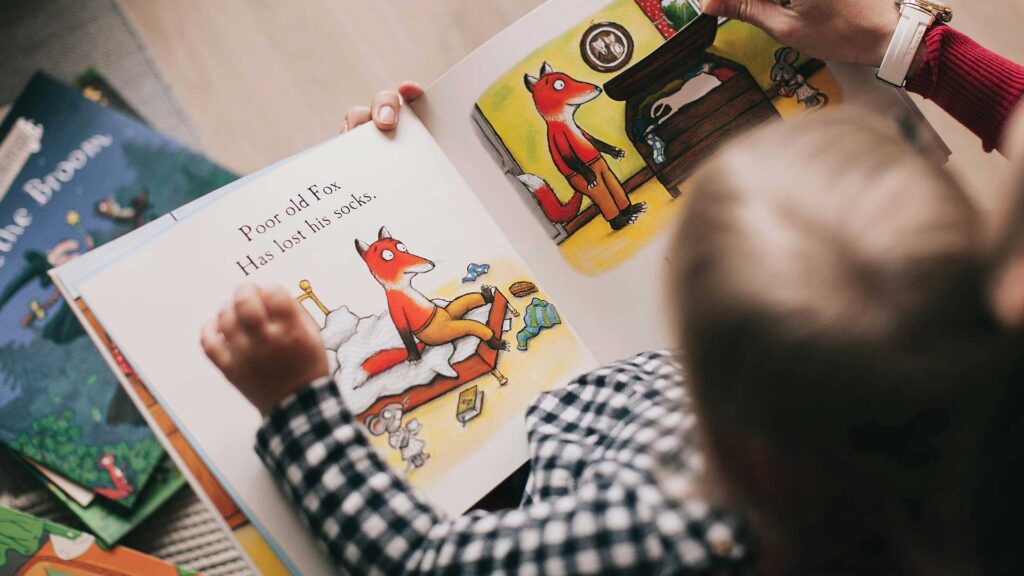
We must read to them daily. Reading aloud brings to life the characters, places and adventures that are hidden between the covers of books. Children learn that books hold exciting stories. Young children associate books with cuddle times with their favorite person. As the family matures, books become the vehicle for countless conversations and laughs, shared memories and ideas. In this environment, children naturally fall in love with books.

…and keep going!

Most of us understand the importance of reading to young children. The nightly bedtime story, I would hope, is a habit that parents maintain. When children have been read to regularly, they start kindergarten eager to learn to read.

But as they get older, reading levels often drop lower and lower. Trelease writes:

“Among fourth-graders, only 54% read something for pleasure every day. Among eighth-graders, only 30% read for pleasure daily. By twelfth grade, only 19% read anything for pleasure daily. In a Bureau of Labor Statistics survey in 2010, young adults between ages 15-19 reported spending only 12 minutes a day reading versus 2.23 hours watching television.”

What is going wrong? Many parents don’t realize that we need to keep reading to children even when they begin to read on their own. Reading is a complex skill that takes years to develop.

Stuck with Cat in the Hat but hungering for more

The problem is, a beginning reader reads at a level far below his comprehension. That means that for a long time, he is stuck reading boring books. Reading is hard work, and if there is little reward, why bother? Typically in grade four, children start to give up on reading. The pain is not worth the pleasure.

This is why continuing to read to your child is so important. You need to read captivating books that keep alive the interest and the motivation to read. Reading to your child every day is like advertising for books. Smart companies do not stop advertising. According to Trelease, the research shows that the gap between a child’s listening vocabulary and reading vocabulary usually does not close until about grade eight. Yet most parents stop reading to their children long before that time.

Expanding their vocabulary

Besides giving children the motivation to want to read, reading to our children also gives them the building blocks to be able to read. It gives them words.

Researchers can tell how well a child will do in school based on the size of his vocabulary before schooling begins. Does speaking to our children provide enough vocabulary? No. We use 5,000 words in our daily conversation, with another 5,000 used less often. Trelease writes:

“The eventual strength of our vocabulary is determined not by the ten thousand common words but by how many rare words we understand.”

When we read to our kids they hear three to eleven times as many rare words as they would during normal conversation. Reading aloud pours a rich variety of words into our kids’ ears and minds. This vocabulary is crucial for their learning.

What about TV?

Does television build vocabulary? Research shows that television is greatly inferior to print. Most TV script is made up of conversational vocabulary and over the years there has been a steady decline in the use of complex sentences and rich vocabulary.

Trelease devotes a chapter to television and whether it helps or hinders literacy. To highlight one item, a study in 2004 which tracked 2,500 children concluded that:

“for each hour of daily TV viewed by the child before age three, the risk of attention deficit hyperactivity disorder (ADHD) by age seven increased by 10 percent.”

In contrast, reading aloud is the best way to increase attention span. The American Academy of Pediatrics has warned that children under two should not watch any TV. This would include other screens as well. As parents, we need to be in control of the technology in our homes if we want to foster reading and raise healthy children.

Benefits abound

Reading aloud is an incredible force in the lives of children. Sharing books builds the bond between adult and child and gives the child a secure sense of being loved and valued. Reading enriches life and is a gateway to the world of ideas. Good readers are able to provide leadership in our communities because they have thought about many things. We need more readers. The time you invest in reading to the children in your life is of incalculable value. Start reading today. It’s never too late to start.

And be encouraged by what God has been doing in our families. He has built reading into our lives by giving us the Bible and making us people of the Word. He has given us wonderful routines of mealtime reading and bedtime Bible stories, where fathers especially can be the role models their sons so desperately need. These habits alone give our kids a huge boost in literacy. Our Heavenly Father knows what our children need. Praise God and keep reading to your kids!

A version of this article was first published in the July 15, 2017 edition of Una Sancta and is reprinted here with permission.


Practical Suggestions

For even more suggestions see Jim Trelease wonderful list of the "Do's and Don'ts of Read-Aloud."

MAKE READING OUT LOUD A PRIORITY

  • Make it a habit by setting a specific time. Doesn’t matter when – before bed, after lunch, naptime, or school – it just has to be a daily appointment.
  • Model reading. Children should see you reading for enjoyment.
  • Have books in the house.
  • Visit the library regularly.
  • Read out loud every day for a minimum of 15 minutes.
  • Keep reading to children even after they learn to read.
  • Get the grandparents reading to your kids.
  • Read to your infants – long before they can talk, they are language sponges.

MAKE IT EXCITING

  • It’s okay to skip boring bits. Pre-reading helps with this.

FIND POCKETS OF TIME

  • Read to your preschoolers while nursing/feeding your baby.
  • Read to your kids while waiting for the doctor, dentist etc.
  • Read nursery rhymes (or that book you’ve read so often you have it memorized) while folding laundry or doing ironing.
  • Pick a good book to read aloud when camping.

READ OUT LOUD EVEN IF YOU’RE NOT A READER

  • Not the best reader yourself? Don’t worry – your child will love it. As the parent, you are the very best reader for them.

FEEL FREE TO USE TECHNOLOGY

  • Make use of audio books.
  • Picture books are best as paper books, with their big bold pages. But e-readers have a place too, with their ability to store many, many books.
  • If the grandparents live far away they can still read to your children via Skype.

Red heart icon with + sign.
CD Review, Music, Parenting

Fun music for your kids (that you might like too)

We often find that turning on some music can completely change the mood of our house: kids go from complaining to dancing and singing. So here are three recommendations – oldies but goodies – that have been tested in our household, and recommended by lots of friends and family too. Fun and Prophets by Jamie Soles 2006, 48 minutes When I asked around for other good children's CDs, Jamie Soles was a clear favorite with friends and family. While he has adult albums too, Soles is best known for his children's music, which has a solid Reformed theology behind it. Some of his songs retell Bible stories, others help children memorize things like the books of the Bible, the order of the Creation days, or the names of the patriarchs.  A lot of it is energetic, with a bit of a beat. The kids enjoy them all, but one of my favorites is "Run," from the album Fun and Prophets, based on the passage 2 Kings 9:1-13, where a nameless prophet is instructed to anoint Jehu as king of Israel, and then get out of there quickly. Sometimes a prophet has to stand Like an iron wall against the land And standing is fine, when the time is right But the time is wrong, and it's fine for flight so.... RUN! Jehu is king, so RUN! If you want to live you better RUN! Jamie Soles has more than a half dozen children's albums (Giants and Wanderers, Wells, Fun and Prophets, Memorials, Up From Here, The Way My Story Goes, Good Advice) all of which can be ordered, and downloaded at SolMusic.ca. He is worth checking out! Go to the Ant by Judy Rogers 1989, 31 minutes As I was asking around, another name that came up repeatedly was Judy Rogers, the wife of a Reformed Presbyterian pastor, who has been making music for more than 25 years. In Go to the Ant she bases most of the songs on passages from Proverbs, teaching children about the dangers of "The Tongue," about what we can learn about hard work when we "Go to the Ant" and about the cost of attending "The School of the Fool." The lyrics are a solid mix of fun and wisdom. A problem common to children's Christian music is that it often strays into irreverence but that is certainly not a concern here. If you are familiar with Jamie Soles, Judy Rogers has an overall quieter sound – quite a bit less beat. Her voice is beautiful, and also contributes to the lighter sound; this is folk music that won't be confused with pop/rock. My three-year-old daughter is a fan and, incidentally, R.C. Sproul is too. Overall I would say this is an album that kids will like, but it won't have the same crossover appeal with parents that Jamie Soles seems to have. To hear song samples and read the lyrics, visit JudyRogers.com. The album can be ordered many places online including Amazon.ca. Hide 'Em in Your Heart Vol. 1 by Steve Green 1990, 37 minutes Steve Green's music is bright and cheerful, and the words are always clear and easy to understand. Each song on this album is a verse, or two, from Scripture (either NIV or NKJV) with Green beginning each track with a short, spoken introduction. The verse is repeated at least a couple of times in each song, but Green finds a nice balance in promoting Scripture memorization and keeping the repetition to a minimum so the songs don't become wearisome – on average each track is less than 2 minutes long. The album also features some of the very best children's singers. The boys and girls still sound like normal children, rather than professionals, while hitting all the right notes. If I had to pick a nit with this album then I could point to a couple of the spoken introductions, where Green seems to explain the passage in a slightly Arminan-ish way. But this really is a nitpick, because kids won't notice, and the parts your children will be singing all over your house are the verses taken straight from Scripture. I love this album because I love hearing my daughter sing "And Jesus grew in wisdom, and stature and in favor with God and men" (Luke 2:52 and Track 8). Very fun!...

Red heart icon with + sign.
Parenting

From explanations to dialogue, from monologues to questions

Explanations often lead to monologues, especially with teenagers. This is not a helpful communication pattern. The goal for good, biblical communication with teenagers is the combination of questions that lead to dialogue. But these questions must come from a genuine interest in your teenagers for who they are, not for what you want them to be. Who would you go to? In this context, let me ask you a question. When you need help with a problem, do you look for answers from any random person? The answer is obvious. You ask the people whom you trust and respect, someone who will really listen to you. Let me take this one additional step. Suppose a friend from church calls and asks you for advice on some relational issue. You are thrilled because you have wanted to talk to her about this very problem. You immediately launch into your explanation about her problem. You tell her that she must not have been listening to the sermons because the pastor just spoke on that very issue. You go on to say that if she were not always late to church she might be in better shape to actually listen to the sermon. You suggest several books for her to read and you finish by telling her you hope you have been helpful. Over time you wonder why she has never called back for more “help.” This example illustrates the danger warned about in Proverbs 18:2; "a fool delights in airing his own opinions." Listen, don't lecture The active, aggressive listener of Proverbs 18:15 – "the ear of the wise seeks knowledge" – will recognize the types of questions that are asked...and the questions that are not asked. If your teenagers are primarily asking logistical questions, such as "Can I have the car?" or "When is dinner?" this should alert you that the important questions are going to someone else. Your goal is to have your kids ask you about the hard things in life. But like you, your older children and teenagers will reserve those questions for the people whom they respect and trust, for the people who will carefully listen. Monologues do not build relationships, only frustrations. You goal is to create a relational climate in which your teenagers want to come to you. Listen carefully to your children and observe the things that they struggle with. Take an interest in the things they are interested in. Ask them genuine questions about their interests. Patience is key here. If you have not been a good listener, you can become one. Even if you do, it may take time for teenagers to begin to seek you out. Pursue your teenagers not so much for what they have done, but for who they are – your children given to you by God. Delight in your teenagers for who they are, your children. If God can delight in you and in me, with all of our issues, then we can delight in the children he has given to us. Being an aggressive listener will lead you to questions and then to dialogues. This is a good thing, for both you and your teenager! Jay Younts is the author of Everyday Talk: Talking freely and Naturally about God with Your Children and Everyday Talk about Sex & Marriage. He blogs at ShepherdPress.com, where this article (reprinted with permission) first appeared....

Red heart icon with + sign.
Parenting

Five things I wish I had known... about being a father

As I have met many fathers around the country at conferences and homeschool conventions, I am often reminded of my own time as a father with three children in the 1970s, 80s and early 90s. Charles Dickens used a phrase to describe the time of the French Revolution that in many ways describes my experience as a parent – it was the “best of times and the worst of times.” Nothing in my life has given me as much fulfillment and joy as being a father to my children. I can also now see that nothing has been as difficult, even though at the time I was blissfully oblivious to most of my weaknesses and shortcomings. Only as my children have become adults have many of my own failures surfaced. What follows are five of those “blind spots” to which I was completely unaware as a young father and that have come to light only in the past few years. 1) I did not see that loving my children is different from worshiping them We are all in some way unconscious idolaters in our hearts. For some of us, our prevalent idol is our job, money, success, personal recognition, fame, leisure time, entertainment, sports, sex, intellectual attainment or even religious achievement or Christian ministry. These are all perfectly innocent pursuits in themselves until they come to occupy the central place in our hearts around which all else revolves – the place reserved for God alone. I did not recognize it at the time, and I would have vehemently denied it if you had suggested it to me, but my children became my predominant idol of choice, though there were others always waiting in the wings, vying for my attention. I taught in their Christian high school and coached their basketball teams, coached all their little league teams and was always eyeball deep in all they did. Only from the distance of more than a decade have I realized that much of the recognition, success and achievement that my involvement in their lives encouraged was for me as much as for them, because their success made me look like a successful father. “My, what well-behaved, smart, successful children Robert and Jill have. They must be wonderful parents.” All of our idolatry is really in some way the exaltation of ourselves. I have discovered that my children had indeed, very subtly, become idols in my life. I was too busy congratulating myself for the wonderful parenting job I was doing for that thought ever to enter my mind! 2) I did not know that the goal of parenting was not to be the perfect parent or even the best parent I could possibly be, but to be a parent who is a repentant sinner I did not know that the way to a real relationship with my children was to walk in the light with them, not by living in darkness, convincing myself that while I was not the perfect parent, I was at least in the top echelon. Oh, there were occasional flashes of lightning that illuminated the fact that I was nowhere close to a perfect parent, but after a brief time of uneasiness, I was always able to return to my comfortable darkness. 1 John 1:7 encourages us to “walk in the light,” and “walk” implies a way of life. I didn’t understand that an open, daily recognition of weakness and dependency on the Lord and not my superior parenting skills was the way to true relationship with my children. 1 John 1:7 says that “fellowship (genuine relationship) one with another” is the result. When my sons were early teenagers, both came to me on separate occasions for help in resisting the pornography that a neighbor boy had shown them. I counseled them on the dangers of pornography, how addictive it is and how destructive it can be to their future relationship with their wives. I then prayed with them that God would give them the power to resist. I was being the perfect father, standing for righteousness, but not being a transparent, repentant one. I didn’t understand that parenting by the gospel meant walking in the light with them, confessing to them my own struggles with pornography over the years, and then praying for us both that in our weakness God would be our power. I missed a golden opportunity to strengthen my relationship with my sons. 3) I did not know that I shouldn’t compare my children with other children, either positively or negatively In 2 Corinthians 10:12, Paul says it is foolishness to compare ourselves with others. The only standard for comparison is the law of God, whereby we are all judged as sinners, including our children. My modus operandi was to proudly compare my children to others around me and to invariably find them far superior. As a result, I unconsciously ignored besetting sins in their lives for which they needed their father to help them face; not only the obvious sins of the flesh, but pride, self righteousness, the fear of man, etc. However, I was unable or unwilling to see them clearly and therefore unable to help them to see themselves because of my pride in their performance compared to others. On the other hand, some parents are dissatisfied with their children for what they see as always falling short of the performance of other children. If we are dissatisfied with our children, be assured that it will be communicated to them, no matter how hard we try not to do so. The result will be defeat and discouragement because they will feel they can never measure up enough to please us. Parenting by the gospel rather than the law involves an evaluation of a child’s gifts and abilities so that unrealistic expectations are not imposed upon him or her.  Gospel parenting is practically applied as the parent models for his child how to handle besetting sins (laziness, making excuses, irresponsibility, taking offense, etc.) by the parent facing those sins squarely and openly in his own life and then repenting! Without this step, “What you do speaks so loudly I cannot hear what you say” will be the order of the day. All children have a powerful “hypocrite-detector” that improves exponentially in effectiveness as they grow older. Comparing our children with others is foolish because it leads to self-righteousness when children are judged as superior, or discouragement and even rebellion when parents feel their children never seem to reach their standard of achievement. How we approach our children, by law or gospel, reflects how we see our relationship with God. Since I am most generally an “older brother” from the parable of the prodigal son, my tendency is to see myself, and therefore my children, as superior. A “younger brother” will see himself and therefore his children as failures, never quite measuring up. But we are all sinners, loved by God with a love that is not in any way affected by our sin. It is seeing God’s love for us as fathers that will allow us to love our children in the same way and free us from comparing them with others. 4) I did not know that I was creating a default mode in the hearts of my children that would either help them to think the best of others or foster judgment and criticism When my oldest son was in college, he was the head-resident on his floor in his dorm, charged with the very loose responsibility of keeping order on the floor. On a visit to campus, I asked him about the other boys on the floor, which included a good number of rather rowdy football players. “Oh Dad, they are just a bunch of meat-heads.” His attitude of scorn and judgment struck me like a thunderbolt and I heard the Lord say to me, “He got that critical attitude straight from you!” I am sorry to say that much of the heritage I have left with my children that they now carry with them is judgment and criticism. I have an opinion about what everyone ought to do, even when I have no responsibility in their lives, and I do not hesitate to make that opinion known. How much better to love them with a love that covers all things and does not expose sin but believes and hopes for the best in them (1 Corinthians 13). Too bad that is not my spontaneous reaction! My default mode is to be critical and judgmental. As they were growing up my children constantly heard me be critical of others and the decisions they made, the lifestyle they chose to live and the friends they kept. It is not my job to even have an opinion about what others do if I have no God-given authority in their lives. They answer to their own master and not to me (Romans 14:4). I was sharing my besetting sin of critically judging everyone I see with a friend. His reaction was, “Oh, we all do that.” My response to him was, “So, what’s your point? Do the sins of others excuse me to sin? Does ‘everyone does it’ give me a free pass?” As we Andrews are recognizing this sin, acknowledging it and repenting, the Lord is graciously beginning to reset our default mode, even as adults. This is the only possible way for me to “Be holy, even as I am holy”—not by trying harder but by facing my sin, acknowledging it, repenting and trusting the Spirit within to change my critical heart. I know it will be a life-long process. Have you ever recognized a besetting sin of yours reproduced in your children? What was it? 5) I did not know that there are times to be a sympathetic listener and not an answer man who can “fix the problem” James 1:19 says to be “swift to hear and slow to speak.” Legions are those to whom I have done just the opposite. I have had correct biblical answers to questions they really weren’t asking me, though I was convinced they should be. More often than not, they already knew the answer—they just needed me to listen, understand and then encourage them to trust the Lord for the power to do what they already knew to do. There is nothing less attractive than an answer man who is always the teacher and never the learner himself. Just recently I fell into the trap again of giving a close friend the right answer for what he should do about a vicious personal attack by a member of his extended family, someone with whom he had grown up and who supposedly loved him. His confidence as a man was shaken. He did not need to hear initially what he should “do,” but that I loved him, as did God, Who also believed in him, was pleased with him and had him right on schedule in his spiritual growth. There would be plenty of time later to let God show him a course of action. Interestingly enough, this family crisis is bringing my friend’s immediate family together; what the enemy meant for evil, God intended for good. This has been my pattern over the years with my wife and children as well. Their struggles have more often than not elicited an answer as to what they should do rather than addressing the insecurity that comes from wondering whether or not their problem-solving father really cares about them as people. As the one who represents God in my family, my attitude is to be a reflection of His, and His primary concern is His relationship with me, not what I do, what I say or the theology I believe. If I understand His great love for me in spite of what I do, what I do will naturally and unconsciously change. Conclusion Seeing these five failures in my parenting that we have discussed over the past few weeks has surprisingly been a source of encouragement to me and a means of strengthening the relationship between my wife and me and our grown children. Grandfathers and grandmothers are still little children in God’s classroom of learning to face their sin, repent and walk by faith! Does it make sense to you that openly facing failure as a parent can strengthen family relationships and be a source of genuine encouragement to all family members? Robert Andrews has been a college campus evangelist, high school chemistry teacher and basketball coach, church teaching elder, church planter, national conference speaker and certified business coach and is a husband to one, a father to three and a grandfather to ten. His website, where this article was first published, is www.gospelparenting.com....

Red heart icon with + sign.
Parenting

Spanking does have a place in Canada

In an article late last year, “Spanking has no place in Canada, period” – Globe and Mail reporter André Picard argued that physical discipline is at best ineffective and at worst harmful. He concludes it is “well past time” that the government scrap Section 43 of the Criminal Code, making spanking illegal. The truth is that physical discipline, when administered in keeping with Canadian law, not only has better outcomes than other disciplinary techniques, but is preferred by children as less cruel than other techniques, such as privilege loss or isolation. We can learn from countries that have gone ahead with banning spanking, and have regretted it. How can Picard and many well-intentioned child advocates get this issue so wrong? Part of the problem is that they go only skin deep into the research. Picard notes: “there has been a significant body of research showing that the real harm from spanking and other forms of corporal punishment is not the immediate physical harm, but the lasting psychological harm.” That is about as deep as almost any mainstream media analysis goes. But if we dig deeper, we discover that the truth is far more nuanced and, in some respects, completely contradicts the mainstream spin replicated in Picard’s article. Digging into the data Picard cites a 2012 American Academy of Pediatrics study that correlates harsh physical punishment with higher rates of mental illness and drug and alcohol abuse. He correctly acknowledges that this is correlation, not proof that spanking causes these things. This is an important distinction that is lost on almost all the research that attracts mainstream attention. And the distinction matters. It could well be that aggressive children were spanked more often because they were aggressive. The heavy reliance on correlational evidence makes even the most effective disciplinary tactics appear harmful. Dr. Elizabeth Gershoff, a well-known researcher on the topic, concluded: ...if we found that people who have undergone radiation treatment have a higher likelihood of having cancer, we should not conclude that the treatment is the problem or that it doesn’t work. Will anti-spanking advocates follow their logic and also argue that all discipline tactics should be banned? We need to dig deeper into the research. Picard, along with other anti-spanking activists, constantly appeal to research that lumps together harsh physical punishments, such as slapping and pushing, with the kind of mild physical discipline that our Supreme Court studied and approved. In 2007, researchers conducted a scientific review of studies that compared physical discipline with alternative methods. Twenty-six studies from the past fifty years were examined. They also examined the “optimal” type of physical discipline – conditional spanking. As reflected in the parameters laid out by our Supreme Court, conditional spanking is non-abusive, and done sparingly and under control. The conclusion of the study: “Conditional spanking was more strongly associated with reductions in noncompliance or antisocial behavior than 10 of 13 alternate disciplinary tactics.” In other words, when physical discipline is administered in keeping with Canadian law, it came out as good as, or better than, all other forms of discipline studied. Not only can physical discipline be more beneficial than other commonly used methods, a 2006 study came to another surprising finding: non-physical punishment was most frequently regarded as the worst punishment ever received, with 50% of naming at least one non-physical punishment method such as privilege loss. As well-intentioned as Picard and others may be, before they proceed further with their anti-spanking crusade, they should talk to the children. Children who have experienced appropriate physical discipline will often prefer it because it resolves the matter in a timely way and makes it less likely to occur again. Contrast that with what so many parents revert to otherwise (yelling, forced isolation, long-term privilege loss and extended grumpiness) and we begin to understand why physical discipline is the preferred choice for many honest children. Lessons learned from Sweden Picard argues that 51 countries have outlawed spanking, and it is time for Canada to follow suit. But he fails to look at what has happened in those countries. Take Sweden. In 1979, Sweden was the first country to ban spanking. The statistics coming from Sweden since then are downright shocking. Following the ban there was a 519% increase in criminal assaults by children under the age of 15 (born after the ban) against children age 7-14. Even more troubling, 46-60% of the cases investigated under the law resulted in children being removed from homes. That totaled 22,000 children in 1981, compared with 163 in Norway and 552 in Finland. Picard cites the Truth and Reconciliation Commission as another reason to ban spanking. If the residential school legacy has taught us anything, it is that we better be certain we are doing the right thing when forcefully removing thousands of children from their parents’ homes. As a side note, New Zealand followed Sweden’s example and adopted anti-spanking legislation in 2007. Just two years later, a whopping 87% of voters in a public referendum asked that the law be rescinded. It is time to drop the rhetoric and take the time to study the issue before criminalizing a form of discipline used by half of Canadian parents. Mark Penninga is the executive director of ARPA Canada. He has a MA in political science from the University of Lethbridge and has authored a policy report and numerous articles on corporal discipline. ...

1 2 3 4