










Transparent heart icon with white outline and + sign.

Life's busy, read it when you're ready!

Create a free account to save articles for later, keep track of past articles you’ve read, and receive exclusive access to all RP resources.

White magnifying glass.

Search thousands of RP articles

Helping you think, speak, and act in Christ.

Open envelope icon with @ symbol

Get Articles Delivered!

Helping you think, speak, and act in Christ. delivered direct to your Inbox!

In a Nutshell

Tidbits – April 2026

Some is better than none

“There is nothing wrong with starting a hefty book like Calvin’s Institutes and only getting a hundred pages read. Think what the Church today would be like if we all read the first hundred pages of Calvin.” – Ben House

What kind of impact will you have?

Whether it is municipal, provincial, or federal, there always seems to be an election just around the corner and Tim Bloedow’s way to influence these elections is worth considering. Some years ago he passed on a strategy he’d gleaned from one Dr. Glenn Martin. The professor was convinced that every serious Christian should try to influence the vote of at least 100 people. He himself wasn’t satisfied unless he attempted to influence at least 1,000. This was back before social media was much of a thing, so he would write these 1,000 people and tell them how they should vote and why. We’ve got more means now than he did then, so this next election can we have that kind of impact?

A brief rebuttal of post-modernism

“Some of you may believe that you cannot discover Truth. If this is true, you have actually discovered a truth. You might as well continue searching for more.” - Thor Ramsey, A Comedian’s Guide to Theology

How much do our children owe?

Parents try to leave their children with an inheritance, not debt (Prov. 13:22), but Canada continues to debt-finance their federal and provincial government budgets. They spend money they don’t have to pay for promises made to this present generation. But while this generation gets more than they paid for, the next generations will be saddled with paying off the more than $2.3 trillion combined debt of our federal and provincial governments. Individually what we owe differs some, depending on what province we live in, but according to the Fraser Institute, even in Alberta it amounts to $41,000 per person, and it rises to nearly $69,000 per Newfoundlander.

So what’s a billion… or a trillion?

When our debt is in trillions that’s pretty hard to fathom. So let’s start with a smaller number and see if we can wrap our heads around it. Just how much then, is one billion? Well…

• A North American’s average age expectancy is 2-3 billion seconds
• A billion liters would fill 400 Olympic-size swimming pools
• 170 African bull elephants weigh the equivalent of one billion grams
• A bit over one billion minutes ago Jesus walked the Earth

And what’s a trillion? Dr. D. James Kennedy did an interesting bit of calculating in his book The Mortgaging of America. He notes that, “if you had gone into business when Jesus Christ was born – a business that was so unprofitable that… you lost a million dollars a day, seven days a week, it would still take you 700 more years from today to lose a trillion dollars.”

The log in our own eye

When the London Times asked notable personalities across Britain to write on what they thought was wrong with the world, they purportedly got this response from author G.K. Chesterton: “Dear Sirs, I am. Yours truly, G.K. Chesterton.”

Fcat or foitcin?

An email mkanig its way ronud the Ietrnent calims:

It deosn’t mttaer in waht oredr the ltteers in a wrod are. The olny iprmotnant tihng is taht the frist and lsat ltteer be at the rghit pclae. The rset can be a taotl mses and you can sitll raed it woutiht a porbelm.

Tish is bcuseae the huamn mnid deos not raed eervy ltteer by istelf, but the wrod as a wohle. Azamnig, huh?

But is it ture? Yes and no. Lsat lteerts are irtomanpt but wehn the wdros we raed are lses flaimiar or qtiue lhtgney or rbleemse oehetr wdors it bmoeecs duicflift to urnneadtsd eevn wtih frsit and lsat lterets paceld ctlrcroey.

Parental dictionary

If words were defined just for parents:

bathroom: used by the entire family, believed by all except mom to be self-cleaning
feedback: what you get when your baby doesn't appreciate dinner
grandparents: people who think your children are wonderful even though they're not sure you're raising them right
independent: how we want our children to be, as long as they do everything we say
ow: the first word spoken by children with older siblings
puddle: a small body of water that draws other small bodies, wearing dry shoes, into it
show-off: a child more talented than your own
sterilize: done to your first baby's pacifier by boiling it and your last baby's pacifier by blowing on it
sweater: garment worn by child when its mother is feeling chilly
top bunk: bed where you should never put a child wearing Superman pajamas

Some choices are wicked

When American abortionist George Tiller was murdered in 2009, pro-life leaders knew that whatever they said in response would be misinterpreted by the media. That left most too cautious to speak out, but it pushed columnist Ann Coulter to do so. In an interview with Fox News anchor Bill O’Reilly she talked about the murder using rhetoric that pro-abortionists use to justify killing the unborn.

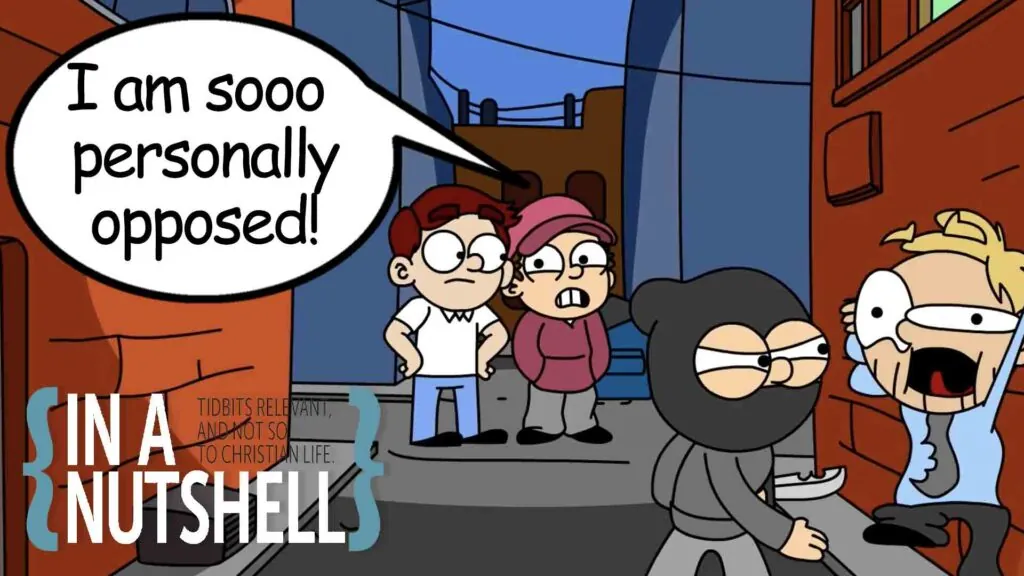
She started by telling O’Reilly that she didn’t like thinking of Tiller’s death as murder, preferring instead to call it “terminating Tiller in the 203rd trimester.” O’Reilly, misunderstanding what Coulter was doing, started to protest, which prompted Coulter to take it further, putting a twist on another well-known bit of abortion rhetoric. “I am personally opposed to shooting abortionists,” she told O’Reilly, “but I don't want to impose my moral values on others.” Putting her own spin on a best-selling pro-abortion bumper sticker she told viewers, “If you don't believe in shooting abortionists, then don't shoot an abortionist.”

When abortionists bring up issues like “privacy,” “choice,” or “imposing morality” on others, they’re trying to evade the only relevant issue in the abortion debate: are the unborn human beings? If they aren’t, then no one should object to abortion; if they are, then everyone should! But instead of arguing this issue, abortionists avoid the debate entirely using slogans that assume what they are trying to prove – that the unborn aren’t human. Coulter exposed this evasion by showing how their slogans make no sense when applied to an acknowledged human being, abortionist George Tiller.

Seamus Coughlin attacks the "personally opposed" evasion in the video below (which is cartoon, so some of the brutal is taken away, but it still should not be watched with kids around).

Red heart icon with + sign.
In a Nutshell

Tidbits – November 2025

Are you passing the baton? “My dad….made a great commitment in my life and had given me many things to pass on. His father had given him things to pass on. And what I have, I have passed on. You have to take it, develop it, learn it, and pass it on to somebody else. This is a relay race, and we are all involved.” – John MacArthur on the importance of telling the next generation what we have learned about God. Knowledge doesn’t save “The devil is a better theologian than any of us and is a devil still.” – A.W. Tozer. A third way God’s name can be used in fiction In a March 16, 2015 post titled “Fiction and the Third Commandment” Douglas Wilson continued a discussion that began in the February 2015 issue of Reformed Perspective. In that issue, I asked why so many Christian fiction authors have their characters taking God’s Name in vain. I argued that there were only two ways God allows us to use his Name. God says we can use his Name to talk to Him. And we can also use his Name to talk about Him. That meant that a writer may not use God’s name simply because his heroine has stubbed a toe and he want the readers to understand that it really hurt. In his post, Pastor Wilson noted that there is one more proper use Christian authors can make of God’s Name – an author can depict someone sinfully abusing God’s Name without being guilty of abusing it himself. As evidence, Wilson pointed to Christ’s parable of the Pharisee and the tax collector in Luke 18. Jesus tells us that both men were praying in the temple but whereas the tax collector was penitent the Pharisee prayed: “God, I thank you that I am not like other men, extortioners, unjust, adulterers, or even like this tax collector.” The Pharisee here is neither talking about God, nor talking to Him (bragging isn’t prayer) but rather is blaspheming God. What we have here, as Wilson notes, is a "…fictional depiction a high violation of the Third Commandment, committed by a character in a bit of prose composed by the Lord Jesus Himself." Since Christ does it, we can be sure that it is indeed permissible to depict characters taking God’s name in vain. If that strikes you as strange (and it did me) the key point to understand is that in Luke 18, while Jesus is depicting someone taking God’s Name in vain, his purpose is still to honor God’s Name. This third use of God’s name is an easy thing to mess up, which is why Wilson concludes with a caution to writers who are considering making use of this third way: they need to carefully assess whether they are skilled enough to pull it off. This is not the sort of thing to fail in the attempt. Don’t just think about it “The smallest good deed is better than the greatest good intention.” - unknown No need for false modesty “Humility is not thinking less of yourself, but thinking of yourself less.” – C.S. Lewis in Mere Christianity The (honest) rich get rich by making us all wealthier God told us not to covet, but there are many, particularly in the government, who want to assure us it’s fine to demand what the rich have. They tell us it’s only fair to make the one per cent pay way more because when we look over the fence at all they have we can’t help but notice that it is quite a lot. Sure, God told us to stop looking over the fence (Ex. 20:17), but the world insists that all this ogling is okay because our neighbor’s wealth, well, a lot of it is really ours in the first place. The way they tell the story there is only so much wealth to go around, so our rich neighbor could only become wealthy by taking from the poor folk like us. And it’s about time he gave some of it back. That’s what they say …but as you might suspect, folks who tell us it is okay to do what God forbids often don’t have their facts straight. The truth of the matter is that, so long as our rich neighbor didn’t get their money from piracy, bank robbing or lobbying the government, he likely got his money by earning it. And if his money was earned, then this neighbor of ours didn’t take anything from anyone, but actually gave more than he got. As commentator John Stossel explains: "It is instinctive to think of life as a zero-sum game – if I win, you lose. Politicians think that way because that’s how their world works. And lawyers who sue people think that way – you either win or you lose. "But in business, you only win if you give your customers something they want. If you make a big profit, it doesn’t mean you took it from the customer. The customer voluntarily gave you his money. He felt he gained something too. It is why you get the weird double thank you moment when you buy anything. If you bought a cup of coffee this morning, you gave the cashier a buck, and she said, 'Thank you.' She gave you the coffee, and you said, 'Thank you.' “'Thank you.' 'Thank you.' "Why both? Because you both felt you won. "But that’s just not intuitive. It’s intuitive to think Bill Gates made $50 million because he took $50 million from other people. If that’s the case, how come there is so much more wealth in the world now with all these billionaires? They didn’t take a big piece of the pie. They baked lots of new pies and then took a big piece." An approved Christian pick-up line "Hey baby, wanna come back to my place? My parents are home." Matthew Henry would have hated The Hunger Games On the night that the author of Matthew Henry's Commentary was robbed, he prayed a prayer that showed his understanding of just how blessed he was, and how, when it comes to harm, it is much better to receive than to give. "I thank Thee first because I was never robbed before; second, because although they took my purse they did not take my life; third, although they took my all, it was not much; and fourth, because it was I who was robbed and not I who robbed." SOURCE: Chris Craig's book "Becoming a Person of Prayer." There is some question if this really is a quote from Henry. Wikiquotes says no, but several other sources, including Chris Craig's book, say yes. Now it all makes sense Johannes Gutenberg is best known as the first man to print a Bible using movable metal type. But did you know he kept his metal letters in drawers, called cases, with all the capital letters stored in an upper case, and the small letters stored in a lower case? That is the reason that even today, capitals are known as "uppercase" and small letters as "lowercase." Add a word, ruin a Christian book About a decade back, a meme circled the globe that had people tweeting famous Christian book titles with one-word additions that, had they been real, would have completely ruined the book. For example, C.S. Lewis's Surprised by Joy became Surprised by Joy Riding. Other notables include: Till We Have Smiley Faces (C.S. Lewis) Dave Ramsey's complete guide to money laundering Don’t Waste Your Life Reading (John Piper) The Silver Rocking Chair (C.S. Lewis) The Pilgrim’s Progressive (John Bunyan) Calvin Klein’s Institutes The Lion, the Witch, and the Locked Wardrobe (C.S. Lewis) Orthodoxy Schmorthodoxy (G.K. Chesterton) Strange Camp Fire (John MacArthur) One title was actually improved with an addition; Joel Osteen's Your Best Life Now became Your Best Life Isn't Now. "Okay then, if you cross this line..." Two aged orthodox Anglican priests knelt side-by-side in the trendy new diocesan cathedral, waiting for their bishop’s Easter service to begin. It commenced with a lonely, eerie wisp of Tibetan bells wafting through the rafters. Then a chorus of plucked hand-harps took up the icy harmonies. After the bell ringers and harpists came a dancing troupe of near naked young men in red speedos, streamers flying from their wrists. Then something new – six women in purple robes shouldering a litter which bore a larger-than-life-sized Buddha. The bishop brought up the rear, her tresses plaited with white and red ribbons hanging from the edges of her mitre, her brocaded cassock matching the thurible in her hand. One aged priest turned to the other and said, “Just one more thing, and I’m outta here!” SOURCE: Abbreviated version of a joke on Tim Bayly's blog baylyblog.com/blog/2013/10/silence-them That silver lining Father: "Well, son, with marks like these, at least we know you're not cheating."...

Red heart icon with + sign.
In a Nutshell

Tidbits – October 2025

No one even knows how to bake bread Our new Prime Minister is very sure he has just the right recipe to get the country’s economy going, and his plan involves more governmental control. But what if an economy is too complex for such top-down control? That’s the case Walter E. Williams (1936-2020) makes when he highlights how no one, on their own, would even have the know-how to bake a loaf of bread: “We’re all grossly ignorant about most things that we use and encounter in our daily lives, but each of us is knowledgeable about tiny, relatively inconsequential things. For example, a baker might be the best baker in town, but he’s grossly ignorant about virtually all the inputs that allow him to be the best baker. “What is he likely to know about what goes into the processing of the natural gas that fuels his oven? For that matter, what does he know about oven manufacture? “Then, there are all the ingredients he uses – flour, sugar, yeast, vanilla and milk. Is he likely to know how to grow wheat and sugar and how to protect the crop from diseases and pests? What is he likely to know about vanilla extraction and yeast production? “Just as important is the question of how all the people who produce and deliver all these items know what he needs and when he needs them. There are literally millions of people cooperating with one another to ensure that the baker has all the necessary inputs. It’s the miracle of the market and prices that gets the job done so efficiently. What’s called the market is simply a collection of millions upon millions of independent decision makers not only in America but around the world. Who or what coordinates the activities all of these people? “Rest assured, it’s not a bakery czar.” Hollywood romance ain’t right Hollywood tells us that there is one special someone, one soulmate, just one person out there who, as Jerry Maguire put it, completes us. Blogger Matt Walsh sums up the Christian position in one sentence: “I didn’t marry my wife because she’s The One, she’s The One because I married her.” How many did you know? By one estimate, there are 170,000 English words in common usage. Here a baker’s dozen of some that our kids probably don’t know, but you might. How many can you define? Answers are at the bottom of the page. • Agog • Dawdle • Defenestration • Discombobulate • Flibbertigibbet • Gobbledygook • Hullabaloo • Kerfuffle • Lollygag • Malarky • Skedaddle • Snollygoster • Verklempt A trick that’s a treat The Dutch have, through the years, earned a reputation for being wise with their money. We, after all, invented the Dutch treat, which halved the cost of dating! But while we worked hard to earn this reputation, we can’t just rest on our laurels and hope to retain our penny-pinching crown. In other words, what have we done lately? I've canvassed Dutch people across the world asking them for their best money-saving ideas (if you have any, please pass them on) and here's one that’s appropriate to this time of year. It seems a particularly smart Dutch mother used to send her children out trick-or-treating early. Very early. The children would hustle door to door, as quick as they could. Then, when they had enough, they would run on home to their mother, who would proceed to divide their bounty into two piles: one of stuff they liked, and the other of all the candy they didn’t want. She then handed out this second pile to the trick-or-treaters who came to her door! This is the sort of stuff that will let us keep the Dutch thrifty reputation intact. Why governments mismanage the economy You’d be hard-pressed to find, in the Bible, a role for the government in “managing” the economy. And you’d find plenty of texts warning against arrogance (Prov. 26:12, Rom. 12:3, etc.). Along those lines, one argument against big government is the capabilities of the people it puts in charge of billion- and trillion-dollar decisions. It’s a task that’s beyond any man, and all the more obviously so in recent instances. Was Justin Trudeau ever an astute businessman? Joe Biden? Canada now has a prime minister who has an extensive economic background, but with other people’s money. In contrast, an entrepreneur has his own skin in the game, and when he blows it, he pays the price. A politician is playing around with others’ money, and if his plan doesn’t work, the politician can hide the impact by saddling the next generation with the cost of his failure. That leaves politicians with a motivation to take risks that businessmen never would. Here's three more reasons that government is prone to economic mismanagement. “The first lesson of economics is scarcity: There is never enough of anything to satisfy all those who want it. The first lesson of politics is to disregard the first lesson of economics.” – Thomas Sowell “What our nation needs is a separation of 'business and state’ as it has a separation of 'church and state.’ That would mean crony capitalism and crony socialism could not survive.” – Walter E. Williams “One of the great mistakes is to judge policies and programs by their intentions rather than their results.” – Milton Friedman English is a silly language No wonder it’s hard to spell correctly. As Bernard Shaw once pointed out, ghoti could quite logically spell “fish”: with the gh from the word enough, the o from women and the ti from nation. Now do you get it? Some years back in an issue Faith in Focus, Dick G. Vanderpyl told the story of Jack, and his blasphemous coworker. Jack was a good Christian lad, so when his co-worker started taking the Lord’s name in vain, Jack asked him to stop. Unfortunately, no matter how Jack begged him to stop, this guy just couldn’t do it. It was an ingrained habit! Well, one morning, just as they were starting work, Jack decided to use a different approach. When his workmate started swearing Jack started swearing back, not using God’s name, but instead using Queen Elizabeth’s name as an expletive. That got his mate really riled up, and he demanded that Jack stop abusing his Queen. “If you can abuse my Lord and King, I can abuse your Queen,” Jack responded. Though the whole incident almost resulted in a punch-up, in the end Jack’s mate laughed, apologized, and never swore around him again. Homeschooling: the why and why not One objection to homeschooling is that homeschooled children may not fit in with the world around them. One reason parents choose to homeschool their children is so that they won’t fit in with the world around them. More tricky treating If you’re not a fan of the blood and gore associated with Halloween, take a curmudgeonly stand this year and reserve most of your sweets for the sweet. When a cute little princess shows up at your door, give her a huge handful of goodies. An adorable fuzzy bear deserves at least a few Mars bars and a couple of those really good chocolate doppler candies. A courageous knight might even be worthy of a giant milk chocolate letter “C” (for courageous). The forces of evil should not fare as well. Dark sinister skeletons, for example, only rate a tootsie roll at best, while a guy with an ax stuck in his head should get no more than a breath mint (the undead probably have bad breath). This discriminatory candy giving is even more fun when a ghoulish zombie shows up on your doorstep at the same time as a lovable puppy dog. Give the Zombie his due, and then watch his eyes grow as the lovable puppy get richly rewarded. Have a happy Halloween everyone! Answers from the top of the page Agog – very eager and curious to find out what’s what Dawdle – to lollygag Defenestration – tossing folks out a window (happened so often in Prague during the Reformation that they had to come up with a word for it) Discombobulate – to confuse or disconcert Flibbertigibbet – a flighty, silly chatterbox Gobbledygook – nonsense speech, coming from babies or intellectuals Hullabaloo – quite the kerfuffle Kerfuffle – a commotion or goodly amount of fuss Lollygag – to move slowly, especially when speed is required Malarky – complete and utter nonsense Skedaddle – to leave, quickly Snollygoster – an unprincipled politician Verklempt – to be overcome with emotion...

Red heart icon with + sign.
In a Nutshell

Tidbits – September 2025

Ping Pong by Jay Adams “A soft answer turns away wrath. But a foolish word stirs up anger.” – Proverbs 15:1. Every time I read that Proverb, I think of Ping Pong. How’s that? Oh... it just seems to illustrate the principle in the proverb so well! Don’t get it. You see, many Proverbs are pictured principles of portable truth. What about Ping Pong? Oh! Here’s what I meant. One player slams a ball as hard as he can. What happens after that? Dunno. The other guy has to move away in order to receive it. It drives them farther apart. Yeah? And……? And if he slams one back just as hard, or harder, that separates them all the more. Sure. But if he simply answers the slam with a gentle return by merely holding his paddle still in receiving it, the ball barely goes back over the net and... …and that draws them closer together. Right! So what’s the principle in the picture? Don’t slam people? I give up. Taken, with permission, from www.nouthetic.org where you can find more of Jay Adams’ wit and wisdom. When's the last time an elephant called you on your birthday? I've always been bad with names – so bad that, back in high school, I just called all my teachers "sir" (which worked great, except with Miss Schoen). I’ll sometimes be told about how “an elephant never forgets,” as some kind of challenge or encouragement to do better. But really, what do elephants even need to remember? Where they left their car keys? Nope, because elephants insist on walking everywhere they go. What about putting the milk back in the fridge? Don’t need to remember that either, because elephants are totally fine with lukewarm milk. Do they know any of the provincial capitals? No siree, because where they’re from they don’t have provinces. What about all their spouse’s coworkers’ names? Not only do elephants not have coworkers, they don’t have names! I mean, when we’re born, right there in the hospital, we get slapped with Harry, Sally, Fred, or Brooke – so many names to remember! But elephants? They don’t even have a place where the elephants are named! If an elephant never forgets, it's only cause he's got nothing to remember! So, yes, I do need to get better at people’s names… but don’t get me started on elephants! We do have fun here Last month, RP staff was batting around new catchphrases for our Real Talk podcast. All sorts of ideas were shared, including some solid ones by our Executive Director Mark Penninga. But the last on his list struck me as curious: “a place where the elephants are named.” I thought he was having fun, ending his serious list with one that was just plain silly so, to add to the joke, I pledged that if we didn’t pick it, it was so good I’d have to use it in my Nutshell column. So I did, in the joke above. Turns out, though, the joke’s on me. Only afterwards did I realize Mark was referencing the “elephant in the room”… which we do indeed need to name. Just not Harry, Sally, Fred, or Brooke! Domination, no. But dominion, yes. One key difference between secular environmentalism and biblical stewardship is the role they see for Mankind. While environmentalism is a broad movement with differing views, secularists will see Man as merely a part of Nature – and a potentially disruptive, destructive part at that. Meanwhile, God has placed us at the pinnacle of His creation, and given us a role in managing it. Art Caden and Caleb Fuller (featured on a recent Real Talk episode) give a great summary in their Christian economics primer, Mere Economics: “‘Filling’ and especially ‘subduing’ might sound aggressive, but it’s the language of Genesis 1, where God issues his first command: ‘Be fruitful and multiply and fill the earth and subdue it, and have dominion of the fish of the sea and over the birds of the heavens and over every living thing that moves on the earth.’ God’s first command to humanity, believe it or not, is ‘reproduce.’ “This Creation Mandate establishes people as God’s stewards on earth, dispelling a host of fashionable economic misconceptions about creation along the way. That humanity is to ‘fill’ and ‘subdue’ suggests that creation is not a museum where only the daintiest white-glove treatment is permitted. From the beginning, God told people to develop and cultivate creation’s potential…. “Genesis 1 also shoots down the opposite error, that we can do whatever we please. God calls his creation ‘good,’ which means earth mustn’t be stripped bare or treated as a cosmic trash heap, as in 2006’s Idiocracy or 2008’s WALL-E. Humanity is to exercise “dominion” – stewardship that cultivates creation’s nascent possibilities for the good of the creature and the glory of God. We are not permitted to exercise ‘domination,’ whereby one’s gain is another’s loss. The fundamental question for mere economics becomes: How do we avoid stumbling headlong into either a refusal to cultivate or a drive to dominate creation?” Ten conversation starters Going out for a date with your spouse became almost impossible once the kids arrived. But now, when you’ve finally pulled it off, you can’t think of anything to talk about except the kids! Don’t worry. In their book Love Talk Starters, Les and Leslie Parrott outline 275 questions that are guaranteed to get your conversation going. Here are a few: How would you finish this sentence: “My spouse is gifted at…” Think of a time your mom or dad apologized to the other. What have you learned about apologizing to your spouse from your parents? Can you name a spiritual goal you have as a couple? If not, is there one you can set together now? What topic of conversation do you most fear discussing with your spouse? What would be the perfect way for your spouse to wake you up in the morning? On a scale of 1-10, how would you feel to receive a brief call from your spouse just to say, “I love you”? How do each of your ratings differ? When your spouse is ill, how would you rate your bedside manner? From your spouse’s perspective, what would improve it? What patterns of behavior, for better or worse, did you establish in your first year of marriage? What word of advice would you give to a couple about to be married? What is the most tender way your spouse says, “I love you” without using words? If you believe in evolution then why not teach prostitution? Renton Maclachlan is a New Zealander with a gift for getting to the heart of a matter. What follows is an extract from a 2008 speech in which he asks the provocative question, “Why shouldn’t prostitution classes be run at high schools?” “Taught in various ways from the bottom to top of the educational system is the idea that life, the universe and everything is the result of blind, impersonal, purposeless, and amoral forces. That we are not the Creation of a personal moral Creator and thus are not subject to any rules such a Creator may have set for our behaviour. There is no higher law or higher Lawgiver. We are the lawmakers, and we will make any law we like. “On this basis, Parliament legalized prostitution, making it just another service industry – like selling hamburgers, or teaching…. For four years at Onslow College I did woodwork and tech drawing, and then the Careers adviser arranged for me to visit a number of building outfits to see if I liked the idea of becoming a builder. Building is a valid service industry for students to train and find employment in. So now that prostitution has joined building as a valid service industry, why shouldn’t prostitution classes be run at high schools like technology classes are, and why should career advisers not arrange trips to brothels for aspiring prostitutes? “In a Darwinian world, the type of world presupposed throughout most of the educational sector in New Zealand… no valid objection can be raised.” While the world has no basis to raise objections, we all know such a class would be wrong. So... why? While the world has no basis for objection, God's Word tells us why we would all – Christian and unbeliever – object anyway. It's because His law is written on our hearts (Romans 2:14-15). We all know better, even when we pretend not to. You can't multiply wealth by dividing it "You cannot legislate the poor into freedom by legislating the wealthy out of freedom. What one person receives without working for, another person must work for without receiving. The government cannot give to anybody anything that the government does not first take from somebody else. When half of the people get the idea that they do not have to work because the other half is going to take care of them, and when the other half gets the idea that it does no good to work because somebody else is going to get what they work for, that my dear friend, is about the end of any nation. You cannot multiply wealth by dividing it." – Dr. Adrian Rogers Great free Calvin biography John Piper has republished T.H.L. Parker’s 1954 biography of Calvin and made it available online as a free download. It is a short book, only 127 pages, that can be read in an evening, and it is well worth doing so. You can find it at DesiringGod.org here. Lyric o’ the month The band MercyMe, taking on their own biggest idols in "So long to self," on their album Coming up to Breathe Well, if I come across a little bit distant It's just because I am Things just seem to feel a little bit different You understand Believe it or not, but life is not apparently About me anyways But I have met the One who really is worthy So let me say So long, self Well, it's been fun, but I have found Somebody else So long, self There's just no room for two So you are gonna have to move So long, self Don't take this wrong, but you are wrong for me, farewell Oh well, goodbye, don't cry So long, self Stop right there because I know what you're thinking But no, we can't be friends And even though I know your heart is breaking This has to end And come to think of it, the blame for all of this Simply falls on me For wanting something more in life than all of this Can't you see Farewell, goodbye So long self C.S Lewis on “Should you risk asking her out?” “To love at all is to be vulnerable. Love anything, and your heart will certainly be wrung and possibly be broken. If you want to make sure of keeping it intact, you must give your heart to no one, not even to an animal. Wrap it carefully around your hobbies and little luxuries; avoid all entanglements; lock it up safe in the casket or coffin of your selfishness. But in that casket — safe, dark, motionless, airless — it will change. It will not be broken; it will become unbreakable, impenetrable, irredeemable." –  The Four Loves, chapter 6 Taming the terrible tongue “One of the first things that happens when a man is really filled with the Spirit is not that he speaks with tongues, but that he learns to hold the one he already has.” – J. Sidlow Baxter Different sort of dictionary S-Z Suburbia: Where they cut down trees and put in streets named after them. Tact: making a point without making an enemy Tattoo: permanent proof of temporary insanity Toothache: The pain that drives you to extraction. Vegetarian: Old Indian word for bad hunter. Vocabularian: A person who makes up new words. Volunteer: Take on work that makes no cents. Weed: an unloved flower Worry: interest paid on trouble before it falls due. Yawn: An honest opinion openly expressed. SOURCE: various emails making their way around the Internet...

Red heart icon with + sign.
In a Nutshell

Tidbits – August 2025

Husbands, build up your wife R. Kent Hughes in Disciplines of a Godly Man, on Churchill at his very best: “Winston Churchill once attended a formal banquet in London, where the dignitaries were asked the question, ‘If you could not be who you are, who would you like to be?’ Naturally, everyone was curious as to what Churchill, who was seated next to his beloved Clemmie, would say. After all, Churchill would not be expected to say Julius Caesar or Napoleon. When it finally came Churchill’s turn, the old man, the last respondent to the question, rose and gave his answer. ‘If I could not be who I am, I would most like to be’ — here he paused to take his wife’s hand — ‘Lady Churchill’s second husband.’ The old boy made some points that night. But he also said it for everyone who has a good marriage.” One step to a balanced budget Billionaire Warren Buffet once proposed a one-point plan to ensure the United States would always have a balanced budget. It was a half-serious, half-genuine, 100-per-cent-genius suggestion. And it's equally applicable in Canada. "You just pass a law that says that any time there's a deficit of more than three percent of GDP, all sitting members of Congress are ineligible for re-election. Yeah, yeah, now you've got the incentives in the right place, right? ….If you guys can't get it done, we'll get some other guys to get it done. The only problem: the people who would have to pass such a law are the same people who would lose their jobs." Worst names In an old copy of Reader’s Digest, one letter writer noted that their relatives had gotten married in the Boring Baptist Church. It was a curious name. Might it have come about as a reaction to the seeker-sensitive marketing that has churches hyping that "We have a great band, a puppet ministry for the kids, and the very best coffee bar in town!" But no, this is simply what the folks in Boring, Oregon called one of the local Baptist churches. A bad name, to be certain, but better than what the congregations have to deal with in Falls, Virginia. Who wants to say they go to a Falls church? Clues for the clueless Modesty is a battle that every upcoming generation seems keen to wage. So if your teens are either wearing their clothes too high or too low, here's a couple tips that may be hepful. BOYS: If their pants hang low, arrange for the little sister to point out: "Freddy, I can see your panties!” That should do it. GIRLS: This line might be best delivered by mom, or maybe grandma: "If you can’t sit down in it without being indecent, it isn’t decent.” Playing at religion C.S. Lewis, in Miracles, wrote about sinful man's tendency to pretend to seek after God. But what may come of even that when the Holy Spirit is involved? “It is always shocking to meet life where we thought we were alone. ‘Look out!’ we cry, ‘It's alive!’ And therefore this is the very point at which so many draw back – I would have done so myself if I could – and proceed no further with Christianity. An ‘impersonal God’ – well and good. A subjective God of beauty, truth and goodness inside our own heads – better still. A formless life-force surging through us, a vast power that we can tap-best of all. But God Himself, alive, pulling at the other end of the cord, perhaps approaching at an infinite speed, the Hunter, King, Husband – that is quite another matter. There comes a moment when the children who have been playing at burglars hush suddenly: was that a real footstep in the hall? There comes a moment when people who have been dabbling in religion (‘Man's search for God!’) suddenly draw back. Supposing we really found Him? We never meant it to come to that! Worse still, supposing He had found us!” A bumper sticker worth 1,000 words A good question can be a powerful thing (as Jesus demonstrated in His earthly ministry). Spurgeon – the rap If you've got reservations about rap, that's understandable – like rock and pop, most of it is horrible. But consider also what a Reformed rapper can do with this genre. Here's Shai Linne, with part of Verse 3 from his ode to Charles Spurgeon. (Click here to hear him perform it.) To observe this servant is extremely instructive One word about Spurgeon is he was productive Preached Jesus - no speakers - loudly he’d shout it Each week packed houses of crowds in the thousands His sermons were published - sixty-two volumes He worked almost like he just knew he would die soon Made mad disciples, passed on his knowledge Established a school to train pastors in college Sold out to the Lord Jehovah, his portion Also he built two homes for the orphans A monthly magazine, plus he wasn’t too busy to write books - about a hundred and fifty God’s grace in Spurgeon was manifest But remember, the best man is a man at best Yes, he struggled with depression - consistently sick, kid Both he and Susannah, physically afflicted He experienced as a servant of Jesus The power of God made perfect in weakness Later on comes complications His stands for orthodoxy got him shunned by his denomination But through all the hardship and all the controversy He never stopped relying on the sovereign God of mercy And when he had finished pressing towards the goal He entered into heaven at the age of fifty-seven His life is a case of God’s grace effectively At work in sinners to leave a great legacy The proof is many years later in your speakers We’re praising Jesus for raising up the "prince of preachers." Don’t all religions lead to God? In Together for GOOD, Jay Adams gives readers a fictionalized conversation between Greg Cunninghamm, a pastor, and Bob Rawlston, an unbelieving man wrestling with the Book of John. One of the Bob's struggles is with John 14:6 where Jesus says, “I am the Way and the Truth and the Life. No one comes to the Father except through Me." It is the exclusive claim of the last sentence that bothers Bob. "I always thought that whatever religion you accept, so long as you are sincere, it will ultimately lead you to God. But Jesus doesn't provide much room for anybody except those who believe in Him." The pastor has two responses well worth considering: "If all religions lead to God, surely He wouldn't be much of a God since He'd be a contradiction in Himself. You see, since every religion contradicts every other, and if all of their ways lead to God, then God Himself must be confused. You wouldn't want to believe in a God who says one thing today and the opposite tomorrow, one thing to one person and the opposite to another, I'm sure? ".... And think of this: if people can be saved from their sins some other way than by believing the Gospel, then Jesus' crucifixion was not only a senseless tragedy, but sending Him to die was a stupid, brutal act on God's part. No matter how you squeeze it, when you think rationally, you have to come to the conclusion that if there's one God, there can only be one way." Math to make you smile In Craig Damrauer’s New Math the author takes everyday language and gives the words mathematical definitions. Sometimes the results are insightful. His definition of a Ponzi scheme makes it evident that those that fall for them are, most often, looking to get something for nothing: Ponzi scheme = ROI – R – I (ROI stands for Return On Investment). Other definitions are merely humorous. Here are a half dozen of the best. MODERN ART = I could do that + yeah, but you didn’t PERSEVERANCE = if at first you don’t succeed + repetition DOG = cat + loyalty REVENGE = do unto others – as you would have them do unto you CHILDREN = joy – sleep LOSING ARGUMENT = you’re right + I’m sorry REALIST = pessimist + good PR Why read Christian biographies? In his article, "Brothers, read Christian biographies," John Piper explained why we should: “Hebrews 11 is a divine mandate to read Christian biography…. If we asked the author, ‘How shall we stir one another up to love and good works?’ (10:24), his answer would be: ‘Through encouragement from the living (10:25) and the dead’ (chap. 11). Christian biography is the means by which ‘body life’ cuts across the generations.” Danger of biblical biographies I once read a fictionalized biblical biography of Paul that left me thinking that he and James fought over whether we can be saved by works or faith. I learned later that this was the author inserting his own perspective, and, not yet discerning enough to sift what was biblical from what was fiction, I swallowed it all. Some years back, Joanna Voschezang, writing in the Faith in Focus denominational magazine of the Reformed Churches of New Zealand, expressed a similar concern: “ sub-genre within that of biography is a section which could just as well be entitled ‘Biblical Novels.’ There are a number of books that have been written about people in the Bible such as Rahab, Joshua, Moses and Tamar. These books are written with very little factual, biblical information to go on and yet an entire story has been made around it. The danger of these books is that they can color your view of that biblical character for the rest of your life and yet 95 percent of it will be conjecture on the part of the author. When it comes to the lives of those in the Bible it is best to stick with the original source – God’s holy Word!” The real thing In Charles Martin’s When Crickets Cry, the main character has a frank conversation about pornography with a young man named Termite. "Your mind imprints images, especially that kind, on the heart, so that ten and fifteen years down the road, when you're married and trying to make something out of your life, they come drifting back, bubbling up and reminding you how much greener the grass is outside your own bed. I have loved one woman in my lifetime...she's been gone five years, but, I've got enough memories to last a lifetime, and I wouldn't sell you a single one for every picture in every magazine around the world. And you know something– the ones where she has her clothes on are worth just as much as the ones without.... Love is no tool; neither is a woman's heart." ….Termite scoffed and shoved the last bite of jerky into his mouth “How would you know? You just said you’ve loved only one woman. I think you need to test-drive a few cars before you buy one." "You can buy that lie if you want, but if you're working for a bank, you don't study the counterfeit to know the real thing. You study the real thing to know the counterfeit.... From out of the heart, you speak. You put that crap in your heart, and you can't help but find it coming out your mouth. It'll color and flavor your whole person. Pretty soon, it'll eat you up." Cults flourish wherever the Church is neglectful Some cults are started by charismatic figures with large egos – they are quite happy to have the attention on themselves rather than God. But as Jay Adams explained, sometimes it is the Church that is to blame for the rise of a cult: "…as someone has said, 'Cults are the unpaid bills of the Church.' What does that mean? Simply this – whenever the church of Jesus Christ fails to emphasize some truth, and becomes imbalanced in one direction or another, it leaves room for a cult to creep in and take over that area of theology which it has neglected. You didn’t pay your bill, so someone else moves in to take possession of what was your God-given responsibility to teach in the first place. Take the days in which there was little emphasis upon eschatology. The Adventist cults gained favor. The period in which there was little concern for pastoral care led to the beginnings of the healing cults." From insult to insightful "The urge to save humanity is almost always only a false- for the urge to rule it.” Some quotes age well. This bit, from H.L. Mencken (1880-1956), was originally targeting Christian missionaries heading off to “foreign parts” and, in that context, was simply insulting. But today, when we have would-be environmental, economic, educational, and political saviors, all of whom are demanding more control and more power, Mencken’s words have become insightful....

Red heart icon with + sign.
In a Nutshell

Tidbits – March 2025

C.S. Lewis on the danger of indulging in “outrage porn” The term “outrage porn” was coined by a New York Times writer, Tim Kreider to describe the way our culture seems addicted to seek out things to be offended by. More than 60 years ago, in his book Mere Christianity, C.S. Lewis offered up his own assessment on this tendency in us. "Suppose one reads a story of filthy atrocities in the paper. Then suppose that something turns up suggesting that the story might not be quite true, or not quite so bad as it was made out. Is one’s first feeling, 'Thank God, even they aren’t quite so bad as that,' or is it a feeling of disappointment, and even a determination to cling to the first story for the sheer pleasure of thinking your enemies as bad as possible? If it is the second then it is, I am afraid, the first step in a process which, if followed to the end, will make us into devils. You see, one is beginning to wish that black was a little blacker. If we give that wish its head, later on we shall wish to see grey as black, and then to see white itself as black. Finally, we shall insist on seeing everything - God and our friends and ourselves included - as bad, and not be able to stop doing it: we shall be fixed forever in a universe of pure hatred." Gay rights are not civil rights "...the gay revolution is not the successor of the civil rights movement of the 1960s; it is the successor of the sexual revolution of the 1960s. Getting a grasp on this, we get a grasp on where our culture is really headed, helping us recognize that our embrace of homosexuality (even the more committed, less promiscuous kind) is part of our larger descent into sexual anarchy." – Michael Brown, in Outlasting the Gay Revolution On campaign promises “The politician’s promises of yesterday are the taxes of today.” – Mackenzie King “The politician's promises of today are his taxes of tomorrow.” – Jon Dykstra Best pro-life slogan ever In defending the unborn it’s important we not be defensive. Ours is not some regrettable, embarrassing position; it’s the obvious one. And we need to act like that, making it clear to all who are confused that the only sane position is to be against killing babies. Too often we’re scared to defend the unborn. What if someone whose had an abortion reads our pro-life shirt and starts yelling at us? What if someone sees our pro-life bumpersticker and just goes off on us? Though the other side is defending the indefensible we let them go on the offensive, screaming us into silence. We need to set this debate aright putting the baby-killers in their proper place: the defendant’s bench. This slogan “Yes, I’m anti-abortion. Why aren’t you?” crafted by Students for Life does just that, first making it clear that of course we’re against killing babies, and then demanding an accounting from those who hold the pro-death position. What possible reason could anyone give to justify killing babies? Abortion is a great and obvious evil. This is the way we need to talk. Mensa jokes What do you get when you cross a joke with a rhetorical question? A photon was going through airport security when security asked him if he had any luggage. The photon replied, “No, I’m traveling light.” A German walks into a bar and ask for a martini “Dry?” inquires the bartender. “Nein,” the German replies, “just one.” SOURCE: Andy Simmon’s "25 Jokes that make you sound like a genius” in the Sept. 2014 issue of Reader’s Digest. “But the Bible promotes slavery!” “The answer to such people is that if they cannot understand books written for grown-ups, they should not talk about them.” – C.S. Lewis in Mere Christianity on how we should approach people who attempt to ridicule the Bible by taking a small bit of it out of context (he was specifically addressing ridicule directed at the thought people playing harps in heaven – Rev. 14:2 – but his appoint applies more broadly) Psalm One Hundred and Sixty-Six Anyone who knows anything about Corrie Ten Boom knows that this was a woman of great faith – she hid Jews in World War II because she trusted the Lord would take care of her, no matter what might happen. In her autobiography The Hiding Place she also shows herself to be a women of great humor, recounting a version of this joke/riddle from those days. Do you know how Psalm One Hundred and Sixty-Six begins? But there is no Psalm One Hundred and Sixty-Six! It goes only to 150. Shall I recite it for you? Please do! “Shout for joy!” Ah, but that’s only the beginning of Psalm One Hundred! And Sixty-Six too! Words that mean their opposite (or close to) Stylist to customer: "I can clip your hair, certainly, but would you like me to clip it off or together?" The general manager was tired and wanted to resign. But the money was too good, so instead he decided to resign, this time with a four-year deal. Giving Forgetful Fred oversight of the packing led to many oversights. The UN gave us sanction to impose sanctions on Iran. It is scientific to say the Sun goes around the Earth Some Bible critics say that Joshua 10:12-14 can be used to show that the Bible is not trustworthy when it comes to scientific matters. Here we read that at Joshua’s command the Sun stood still and as we all know it is the Earth that moves, not the Sun. So this passage gets it wrong, right? Not so fast! Even today we talk about the Sun as if it moves – setting and rising – and no one complains that we’re being unscientific when we do so, or doubts our ability to be clear about other matters. For example, when a house builder says his latest building project will be done in six days we won’t assume he actually meant six million years just because we also heard him talk about seeing the sun rise that morning. Days still mean days even when someone talks about the sun rising. But let’s pick nits for the moment and consider if there is any way at all we can find fault with Joshua’s statement. Sure, it makes sense in common terminology, but it still doesn’t make sense scientifically speaking, right? Not so fast! It turns out it is perfectly valid, scientifically speaking, to talk of the Sun being in motion around the Earth. Why? Because motion is relative – i.e. it is measured compared to some other object. Most of the time the other object we are comparing our motion to is not explicitly stated – when we go driving, or running, or even biking, we are measuring our motion relative to the ground but we never actually state that. So when we say a train is traveling 20 miles an hour east, it would be more precise to say it is traveling 20 miles/hr. east relative to the ground. But the ground isn’t the only frame of reference we use – we can choose to use another. If a fellow was on this train, and walking 10 miles an hour towards the back (westward) we could say he was travelling 10 miles an hour eastward relative to the ground, or we could say he was moving 10 miles an hour westward relative to the train. Both are valid and true. When it comes to our Solar System we most commonly – because it has the strongest gravitational pull – speak of motion as it is compared to the Sun. And relative to the Sun it is the Earth that is doing all the moving. But we could choose a different frame of reference. Relative to the center of the Milky Way Galaxy the Sun is also moving. Now, if we chose the Earth as our frame of reference (a logical choice, since this is our vantage point) and described all motion relative to the Earth then we could say, scientifically and accurately, that it is the Sun that goes around the Earth! And that’s the reference point that Joshua chose to use. So Joshua 10:12-14 can’t be used to undermine the clarity of the clear six-day creation account in Genesis 1 and 2. In fact, if you find someone trying to do just that, we should instead understand this attempt as undermining the critic’s credibility! Innerancy: a small huge difference In his book Everyone’s a Theologian, R.C. Sproul notes how two very different positions on inerrancy can seem quite similar at first glance. He writes: "...note the difference in the following two statements: A. The Bible is the only infallible rule of faith and practice. B. The Bible is infallible only when it speaks of faith and practice. "The two statements sound similar, but they are radically different. In the first statement, the term only sets Scripture apart as the one infallible source with authoritative capacity. In other words, Scripture is the rule of our faith, which has to do with all that we believe, and it is the rule of our practice, which has to do with all that we do. "These words change their orientation in the second statement. Here the word only restricts a portion of the Bible itself, saying that it is infallible only when it speaks of faith and practice. This is a view called 'limited inerrancy,' and this way of viewing Scripture has become popular in our day. The terms faith and practice capture the whole of the Christian life, but in this second statement, 'faith and practice' are reduced to a portion of the teaching of Scripture, leaving out what the Bible says about history, science, and cultural matters. In other words, the Bible is authoritative only when it speaks of religious faith; its teachings on anything else are considered fallible." Jesus never said? In a guest appearance on the Piers Morgan Live talk show that used to run on CNN, the host asked Dr. Michael Brown about Jesus’ thoughts on homosexuality. PIERS MORGAN: "Can you point to a single public utterance by Jesus Christ – the Christ in Christianity – about gay people or about a gay lifestyle? Can you name one single thing?" DR. MICHAEL BROWN: "I’ll name you three for you Piers. Number one, in Matthew 5 Jesus said he didn’t come to abolish the Torah but to fulfill. He takes the central morals of the Torah to a higher level. In Matthew 15 he says that all sexual acts committed outside of marriage defile a human being, and in Matthew 19 He says marriage as God intended is the union of one man and one woman for life. Look, Jesus did not address wife-beating or heroin-shooting, but we don’t use that argument of silence .... We should love our neighbor as ourself, but that doesn’t mean that we approve of everything of our neighbor."...

Red heart icon with + sign.
In a Nutshell

Tidbits – February 2025

Are there little green men? While there seems no biblical reason to preclude finding simpler life on other planets – plants and even animals – Christians have good reason to doubt we’d ever find intelligent life. It’d be hard to fathom how they would have fallen in Adam’s fall, and how they could be saved in Jesus’ crucifixion, if they don’t share the same human nature both shared. So, then, what are we to make of the many claims of alien encounters? In his book Alien Intrusion, creationist Gary Bates makes the case that some of these were probably demonic encounters instead, with the fallen angels masquerading as aliens. Bates makes a good case, noting how many of the “abductees” were heavily into the occult at the time, which may have opened them to demonic possession. In a recent article, a secular writer, Ron Unz makes a very different case, also compelling, that it is all, or at least largely, pure bunk. He writes: “Sightings of UFOs and aliens have been reported for decades, but the only solid evidence provided usually consisted of a few blurry photos, unable to convince anyone except true believers and sometimes even plausibly accused of being faked. “However, that situation would have completely changed in 2009 with the release of the Apple iPhone 3GS, which introduced the feature of video recording. So for the last fifteen years, the vast majority of Americans have always been carrying those sorts of smartphones, which double both as still cameras and easy video recording devices. If a noteworthy UFO or some strange alien creature suddenly appeared, within seconds a powerful photographic or video record could be produced, documenting that reality in extremely convincing fashion. “Consider, for example, that immense UFO – larger than three football fields – that allegedly hovered over the heads of those five solid Maryland citizens at their dinner-party. If smartphones had existed in 1976, three or four of those individuals would surely have produced a convincing video record of that remarkable encounter, and with exactly the same scene captured from several different angles by such camera footage, a fabrication would have been impossible. Those Maryland eyewitnesses could have sold their collection of videos to our television stations for tens or even hundreds of thousands of dollars, and the reality of UFOs would have immediately become accepted worldwide. Yet although Dolan claims that America alone has ‘something like 10,000 genuine UFO sightings each year,’ absolutely nothing like this has ever happened.” His take? “I personally regard this argument from silence as absolutely conclusive evidence against the reality of such UFOs.” Christ or chaos Whether it’s folks on the cusp of becoming Christian, like Jordan Peterson seems to be, or outright atheists, like Richard Dawkins, there are a lot of people who like the notion of being “culturally Christian.” That’s the trappings of Christianity – the order, work ethic, inherent human worth, equality of the sexes, do-unto-others-as-you’d-like-done-to-you morality, and more that are the fruits of Christianity – but without having to actually bow at the feet of Jesus as Lord and King. Canadian apologist Wesley Huff took on this notion in a recent appearance on The Joe Rogan Experience. “I have a friend, Andy Bannister. He's out in the UK, and he says if you take Christ out of Christian, all you're left with is Ian. And Ian's a great guy but he’s not going to save you from your sins.” Again! Again! Again! A child never tires of being thrown in the air. In Orthodoxy, G.K. Chesterton wondered if, in this endless sense of wonder, they were more God-like than somber adults. “It might be true that the sun rises regularly because he never gets tired of rising. His routine might be due, not to a lifelessness, but to a rush of life. … It is possible that God says every morning, ‘Do it again’ to the sun; and every evening, ‘Do it again’ to the moon. It may not be automatic necessity that makes all daisies alike; it may be that God makes every daisy separately, but has never got tired of making them. It may be that He has the eternal appetite of infancy; for we have sinned and grown old, and our Father is younger than we. The repetition in Nature may not be a mere recurrence; it may be a theatrical encore.” There are no atheists In his book Choosing My Religion, R.C. Sproul argues that “...I don't think too many people who have a firm hold on reality can technically be called atheists. Recently a man came to believe in God at a meeting of atheists. The speaker declared that he was going to give God three minutes to prove Himself by striking him dead. The man stopped speaking and stared at the clock on the wall. In perfect silence one minute passed, then two and at least three. As the deadline passed there was an audible exhalation of air throughout the room. People had been holding their breath. ‘I knew in that moment that we were a bunch of hypocrites. There wasn't a real atheist in the place,’ the man said.” There are no atheists II Romans 1:18-20 says that there are no true atheists; everyone, at some level, knows there is a God. As Paul puts it, "since the creation of the world God's invisible qualities – his eternal power and divine nature – have been clearly seen... so that people are without excuse.” Sye Ten Bruggencate gave an illustrative example of this deep-down knowledge by sharing a conversation he had while doing street evangelism. “This fellow, in his fifties, he comes up on his bicycle. And he tells me that two of his brothers committed suicide. He said that after his brothers committed suicide, he swore at God. He was angry with God. “He happened to have a book on Hinduism on his bicycle that he had picked up at the dollar store just a day or two before. And you could tell that he'd read through it, because he wanted answers, or so he said. He said, ‘You know this Brahman, this oneness of being, I can get into that. I like it. This makes a lot of sense to me; I could get into Hinduism.’ “So I said to him, ‘Tell me, is that the God you were angry at when your brothers committed suicide?’ “He started crying. “People know... they know God exists.” Choosing to be blind A question every creationist has to confront at some point is, “How can so many very smart people be wrong about evolution?” One answer is provided in Ezekiel 12:2 where God describes Israel as a rebellious people that "have eyes to see but do not see, and ears to hear but do not hear." We’ve all been this willfully blind and deliberately blind sort at some time, and if you don’t recall it in yourself, you’ve surely seen it in kids – your son, standing there with a cookie in his hand, insisting that he doesn’t, in fact, have a cookie in his hand. Richard Lewontin once explained how this choice to be blind has also been made by secular scientists when it comes to evolution. To be clear, this is no creationist talking here: “We take the side of science in spite of the patent absurdity of some of its constructs, in spite of its failure to fulfill many of its extravagant promises of health and life, in spite of the tolerance of the scientific community for unsubstantiated just-so stories, because we have a prior commitment, a commitment to materialism. It is not that the methods and institutions of science somehow compel us to accept a material explanation of the phenomenal world, but, on the contrary, that we are forced by our a priori adherence to material causes to create an apparatus of investigation and a set of concepts that produce material explanations, no matter how counter-intuitive, no matter how mystifying to the uninitiated. Moreover, that materialism is an absolute, for we cannot allow a Divine Foot in the door.” Limited RAM I was recently talking to someone who explained that they knew quite a bit about the Middle East, though “I can’t recall most of it right now.” I loved the way he put that. It’s one thing to have just the right response stored away somewhere in our brain, and quite another thing to be able to pull it up at just the moment we need it. I think many of us have this same problem – we might have an adequately-sized "mental hard drive" but it seems most of us have limited RAM storage. "Banned" books Cartoonist Eddie Eddings made this provocative suggestion on his blog: “When you see a display of ‘Most Banned Books’ at a bookstore or online – ask them why they didn't include the Holy Bible. It is not only the best-selling book of all time – it is also the most banned.” Wit and wisdom of Thomas Sowell Thomas Sowell is a 94-year-old American economist who may or may not believe in God – he never talks about Him – but who most certainly has a keen understanding of human nature. What follows are a half dozen quotes that highlight his biblically-aligned insights into man’s fallen nature. “What the welfare system and other kinds of government programs are doing is paying people to fail. Insofar as they fail, they receive the money. Insofar as they succeed, even to a moderate extent, the money is taken away.” “What exactly is your ‘fair share’ of what someone else has worked for?”“Much of what are called ‘social problems’ consists of the fact that intellectuals have theories that do not fit the real world. From this they conclude that it is the real world which is wrong and needs changing.” “One of the sad signs of our times is that we have demonized those who produce, subsidized those who refuse to produce, and canonized those who complain.” “There are 3 questions that would destroy most arguments of the Left. The first is, ‘Compared to what?’ The second is, ‘At what cost?’ And the third is, ‘What hard evidence do you have?’” “How long do politicians have to keep on promising heaven and delivering hell before people catch on and stop getting swept away by rhetoric?” ...

Red heart icon with + sign.
In a Nutshell

Tidbits – January 2025

Flying Duck Orchid God's inventiveness is sometimes so shockingly inventive, it might make you laugh out loud. This is a real flower called the "Flying Duck Orchid" that actually looks like the bird in flight (see above). Is Christianity good for the world? God's critics love to attack all the good He gives. But Gary Bates, the former CEO of Creation Ministries International, once told a short story that shows just how apparent God's goodness is, even to those who try to deny it. "Two of my colleagues were speaking on an Australian Christian radio station a few years ago....and a young geology student....told my colleague that Christianity was "not much good," and that she was drawn to religions like Buddhism or Islam. My colleague asked her what country in the world she would choose in which to raise her future children. “'Australia, of course,' she replied. "He shot back: 'If it couldn’t be Australia, what would be your next choice?' “'Umm … America, I guess … or maybe England.' “'And if that isn’t possible?' “'Well,' she replied, hesitating, 'probably Germany … or Switzerland …' "After she had been prodded to consider several more, my colleague pointed out that she did not cite any predominantly Buddhist or Islamic nations. Her ‘wish list’ was made up entirely of countries that most would define as having a Christian foundation (despite their rapid decline into secularism)." My colleague wrote: “Of course, our young lady’s choices were neither unusual nor surprising. Not even the most vehement Christian-bashers would prefer to bring their children up in Iran, Burma, Saudi Arabia or the like. But rarely would any of them make a connection between their choice of countries and the Bible.” SOURCES: Gary Bates' 2013 End of the year letter; He culled the story from Dr. Carl Wieland's "One Human Family" On reputation “Be more concerned with your character than your reputation, because character is what you really are, while your reputation is merely what others think you are.” – Coach John Wooden Hebrews 12:6-7 in fiction In Russell Hoban's Bedtime for Frances, Frances is having some troubles staying in bed. Thankfully, when Frances has once again gotten out of bed and padded to her her parents' room, her Father knows just what to say. "'How can the wind have a job?' asked Frances. "'Everybody has a job,' said Father. 'I have to go to my office every morning at nine o'clock. That is my job. You have to go to sleep so you can be wide awake for school tomorrow. That is your job.' "Frances said, 'I know, but...' "Father said, 'I have not finished. If the wind does not blow the curtains, he will be out of a job. If I do not go to the office, I will be out of a job. And if you do not go to sleep now, do you know what will happen to you?' "'I will be out of a job?' said Frances. "'No,' said Father. "'I will get a spanking?' said Frances. "'Right!' said Father. "'Good night!' said Frances, and she went back to her room.” On the pull of power "Power is a poison well known for thousands of years. If only no one were ever to acquire material power over others! But to the human being who has faith in some force that holds dominion over all of us, and who is therefore conscious of his own limitations, power is not necessarily fatal. For those, however, who are unaware of any higher sphere, it is a deadly poison. For them there is no antidote." – Alexander Solzhenitsyn Two great lines from a great book "Don't trust in your strength, because there is such a thing as pride. "Don't despair in your weakness, because there is such a thing as forgiveness." – Trevin Wax, from his "Clear Winter Nights" Democracy needs Christ as King “If you want to defend democracy, you must first understand why. It’s not because the people are always right, as some hyper-democrats have claimed. Remember that, given the choice, the people cried, 'Give us Barabbas!' The reason we defend democracy is that, in a fallen world, no man or woman can be trusted with absolute power; so those who govern must be made accountable to those they govern. “But the electorate, in turn, must have a standard to which the government is held accountable – a fixed standard of right and wrong. And unless that standard is transcendent – from a source higher than the shifting tides of public opinion – society will inevitably descend into the Law of the Jungle: 'Might makes right.' The transcendent, immutable standards of Biblical justice and compassion are the only reliable protection for the weak and helpless."  – Ron Gray, former leader of the Christian Heritage Party of Canada A peculiar blessing “I have been driven many times to my knees by the overwhelming conviction that I had absolutely no other place to go.” – attributed to Abraham Lincoln 7 one-liners Give Satan an inch and he'll become a ruler. Morality, like art, consists of drawing a line somewhere. Don't put a question mark where God put a period. When it comes to giving, some people stop at nothing. A Bible that is falling apart probably belongs to someone who isn’t. If evolution is true, why do mothers have only two hands? Give God what’s right…not what’s left. SOURCE: from material circulating the Internet A man in a pit A man fell into a pit and couldn’t get himself out. A liberal came along and said, “I feel your pain.” A conservative walked by and said, “Only bad people fall into pits.” A politician promised, “We’ll pass a law banning pits.” An optimist said, “Things could be worse.” A pessimist claimed, “Things will get worse.” A news reporter wanted the exclusive on the pit. A socialist was angry there weren’t more rich people in pits. A capitalist left to look for investors to build a toll bridge over the pit. A self-pitying person said, “You haven’t seen anything until you’ve seen my pit!” A fire and brimstone preacher thundered, “You deserve your pit!” A psychologist noted, “Your mother and father are to blame for you being in that pit.” A self-esteem therapist said, “Believe in yourself and you can get out of that pit.” A Christian, seeing the man, said, “Jesus would want me to help you out of this pit,” took him by the hand and lifted him out. Source: adapted from a bit in Cal and Rose Somra’s "More Holy Humor" The wit and wisdom of Will Rogers Years ago, comedian Will Rogers got a laugh when he noted: “We don't seem to be able to check crime, so why not legalize it and then tax it out of business?” Today governments in North America and Europe are using this method to deal with prostitution, illegal drugs and gambling. They’re turning Rogers’ small, gentle joke into a big bad one....

Red heart icon with + sign.
In a Nutshell

Tidbits – December 2024

Red flags apply to politics too John Piper thinks that deciding who you are going to vote for is a lot like picking out a potential spouse. In both cases, you have to decide what will and will not disqualify a candidate. Or as he puts it: “not liking cats would not have disqualified a woman as my wife, but not liking people would. Drinking coffee would not, but drinking whiskey would. Kissing dogs wouldn’t, but kissing the mailman would. And so on.” The same holds true in politics. Before we vote we have to ask ourselves what issues matter enough to us to disqualify any candidate who holds a differing stand. To quote Piper again: "....there are numerous single issues that disqualify a person from public office. For example, any candidate who endorsed bribery as a form of government efficiency would be disqualified, no matter what his party or platform was. Or a person who endorsed corporate fraud (say under $50 million) would be disqualified no matter what else he endorsed. Or a person who said that no black people could hold office—on that single issue alone he would be unfit for office. Or a person who said that rape is only a misdemeanor – that single issue would end his political career. These examples could go on and on. Everybody knows a single issue that for them would disqualify a candidate for office." There are, of course, no perfect candidates. But there is imperfect and then there is wicked, and we all know there is a line we need to draw. So a candidate who wants to waste tax dollars on an Olympic bid might still get my support, but if he's racist, wants to indoctrinate children into the LGBT lifestyle, or wants mothers to continue to be able to kill their unborn children, then he isn’t getting my vote. Some Christians refuse to vote for pro-life candidates because they say that it is silly to vote based on just one issue. True enough: just because someone is pro-life doesn’t mean they will know what to do about foreign affairs, Indigenous treaties, or problems with unemployment and homelessness. A candidate’s stand on one issue, even if it is a stand against abortion, is never enough to qualify him for office. However, a candidate’s stand on just one issue can certainly be enough to disqualify him. Being able to make the trains run on time means nothing if the candidate also supports mass murder. Source: “Single-issue politics” World, Nov. 4, 2000 Annie Wilson's Red Flag Top 10 pro-life slogans As seen here, there, and everywhere across the Internet: Life – the choice of the next generation Pro-woman, Pro-child, Pro-life She’s a child…not a choice. Abortion is legal. So was slavery. Thanks Mom! I got born! It’s a wrong, not a right – stop abortion now Abortion doesn’t make you “un”pregnant; it makes you the mother of a dead baby. Life begins at conception…and ends at Planned Parenthood Abortion stops a beating heart Choice before the act, not after the fact. What Jordan Peterson gets right As the headline of Brad East's Christianity Today article put it, "Jordan Peterson loves God's Word. But what about God?" The Canadian psychologist is as famous for the stand he took against compelled speech – he refused to be forced into calling male students by "preferred pronouns" – as he is for his passion for God's Word. There's reason to hope he might someday become Christian, but he isn't there yet. But why, then, does much of what he says and write have an appeal to Christians? Brad East has thoughts on that too. "About a decade ago, a friend of mine mentioned a series of videos about the Bible he’d discovered online. It was by an obscure Canadian academic whom neither of us knew. My friend had been raised evangelical and remained a Christian, but after watching, he asked me a question he’s repeated many times since: 'Why didn’t anyone ever tell me the Bible is interesting?' "....An odd ally for Christians, in other words, at least at first glance. Yet my Christian friend found Peterson a breath of fresh air. The reason, I’ve come to see, is simple. Peterson was speaking about the Bible as if it were the most important thing in the world, as if the stakes were a matter of life and death, as if the stories and themes of Scripture demanded an immediate existential decision on the part of everyone who encountered them. My friend was familiar with old-time religion. He wasn’t familiar with this." There is a question apologist Del Tackett asks, along the lines of "Do you really believe that what you believe is really real?" Any time our actions don't match our profession, then the answer is plain, no, we don't really believe what we say we believe... or we'd act differently. I'm not suggesting everyone (or anyone) go out and buy Peterson's books, but in one big way there is something we can learn from this yet-to-be-Christian – his kind of enthusiasm is what it looks like to love God's Word! Quote of the month “Sports don’t teach character; sports reveal character.” – John Wooden Two cults and a Christian In the predominantly Mormon town of Cardston, Alberta, a certain Dave De Haan used to go door-to-door asking people if they would like to learn about Jesus Christ. This well-dressed man was hardly the only person going door-to-door in Cardston, but while most of the others were Jehovah’s Witnesses (yup, JW’s love to try and recruit Mormons!) Dave was different – he’s Christian. One of Dave’s favorite door-to-door stories is of the time one of the town’s higher-ranking Mormons pulled him into his house. After hustling Dave into the kitchen, the Mormon elder confessed that he had been seriously examining the Bible lately and was starting to doubt his Mormon faith. And now he wanted to ask Dave some questions about Christianity. “That’s great!” Dave exclaimed, “Go grab your Bible, and we’ll talk.” The elder disappeared and then reappeared a moment later with his New World Translation of the Holy Scriptures. It turns out this Mormon took his first steps from Mormonism to Christianity using a Jehovah’s Witnesses translation of the Bible! God can even use two cults to make a Christian. Source: a speech by Dave De Haan on February 2, 2002 at Missions Fest 2002 If you don’t have grace… Sometimes, we may take Jesus’ saving grace for granted. An excerpt from the Talmud of Jerusalem describes what life is like for those who do not rely on Jesus as Mediator and Savior. "When Rabbi Jochanan was close to death his students came and visited him. When he saw them all he burst into tears. “'Rabbi!' they exclaimed, 'Light of Israel! Our chief pillar! Why are you weeping?' "The Rabbi answered, 'Were I to be brought before a king of flesh and blood, who is here today and tomorrow in the grave; who may be angry with me, but not forever; who may imprison me, but not forever; who may kill me, but only for this world; whom I may sometimes bribe; even then I would be afraid. But now, I am to appear before the King of kings, the Most Holy One, blessed be He who lives through all eternity. If He is angry, it is forever; if He imprisons me, it is forever; if He slays me, it is for the future world; and I can bribe Him with neither words nor money. So now, on my deathbed, two paths are before me, one leading to punishment, the other to reward, and I don’t know which path He will have me travel. Should I not weep?'” Good questions Folks on the Internet want to know: Why don’t they just use the fattest man in the world for a hockey goalie? How do you get off a non-stop flight? Why don’t you ever see the headline "Psychic Wins Lottery"? How do you throw away a garbage can? Why do ballet dancers dance on their toes? Why doesn’t the company just hire taller dancers? How does the guy who drives the snowplow get to work in the mornings? Why isn't there a mouse-flavored cat food? How do you know when you've run out of invisible ink? Why is it called lipstick if you can still move your lips? The lazy man’s guide to getting fit If you’re considering a New Year's resolution to rid yourself of some excess baggage but think exercise is just too painful, then the latest, greatest fitness craze might be just the thing for you and me. We’ll still have to exercise – there’s no avoiding it – but with this program, it’s unlikely we’ll feel pain. The key is starting off slowly, very slowly – the first day you exercise only 1 minute. The next day you increase that by 30 seconds, and then continue adding 30 seconds each day. In a month, you’ll be up to 15 minutes! Missed a day? No worries. Just resume the next day using the same length of time you used in your last day. If you miss 3 or more days in a row, you may have to lower your time by 30 seconds or a minute when you resume, because your fitness level will have dropped a bit. Most people start exercising with the best of intentions, and with a very vigorous first workout. Then the next day they are so stiff they have to take a day off. The slow start in this “lazy man’s exercise program” will help you avoid all those aches and pains, and will allow you to get into the habit of exercising regularly. It’s a pretty simple program, but that’s the beauty of it. English is a weird language People on the Internet also want to know this: Why does the word monosyllabic have five syllables? If poli means many, and tics are blood-sucking creatures, then what does politics really mean? Why do the words loosen and unloosen mean the same thing? Whose cruel idea was it to put an “s” in the word lisp? Why is bra singular and panties plural? How come the word one has a “w” sound in it, but the word two doesn't? Why is abbreviation such a long word? Why is it that when you send something by ship, it's called a cargo, and if you send something by car, it's called a shipment? Turnabout is fair play Can someone be pro-life and still be in favor of the death penalty? Certainly. While abortion and the death penalty both involve killing a person, abortion involves the killing of someone who has committed no crime, while the death penalty involves the killing of a murderer. So, a pro-lifer who wants to stop the killing of the innocent unborn does not necessarily have to be against the killing of the guilty. In fact, this question can be turned around and addressed to opponents of the death penalty. How can they be against the death penalty and not be against abortion – how can they be against the killing of the guilty and not be against the killing of the innocent? Seeing hope in Hitler’s children The late Nancy L. Harvey suffered from Crohn’s disease, or as she put it, she was a “gut cripple.” Totally dependent on a wheelchair and a portable machine, she still traveled extensively, and in 2001 went to Germany to do research on the pianist Werner Haas. It was there she met Hitler’s children – born in 1929, her German hosts were part of the generation that had grown up under the Nazi leader’s tutelage. “But,” she writes, “my three hosts, Hitler’s children, taught to despise cripples like me, were not spiritually blind. They cared for me as if I were Christ himself – often touching my hand to see if I was cold, bringing me spring water for my dry mouth, continually replenishing the supply of toilet paper, carrying my IV bag and pump into churches and restaurants, setting up and taking down the wheelchair, parking the car on the sidewalk, kissing me every morning and evening, reaching out to caress my cheek. How could I be a life unworthy of Life when I could receive and return such love? Our hosts lifted up my spirits. If Hitler’s children could turn away from the evil teaching of the Third Reich and become such Christ-like people, surely there is hope, even in abortion-bloodied America, for the rest of us.” Source: “Hitler’s children” The Human Life Review, Fall 2001...

Red heart icon with + sign.
In a Nutshell

Tidbits – July 2024

7 debunked evolutionary “evidences” As Dr. Jonathan Wells has documented in his books Icons of Evolution and Zombie Science, there are long discredited “evidences” for evolution that keep popping up in science textbooks. Why do evolutionists use these bad examples? Because, as lies go, these are pretty compelling ones, especially to high school and college students who don’t know better. And they use them because they don’t have any better evidences. Click on the links below to learn more. Galapagos finches – Darwin though changing beak sizes was a great proof. But the back and forth change only showed a built-in adaptability. Junk DNA – Evolutionists presumed the majority of our DNA was just non-functioning remnants of our previous evolutionary stages. Wrong. Vestigial organs – Evolutionists presumed that parts of the body they didn’t understand were just useless remnants of previous evolutionary stages. They were wrong again. Backward retina – Our eye isn’t designed the way evolutionists would design it, so they thought that was evidence of bad – i.e. unguided – design. But it’s not bad; it’s brilliant. Haeckel’s embryos – Embryos of different species were drawn to make it look like we all start life looking the same. But reality is quite different. Miller-Urey experiment – This intelligently-designed experiment done in a controlled lab setting is often cited as proof that the building blocks of life could come about by sheer luck, in the great outdoors. Homology in vertebrate limbs – Both frogs and humans have five digits, so does that show we evolved from a common ancestor? Well, no, as we now know very different genes can be at work here. Go to Creation.com, AnswersInGenesis.org or ICR.org to find out more about each of these. Education is never neutral There is a quote circulating the Internet, commonly attributed to Dr. R.C. Sproul and which certainly reflects his views, but that I haven't been able to trace directly to him. Regardless of whether he said it or not someone certainly should have. “There is no such thing as a neutral education. Every education, every curriculum, has a viewpoint. That viewpoint either considers God in it or it does not. To teach children about life and the world in which they live without reference to God is to make a statement about God. It screams a statement. The message is either that there is no God or that God is irrelevant. Either way the message is the same.” One paraprosdokian deserves nine others A paraprosdokian is a turn of a phrase that might seem to be heading in a certain direction, only to then take a sudden twist. Going to church doesn't make you a Christian, any more than standing in a garage makes you a car. Always swim or dive with a friend. It reduces your chance of shark attack by 50%. If you're not part of the solution, you're part of the precipitate. Don't let the village raze your child. Everything comes to those who wait… except a cat. Two guys walked into a bar; the third one ducked. I used to play piano by ear. Now I use my hands. Knowledge is knowing a tomato is a fruit. Wisdom is not putting it in a fruit salad. Outside of a dog, a book is a man's best friend. Inside of a dog it's too dark to read. – Groucho Marx Last night I removed all the bad food from the house. It was delicious. Tim Keller on Anglo-Saxon warriors and their feelings It is for the sake of “authenticity” that we now have men saying they are women. It’s how they feel, so the world has to take them as they identify. But what this supposes is that we are our feelings, and these emotions define us more certainly than anything else. It also assumes those feelings are so set in stone, so utterly unchangeable, that if our body runs counter to our feelings, it is our body that needs to be changed and not our feelings. To clear up this confusion, Tim Keller uses a thought experiment (from his book Preaching: Communicating Faith in an Age of Scepticism) to demonstrates that our feelings don’t define us. “Imagine an Anglo-Saxon warrior in Britain in AD 800. He has two very strong inner impulses and feelings. One is aggression. He loves to smash and kill people when they show him disrespect. Living in a shame-and-honor culture with its warrior ethic, he will identify with that feeling. He will say to himself, That's me! That's who I am! I will express that. The other feeling he senses is same-sex attraction. To that he will say, That's not me. I will control and suppress that. “Now imagine a young man walking around Manhattan today. He has the same two inward impulses, both equally strong, both difficult to control. What will he say? He will look at the aggression and think, This is not who I want to be, and will seek deliverance in therapy and anger-management programmes. He will look at his sexual desire, however, and conclude, This is who I am.” This highlights how there is something outside us that defines us. The unbeliever may just attribute it to “culture” but even he’ll have to admit that he is more than his feelings. Keller continues: “…we receive some interpretive moral grid, lay it down over our various feelings and impulses, and sift them through it. This grid helps us decide which feelings are ‘me’ and should be expressed – and which are not and should not be. So this grid of interpretive beliefs – not an innate, unadulterated expression of our feelings – is what gives us our identity. Despite protests to the contrary, we instinctively know our inner depths are insufficient to guide us. We need some standard or rule from outside of us to help us sort out the warring impulses of our interior life.” So what the world needs to hear from Christians then, is: Your feelings are answerable to a standard that is outside of yourself. Your culture can only offer an ever-changing, baseless standard. Your Maker made you for a purpose, and we can only be our most “authentic selves” when we yield to the One who knows us better than we know ourselves. A tribute of sorts Reagan once shared a quip about a teacher who had: “…taught her class about magnets and all their properties and then several weeks later gave a test and asked them what it was that was spelled with six letters, began with an M, and picked up things. Eighty-seven percent of the class said, ‘mother.’” Reason to pray For those who find prayer difficult, there are many reasons to persist, one of which Willem J. Ouweneel lists in The Heidelberg Diary: "There is a peculiar element in the Catechism's answer that we should not overlook. God gives his blessings 'only to those who pray continually.' Here, a direct causal link is seen between our prayers and God's answers. Some people feel that God's sovereignty implies that he cannot make himself dependent on what humans ask. If God would depend on humans, in whatever small way, they argue, this would ruin his sovereignty. They overlook the fact that, apparently, God has sovereignly decided to involve human actions and decisions as well as prayers in his ways with the world..." SOURCE: (h/t Jan Broersma) On the value of one plus one “…there are no words to express the abyss between isolation and having one ally. It may be conceded to the mathematician that four is twice two. But two is not twice one; two is two thousand times one. That is why, in spite of a hundred disadvantages, the world will always return to monogamy.” – G.K. Chesterton 11 things to do instead of screens Summer is here and as blogger Arlene Pellicane noted, “more free time usually morphs into more screen time.” While the pull of screens might persist, there is so much your kids can get up to. Here are 11 suggestions, but a 12th might be to have your kids create their own activities list. Play ultimate frisbee, or create your own backyard frisbee golf course. Wash your car… and your neighbor’s or grandparents’. Take an online course (programming, logic, Dutch, etc.). Have a yard sale for a good cause. Canvass for donations, make posters, etc. Create a list of books, with your parents’ help, that you should read before you leave home… and then read some of them. Play a board game. Change some of the rules to invent your own version. Do a chore, unasked, every day. Design and create a pro-life chalk picture for your driveway. Write, and draw, a series of stickman comics. Recruit a friend to do it with you. Get outdoors, swimming, biking, rollerblading, paddleboarding, or whatever. Compliment three people a day. Are you interruptible? If it ain’t an emergency your kids shouldn’t interrupt, right? That’s a good general rule, because we want our kids to be patient, and not think the world revolves around just them. But we also want them to understand God gave them parents to be there for them. So it can be overdone. As I heard noted on a podcast, even Jesus was “interruptible” – the woman who reached out to touch Jesus (Luke 8:43-48), and the men who lowered their friend through the roof (Mark 2:1-12) weren’t waiting patiently. Busy parents need to note that it is often the unplanned conversations that really matter. Yes, your daughter might already be late for bed, but if she’s sharing now, right before you’re heading out her bedroom door, maybe you’re the one who needs to learn some patience… so you can stop and listen. There is a balance to be had, but if you want your kids coming to you with their troubles – and you should want that – then you need to be interruptible. Not just a G-rating You have three kids wondering what they can do, and meanwhile laundry still needs to be folded, and you haven’t even begun figuring out what dinner will be. “What about a movie, Mom?” That sounds like just the idea, an animated classic, with a nice safe G-rating of course. But wait just a second! The authors of a 2014 study called “Cartoons Kill” compared death in kids’ films with adult dramas and found that main characters were more likely to die in the kids’ movies! If you find that hard to believe, consider what happens in just a few of Disney’s biggest hits: Bambi – Bambi’s mother is shot by hunters The Lion King – Simba’s father is murdered Frozen – Elsa and Anna’s parents are drowned Tarzan – Tarzan’s parents are killed by a leopard Finding Nemo – Nemo’s siblings and mother are killed by a barracuda The Fox and the Hound – Tod’s mother is shot The researchers concluded: “There was no evidence to suggest these results had changed over time since 1937, when Snow White’s stepmother, the evil queen, was struck by lightning, forced off a cliff, and crushed by a boulder while being chased by seven vengeful dwarves.” While “effects of exposure to animated depictions of death have not been studied,” one experimental study showed an impact: “…children who watched a movie about drowning were less willing to try canoeing than other children.” The study’s authors wanted parents to understand that while animated films may have a G or PG rating, they can still have a death count comparable to adult films. Hay mon! My hearing isn’t quite what it was, and I’m determined to have as much fun with it as I can. So I shared the joke when I couldn’t figure out what it was that my neighbor’s dad was up to that day. This 60-something gentleman has his own karaoke machine, so when his wife said he had left “to reggae,” it at least seemed possible. It turned out, however, that the retired farmer had gone “to rake hay.”...

Red heart icon with + sign.
In a Nutshell

Tidbits – June 2024

Good parenting is time-consuming In The New Tolerance, authors Josh McDowell and Bob Hostetler recall the method one dad used to teach his teenage son to see through the messages being presented in pop music. The son was allowed to buy any album he wanted so long as his dad listened to it beforehand. "If dad approved not only of the language but of the more subtle messages in the music, fine; if not... dad would always explain his decisions." At one point this father rejected three straight albums, which didn't leave his son all that happy. And it wasn't so easy on the dad either; he had to spend a long time listening to some lousy music. Nowadays parents might go song by song instead. But either way, by investing "quantity time" with his son – by slogging through track after tracj – this dad was able to equip his son to know and appreciate what was praiseworthy, and to see through what was shameful and unworthy. No biggie, right? "As my friend Terence McKenna used to say, 'Modern Science is based on the principle, Give us one free miracle and while explain the rest.' And the one free miracle is the appearance of all the matter and energy in the universe and all the laws that govern it from nothing, in a single instant." – Rupert Sheldrake A tip to talk to your kids about God by Jay Younts In Matthew 16, Jesus presents his disciples with a two-part question. It is a masterful question and one that parents can use with great benefit. Jesus asks his disciples, “Who do people say that I am?” When the disciples finish giving their answers, Jesus makes the question personal. He asks, “Who do you say that I am?” Peter quickly proclaims that Jesus “is the Christ, the Son of the Living God.” This question revealed the content of Peter’s heart. You can use this two-part question effectively to help you understand your children’s thoughts. For example: “Hey kids, what do you friends say is causing all of the damaging weather the country has been having?” “What do you think has been causing this weather?” or: “What do your teammates say about major league stars using performance enhancing drugs?” “What do you think about PED’s?” There are many, many possible situations that this two-part question can help you better understand your children. For this to be effective, your concern and questions must genuine.  They should flow out of normal conversations. This is a tool to help you gather data. If you want to use this more than once, then don’t immediately correct an answer that you think is wrong. You are asking for their opinion, don’t penalize children for doing what you asked. Rather, use the answers you receive to help plan positive ways address your children’s thoughts and correct them if needed. It is always a good idea to follow Christ’s example in interacting with people. SOURCE: Reprinted with permission from ShepherdPress.com Good News vs. good advice What's the difference between good news and good advice? Douglas Wilson gives the illustration of a teacher who, at the beginning of the term tells students to take careful notes, study hard, and listen with attention. That is all good advice. However when exam day comes the teachers notices one student who is staring, just staring, at his blank test sheet - he's written nothing. The teacher could give some more tips: relax, clear your head, take some deep breathes. Those would all be good advice. But if the teacher says, "Scoot over - I'll take the test for you," that there is Good News! Socialist says something smart! "I'd rather vote for what I want, and not get it, than vote for what I don't want and get it." – Eugene V. Debs, Socialist candidate for President in the 1900, 1904, 1908, 1912, and 1920 American elections. Weighing words "There are two kinds of people who don’t say much – those who are quiet, and those who talk a lot." – Unknown (but pretty in accord with Eccl. 5:2, 9:17, Prov. 10:19, Prov. 18:2 & Prov. 29:20) G.K. Chesterton on dragons and monsters Chesterton valued reading fantastical fiction to children, or at least the sort where good triumphs. He wrote: “Fairy tales do not give the child his first idea of . What fairy tales give the child is his first clear idea of the possible defeat of . The baby has known the dragon intimately ever since he had an imagination. What the fairy tale provides for him is a St. George to kill the dragon. Exactly what the fairy tale does is this: it accustoms him for a series of clear pictures to the idea that these limitless terrors had a limit, that these shapeless enemies have enemies in the knights of God, that there is something in the universe more mystical than darkness, and stronger than strong fear.” A common Bible-reading blunder Some of people’s favorite Bible verses are actually misleading because they are isolated from their broader context. In the movie Soul Surfer, after Bethany Hamilton loses an arm to a shark attack, she grabs hold of Philippians 4:13 – “I can do all things through Christ who strengthens me” – as an assurance that she will again return to surfing. But when we look to the broader context in which this verse appears we see it is not about being able to do everything but rather about the author, the apostle Paul, being able to endure anything through Christ. In the January 2015 issue of Solid Ground (www.str.org) Greg Koukl succinctly summarizes what’s going wrong here: "A host of popular verses have been consistently misunderstood by well-meaning Christians because of a simple mistake they’d never make with other writings. Here’s their blunder: They think there are verses in the Bible. What I mean is, the numbers creating individual verses give the false impression that sentences or phrases stand on their own as spiritual truths. But they almost never do. When you ask, “How does this verse apply to my life?” you may be assuming it has significance – and therefore, application – disconnected from the larger narrative or flow of thought. That’s the problem. Most people would be surprised to discover there actually are no verses in God’s inspired Word. They were added 1500 years later. As a result, some of the most popular passages have been consistently misread by believers because the numbers got in the way." Evangelism is vital, but why? "Mission is not the ultimate goal of the Church. Worship is. Mission exists because worship doesn't. Worship is ultimate, not missions, because God is ultimate, not man." – John Piper Bible reading blunder II As incendiary blog post titles go, this one was scorching: “The One Page of the Bible I’d Like to Rip Out.” But this truly was addition by subtraction: Chad Bird wants to rip out a page that is “blank except for three words: ‘The New Testament.’” As he explained: …it’s more than a page; it’s really a mind-set that this page represents. It’s the wrongheaded assumption that a radical separation exists between the Old Testament and the New Testament. This way of thinking dams up the waters of the first part of the Bible from the last part of the Bible. In reality, yes, the biblical stream flows deeply and freely from Malachi to Matthew, but too many Christians don’t see it that way. They see two, very distinct, often even opposing, bodies of water. They look to the left and see the “river of law” in the OT; and to the right they view the “river of Gospel” in the NT…. Rather than confessing that the writings of Moses and the prophets are Christian scripture, they treat them as Jewish scripture from which Christians might learn a few things. So you see, it’s not so much that I want to rip the page out of the Bible that divorces the OT from the NT, but that I want to rip that mindset out of the heads of modern Christians. Those forgiving privateers Spotted on a T-shirt: “To err is human; to ‘arr!’ is pirate.” Pierre vs. Justin on abortion Back in 2014 Liberal Party leader Justin Trudeau announced that anyone running for his party in the next election would be expected to vote against any limits to abortion. In response pro-life Conservative MP Maurice Vellacott shared an old newspaper quote to contrast Justin Trudeau's views on abortion – as an unquestionable and absolute right – with that of his father, Pierre. Though the former prime minister eliminated most of the unborn’s legal protections he was against the unfettered access his son supports. In a May 25, 1972 article the then Prime Minister Trudeau was quoted in The Montreal Star saying: You know, at some point you are killing life in the foetus in self-defense – of what? Of the mother’s health or her happiness or of her social rights or her privilege as a human being? I think she should have to answer for it and explain. Now, whether it should be to three doctors or one doctor or to a priest or a bishop or to her mother-in-law is a question you might want to argue…. You do have a right over your own body – it is your body. But the foetus is not your body; it’s someone else’s body. And if you kill it, you’ll have to explain. It’s hard to determine which Trudeau’s position is the more detestable: the father who admitted that another body – another somebody – was involved and still wanted abortion to be allowed in many circumstances, or the son who has never made such an admission, but wants abortion allowed in every circumstance. Answering a fool In Proverbs 26:4-5 God says we shouldn’t argue with fools…except when we should. Do not answer a fool according to his folly, or you yourself will be just like him. Answer a fool according to his folly, or he will be wise in his own eyes. The danger in responding to fools is in coming off looking like them. So if a fool is just hurling insults in an online flame wars we shouldn't engage with that kind of folly, because we’ll be likely to come off like just another angry fool. But when a fool offers an argument, then we can answer his folly by showing where his argument will logically take him. So, in an online forum an abortion advocate wrote: I don't get why a human that lives 80 years with modern medicine is more important than a tree that lives 500 years. Long-living trees are more important than short-living humans? We can expose the folly here by following it to its logical end. And we will glorify God when we contrast this foolishness with the wisdom of what God says. Our response might look something like this: God says that man is the pinnacle of creation, but you place us somewhere behind trees. Do you live your life consistent with that belief? Do you read books? (You do know what those are made of, don’t you?) Have you sat around a campfire and enjoyed watching the flames dance over countless wooden carcasses? What is your home made out of? Your coffee filters? Do you use toilet paper? If you’re participating in the slaughter of trees your lifestyle shows even you don’t believe trees rate above humans. So reject your lie and explore what God has to say about his creation, and how Man is to care for it. And that begins with caring for the littlest and the weakest who are made in His image right from conception. One reason we want really smart cops In his book, The Notes, Ronald Reagan offered one very good reason why extra smart officers would be ideal. He shared a quip about a rookie cop who was asked, in an exam, how he would go about breaking up a crowd. The officer replied, “I’d take up a collection.”...

Red heart icon with + sign.
In a Nutshell

Tidbits – April 2024

Benefit of boredom There’s a certain sort of belonging that comes out of boredom. One of my formative young experiences was spending four years in the Air Cadets, which I didn’t really have any interest in joining, but a friend invited me and I had nothing better to do. Collective boredom is even better – a great family memory is the enormous sandcastles we’ve built, again, not because of anyone in particular wanting to, but just because there’s only so long you can splash in the waves at the beach. As Ted Kluck wrote in his March 1 WORLD magazine column “An argument for being bored together,” boredom can be magical. He’s reviewing a movie, set in 1971, that he loved and I never saw because of its 35 f-bombs, so I’m not pitching the film. But I am also remembering the merits of boredom. "The Holdovers …is actually about the magic of being bored with other people, and the creativity and connection that comes as a result. You end up exploring campus buildings. You end up watching television together. You end up breaking bread together. Somebody gets hurt, and then cared for by the group. You hatch outlandish schemes together, and then carry them out. ….I daresay nobody will ever want to watch a movie about college (or boarding school) in 2024. What is there to be romantic about? 'We had a really nice class session on Microsoft Teams'? No thanks. "In a modern context, of course, we don’t have much of an opportunity to be bored together, in that we can carry our televisions, our stereos, our classrooms, and all of our conversations with us on our phones. We can curate and self-promote and move-make and side-hustle – all while standing in line at the supermarket. We never have to be bored. "As a result, we are probably very productive. But we are also – if anecdotal evidence as well as everything written in the past decade is to be believed – very lonely. Perhaps we need more unmediated time together, because relating to one another takes time. 3 Me jokes Me: I am soooo hungry! Horse (nervously): How hungry are you? Genie: You have 3 wishes. Me: I’m not doing this. I know that whatever I wish for is just going to come back and bite me in some way. Genie: It won’t. If it does, I promise I’ll give you infinite wishes. Me: Okay, then I wish for a boomerang with teeth. Genie: Well played sir, well played … Doctor: “It turns out, you have acute appendicitis.” Me (blushing): “Compared to who?” What’s wrong with the world? “In one sense, and that the eternal sense, the thing is plain. The answer to the question, ‘What is Wrong?’ is, or should be, ‘I am wrong.’ Until a man can give that answer his idealism is only a hobby.” – G.K. Chesterton (Aug 16, 1905 in a letter to the Daily News) “It’s me. I’m the problem.” – Taylor Swift “We should not ask, ‘What is wrong with the world? for that diagnosis has already been given. Rather, we should ask, ‘What happened to the salt and light?'” – probably John R. Stott Baby whale’s outboard motor is delivered first Could whales have come about via a step-by-step evolutionary process? Or does their make-up evidence a Brilliant Designer, Who created them just so, from the get-go? Geoffrey Simmons weighs in: "No one knows how blow holes came about, certainly not by small successive steps, or how the internal lungs became connected up to these holes in a way that prevents drowning. Or, how a massive communication center, found in their heads, came about. Or, how the ability to depressurize body segments during deep dives evolved. Calves are born tail first (they cannot go head first in case the process is too slow) and these newborns must rise to the surface immediately for air or else they will drown. The ability to swim must be present from the beginning. Trial and error would never have worked." Opportunity to honor God’s Name in Christian films I often get sent a “screener” link for upcoming Christian films. It’s a chance for me to watch the film online before it comes out in theaters so I can let RP’s readership know about a good one that’s coming to theaters soon. But more often than not, even in these Christian films, someone will stub a toe and let loose with an abuse of God’s Name. Very often it happens just once, but even so in film after Christian film, there it is: God’s Holy Name treated as an expletive. You know what you’ll almost never find in a Christian film? Actual expletives. Because Christians won’t stand for that. When it happened again with the latest screener, I sent the promoter this note: Thanks for the follow up. I did get the screener link. It looked intriguing but pretty early on someone took God’s Name in vain and that’s our one big no no, so it isn’t for us. I know that’s an unusual position, but it’s based on the holiness of God’s Name, and the fact that taking it in vain is completely unneeded. Christian studios manage to never use the F-word, so this isn’t a matter of realism. It’s that the F-word is treated with more “reverence” than God’s own Name. RP reviews movies that have violence, or some degrees of sexuality, or which delve into all sorts of dark topics (we reviewed Sound of Freedom, for example) but not movies that take God’s Name in vain. And, that one stand eliminates about 99% of movies, including the vast majority of Christian films too, which only underscores that need for us all to make the holiness of God’s Name more of an issue. Whereas folks might go to a movie for the sex or violence, no one goes to hear God’s Name taken in vain, so it has no upside for the producer. So why does it happen? Because Christians have treated it as so unimportant that there’s also no downside for the producer to do it. I got a very polite reply, and she promised to send it on to the film’s producers. There’s a real opportunity for us to effect a change here, if we’re willing to track down the production companies and send them a polite note. It might be as simple as googling the movie, and seeing if it has a website. If not, the production company probably will, and because these are mostly smaller companies, some will still have contact option. These are Christian filmmakers, so this isn’t due to any hatred of God; it’s just ignorance. Even a few notes making the same point could go a long way, because they’ll want to listen. Tradition, not simply for tradition’s sake Tradition is often the received wisdom of the previous generations, and shouldn’t be lightly discarded. But as Ronald Reagan pointed out in the anecdote below, it’s also important we understand why we maintain these traditions. “We can’t be like the fellow’s wife who used to cut off both ends of the ham before she cooked it. When he asked her why she did that, she said because that was the way her mother always did it. “One day, he got the chance to ask his mother-in-law why she cut off both ends of the ham before she cooked it. And she said because that’s the way her mother did it. “Came the holidays and Grandma was visiting and he told her about it and asked if that was true – why did she cut off both ends of the ham before she cooked it? She said, ‘That’s simple. I never had a pan big enough to get the whole ham in it.’” Awfully good oxymorons An oxymoron is a phrase that seem to be self-contradictory, but isn’t. The most common examples are just two words, like jumbo shrimp, plastic silverware, civil war, and unbiased opinion. But they can be larger too. “May I ask a question?” and “Less is more” are both complete sentences. The sardonic “Free advice is worth what you paid for it” shows how they can be employed for comic effect, as did baseball star Yogi Berra’s many oxymoronic turns such as: “Nobody goes there anymore. It’s too crowded.” Other classics include: “It’s the little things in life that are colossal.” – G.K. Chesterton “Always and never are two words you should always remember never to use.” – probably Wendell Johnson “…the mercy of the wicked is cruel.” – Prov. 12:10 “Alas! Hegel was right when he said that we learn from history that men never learn anything from history.” – George Bernard Shaw “I always advise people never to give advice.” – P.G. Wodehouse “Everyone says forgiveness is a lovely idea until they have something to forgive.” – C.S. Lewis ...

Red heart icon with + sign.
In a Nutshell

Tidbits – March 2024

The world’s only pro-life comedian? Nicholas De Santo is an Iranian-Italian who performs what he calls the “only pro-life stand-up act” which, he notes, also means it is “the world's funniest pro-life stand-up act.” Here’s a good bit from a set he did at London’s Backyard Comedy Club to a very receptive audience. “So, in the US the Supreme Court overturned Roe v. Wade and that was a serious blow to casual dating and casual sex, but it was a major victory for babies who want to live so, that's half full. And it was a major victory for Catholic biology. Do you guys know Catholic biology? I was born in Italy; I went to Catholic school. According to Progressive biology, they say “my body, my choice” because according to Progressive biology a woman, at some points in her life, she has a second beating heart, an extra pair of kidneys, and four extra limbs. But according to Catholic biology, a woman throughout her life has only one brain, one heart, and so forth so. In other words, if you are a woman and you ever find a second beating heart in your body, it's not your body! And if you're a man and you ever find a second beating heart in your body, it's not your body…and also you are not a man.” On the point of being open-minded “My friend said that he opened his intellect as the sun opens the fans of a palm tree, opening for opening’s sake, opening infinitely for ever. But I said that I opened my intellect as I opened my mouth, in order to shut in again on something solid.” – G.K. Chesterton English: that weird and wonderful language I’ve wondered if dad jokes might be a particularly or at least especially English thing. As a mishmash of so many other languages, there’s so much potential for wordplay. Here are just a few puns and ponderables: Before was was was, was was is. The word queue is just a Q followed by four silent letters Jail and prison mean the same thing, yet jailer and prisoner are opposites You have fingertips, not toetips, and yet you can tiptoe, not tipfinger How can wise man and wise guy be antonyms? We have players in a recital, and reciters in a play. Cough, rough, dough, bough, and through should rhyme but don’t. While you can drink a drink you can’t eat an eat or food a food. Your nose can run and your feet can smell! Why English is so hard They say Albert Einstein didn’t speak in full sentences until he was five. Maybe he just didn’t have anything to say, or perhaps learning English is hard enough to challenge even a genius. Just consider one small part of the process that, at first glance, might seem easy: creating plurals. Dog becomes dogs; cat becomes cats – it’s as easy as adding an S, right? Not so fast! Below is a part of a poem, credited only to Anonymous, that tackles the problem of plurals. This is just one verse, but there are many more plural problems where this came from! If the plural of man is always called men, Why shouldn’t the plural of pan be called pen? If I speak of my foot and show you my feet, And I give you a boot, would a pair be called beet? If one is a tooth and a whole set are teeth, Why shouldn’t the plural of booth be called beeth? Why English is hard - part II A native English speaker knows never to speak of a “red massive bull.” Instead, he’d describe it as a “massive red bull” …but he wouldn’t know why. That’s because there is a rather precise ordering of adjectives that we all mostly know, even though we don’t know that we know. While it isn’t absolutely fixed, the order of adjectives most English folk agree to goes roughly like this: quantity, opinion, size, age, shape, color, origin, material. So, for example, we might ask for three Grade A eggs (quantity, opinion) but not Grade A three eggs. Or we’d talk about one hundred, enormous, old, round Englishmen (quantity, size, age, shape, origin) but not English, round, old, enormous, one hundred men. This knowledge is a gift to you as a native speaker, but it’s quite the challenge for any latecomer to our country. So, the next time you hear your Dutch grandmother, or maybe some newer immigrant, talk a little peculiarly, you’ll know why (and you’ll be sure to cut them some slack). How English is going to become easy While our native tongue does sometimes tie us up, the next generation can look forward to a much-simplified version. I had my own ideas for streamlining things that involved doing away with the letter C completely, substituting K where it was a hard sound and substituting S everywhere else. Kan’t we all agree that’d be niser? I took the idea to Merriam Webster (the dictionary lady) and she asked what I was going to do with the C in CH and I kouldn’t kome up with mukh of an answer for her. Anyways, Merriam did share with me her own simplification plans, giving me a peek at an upcoming edition of her dictionary. She’s managed to do what I could not – they’ve streamlined everything! She wasn’t sure exactly when this edition was coming out, but she knew it would be very soon. Here are a few entries from the first page: a noun Anything that identifies as the letter A Aaron noun Anything that identifies as Aaron ABBA noun Anything that identifies as ABBA asinine adjective Anything that identifies as being asinine Why today’s temperature? Those that hold to a millions-of-years-old earth also hold that the earth has been both vastly warmer and enormously cooler during that time. So why then do the global warming proponents among them think that the temperature we have now is the one we must maintain? This is an urgent question, as it is on the basis of today’s temperature being the right one that carbon taxes are being implemented, fossil fuels are being made more expensive, and consequently energy, and all that requires energy to produce (i.e., homes, food, heating, clothing, and, well, everything) more expensive as well. That’s even making things tough in Canada, but it’s that much worse for those around the world who have much less. Equal pay laws hurt those they are supposed to help There's both a theological and practical objection to "equal pay for equal work" laws, no matter how well-intentioned they might be. The practical objection is laid out by Milton Friedman in the quote below: "...the actual effect of requiring equal pay for equal work will be to harm women. If women's skills are higher than men's in a particular job and are recognized to be higher, the law does no good, because then they will be able to compete away and can get the same income. If their skills are less, for whatever reason...and you say the only way you are able to hire them is by paying the same wage, then you're denying them the only weapon they have to fight with. If the unwillingness of the men to hire them is because the men are sexist pigs... nonetheless you want to make it costly to them to exercise their prejudice. If you say to them you have to pay the same wage no matter whether you hire women or men then here's Mr. Sexist Pig: it doesn't cost him anything to hire men instead of women. However, if the women are free to compete and to say 'Well now, look, I'll offer my work for less,' then he can only hire men if he bears a cost. If the women are really good as a man, then he's paying a price for discrimination. And what you are doing, not intentionally but by misunderstanding, when you try to get equal pay for equal work laws is reducing to zero the cost imposed on people who are discriminating for irrelevant reasons. And I would like to see a cost imposed!" The theological objection is covered in the "Parable of the Workers in the Vineyard" (Matt. 20:1-16). While the parable is about grace, not economics, what it illustrates is true: “Don’t I have the right to do what I want with my own money? Or are you envious because I am generous?” If an employer wanted to pay the last worker more than the rest, but pays others what he agreed to, what business is the last worker’s wages to us? Or the first? Mo Willems’ sage advice Mo Willems, the author of the delightful Elephant and Piggie children’s book series, has some good advice for adults too. Here’s a trio: You only have one chance to make a twenty-third impression. Better to say, “I love you more than ever” than “I used to love you less.” Better to say, “You are one in a million” than “There are 7,960 others just like you out there.” Some truths are simply written on our hearts In a 1998 debate with atheist Peter Atkins in which Atkins touted science as the ultimate arbitrator of truth, William Lane Craig highlighted how there are fundamental truths that science can’t prove. Craig is a theistic evolutionist, but does well here. “I think that there are a good number of things that cannot be scientifically proven, but that we’re all rational to accept. Let me list five. “Logical and mathematical truths cannot be proven by science. Science presupposes logic and math so that to try to prove them by science would be arguing in a circle. “Metaphysical truths like, there are other minds than my own, or that the external world is real, or that the past was not created five minutes ago with the appearance of age are rational beliefs that cannot be scientifically proven. “Ethical beliefs about statements of value are not accessible by the scientific method. You can’t show by science that the Nazi scientists in the camps did anything evil as opposed to the scientists in Western democracies. “Aesthetic judgments cannot be accessed by the scientific method because the beautiful, like the good, cannot be scientifically proven. “And, most remarkably, would be science itself. Science cannot be justified by the scientific method, since it is permeated with unprovable assumptions.” Just one issue? “If you're pro-life, you realize abortion is murder. How can you say ‘it's one of many issues’ and vote for a pro-choice candidate? What policy of theirs could be so good that it's worth allowing millions of babies to be killed?” – Seamus Coughlin...

1 2 3 4