Transparent heart icon with white outline and + sign.

Life's busy, read it when you're ready!

Create a free account to save articles for later, keep track of past articles you’ve read, and receive exclusive access to all RP resources.

White magnifying glass.

Search thousands of RP articles

Helping you think, speak, and act in Christ.

Open envelope icon with @ symbol

Get Articles Delivered!

Helping you think, speak, and act in Christ. delivered direct to your Inbox!

Apologetics 101, Politics, Transgenderism

"Am I A Chinese Woman?" How questions can defend the Truth

https://www.youtube.com/watch?v=xfO1veFs6Ho&feature=youtu.be

It was a political science class in my first year in university, with a hundred-some students spread out around the large auditorium. When the professor asked us, by show of hands, to indicate who was pro-life I popped my arm up quickly. It was only then I realized, mine was the lone hand up. The prof scanned the room, and when he saw me tucked up against the back wall, 20 rows away, this 50-something-year-old came sprinting down the aisle, then scampering up and over the last few rows of seats, until we were face to face.

“Why,” he asked, “are you pro-life?”

He waited, and I could see my classmates twisting in their seats to get a good look. This was no debate between equals. He was a world-renown lawyer, a drafter of United Nations agreements, and he’d been teaching this class for years. I was an 18-year-old student, who had never had to defend the unborn before. I don’t recall the exact answer I gave, but I do remember how easily the prof slapped it aside.

He made me feel foolish. More importantly, he made the pro-life position seem foolish.

Let the teacher teach

It used to be that this sort of on-the-spot inquisition would only happen if you signed up for something like a political science class. Nowadays we can expect hostile questioners in settings from the coffee shop to the workplace. Whether you proudly walk around wearing a pro-life shirt, or quietly decline having a rainbow flag decorate your cubicle, the world is going to want some answers.

What we should offer are some good questions.

The key here is to realize what the world is up to. They think we’re wrong and want to correct. They want to show us the error of our ways. They want to re-educate us.

So we should let them try.

The mistake I made with my university professor was when I let him swap his role for mine. He wanted me to teach the pro-life position to the class – he wanted me to take on the role of teacher. Now he’d had a few decades of experience, and maybe some hours of preparation to get ready for his lecture, but he expected me, on a moment’s notice, to be able to teach the class. How fair was that? And yet I accepted the role-reversal, gave it my best go, and failed miserably.

But what if I had refused his job offer? What if, instead of trying to mount an on-the-spot defense of the unborn, I had simply asked the teacher to teach?

“I’m just a student – I’m paying the big bucks to hear your thoughts. So what I’d like to know is why are you so sure the unborn aren’t precious human beings?” 

You want me to teach? I decline. This is a great strategic move, but also a humble one. It’s strategic because asking questions is a lot easier than answering them. That’s why our kids – back when they could barely string a sentence together – could still stump us by simply asking one “But why?” question after another.

It’s humble because in adopting this approach we’re not setting ourselves up as the ones with all the answers.

As I recall it, my professor believed there was some gradual increase in the fetus’s worth as it grew bigger and became able to do more things. If he’d offered that as his explanation – the unborn isn’t worth as much as an adult because it can’t do as much – my follow-up would have been easy: “But why?”

The Columbo Tactic

Christian apologist Greg Koukl calls this the Columbo Tactic, naming it after the famous TV detective. Lieutenant Columbo, as he was played by actor Peter Falk, was a slow-talking, slow-walking, middle-aged man, perpetually unshaven, and as Koukl put it, who looked like he slept in his trench coat.

His unassuming manner was the key to the detective’s success. He wasn’t aggressive. He wasn’t pointed. He only asked questions.

"Just one more thing…"
"There's something that bothers me…"
"One more question…"
“What I don’t understand is…

As he followed up his quiet question with another and then another, the murderer’s story would fall to pieces, bit by bit. Columbo’s approach was meek, but also merciless. And the killers never saw it coming.

Question the re-education

This quiet questioning was put to masterful use by the director of the Family Policy Institute of Washington. Joseph Backholm headed down to the University of Washington campus to talk to students about gender identity. His position? Men are men and women are women. But rather than begin by sharing his own thought he asked others for theirs.

His first question had to do with whether men should be able to use women’s washrooms, and the students agreed with one another that “whether you identify as a male or female and whether your sex at birth is matching to that, you should be able to utilize” whichever locker room you like.

That when things got very interesting. Space doesn’t permit sharing all the students’ answers (and they were all quite similar) so we’ll focus on just one.

Joseph Backholm: “If I told you that I was a woman what would your response be?”
Enthusiastic girl: “Good for you. Okay! Like, yeah!”

JB: “If I told you that I was Chinese what would your response be?”
EG: “I mean I might be a little surprised, but I’d say, good for you! Yeah, be who you are!”

The next question made our energetic girl pause. She wasn’t ready with a quick answer but after thinking it through she tried to maintain consistency.

JB: “If I told you that I was seven years old, what would your response be?”
EG: “If you feel seven at heart then, so be it, good for you!”

JB: “If I wanted to enroll in a first-grade class, do you think I should be allowed to?”
EG: “If that's where you feel mentally you should be…then I feel like there are communities that would accept you for that.”

This final question stymied several other students…for a few moments. Then they too headed into the ridiculous, just to maintain consistency.

JB: “If I told you I'm 6 feet 5 inches what would you say?”
EG: “I feel like that's not my place, as another human, to say someone is wrong or to draw lines or boundaries.”

As Backholm concluded:

It shouldn't be hard to tell us 5’9” white guy that he's not a six foot five Chinese woman. But clearly it is. Why? What does that say about our culture? And what does that say about our ability to answer the questions that actually are difficult?

The video was effective, funny, and popular – it’s been viewed well over a million and a half times already. (A Swedish version, in which a petite blond girls asks students whether she could be a two-meter tall seven-year-old Japanese male, has been viewed by another half million.)  Backhom took the students’ stand – that identity is whatever a person says it is – and exposed it as ridiculous by asking half dozen simple questions.

But did the questions do anything to convince the students? After all, none of them seemed to change their mind. Well, most of them were giggling by the end – they couldn’t help but laugh at the bizarre stand they found themselves defending. Few of us are able to change our minds in a moment, even when all the facts are against us, so it’s no surprise these students didn’t do an on-camera about-face. However we have reason to hope that once they had time to reflect, they too may well have realized the enormous problem with their thinking.

Beyond self-preservation

How might this questioning approach work in our day to day? Let’s try it in an office setting. Imagine that your company has sponsored the local gay pride parade and the boss has handed out little pride flags so employees can decorate their cubicles. You decline. Shortly afterwards you find yourself summoned to the boss’s office. How can quiet questions be a help here?

First, it’s important we first understand the goal we should have for this interchange. Unprepared we might conclude our objective is self-preservation – we want to save our job. That’s a good goal, but it shouldn’t be the goal – our primary goal, as the Westminster Shorter Catechism puts it, “is to glorify God, and enjoy Him forever.” As our country takes a perverse turn, we are going to start losing our jobs because of our beliefs and it won’t matter what we say or how we say it. When we’re called to explain ourselves, we need to realize there may be no God-glorifying way of preserving our job – the only options maybe to profess or deny. So we need to prepare ourselves to profess…regardless of what happens afterwards.

Do you really believe what you say you believe?

Still, saving our job can be a goal and questions can help here too. Your boss wants to know why you aren’t waving the rainbow flag? Ask him whether the company really believes what it says it believes. If they want to celebrate tolerance and diversity how about they do so starting with you?

Boss: “Why don’t you have your flag out? You know we’re an inclusive company.”
You: “Hey boss, as a Christian, and I have some views that differ with the company’s. I knew that might cause some problems but I also know that we’re a super inclusive company, so I was confident we could work something out. Sir, how can the company’s inclusiveness be applied to me?

How is your non-judgmental, life-style-affirming, politically correct boss going to be able to answer this one without his head exploding? That’s for him to figure out.

Conclusion

A question isn’t the best response in every setting. Questions are very helpful in poking holes in other people’s incoherent worldviews – they’re good tools for demolishing lies – but when it comes to teaching people the truth, we need to do more than ask questions. We’ll need to share God’s Word, let our listener question us, and offer explanations. That’s how we should talk to anyone interested in an honest dialogue.

But for all those shaking their fist at God, a good question may be the best response. We live in a time where every one of God’s standards is being attacked and it’s about time we were asking why.

Picture is a screenshot from the Family Policy Institute of Washington’s video “College kids say the darndest things: On identity” posted to YouTube.com on April 13, 2016. This article first appeared in the June 2016 issue. If you want to know more about the Columbo Tactic you should pick up a copy of Greg Koukl's "Tactics" which we review here.

Red heart icon with + sign.
Apologetics 101, Pro-life - Abortion

If the unborn are not our equals...

In the West we believe all people should be treated equally, no matter their age, race, religion, etc. But why is that? Why should we treat all people equally when, in any way you measure it, no two people are equal? We differ in size, intellect, strength, coordination, hearing, visual acuity, musical aptitude, and in the amount of hair we have left on our head. No two of us are the same so why should we get the same treatment? In any other situation we don’t treat unequal things equally. We hang a Rembrandt up on a museum wall, while our kids’ efforts only make an appearance on the fridge. Both are art, so why don’t we treat them equally? We recycle our newspapers but save our dollar bills securely in banks. Both are printed paper so why don’t we treat them equally? Because they aren’t equal.  So let’s ask the question again: if we don’t treat unequal things equally, and in any measurable way no two people are equal, why should we treat people equally? The Christian answer There is a Christian answer to that question. The Bible tells us we are all made in God’s image – all of us, without exception. The smallest, weakest child and the largest, strongest man may seem to have nothing in common but that they are both made imago Dei, in God’s image. What makes us equal is not based on our abilities, but is instead intrinsic, not measurable, but still evident to any who pay attention. Every human being is remarkable precisely because we are all, from conception onward made in God’s image. The world’s fail The world rejects God, yet they still talk about equality. Just not for the unborn. They won’t give the unborn equal rights – not even the right to life – because the child can’t yet breath on its own, or because it doesn’t have a heartbeat yet, or because it can’t feel pain yet. They won’t treat it equally because it can’t do this, or that, or the other thing. In arguing against fetal rights they ground equality on ability. Why are we worthy of respect and the unborn aren’t? Because we can do things that they can’t. However, if ability is the basis for equality, then we’re back to the same question: on what basis do we treat people of greatly varying abilities equally? If women can’t lift as much as men, then aren’t men better than women? Aren’t they superior? That’s not an attractive thought to anyone. But only Christians know why: “…in the image of God he created him; male and female he created them” (Genesis 1:27). Meanwhile the world has to pretend that a 150-pound woman really can lift the same amount at a 200-pound man – they have to pretend that in every respect women can do all that men can do because ability is their only basis for equality. The question As Christians our pro-life argument is that an unborn baby is equal to a newborn, is equal to a toddler, is equal to a teen, is equal to an adult. Different in every measurable ability, and yet equal because they all share the imago Dei. And the question we have for the world is this: “if you think the unborn aren’t our equals, then explain please, why you think anyone is equal?”...

Red heart icon with + sign.
Apologetics 101, Pro-life - Abortion

How to defend the unborn in under a minute

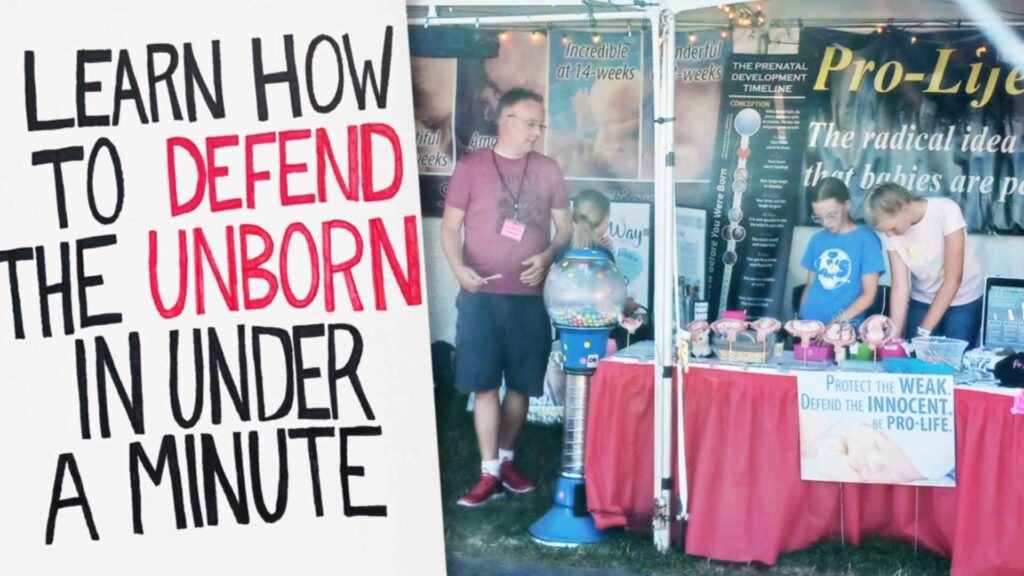
I live in a town that’s so pro-life that when I go outside wearing a pro-life t-shirt the only reaction I get is, “Hey Jon, great-looking shirt there. Does it come in red?” We’re so pro-life that when pro-abortion politicians marched in this year’s Farmer’s Day Parade, there was all sorts of cheering and clapping for the float in front of them and the marching band behind them, but not a peep anywhere near them. They were enveloped in an angry bubble of silence. Our town is so pro-life that when my daughters and I volunteer at the pro-life booth, we can count on thanks, not shouts. The booth is set up at the summer fair each year, and most everyone stopping by is there to offer encouragement. They bring their kids to get free pro-life lollipops and pencils. Some buy yard signs or hats. The most popular items are our life-size fetal models showing what the unborn look like at 6 months, and 4 months, and 12 weeks; it’s always fun when a pregnant mom comes by to show her kids what size their baby brother or sister is right now. In the half dozen years we’ve been at this, I’ve only had a dozen or so folk either insult or argue with me. This, then, is more about preaching to the choir than reaching the opposition. Equipping the choir That’s why this year I decided to switch things up a bit. If it was always the choir stopping by, then what if we focused on equipping them? What if we tried to give them a quick “Pro-life 101” refresher, so they could walk away better able to speak up for the unborn? Of course, everyone at the fair is there for the rides and the food and the demolition derby, so it isn’t really the time and place for a class in apologetics. If I was going to pitch something educational, it needed to be quick. My daughters helped me out with a big poster that made an even bigger promise: “Learn how to defend the unborn in under a minute!” The sign was eye-catching and, thankfully, ambiguous enough to give me a little wiggle room on the time limit. Was I promising passersby a 59-second lesson or was I going to show them – in perhaps a slightly longer length of time – how they themselves could offer up a sub-minute defense of the unborn? The fudge factor allowed me to go a little long if I needed it. The short version A lightning-quick defense of the unborn is possible because most abortion arguments focus on one thing: what the unborn can’t do. The fetus is said to be less valuable and less deserving of protection than you or me because: they can’t breathe yet they don’t have brainwaves yet they aren’t self-aware yet they can’t survive on their own Whatever the reason given, it amounts to an abilities test – the unborn are said to be worth less, because they can do less. Therefore to defend the unborn all we have to do is show how it isn’t our abilities that give us value. We can do that by asking a couple of key questions. We’ll need our opponents to explain: Where does human beings’ worth come from? On what basis are we all equal? Unpacking the argument If our value comes from what we can do then that presents a problem for equality, since we all have very different abilities. I’m bigger than most, and maybe you’re faster than me, and that fellow over there might be smarter than both of us. So, then, in what sense are any of us equal? It’s quite the conundrum for the abortion supporter. Any ability-based answers he gives to the first question will run him into problems with the second. After all, we all understand that we don’t treat very different things as equal – a Rembrandt is housed in a museum under guard, while a child’s fingerpainting will only rate the fridge door, even though both are art. So unless men and women are actually equal in some sense, then we shouldn’t treat them as equal. That’s a thought no one wants to think, so we can be aggressive in pressing the abortion defender to explain how we’re equal. When he’s fumbling about, it’s our chance and our turn: “You can’t explain where equality comes from, but I can.” We can explain that what makes us all valuable, and equally so, is the only thing we all equally share: that we are made in the very Image of God (see Gen. 1:27). Being made in the Image of God isn’t something we grow into, or get more of, and it isn’t even something we can cast off (Gen. 9:6). We have it, not on the basis of anything we can do, might do, or should do, but on the basis of Who made us, and how He values us. This is not only an explanation for why a small weaker woman is equal to a stronger bigger man, but why the very small and very weak unborn child is equal to any and all. Stand on God’s Word While our opponent might dismiss the Bible, that doesn’t make it any less powerful (Heb. 4:12, Eph. 6:17). And we can counter their dismissal by challenging them to offer any sort of better explanation. They don’t have one! More importantly, when God says His Word won’t return empty we need to trust that it’s so (Is. 55:11). Too often, Christians will try to defend the Christian position without presenting it as the Christian position. If our opponents are attacking the unborn for what they can’t do, then we’ll try to defend the unborn with an equally godless argument, highlighting all that they can do. Instead of arguments about being made in the Image of God, we’ll show how very much the unborn seem to be crafted in the image of Man: The unborn’s heart is beating at three weeks Brainwaves can be detected at 40 days They may be able to survive outside the womb at 20 weeks They can recognize their mother’s voice at 7 months The problem with any of these points is that, on their own and apart from the Bible, they are only another abilities test. We’re saying that the unborn are valuable because of all these things they can do. But that’s the pro-choice argument! If we argue that the unborn are valuable because their heart begins beating as early as three weeks, what does that implicitly say about the unborn at two weeks, before their heartbeat has begun? Any defense of the baby based on what it can do throws shade on babies who have yet to develop those abilities. We either stand securely on God’s Word, or we will, accidentally but most certainly, end up adopting the very position that we oppose: that our worth comes from what we can do. Conclusion I got to share my two-question apologetic with a dozen or so pro-life folk. I also got to try it out with a young man who wanted to argue. It slowly came out that the reason he thought we should all just mind our own business is because he’d gotten his girlfriend pregnant and paid for her abortion. So he was very interested in justifying what he’d done. He thought the baby wasn’t human because it was so small. But this man, little more than a boy himself, was half my size, which I pointed out. Did he really think bigger meant better? No, he conceded, that wasn’t true. He didn’t repent. Or at least not then and there. But I was able to confront him with just how insufficient his justifications were. He left rejecting the Christian explanation for our value, but admitting that he had nothing else to offer. That’s what I could do standing on God’s firm foundation; I could blow apart the underpinnings of his godless arguments. Because I did this while giving the glory to God, this confused and hurting boy will know where to go, and Who to turn to for truth and forgiveness. And all it took was a couple of questions and a minute… or so....

Red heart icon with + sign.
Apologetics 101

Witnessing without knowing it all

Ding dong! The doorbell goes and through the peephole you can see two young men clad in dark conservative suits. Fortunately you’ve recently read an article or two on Jehovah's Witnesses so you're feeling at least a little prepared to talk. Smiling, you nervously open the door. But as the conversation begins, you quickly realize these aren’t the Jehovah’s Witnesses you’re ready for, but are instead Mormons – and you don’t know anything  about Mormons! So what are you going to do? What are you going to do?!?!? The burden of proof Don’t panic! Understand the battle in front of you: ignorance vs. error. You don't have answers at the ready, but because you serve the one true God you can be confident that there is truth to be found, though it might involve some digging. Meanwhile, these gentlemen at the door might be more knowledgeable about their beliefs than you, but they are utterly wrong. Digging will help here, too, but instead of uncovering truth you'll be uncovering their error. So you’re actually in a great position here. You don’t know anything about Mormons? Well here are people eager to teach you. What a great arrangement! Consider, also, that the pressure is all on them, not you. They’re here to make their case, and provide evidence and reasons for why you should be a Mormon. The burden of proof is right where you want it…on them. In other words it is up to them to make their case and defend it, while you are free to go on the offensive and challenge their assertions with good questions. Maybe that doesn't sound like it's going to be all that effective – how can simply asking questions help you evangelize to Mormons? The key is the burden of proof. Even a four-year-old can confound her parents as long as the burden of proof is on the parents, as long as they have to answer her questions. “Time to got to bed dear.” “Why?” “Because it’s dark out.” “Why?” “Because the sun set.” “Why?” “Um…it has something to do with the earth’s rotation I think…Hey, honey! Where did we put the encyclopedia?” The point, of course, is not just to ask questions, but instead to ask questions with purpose. The four-year-old’s purpose is to stay up a little longer while your purpose will be to expose the errors and weaknesses in Mormon belief. Questions are key In his apologetics book Tactics, Greg Koukl outlines some questions that can be used in just such an occasion. The first is a question of clarification. When you’re first learning about their beliefs you should be sure you understand what they are saying. You might ask them, “What do you mean by that?” or, “So are you saying…?” Clarification is important because it forces the Mormon (or Jehovah's Witness, or atheist, or whomever) to restate and explain what they really mean. They’ll have to drop their script and actually think about what they are trying to say. And more than anything, what you want to do is force them to think. Clarification also allows you to learn from this encounter and start to understand what their beliefs are, which could help you the next time you end up in a similar situation. Secondly, question their assertions. The Book of Mormon is the revealed word of God? “Now how did you come to that conclusion?” The explanation may lead to yet more assertions that you can again challenge. After a while you may learn enough and feel comfortable enough to try and make a few points of your own. The questioning technique works here too. Instead of telling a person why they are wrong, ask them, “Have you ever considered…?” The use of a question here is a more gentle challenge to their beliefs, and more likely to get a thoughtful, rather than reactive response. Shifting it back It’s a simple approach but there is one thing to watch out for…the dreaded switch back! The non-believer answers your question with a question of their own and before you even realize the burden of proof shifts back to you. “So you don’t think The Book of Mormon is God’s word? And yet it seems you think the Bible is. Why is that?” If you’ve got an answer this is a great opportunity to provide them with some information. But if not, don't worry. Remember they’re the ones who've come to your door to make their case, and so it is up to them to back them up. Just play it straight, admit your ignorance, and repeat your original question, “I’m not the one making any claims here. You said The Book of Mormon was God’s word and I’m just wondering if you have any reasons for that.” Study still needed This technique can be used in any number of settings, with all sorts of people: it might be an atheist professor in your university classroom, or maybe a Muslim friend at your local coffee shop, or maybe an encounters with door-to-door cultists. Any time someone is trying to prove a point to you, the burden of proof is theirs. Don't mistake the point being made here. That we can witness without knowing it all doesn't mean we should neglect to study God's Word. To do so is to neglect God. And, of course, evangelism and apologetics will be easier when we know our Bible. It's also true that this same questioning technique works even better if we know a little something about the beliefs of the person we are talking to. Then our questions can become directed, and we can direct the non-believer towards the weaknesses in their beliefs. Then, if the Lord blesses our efforts, this person will see those weaknesses, and start looking elsewhere for answers about God. He may just ask you why he should believe what you believe. And as unprepared as we can be for any of their other questions, this is one we really must be ready for. But sanctify Christ as Lord in your hearts, always being ready to make a defense to everyone who asks you to give an account for the hope that is in you, yet with gentleness and reverence. (1 Peter 3:15)...

Red heart icon with + sign.
Apologetics 101

The don't and do's of answering fools

In Proverbs 26:4-5 God says we shouldn’t argue with fools…except when we should. Do not answer a fool according to his folly, or you yourself will be just like him. Answer a fool according to his folly, or he will be wise in his own eyes. Don't get in flame wars The danger in responding to fools is in descending to their level. If a fool is a dishonest questioner – peppering you with one after another, but with no interest in interacting with or listening to your answers – stop responding. In these situations the longer we talk, the more we make it look like the fool has a legitimate point. And if an online troll hits you with an ALL CAPS EXCHANGES, don't indulge in any sort of flame war. Here the louder we talk the more we end up looking like just another angry fool. Shouting matches aren't going to glorify God. All they do is make it hard for anyone listening to tell the difference betwixt the two combatants. Do answer real arguments The danger in not answering a fool is to leave his foolishness standing. When a fool offers an argument – misguided, shortsighted, naive, but genuinely offered and open to response and rebuttal – we need to answer him. Our goal is to show him his folly by explaining where his argument will logically take him. After that we can point him to real answers. Here’s how this looks in real life. In an online forum an abortion advocate wrote: "I don't get why a human that lives 80 years with modern medicine is more important than a tree that lives 500 years." A tree rates above people? How do we expose this for the folly it is? There are three keys: Do follow his argument to its logical end - What would it be like if we actually lived that way? Do contrast his foolishness with God's wisdom - How does his position compare and contrast to what God says? Do end on a question - This isn't must, but it is a good idea. Greg Koukl says a good question can be like putting a stone in someone's shoe: it's not big, but it sure is hard to ignore. A question can challenge them to think through what you've said. And it can be more winsome than ending on a statement. "Aren't you wrong?" is challenging enough, but it sure sounds nicer than "You are wrong." How that looks When it comes to our tree and abortion-loving debate partner, our response might look something like this: "God says that man is the pinnacle of creation, but you place us somewhere behind trees. Do you live your life consistent with that belief? How do you treat trees? Do you read books? (You do know what those are made of, don’t you?) Have you sat around a campfire and enjoyed watching the flames dance over countless wooden carcasses? What is your home made out of? Your coffee filters? Do you use tissues? How about toilet paper? "God says we matter more than trees. You say trees matter more than us. But if, in your day-to-day routine, you’re participating in the slaughter of trees, doesn't your lifestyle show that even you don’t believe what you're saying?" Now how about a more common example, say someone railing against the 1% not because of anything wrong these rich folk have done, but simply because of how much money they have. God says we should help the poor, but He doesn't want us looking at our neighbor's goods - He calls that covetousness. You argue that because someone has much more than you, that's obscene, and their wealth should be "redistributed." But do you live your life consistent with that belief? If you make more than $35,000 US you are a part of the global 1%. Just consider how much more wealth you have someone in Venezuela; when are you going to redistribute your wealth to them? God said we should help the poor, so redistributing our own wealth is a wonderful idea. But it's not our job to redistribute other's wealth. If you think others having more is a reason to take it from them, then what reason can you give that it shouldn't start with you? It's not likely you'll have someone do an immediate about-face, but you'll have exposed his foolishness to any others listening in. And you've given him something to chew on. Who knows but that God might use this seed you sow today to bear fruit at a later date?...

Red heart icon with + sign.
Apologetics 101

Tactics in defending your faith

In 2018, Stand to Reason's Tim Barnett teamed up with Reformed Perspective, traveling to churches across Canada to speak on "Tactics in Defending our Faith." This is a rough transcript from his March 18 presentation in the Smithers Canadian Reformed Church in Northern BC.  **** Alright, let's talk about tactics. I want you to imagine that you’re a student and you're hanging out with your friends in the hallway outside of the classroom. One of your friends in the group – maybe they're not a close friend – says, “I've never understood how anyone could believe in a good God. Look at all the evil in the world look at the shooting that took place a couple weeks ago. Some good God, right?” Or imagine you're at work and it's lunch hour and you're just hanging out with your co-workers trying to be social. You strike up a conversation and one of your co-workers says, “I can't believe anyone would believe a Bible that's so full of contradictions. Who would be dumb enough to believe that stuff?” Or maybe you're with your family at Easter and a family member says something like: “Billy Graham was a good guy except for the fact that he was an intolerant homophobic bigot.” Think about how you would respond in that situation. There's a whole lot of Christians, if we're honest with ourselves, who would say absolutely nothing. You might make a face, or you make an awkward head nod, or something. But you don't say anything. Most of us just want to keep our mouths closed, because we want to be nice. And we're probably thinking: “Oh, I couldn't change their mind anyway. In the next five minutes how am I going to have an impact? Are they going to come to faith in Christ in the next couple of minutes? I can't get them there.” That's a typical “religious” response: “If I can't get them to accept Christ in the next three minutes, then what's the point?” Now I want to say something that may surprise. I don't have it as my primary goal in any one of those short conversations to actually convert that person on the spot. Now, I want you to hear me out: of course, my goal is that they would come to Christ. But in that conversation I don't put that weight on my shoulders. Because if I do – if every conversation has to lead to a Gospel presentation – it can get a little awkward. Just imagine, you're talking with your friend, your unsaved friend, about the hockey game and you say something like: “Did you see the save that goalie made? What a shot, and then he made that awesome save. Oh, and that reminds me of how Jesus saves all of us..." You see how awkward that is to move from the hockey game to the Gospel? A little bit forced, right? A little bit contrived going from the weather to salvation. Sometimes it’s a little bit awkward to get there. Gosptacles There's also issues that get in our way. One of them is the culture is religiously ignorant. That's not a put-down – I'm trying to be accurate here. In our culture, when we start talking about the Gospel, it's like we're speaking Greek to them. This is truly a post-Christian culture that we're trying to witness to. They don't understand a lot of what we're talking about when we use words like sin and repentance, and they need to be defined. In addition, there are these things that I want to call “gosptacles” – obstacles to the gospel. Now don't look it up; it's not a real word, but it's a helpful way to remind you that apologetics what is fundamental to the gospel. Why? Because when you start sharing the gospel with this culture you've better believe that gosptacles are going to come up, and you're going to have to respond to them. For example, you go to your friend and you start talking about how Jesus died for their sins and all of a sudden they're talking about the Big Bang. And you're, like, “I'm talking about Jesus here; what are you talking about?” But the Big Bang is a gosptacle for them. You go to any university campus and you try and talk about the Gospel and I guarantee you one of the top five responses will be: “I can't believe you can believe in a loving God who would send anyone to hell.” Hell is a gosptacle for our culture. Even the Bible has become a gosptacle. I don't know if you're familiar with guys like Bart Ehrman. He's responsible for more Christians walking away from their faith than any other atheists alive today – not Richard Dawkins and The God Delusion. Bart Ehrman is a New Testament textual critic who says you can't trust your Bible. He says those words that you're reading in the pew are nothing like what the original author recorded. And a whole lot of students are buying into it. So the Bible becomes a gosptacle. You want to talk about the Bible? How can you believe that book that is so full of contradictions? Or all of a sudden evolution comes up you're thinking “I'm talking about Jesus Christ.” It’s a gosptacle. Francis Schaeffer said, in our cultures, before you can do evangelism you need to do pre-evangelism. There's people who are looking for us to tear down those strongholds before they will give you an ear to. So, yes, there is religious ignorance – that’s something out there. But there’s also something in here that we need to get over, and it's personal discomfort. There's a whole lot of people, even in this room, that if you had five minutes to give someone the Gospel, a complete stranger, well that just makes you a little bit uncomfortable. There’s a whole lot of people in this room who, when they hear someone say, “Oh those Christians are intolerant” or “They’re homophobic” you just want to walk the other way. You don't want to in on that conversation. We have to get over this idea of personal discomfort. There are obstacles out there, but there also something in here – personal discomfort – that we have to get over. This issue of personal discomfort reminds me of this video that was put up by the Billy Graham crusade. It doesn't have to be hard – that's the take-home message. And it’s not hard – we’re going to work through this. Ambassadors model’s three skills So I don't consider myself in any given conversation to be the evangelist. I think there are brilliant evangelist out there – Billy Graham was one of my heroes. I'll tell you what we all are called to be, and that is Christian ambassadors. We are ambassadors for Christ. Second Corinthians 5:20 says this: “Therefore we are ambassadors for Christ, God making his appeal through us. We implore you on behalf of Christ be reconciled to God.” So what does an ambassador look like? It's a good question – you're called to be an ambassador, so what does it look like? At Stand to Reason we’ve come up with this ambassador model. We think an ambassador for Christ has three essential skills. KNOWLEDGE The first is knowledge. Do you want to be a good ambassador for Christ? You’ve got to know some stuff. I think that makes sense. You don't have to know everything. You don't have to be a Ph.D.; you don't even have to have a master's degree. You’ve just got to know a little bit. You’ve got to get some facts right. WISDOM The second, you also need some wisdom. This is your method and this is what we're talking about right now – to communicate that knowledge in a persuasive and effective way, and that might involve using illustrations and analogies, and asking good questions. There's a whole lot of ways to be winsome, and have wisdom. This is going to be our game plan. CHARACTER Here's the last thing – you can have all the knowledge in the world, and be winsome, but if you don't have character, then just keep your mouth closed. There's a whole lot of apologists out there who’ve filled their minds with all kinds of stuff, but they're jerks, and they actually do a whole lot more damage than good. So character matters. If you want to talk about love with someone, you better show love. If you want to talk about respect, show respect. I like how Martin Luther King Jr. put it – he said this talking in the context of segregation and racism, and he's trying to change people's minds. Here's what he said: “Whom you would change, you must first love” and here's the catch: they must know that you love them. Oftentimes we get in these heated arguments – we'll call them discussions– where you disagree with me, and I disagree with you, and all of a sudden your ears feel like they're on fire. Right? We've all been there! Then, let's take a step back and ask, does that person know you love them? And maybe we react “Oh, of course, they know I love them!” No, but do they really know? That's important. Key texts Now, most people have the impression that we're all Christian ambassadors, but that there's this subset of apologist – it's like you have the police, and then there’s the SWAT team and they handle like the really difficult situations.  So all you guys are ambassadors but the apologists, they're the guys who maybe get paid to do this – Tim, you can do that but I'm good, thanks. No, it's not like that! Ambassadorsareapologists; that's just the way it is – I hate to break it to you. Let me prove it to you. If we go to First Peter 3:15 – a go-to verse on this issue: “…always be prepared to give an answer to anyone who asks you for a reason for the hope that is in you; yet do it with gentleness and respect…” It says this:  “Always be prepared to give an answer…” An answer? What's that? Well if you look at the Greek it's the word apologia which is actually the word that we get “apologetics” from. So always be prepared to give an answer – some translations say “defense” – to everyone who asks you to give the reason for the hope that you have. And then here's the character part – it's almost like Peter was anticipating that when people give answers they may not be nice about it and so he says “but do this with gentleness and respect.” How about this verse; I actually like this even better: “For the weapons of our warfare are not of the flesh but have divine power to destroy strongholds. We destroy arguments and every lofty opinion raised against the knowledge of God, and take every thought captive to obey Christ…” (2 Cor. 10:4-5) Destroying strongholds – we destroy arguments and every lofty opinion raised against the knowledge of God and take every thought captive to obey Christ – that's what an apologist does. Or how about this one in Jude 3: “Beloved, although I was very eager to write to you about our common salvation, I found it necessary to write appealing to you to contend for the faith that was once for all delivered to the saints.” How about one more? “‘Teacher, which is the greatest commandment in the Law?’ Jesus replied: ‘Love the Lord your God with all your heart and with all your soul and with all your mind.’” (Matt 22:36-37). Now think about this. I get how we love God with all our heart and soul– that's just like during a worship song, or during moments of meditation, or prayer. But what about loving God with our mind? What does that look like? Well I think it looks like a couple of different things. I don't think we check our minds out when we're worshiping, but I think it also looks like study, understanding God's word, understanding arguments from the culture and how to respond to them. That's all loving God with our minds. Think about that parents, grandparents – how are we training our kids and our grandchildren to love God with their minds? What are we doing intentionally to do that? All right one more verse. I just I found this one recently and I love it Colossians 4:5-6 says: "Walk in wisdom toward outsiders, making the best use of the time. Let your speech always be gracious, seasoned with salt, so that you may know how you ought to answer each person." “Walk in wisdom towards outsiders making the best use of your time”  That's be smart: “walk in wisdom making the best use of your time” Then it says “let your speech always be gracious seasoned with salt.” You know how salt makes things taste better? So let your speech be like that – this is be kind. And then finally, “…so that you may know how you ought to answer each person” – this is the tactical part, which is what we're gonna talk about. So be smart, be kind, and be tactical. Putting a stone in their shoe What does it look like? Let's get practical. All these verses, they’re great, and we thank God for them. But what does it look like for me when I'm sitting across at Easter with my atheist brother-in-law? When I'm at the lunch table and the person raises a challenge, what does it look like? I’ll tell you what it looks like: it's a stone in someone’s shoe. Have you ever had a stone in your shoe before, where you're walking along, and it's really annoying, and you can't seem to stop thinking about it until you take it out. You notice it don't you? Have you ever had a stone in your sandal before, like a flip-flop, and it seems to defy physics – you're, like, kicking it out and it stays in. You ever had that happen? That's crazy– it's got something to do with quantum physics or string theory or something like that. Click on the cover for our review. We're gonna put a stone in someone's shoe – okay, not physically, this is all kind of theoretical –  and we're going to get people thinking about what we just said, walking away, kind of annoyed, but in a good way, until they deal with the thing that we just put in their minds. Alright so, what I want to do is give you a game plan. No matter how little you think you know, or how shy you think you are, or how scared you might be, if you follow the rules of the game plan you are going to be all right, and you're going to be effective in being an ambassador for Christ. We're going to go from the content – what you know – to the conversationwith the game plan. The whole game plan is in this book, Tactics. Here's the thing: you shouldn't be allowed to graduate high school without reading Tactics. Seriously! This is like Critical Thinking 101. I'm going to take some of this from the book and present that to you. If you're interested in more of it you’ve got to read the book. So here's the thing: I used to think that when someone raised a challenge, that it was my job to answer it –be the Bible Answer Man. Maybe this is you too. So someone raised the challenge, “Christians are intolerant” or “Christians are irrational” or “All religions lead to God” or “The Bible is not true.” Of course, I thought, “Oh, you say God does not exist? Well, yes He does!” and then I go into my arguments for God's existence. But notice what happened there – they made the claim “God does not exist” or “Christians are irrational” or whatever, and now I'm doing all the work. No! If they make the claim they bear the burden of proof to defend the claim; it's not my job to start defending something that I didn't even assert. But this is what happens – Christians, we think “Oh, you said something so now I better go into Bible Answer Man mode.” I think that's the wrong approach. And I think that's why the Culture has been getting away saying a whole lot of ridiculous things, and they go unchecked. For far too long we've allowed people to make claims, statements, challenges, and fold their arms and then just say “I'm waiting Christian, answer – God doesn't exist. Now go ahead and refute me.” That's not our job. Our job is not to refute random statements like that. Columbo Tactic #1 – What do you mean by that? I want to give you the game plan. The game plan is what I'm going to call the “Columbo Approach” or the “Columbo Tactic.” Do you guys know who Lieutenant Columbo is? Raise your hand nice and high so I can see. Okay, good it's all the older people. No, there were some young people; you're watching the reruns. Let me tell you about Lieutenant Columbo. Okay, Lieutenant Columbo is a bumbling, seemingly inept, TV detective who has remarkable success in catching crooks. The inspector arrives on the scene of the crime and he's in complete disarray. I mean his hair is a mess; his trench coat looks like he slept in it; he’s got a cigar wedged between his fingers; he's got a notepad but he's got no pen or pencil and he's got to bum one off somebody. I mean, this guy to all appearances looks harmless and stupid, but he's not because Lieutenant Columbo has a game plan. So Lieutenant Columbo, he maybe poked around at the scene of the crime, and then he'd scratch his head and do his trademark move: he turned to maybe the suspect – the killer or the robber, whoever – and he'd say “There's something about this thing that bothers me. Then he turned to the suspect and say, “You seem like a very intelligent person. Maybe you could clear this up from me. Do you mind if I ask you a few questions?” And then he'd ask a few questions and he'd seem satisfied. And he’d maybe start walking away and then turn on his heel and remember something and say, “Just one more ting.” And then he’d one more “ting” them to death, with question after question after question. He’d say, “I know I know it's annoying but this is a habit” and this is a habit I think that Christians need to get into. We need to start asking questions, instead of making so many statements. There's going to come a time where we're going to have to make statements, obviously. But there's so many instances where a question would have been better than an assertion or a statement. This tactic, the key to it, is to go on the offensive but in an inoffensive way, Colombo-style, by selecting carefully crafted questions for the conversation. There's a book called In but not of by Hugh Hewitt. I'm not actually recommending the book because it wasn't actually that great but there was one chapter in it that was fascinating, and it was on questions. In fact, he says in any conversation you should ask a half a dozen questions. So you meet someone, just start asking questions. Well, why ask questions? Here's a list of reasons why we should start asking more questions. Questions help you understand a person's point of view. Oftentimes I'll have people come up to me after I give a talk and say “Tim, can you recommend a good book on Buddhism?” And I'll say, “Why do you want a book on Buddhism?” “Well, I have this friend and they're a Buddhist. I'd really like to be able to witness to them. So do you know a good book?” I'm thinking, “Wait, you want to learn about Buddhism. Your friend is a Buddhist. Why don't you ask them?” Doesn’t that make sense? Instead of reading a book that may or might not be on their version of Buddhism anyways, why not just sit down at Tim Hortons and learn about Buddhism from your friend? Seems smart enough, right? Questions take the pressure off you. When you're asking questions, you're not defending anything. You ever think about that? You're asking them; they're doing all the work. By the way, it's not a lot of work because, turns out, people like it when you ask them questions. You should try it sometime; it works! Questions keep you from distorting the person's view – you understand where they're coming from by getting by getting them to clarify their view Questions are friendly and they build relationships. This is so true. When I met my wife in university it turned out that our birthdays are one day apart – she's born on April 28th and I'm born on the 29th. She's two years younger than I am, but I got invited to her birthday party and I didn't really know anybody. She had this one guy friend and we sat down and we started chatting. We were at this bowling alley and I spent the whole night asking him questions, asking him questions, because I was reading this material. We all went home and I found out that he called my wife and said “That Tim guy is one of the most interesting people I've ever met.” I don't even think he knew my name! Okay, maybe that's the one thing he knew. De didn't know anything about me; I didn't talk about me. I spent the whole night asking about him. Let me tell you something, interested is interesting. It just is. And it turns out questions show you're interested. We're not faking it – I wasn't faking it; I wanted to know about him. It just so happens that I just kept asking the questions and he just kept answering. Questions give you an education. In many cases you don't need to go to university for this stuff. Just learn it from people who know something you don't. Questions don't require a defense, You put it all together, and questions get you in the game. Someone says something and you're just caught off guard, you're flat-footed, you don't know what to say. Questions get you in the game, okay? You don't have to hit home runs; you don’t have to get on base! If we had Christians that would step into the batter's box once in a while and just start swinging, I'm telling you this Culture would look a whole lot different. I also want to make a really important point and I think Blaise Pascal, the famous Christian mathematician and philosopher, hit it right on the head. Here what he says: “People are generally better persuaded by the reasons which they have themselves discovered than by those which have come into the minds of others.” Think about that. If you want to convince someone to be pro-life, if  you want to convince someone that marriage is a certain way, you want to convince someone about God's existence, then don't just say “Believe God exists.” Or “Here’s this, this, and this.” No, no – if you want someone to change their mind about something people are better persuaded by the reasons which they discover. Well, how can you help them discover reasons? You can do that by asking really good questions. I like how Francis Schaeffer puts it – this is so counterintuitive! He says, “If I have only an hour with someone, I will spend the first 55 minutes asking questions and finding out what is troubling their heart and mind, and then in the last five minutes I will share something of the truth." That is so counterintuitive, because I'd imagine I'm not the only one here who, if I had 60 minutes with an unbeliever, I’d preach at them for fifty five minutes and then at the end say, “Do you have any questions?” Right? That's just what we do. But here's the problem: So many times in our culture we will end up preaching sermons that nobody wants to hear, and answering questions that nobody was actually asking. That happens all the time. But let's say you don't like Francis Schaeffer and Blaise Pascal (who were both brilliant). You've heard of Jesus Christ and like to follow his example. Well, Jesus knew this better than anybody. Questions were Jesus’ tool of choice; we heard that in Matthew 21 – we didn’t even plan that; that was great. They were his tool of choice for friend and foe alike in the Gospels. This may surprise you: Jesus answered 183 questions. Wow! However – and this should astonish us – Jesus asked 307! Jesus – the smartest person who ever walked the face of the earth – asked more questions than he answered. Was that because he didn't know a whole bunch of stuff? Not even close! The reason he was asking these questions was to get people to, like Blaise Pascal said, rethink things within their own hearts and minds. He used questions to get them to think about their own worldview. This was important for people to evaluate and reevaluate their own beliefs. Alright, let's get to the game plan: the first Columbo question. It's going to be: “What do you mean by that?” Everyone say, “What do you mean by that?” I'll tell you what I mean by that! “What do you mean by that?” is your go-to question because this is the kind of question that gives you more information so that you can move into the conversation. I'm just going to step into the conversation. How am I going to do that? “What do you mean by that?” Someone is going to make a challenge and I'm just completely caught off guard but I do remember this question “What do you mean by that?” Now you get more specific, as we'll see in a second here, but this question allows you to clarify what the person is actually saying. Sometimes they don't even know what they're saying, as we're going to find out. So, “what do you mean by that?” CHALLENGE #1 – Evolution disproves God Let's do a little exercise here. First challenge: let's say you're with someone, your friend who's maybe not a believer, and they say “Evolution has proven that God isn’t necessary.” Now hold that knee down, okay, because I know your knee-jerk reaction is to do a roundhouse kick or something, right? It's to start going into your creation mode, but you didn't make a claim; they did! Evolution has proven that God is unnecessary? You're going to ask “What do you mean by that?” In fact, I would ask if I were you, “What do you mean by evolution?” because I can, off the top of my head right now, name six different definitions for evolution. I can tell you something right now, whether you are the most staunch young earth creationist in the room, you believe in evolution in some sense. That is, if we're just talking about change over time, then of course we all believe in evolution. But if we're talking about molecules-to-man then I'm sure – well I don't know how many people here – but most of you I'm almost positive would say, “No I don't believe in that.” So there you go, those two definitions shows it depends “What do you mean by evolution?” And by the way, in this discussion people do kind of the bait-and-switch. It's like, “Of course evolution is true; it happens all the time.” Well now, it just depends “What are you talking about with evolution here?” and“What do you mean by evolution here?” Good question to ask. CHALLENGE #2 – Christians are intolerant How about this one?“Christians are intolerant.” You're going to ask “What do you mean by that; what do you mean by intolerant?” because let me tell you something, the word tolerance has actually changed in our culture. Tolerance used to mean that we disagree but I'm going to respect your right to disagree – I'm going to respect you as a person. In fact, think about it: if you accept the view then you just accept it; you wouldn't tolerate it. The fact that you tolerate it means you disagree. But today tolerance means “all views are equal and if you think thatthey're not all equal you're intolerant” So the definition has changed! I would want to ask “What do you mean by intolerant?” and they say “Well, you think you're right and everyone else is wrong; you're intolerant.” I'd say, “Well are you saying that I'm wrong then? Do you think you're right and I'm wrong?” You know what I’m saying? It's self-refuting actually, if you think about it. So you want to ask some questions. “What do you mean by intolerant?” – that's going to get you in the game. CHALLENGE #3 – Irrational to believe in God How about this? “It's irrational to believe in the God of the Bible.” You're gonna ask? “What do you mean by irrational?” You're getting the hang of this. I know some of you are like, “I can't do this anymore.” Listen, you need to practice doing this because Easter's coming Okay, what do you mean by “the God of the Bible?” I do not want to talk to my atheist friend until I define what they mean by God. Seriously, who is the God you don't believe in? What do you mean by God, because it turns out, usually, the God they don't believe in is the same God I don't believe in. The God they don't believe in is like some finite Zeus-like creature who, you know, maybe has a temper tantrum here and there. It’s finite so they can't really do much, and there are created, that kind of thing. That's not the God of the Bible, so the God they don't believe in – I'm joining them – I don't believe in that God either! That's an idol; I don't believe in those. CHALLENGE #4 – My body; my choice How about this one? “My body; my choice” is a very common pro-choice slogan. You see it on bumper stickers, t-shirts you name it. You're going to ask, “What do you mean by choice?” If we're going to talk about being pro-choice/pro-life I want to know what you mean by choice. What are the choices we're talking about, because some choices I'm absolutely pro-choice about. I'm pro-choice about which school women go to, and who they marry, and what they want to wear, and what doctor they have, and all that, so I'm pro-choice about all that stuff. But some choices are immoral, like killing innocent defenseless human beings. They just are. And they recognize that some things we should be anti-choice about. Should we be pro-choice about drinking and driving? No, we shouldn't be. In fact, they have laws against drinking and driving? Why? To protect people. Yeah, so most people are anti-choice about that. What about “my body”? “What do you mean by your body?” Well, it turns out it's a body inside your body. That's just science. Different DNA. How many eyes does that woman have? She didn’t just get two more – those are in a different body. In fact, that body inside her body could have a different gender! So it's definitely not the woman's body; there's another body in play. CHALLENGE #5 – The Bible condones slavery How about this: “The Bible condones slavery”? Lots of challenge go against the Bible. Someone says “the Bible condones slavery” and you may not know how to respond, but you could ask “What do you mean by slavery?” and “What do you mean by condones? Oh you’ve got to show me that – in what passage does it say ‘thou shalt own slaves?’” Because not everything the Bible describes is it prescribing. The Bible describes lots of stuff that it's not saying “go out and do.” It's just giving a description of history. What do you mean by slavery? What do you mean by condones? Columbo Tactic #2: How did you come to that conclusion? All right, don't be surprised that if you use the first Columbo tactic (which is very powerful) “what do you mean by that?” and you get a blank stare and complete silence. Seriously. And this is not your chance to jump all over them and say “Ha! Gotcha – you're so stupid!” or something like that. No, remember the character part? This is your chance to show grace and love. So you're going to be patient, and you may say “You know, maybe you need to think more about that; we could talk about it again some other time,” or something like that. By the way fellas, married men, if your wife calls you an idiot don't respond by asking her “What do you mean by that?” Just saying. I may know that from experience. How about this one? Second Columbo question. We’re only going to give you two Colombo’s: “What do you mean by that?” and the second one is, “How did you come to that conclusion? The first question gives you more information but eventually you've got to stop asking “What do you mean by that?” It's like your kids going on, “Why, why, why?” Okay, stop it! What do you mean by that, what do you mean by that, what do you mean by that? Okay, now I’ve got enough information. You can ask it, you can ask it until you get the information. But now you’ve got to find out – here I know what you mean, but why are you saying that? Why do you believe that? How did you come to that conclusion? This is a very generous question because it assumes people have come to a conclusion. And usually, from my own experience when I talk to people, they didn't conclude anything. They're just emoting and asserting, and they read it on a bumper sticker somewhere, or they heard someone on TV say it, and yeah that sounds good, and “When they accepted that award at the Oscars they said the same thing so it must be true.” This kind of thing. Here's the general rule: Whoever makes the claim bears the burden of proof to defend the claim. That goes for you too Christian. You say Jesus rose from the dead; I hope that you can defend that claim. But if they're making claims, like God doesn't exist, then we got to make sure we hold their feet to the fire a little bit and say “Okay, you just made a claim; now you need to defend it” so they bear the responsibility to give a defense for that claim. Christians are not the only ones who give defenses for things – everyone is an apologist for their view. And it turns out we just haven't done a good job making our atheist friends, or whoever, could be another Christian who just holds a conflicting view of yours. and you want to challenge it. Now let me give you an illustration of how this works. I was at the Royal Ontario Museum (ROM) when I was going through Teachers College. I went and got my degree in physics and then I went to Teachers College to get my Bachelor of Education so I could become a teacher. One of the things that we did was we went on all kinds of field trips to the zoo, and they showed us kind of behind-the-scenes, what's going on there, so that we would bring our students when we became teachers. So we're getting a tour and we're walking through the ROM and I'm with my friends. You’ve got to understand when I was in Teachers College I needed Stand To Reason and these other ministries because it was like me against everyone. I went to the University of Ontario Institute of Technology with all these other future science teachers and they all held views contrary to my own. Every day I would spend more time going home and looking on apologetics websites than doing my homework – somehow I still passed – and I would come back and it would be like me, and I'm not joking against 15, 20 people. It was always gracious. In fact, some of these guys went on to get jobs, became department heads, and people who vehemently disagreed with me, are trying to offer me jobs. “Tim my physics guy is retiring; you’ve got to come work in my department.” That's when you know you've got that good relationship, that they know you love them. So I'm standing next to this thing, that's a Brachiosaurus – it's the largest sauropod dinosaur in Canada, actual skeleton, actual fossil – and we have myself, my atheist friend, and he's bit shorter so he looked up at me like this, and he said “There's no way Noah's fitting that on the ark.” To which I had to fight my knee-jerk reaction, right, to do that roundhouse kick again. Again, I didn't make a claim; I don't need to defend anything here. So what I do is I ask a few questions, kind of a how-did-you-come-to-that-conclusion although they were much more specific. I said, “Okay, you don't think Noah could get that down on the ark, then clearly you must know how big the boat was.” He said, “No, I have no idea; nobody knows how big the boat was.” I said “Actually I think it's recorded in Genesis” so that was news to him. You’ve just got to make the conversion from cubits to meters. And then I asked, “Okay, you don't know how big the boat was; then you must know how many animals were on the boat because obviously, you know if it wasn't that many maybe….” And he's like “How could anyone know how many animals were on the boat?” I think, Wait, you don't know how many animals were on the ark, and you don’t know how big it was but you're certain there's no way Noah’s get that on the ark. Anyways, this right here is a baby Brachiosaurus and so long as you get a pink one and a blue one you'll be ok. You see the approach. You're going to want to be the Bible Answer Man. That’s how you've been trained, for whatever reason. That's just how we react as human beings, even when what you need to do is start asking questions. The Gauntlet This person had thrown down the gauntlet. A gauntlet is a medieval glove but in our culture today what they do is they throw down the gauntlet and then they celebrate like they just won. I'm not gonna show you my celebration dance; I almost did but I pulled back here. They throw it down and they celebrate. No, no, that's not how this works. In medieval times you throw down the gauntlet, someone picks it up, and then the duel happens. So we have to change our approach. We have to point this stuff out: you made a claim, now defend it. Now the second Columbo question is actually, again, very, very generous because it assumes that a person actually came to a conclusion. Again, don't be surprised if you say, “How did you come to that conclusion?” and they're thinking “What are you talking about? What do you mean, what reasons do I have for believing that?” and they don't have any good reasons. In that case, you're gonna have to be gracious again. So in summary, we've just looked at two Columbo questions. The first one tells you what the person believes, and the second one tells you why they believe it – what they believe, why they believe it – and that's exactly what Christians should know. We’ve got to know what we believe and why we believe it. As well, notice that these questions keep you out of the hot seat and, in a certain sense, you're in the driver's seat. When you're asking questions you're kind of steering the conversation where you would like it to go and that's a good place to be. When you are out of your depth Now let me make a couple of final remarks. It turns out that you could end up asking the wrong person the right questions, but you find out this person is really smart, like they are way smarter than me. You’re thinking, oh I'm gonna try Columbo on my next airplane ride but it turns out the guy next to you is like a quantum physicist. And you're like, Why did I open my big fat mouth? That kind of situation. Well, what happens when you're outgunned like that and you feel like you're in over your depth? I'll tell you what you do. You stick to the game plan. Here's what you do – and this works online too by the way – let's say you're messaging with someone and you're in a conversation you can't end. That's the problem with Facebook conversations; they never end because it’s just comment, comment, comment. How do I get out of this? It's a black hole! So here's what you do. You say. “You obviously are very smart; you've done a lot of reading on this. Maybe you’ve got a Ph.D. in philosophy and you're an atheist and you debate people for a living. Okay, great. Tell me what you believe and I'm going to write it down. Or I'm going to memorize. Okay, this is what you believe? And why is it you believe that?” Those are the two questions. And here's the magic words – you ready for the magic words? – “Now let me think about it.” You see how that works? “Let me think about it,” because that's exactly what they want you to do, and that's exactly what you're going to do. You're going to think about what they've just told you, when the pressure is off, because I'm telling you, maybe you're like me, but my neurons don't fire as well when I'm in the heat, in the middle of a conversation. Tensions are a running high. Sometimes actually I think they shut right down. So you want to take that information, and now I'm sitting in front of my computer I'm going to Stand To Reasons website STR.org and hey, “Maybe Tim has an article about that” and then you can find out more information. Or you're going to go to ReformedPerspective.ca and you're going to say “Hey they just wrote about that last week and look it there's – all the information I need.” That's why we exist: trying to get that information so that you can do something with it. Strengthen your own faith and then go and have an impact on the Culture. Flashlight, not a hammer Here’s this – I’ve got just two more slides, so hang on here. Questions are not meant to be used as a hammer to beat people up. I'm telling you, you start doing this (and you need to start doing this) and you're going to see that you can hurt people. You just can; you may not even mean to but you can, because you're going to find out people are not as smart as they think they are. They just haven't thought things through. They don't even know how to think critically; they just don't. I used to teach high school – I taught in the Christian school system and I taught in the public school system. Let me tell you something: a lot of the kids that are out there just cannot think critically because they were never taught to think critically. They're taught to memorize a whole bunch of information but never how to think. Questions are not a hammer to beat people up. I'll tell you what they are: it's how Jesus used them. They're a flashlight to guide people towards the truth. They're a flashlight to point people towards the truth. Sweat now Last thing: the Marines have a slogan in the States and it's translated from Latin into English and here's what it is: The more you sweat in training, the less you bleed in battle Why am I telling you this? Because something like sixty to seventy-five percent of young people in our congregations go off to university, many to secular universities and they end up walking away from the church. Why do they do that? The number one reason, the most popular response is intellectual doubt and skepticism. They do not know how to interact with the aggressive professor or the friend or whoever. So what I'm telling you is the more you sweat in training nowt hen when you get into those conversations you're not going to bleed out on the battlefield. And we have a whole lot of students that are bleeding it on the battlefield. And even at the workplace or wherever. I want to encourage you that we need to practice what I'm preaching here. That may mean tomorrow morning at breakfast, start asking these questions. That may mean before we go to bed, or on the drive home, “Oh so do you guys want to stop at Wendy's?” “What do you mean by that?” you know this kind of thing. Just do it. Because now it's second nature for me. I just kept doing this and kept doing it, and now my wife asks me “Do you want chicken for dinner?” and this is what happens: she gets kind of angry “Don't use that stuff on me.” But when it becomes second nature, then when the pressure is on three weeks from now, a month from now, six months from now, and you find oh my, now I'm face to face with that opponent, that person who disagrees with me, you're going to want this to come to mind. And it won't come to mind, it just won't, if you haven't been practicing it....

Red heart icon with + sign.
Apologetics 101, Documentary, Movie Reviews, Watch for free

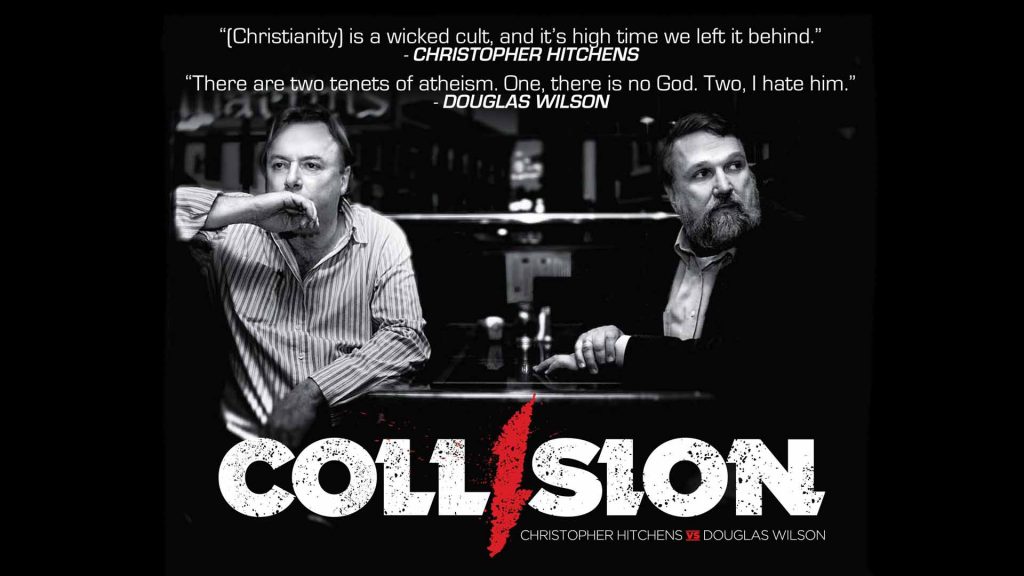
Collision: Christopher Hitchens vs. Douglas Wilson

Documentary 88 minutes / 2009 Rating: 9/10 The genesis of the film started back in May of 2007 when leading atheist Christopher Hitchens and Reformed pastor Douglas Wilson were asked by Christianity Today to dialogue on the question “Is Christianity good for the world?” They wrote six exchanges which were printed in the magazine and then, in 2008, compiled into a book. When the two men headed out to do an east-coast book tour, filmmaker Darren Doane tagged along. He captured their exchanges and interactions, both onstage in formal debate settings, and as they conversed over a pint of beer in the local pub. The end result is the most entertaining and enthralling debate you will ever see on film. But its appeal is not the reason this is a must-see film. You should see Collision because: It prepares our children for what they’ll encounter at university. The attacks that Hitchens levels against God and Christianity are mimicked on secular campuses so Wilson’s able defense of the faith will be instructive and will be an encouragement to our young people when they face these same attacks from their professors and fellow students. It demonstrates the approach we need to take to answering the theistic evolutionists. How are we to understand Genesis 1-11, and what role should science take in guiding our interpretation of these chapters? To properly answer it we need to rediscover a mislaid aspect of our Reformed heritage – presuppositional apologetics. Throughout Collision Wilson brilliantly demonstrates (though doesn’t entirely explain) this distinctly Reformed way of defending the faith. So what is apologetics? And how does presuppositional apologetics compare to the other, evidential, approach? Despite how it sounds, apologetics isn't about apologizing – it is about defending and arguing for God's Truth. Evidential apologists figure if we present the evidence – enough of it, and the right sort – people will follow the facts and come to realize that there is indeed a God. The problem with this approach is that facts are always interpreted. Present someone with information about the stunning intricacy of the human eye and they’ll fall back on their worldview – their presuppositions – to tell them how to understand this information. So a Christian will look at the eye and acknowledge it as evidence of a brilliant Designer. Meanwhile, an atheist will understand it as evidence of millions of years of evolution since something this amazing couldn’t have just sprung up overnight! Confronted with the same evidence, they come to opposing conclusions. Why? Because sin taints even our intellect – even our reasoning – so evidence can be twisted to support conclusions that run right up against God's Truth. Presuppositional apologetics delves into the assumptions – those presuppositions – that underlie every worldview. When, in Collision, Hitchens accuses God of being a tyrant for ordering the death of the Amalekites (Deut 25:19), Wilson asks Hitchens to provide, from his atheistic worldview, a grounds for being upset. If we are just “matter in motion,” as the atheist worldview contends, what reason is there for Hitchens to care what happens to Amalekites? Hitchens makes repeated moral claims, and Wilson repeatedly shows that his atheistic worldview gives him no basis for claiming that anything is wrong or anything is right. Hitchens has debated a throng of other Christians but it’s only Wilson, and his presuppositional approach, that has given him pause. Does that mean presuppositional apologetics is the way to go if you want to win the argument? By the film's end, Christopher Hitchens wasn't won over. And while Wilson was impressive, many of the atheists who watched Collision said that Hitchens won the debate. In that sense, this presuppositional approach didn't "work." But, of course, it is always the Holy Spirit, and not the apologist, who transforms a person's heart. What makes presuppositional apologetics the way to go is that it begins with the right basis, acknowledging, as Romans 1:18-32 makes clear, that this is not a battle over evidence – on some level everyone knows God exists, everyone has God's moral law written on their hearts, and everyone is aware to some degree of how we don't measure up. When we understand that God has already declared Himself, then we can stop wasting our time with the red herring of having to prove His existence, and we can get to the real apologetics work of clarifying and presenting His truth. Then apologetics is an opportunity to glorify God by contrasing the unshakeable biblical worldview with the unbeliever's foundationless one. We can learn from Wilson and use this same approach to properly answer the theistic evolutionists in Christian circles. Like Wilson, we need to cut to the very core of the debate and address their presuppositions – we need to ask how evolution can fit with Christianity when it requires a mythical Adam and Eve, millions of years of mutations and mistakes, and death before the Fall? This is a film some will love, and others might find too loud (the producer has shot music videos in the past, and that influence is felt here in the driving, beat-y soundtrack) but the meat of what’s discussed, and the example that is set, will be valuable for all ages and all interests. Would that everyone would watch this one... and now you can, on Facebook, for free!...

Red heart icon with + sign.
Apologetics 101

I love apologetics

Don’t be intimidated; sharing the good news isn’t as complicated as we make it  **** The Evidence Bible is filled with my favorite apologetical arguments. I love to use these arguments to pursue the lost. I also enjoy watching instructional videos about the subject of apologetics. One of my favorite Bible teachers explains how to defend the faith. He is so eloquent and has such a brilliant mind, it makes me want to never open my mouth again. Plus, he is incredibly gracious and humble. I say that because I want you to know that what I’m going to say is not a criticism. It simply illustrates a very important point when it comes to sharing our faith. I remember him speaking of the importance of truth when reasoning with the unsaved. He spoke of five critical grades to keep in mind when it comes to reaching the lost. He said that when testing truth there are two theories – the “correspondence theory” and the “coherence theory” – plus there is consistency, empirical adequacy, and experiential relevance. Then he added, “There are four questions to be dealt with – our origin, meaning, morality, and destiny – and to deal with those questions there are five disciplines you have to pull together: theology, epistemology, metaphysics, ethics, and anthropology.” He also spoke of three cultures that we deal with: the theonomous culture, the heteronomous culture, and the autonomous culture, which dictates a “mutual autocracy.” Got it? If you did, you’re more intelligent than most people. Most people have trouble even pronouncing those words, let alone knowing what they mean. And that’s okay. That’s because proclaiming the gospel can be as simple as doing what Jesus did: use the Ten Commandments to stir the conscience, and show the sinner that he needs the Savior. I rarely get into arguing about apologetics, the infallibility of Scripture, the deity of Christ, evolution, why there is suffering, etc. When I do enter that territory, I am always aware that there is a way out, and I take it. I can get out, because I have learned the importance of having control of the conversation. I know our ultimate agenda; it’s to “preach the gospel to every creature” (Mark 16:15). If I wanted to teach you how to fish, I could take you to a quaint little pond and catch a nice small fish. But I’d rather take you deep-sea fishing and let you see some action. If you watch a deep-sea fisherman, when he gets a marlin on his line he will let it run. He does this because he knows that at any time he chooses he can pull back the rod and get the hook deeper into the fish’s jaw. The “hook” that Jesus used was the moral Law (the Ten Commandments), and the “jaw” is the sinner’s conscience. It is because of this knowledge that I can let him run off in any direction he wants to, because I know that any time I choose I can take complete control, simply by asking the question, “Do you think you’re a good person?” and bringing out the Ten Commandments as Jesus did in Mark 10:18–21. That gives me a level playing field because I’m not talking to his contentious intellect. I have moved to his conscience. This puts even Einstein on the defensive. Never be intimidated by so-called intellectuals. Our Creator has put something infinitely more powerful into our hands: the gospel. It is “the power of God to salvation” (Romans 1:16). This article is reprinted with permission from LivingWaters.com....

Red heart icon with + sign.
Apologetics 101, Pro-life - Abortion

Pro-life 101: Removing the red herrings

RED HERRING: In argument, something designed to divert an opponent's attention from the central issue. If a herring is dragged across a trail that hounds are following, it throws them off the scent. – Dictionary.com ***** It’s about the unborn, but we so often get distracted. There’s only one issue that matters in the abortion debate, and that’s who the unborn are. If they aren’t human beings made in the very Image of God (Gen. 1:26-27) – if the unborn is just a bit of tissue – then no one should care if a woman goes in for elective tissue to get this bit of excess tissue taken care of. Tonsillectomies, appendectomies, bunionectomies: we don’t protest any of these things. If the unborn aren’t human, no one, including Christians, should object. But if they are human, if they are fellow Image-bearers, then the unborn warrant the same protection that everyone else has under the law. God has said, “You shall not murder” (Ex. 20:13) and written that on our hearts (Romans 2:14-15) such that even the world acknowledges (or at least knows) that killing human beings is wrong. So it comes down to just one issue, just one question: “What are the unborn?” That’s what it’s about…but this isn’t what we most often talk about. Abortion supporters will talk about anything and everything else, trying to distract us with red herrings. And, strangely, pro-lifers will throw out red herrings of our own. So how can we stay focused? First, we need to be able to spot these red herrings whether offered up by their side or our own. Then we need to always, always, get back to the only issue that matters: the humanity of the unborn. 5 pro-choice red herrings So what are the most common pro-choice, pro-abortion red herrings?* #1 "Women have the right to privacy.” This argument is the basis for legal abortion in the United States, and it is popular in Canada as well. But we all know a right to privacy has limits and can’t be used justify child abuse – parents aren’t allowed to abuse their children so long as they do it behind closed doors! So the real issue isn’t privacy, but rather whether the unborn is a human being. If it is, then it shouldn’t be abused or killed, even if that abuse/dismemberment takes place behind closed clinic doors. #2: "Women should have the freedom to choose.” This is another right that must have limits. We aren’t free to do everything, so the key question here is: “women should have the freedom to choose what?” We don’t believe people should have the choice of whether they are going to kill others, so if the unborn are human beings then they should be protected like all other human beings. #3: "Women shouldn't have to carry a child conceived through rape.” The emotional impact of rape can be devastating, and complex. However, the moral issue is clear – it still depends on whether the unborn are human. If the unborn child is human we shouldn’t kill it for the sins of its father (we don’t even kill rapists!). So the issue is not rape, but rather whether the unborn are human. #4: "Making abortion illegal forces women into dangerous back-alley abortions.” In what other circumstances are we worried about making crime safer? Bank robbing is also hazardous, but no one thinks that a good reason to make it legal. Thus, if the unborn are humans, we would not be all that concerned that those who want to kill it may have to do so under risky conditions. So, once again, the issue isn’t back-alley abortions, but the humanity of the unborn. #5: "What about when the woman’s life is in danger?” Before Canada’s abortion law was struck down, this was one of the reasons abortions would be legally permitted. However, in many instances it was only the mother’s mental, not physical, health that was said to be at risk. So while this was a frequently used justification, it is only a very rare situation in which a mother’s life can be saved by aborting her child. This might seem an ethically complicated situation, but clarity can be found if we ask the one key question in the abortion debate: “What is the unborn?” If the unborn aren’t human beings, then if the woman’s life was in any sort of danger, abortion should be permitted. However, if the unborn is human, then this baby should be treated as fully human, just like the mother, and treated as such. Then abortion wouldn’t be permitted for faux dangers, as was happening in Canada. But it would be an option where there is a genuine danger, not because the unborn is worthless but because in some circumstances only one life can be saved. Common ground Both abortion advocates and pro-lifers employ red herrings and for the very same reason: pro-choicers raise red herrings because they don’t want to talk about the real issue. pro-lifers also raise red herrings, and again, it's because pro-choicers don’t want to talk about the real issue. When the abortion supporters absolutely won’t talk about the humanity of the unborn – when they won’t stick around for it, when they won’t take their fingers out of their ears, when they won’t stop screaming long enough to listen – then what use is there to talk at all? In the face of such bluster there is no reasoning, and no chance to dialogue. That's why many pro-lifers have changed tactics. Instead of asking the pro-choice side to join with us in common cause for the unborn, we've instead looked for a common foe. Feminists don’t want to defend the unborn, but they oppose sexism. Can we work together to stop sex-selective abortions, which target girls far more than boys? Might a woman who cares nothing for the unborn, still be concerned with anything that would impact her own health negatively? Can we save her baby by raising the abortion/breast cancer link and showing her that abortion isn’t in her own best interest? What of a vegan who catch-and-releases even the flies in her home? Might she be shocked to hear that a 20-week fetus feels pain as its limbs are being torn off one by one? Though she has no interest in the unborn as human beings, she wouldn’t treat her rescued pet goldfish like this. Maybe this sort will join with us in opposing abortion when the fetus is developed enough to feel pain. These are “red herrings” in that they don’t address the only issue that really matters: whether the unborn is a human being. But we use them because through them we seem able to make the forward progress that can’t be had while talking about the humanity of the unborn. 4 pro-life red herrings Thus there seems real potential in talking about more than just the humanity of the unborn – trying other approaches can save lives! But there is also an accompanying danger. The truth is that the only reason abortion should be illegal is because the unborn are human beings. As pro-life apologist Scott Klusendorf has noted, it would be fine to experiment on fetuses, clone them, use them in make-up, harvest them for their stem cells, eat them, kill them for any reason at all… if the unborn were not human beings! But if they are precious human beings like you and me, they deserve the very same protection. That's the heart of the matter and the only relevant issue. The danger with using "pro-life red herring" arguments comes when we present these arguments as our only, or main, objection to abortion. These are arguments we can use, but they are not ones we can stand on...because they won’t support us. What follows are four of the more common pro-life red herrings, and explanations of how these arguments fall to pieces when they are presented on their own, apart from the issue of the unborn’s humanity. #1: “Maybe your unborn baby is going to cure cancer!” There are many versions of this argument (it is sometimes called the “Beethoven argument” as in “What if your child is going to be the next Beethoven?”) but all focus on the baby’s potential: the reason a child shouldn’t be aborted is because of what they might do in the future. But what if a mother already knows that their child isn’t going to be a genius? What if they’ve been given a Down syndrome diagnosis? Do we think the mother should be allowed to abort then? No, of course we do not. So this isn’t about what the child might be able to do one day, but rather about whether or not they are human beings. If they are, then no matter what they will or will not be able to do some day, they should be given the same protection as all other human beings. #2: “What if the fetus can feel pain?” Here the focus is on what the unborn can do right now. Other forms of this argument focus on other abilities: it has brain waves, or a beating heart, or can react to music, etc. But what if a child doesn’t have this ability yet? Would it be fine to abort the child then? No – that’s not what we believe at all. The real issue for us is not what the unborn can do right now – whether they have this ability or that – but whether they are human beings, made in the very Image of God, just like you and I. #3. “Studies show that abortion causes breast cancer!” While some studies show abortion increases a woman’s chance of getting breast cancer, drinking a glass of wine a day, or being overweight also increases her risk. Should we then restrict wine or caloric intake for women? No? Then why would this be a good reason to restrict abortion? This issue is not whether abortion harms a woman, but whether it kills her child. #4. “Did you know they’re selling baby body parts?” The Center for Medical Progress has exposed that Planned Parenthood in the US is selling body parts from the babies they abort. This is contrary to federal law and the details have horrified many millions. In response Planned Parenthood has agreed not to take money for these body parts – they promise to stop selling them, though the abortions will continue. Are we satisfied? No, our objection isn’t to the selling of body parts, but rather that there are body parts to sell. The killing is what we want to stop. Using red herrings the right way To be clear, it’s not wrong for us to use these “pro-life red herrings,” but we shouldn’t rely on them. These are not, after all, our arguments. We don’t believe them. We know it’s not the possibility of breast cancer, or that the fetus could feel pain, that makes abortion evil. That’s not only not our position; we know that it is factually and actually wrong. Instead, these are arguments we’ve adopted from the other sides’ worldview. We aren’t feminist (or at least, not at all in the way they are) but we can step inside their worldview and consider why a godless feminist might still object to abortion. And then, with that insight in hand, we can confront them with the reason why they, by their way of thinking, should oppose at least some abortions. But we always want to up be clear about the fact that they’ve got it all wrong. We want to use their arguments, but we sure don’t want to stand on them because they are without foundation. Thus when we make use of their arguments, they should always be connected to our own. First we adopt their worldview for the sake of argument, and then, once we have them talking, we lay out our own. Our argument need not be presented explicitly, but it does need to be done clearly. That might seem a contradiction in terms, but that's exactly what has been done by the Center for Medical Progress (CMP). Their brilliant undercover work exposed that Planned Parenthood was illegally selling fetal baby body parts. Their explicit argument was that Planned Parenthood was breaking the law, but barely concealed was the real issue: Planned Parenthood isn’t just doing something illegal, but murderous. The CMP aren’t speaking to the humanity of the unborn, but the video footage they shared speaks for itself. It’s hard to miss the horror of what’s really going on when we hear abortionists laughing as a speaker recollects the time a baby’s “eyeball just fell down into my lap!” ARPA Canada is another example of how to make good use of red herrings. They use the fetal pain and parental notification arguments, and then put on enormous cross and flag displays (see the October 2014 RP issue for stunning pictures of the Parliament Hill display) that speak directly to the humanity of the unborn. Again, it is hard to miss the horror of what’s really happening when 50,000 pink and 50,000 blue flags – each one representing a child killed by abortion in Canada this year – cover the hillside. Conclusion There are many arguments offered in the abortion debate, but just one issue that matters. If we can spot the red herring arguments, and then either clear them away, or put them to our own uses, we will be ready to direct the conversation back to where it belongs. Then we can highlight the humanity of the unborn to a culture and a country that wants desperately to talk about anything else. May God grant us insight, clarity, and courage as we speak up for these little ones. Endnote * These five examples are taken from a list in Making Abortion Unthinkable: the Art of Prolife Persuasion, a DVD-based pro-life apologist group study by Greg Koukl and Scott Klusendorf (that I highly recommend). The wording is mine but the ideas are largely theirs. A version of this article first appeared in the November 2015 issue....

Red heart icon with + sign.
Apologetics 101

Ready to reason: is apologetics even necessary?

A surge of pious agreement overcame me the first time I heard someone confidently assert that: "The word of God no more needs defense than does a lion in a cage. Just let the lion loose, and it will take care of itself!" There seemed something very right about that sentiment. It almost appeared irreverent to disagree with it. Well, something about that assertion is indeed right. God is certainly not in need of anything - much less the puny efforts of any particular man or woman to defend His word. He is the Creator of heaven and earth, almighty in power, and sovereign in controlling all things. The Apostle Paul, when reasoning with the Athenian philosophers, made that very point: he declared that God is not worshiped with men's hands "as though He needed any thing, seeing that He gives to all life and breath and all things" (Acts 17:24). If God were ever to hunger, for instance, He would not need to tell us since the fullness of all creation is His (Ps. 50:12)! He depends upon nothing outside Himself, and everything outside of Him depends upon Him for its existence, qualities, abilities, accomplishments, and blessings. "In Him we live, and move, and have our being" (Acts 17:28). So it is obvious that God does not need our inadequate reasoning and our feeble attempts to defend His word. Nevertheless, the pious-sounding remark with which we began is still mistaken. It suggests that we should not concern ourselves with efforts at apologetics because God will directly take care of such matters Himself. Need? No. Require? Yes. The remark is just as mistaken as saying that God does not need us as evangelists (He could even make the stones to cry out, couldn't He?) – and therefore efforts at evangelistic witness are unimportant. Or, a person might misguidedly think that, because God has the power and ability to provide his family with food and clothing without "help from us," he does not need to go to work tomorrow. Thinking like this is unbiblical. It confuses what God Himself needs from us and what God requires of us. It assumes that God ordains ends, but not means to those ends (or at least not the instrumentality of created means). There is no need for God to use our evangelistic witness, our daily work for a paycheck, or our defense of the faith – but He chooses to do so, and He calls us to apply ourselves to them. The Bible directs us to work, although God could provide for our families in other ways. The Bible directs us to evangelize, even though God could use other means to call sinners to Himself. And the Bible also directs us to defend the faith – not because God would be helpless without us, but because this is one of His ordained means of glorifying Himself and vindicating His truth. Christ speaks to the church as a whole through Jude, commanding us to "contend earnestly for the faith which was once for all delivered to the saints" (Jude 3). False and heretical teaching was threatening the church and its grasp of gospel truth. Jude very well knew that God was in sovereign control, and indeed that God would in time directly deal with wicked teachers, consigning them to everlasting condemnation. Still Jude also urged his readers themselves to contend with the error of false teaching, not sitting back and expecting that God would simply take care of it Himself. Paul wrote to Titus that overseers (pastors and elders) in the church are required to be especially adept at refuting those who oppose the truth of God (Titus 1:9). However this is not merely the assigned task of ordained men. All believers are commanded to engage in it as well. Addressing himself to all members of the congregation, Peter penned the following command: "sanctify Christ as Lord in your hearts, always being ready to give an answer to anyone who asks from you a reason for the hope that is within you, yet with gentleness and respect" (1 Peter 3:15). It is God Himself, speaking through Peter's inspired words, who calls upon us as believers -- each and every one of us -- to be prepared to defend the faith in the face of challenges and questions which come from unbelievers -- any one of them. The necessity of apologetics is not a divine necessity: God can surely do His work without us. The necessity of apologetics is a moral necessity: God has chosen to do His work through us and called us to it. Apologetics is the special talent of some believers, and the interested hobby of others. But it is the God-ordained responsibility of all believers. What 1 Peter 3:15 isn't We should look at 1 Peter 3:15 again and notice a few things that it does not say. 1) Not a call to arrogance It does not say that believers are supposed to take the initiative and start arrogant arguments with unbelievers, telling them that we have all the answers. We do not have to go out looking for a fight. We certainly should not sport or encourage a "I'll prove it to you" spirit, an attitude which relishes refutation. The text indicates that we offer a reasoned defense in answer to those who ask for such from us, whether they do so as an opening challenge to the integrity of God's word or as the natural response to our evangelistic witness. The text also indicates that the spirit in which we offer our apologetic answer is one of "gentleness and respect." It is not pugnacious and defensive. It is not a spirit of intellectual one-up-manship. The task of apologetics begins with humility. After all, the fear of the Lord is the starting point of all knowledge (Prov. 1:7). Moreover, apologetics is pursued in service to the Lord, and "the Lord's servant must not strive, but be gentle toward all, apt to teach" (2 Tim. 2:24). Apologetics is not a place for vain flexing of our intellectual muscles. 2) No guarantee of persuasion Another thing that 1 Peter 3:15 does not say is that believers are responsible to persuade anybody who challenges or questions their faith. We can offer sound reasons to the unbeliever, but we cannot make him or her subjectively believe those reasons. We can refute the poor argumentation of the unbeliever, but still not persuade them. We can close the mouth of the critic, but only God can open the heart. It is not in our ability, and not our responsibility, to regenerate the dead heart and give sight to the blind eyes of unbelievers. That is God's gracious work. It is God who must enlighten the eyes of one's understanding (Eph. 1:18). "The natural man receives not the things of the Spirit of God, for they are foolishness to him; and he cannot know them because they are Spiritually discerned" (1 Cor. 2:14). Until God in His sovereign grace changes the sinner from within, he will not see the kingdom of God or submit to the King. Jesus taught this to Nicodemus, reminding him that "the wind blows where it will... So is every one who is born of the Spirit" (John 3:8). Our task is to present a faithful and sound witness and defense. The task of persuasion is God's. That is why apologists should not evaluate their success or adjust their message on the basis of whether the unbeliever finally comes to agree with them or not. 3. Not based on a supposed "neutrality" Yet another thing that 1 Peter 3:15 does not say is that defending the faith has a different ultimate authority than does the task of expounding the faith. It is a common mistake among evangelicals to imagine that the authority of God and His word is the basis for their theology and preaching, but the authority for defending this faith must be something other than God and His word -- or else we would be begging the question raised by unbelievers. Accordingly, believers will sometimes be misled into thinking that whatever they take as the ultimate standard in apologetical thinking must be neutral and agreed upon by believer and unbeliever alike; and from here they go on to make the second mistake of thinking that something like "reason" is such a commonly understood and accepted standard. These ideas are quite obviously out of accord with Biblical teaching, however. Does apologetics have a different epistemological authority than expounding theology? Our theology is founded upon the authority of Christ, speaking by His Spirit in the words of Scripture. 1 Peter 3:15 teaches us that the precondition of presenting a defense of the faith (apologetics) is also that we "sanctify Christ as Lord in your hearts." It would be a mistake to imagine that Peter is speaking of the "heart" here as though it is our center of emotions over against the mind with which we think. In Biblical terminology the "heart" is the location of our reasoning (Rom. 1:21), meditation (Ps. 19:14), understanding (Prov. 8:5), thinking (Deut. 7:17; 8:5) and believing (Rom. 10:10). It is just here – in the center of our thinking and reasoning – that Christ is to be consecrated as Lord, when we engage in apologetical discussion with inquiring unbelievers. Thus theology and apologetics have the same epistemological authority – the same Lord over all. Reason and reasoning Believers who aim to defend their faith make a serious mistake when they imagine, then, that something like "reason" should displace Christ as the ultimate authority (Lord) in their thinking and argumentation. They also fall into very sloppy and confused thinking due to misunderstanding over the word "reason." Christians are often befuddled about "reason," not knowing whether it is something to embrace or to eschew. This is usually because they do not pinpoint the precise way in which the word is being used. It may very well be the most ambiguous and obscure word in the field of philosophy. On the one hand, reason can be thought of as a tool – man's intellectual or mental capacity. Taken in this sense, reason is a gift of God to man, indeed part of the divine image. When God bids His people "Come let us reason together" (Isa. 1:18), we see that we, like Him, are capable of rational thought and communication. God has given us our mental abilities to serve and glorify Him. It is part of the greatest commandment of the law that we should "love the Lord thy God... with all thy mind" (Matt. 22:37). Reason not ultimate On the other hand, reason can be thought of as an ultimate and independent authority or standard by which man judges all claims to truth, even God's. In this sense, reason is a law unto itself, as though man's mind were self-sufficient, not in need of divine revelation. This attitude commonly leads people to think that they are in a position to think independently, to govern their own lives, and to judge the credibility of God's Word based on their own insight and authority; more dramatically, this attitude deified Reason as the goddess of the French Revolution. "Professing themselves to he wise, they became fools," as Paul said (Romans 1:22). This view of reason does not recognize that God is the source and precondition of man's intellectual abilities – that reason does not make sense apart from the perspective of God's revelation. It does not recognize the sovereign and transcendent character of God's thought: "For as the heavens are higher than the earth, so are. . . My thoughts higher than your thoughts" (Isaiah 55:9). Reason as God's gift Should Christians endorse the use of reason? Two equal but opposite mistakes are possible in answering that question. Believers can recognize the appropriateness of using reason, taken as their intellectual faculty, but then slide into endorsing reason as intellectual autonomy. Believers can recognize the inappropriateness of reason as intellectual autonomy, but then mistakenly think this entails rejecting reason as an intellectual faculty. The first group honors God's gift to man of reasoning ability, but dishonors God through its rationalism. The second group honors God's ultimate authority and the need for obedience in all aspects of man's life, but it dishonors God through anti-intellectual pietism. Paul counterbalances both of these errors in Colossians 2. He writes that "all treasures of wisdom and knowledge are deposited in Christ" (Col. 2: 3). Accordingly we must "beware lest anyone rob you through philosophy, even vain deceit, which is after the tradition of men, after the elementary principles of the world, and not after Christ" (Col 2:8). This exhortation is not a diatribe against the use of reason or the study of philosophy. Paul makes it clear that believers have the advantage of the best reasoning and philosophy because Christ is the source of all knowledge – all knowledge, not simply religious matters or sentiment. Moreover, if there are many philosophies which are not "after Christ," there is also that philosophy which is. Anti-intellectualism throws the baby out with the bath. It destroys true wisdom in the name of resisting foolishness. On the other hand, it is equally plain from Colossians 2 that Paul does not endorse reasoning and philosophy which refuse to honor the ultimate authority of the Lord Jesus Christ. It is in Christ that wisdom and knowledge must be found. Any alleged wisdom which follows the traditions of men and elementary principles of the world – rather than Christ – is to be rejected as dangerous and deceitful. The Bible teaches us, therefore, that "reason" is not to be taken as some neutral authority in man's thinking. It is rather the intellectual capacity with which God created man, a tool to be used in serving and glorifying the ultimate authority of God Himself. Sharpening the tool Reason properly understood (reasoning) is to be endorsed by believers in Christ. In particular it is to be employed in defending the Christian faith. This is one of the things which Peter communicates to us when he wrote that we should always be "ready to give a defense to anyone who asks from you a reason for the hope within you" (1 Peter 3:15). A word of explanation and defense is to be offered to those who challenge the truth of our Christian faith. We are not to obscure the glory and veracity of God by answering unbelievers with appeals to "blind faith" or thoughtless commitment. We are to "cast down reasonings and every high thing exalted against the knowledge of God" (2 Corinthians 10:5), realizing all along that we cannot do so unless we ourselves "bring every thought captive to the obedience of Christ." In 1 Peter 3:15 Peter uses the expression "always ready." This is significant for those who wish to honor the Biblical necessity of engaging in apologetics. What the Lord asks of us is that we be prepared to offer an answer in defense of our faith, whenever anybody asks us for a reason. We are to be "ready" to do this – indeed, "always ready." And that means that it is imperative that we reflect on the questions that unbelievers are likely to ask and challenges which are commonly laid down to Christianity. We should study and prepare to give reasons for our faith when the faithless ask. Christians need to sharpen the tool of their reasoning ability so as to glorify God and vindicate the claims of the gospel. We should all give our best efforts in the service of our Savior, who termed Himself "the Truth" (John 14:6). Every believer wants to see the truth of Christ believed and honored by others. And that is why we, need to be "ready to reason" with unbelievers. This study and those which follow are intended to help us become better prepared for that necessary task. Endnotes 1) Apologetics is the term commonly applied to the defense of the Christian faith against the intellectual opposition and objections of unbelievers. 2) Epistemology refers to one's theory of knowledge (its nature, sources, limits). When we ask "How do you know that to be true? (or how could you justify that claim?)," we are asking an epistemological question. 3) Whatever originates beyond man's temporal experience or exceeds that finite experience is said to "transcend" man. This article was first published in the December 1990 issue of Penpoint (Vol. VI:12) and is reprinted with permission of Covenant Media Foundation, which hosts and sells many Dr. Greg Bahnsen resources on their website www.cmfnow.com....

Red heart icon with + sign.
Apologetics 101

Four things you can do when someone challenges your faith

Have you ever felt “the big chill”? It’s the term I use for the cold shiver that runs up your spine when you’re confronted with what seems at first glance to be a persuasive challenge to your Christian convictions, that terrible suspicion that begins to settle in your bones that the challenger has a point. And it seems convincing. And it shakes you. I have those moments, too, and they’re not fun. Over the years, though, I’ve learned a simple, practical system to deal with the “chill” and I want to pass it on to you. It’s not especially clever or novel – thoughtful people have been using it for ages. But it works well to sort things out and help you get to the truth of the matter. A) Don't panic First, don’t panic. Don’t let the problem overwhelm you before you’ve had a chance to carefully assess it. There are almost always answers to these issues that are within reach if you pause, take a deep breath, then apply some thought to the matter. B) Clarify the claim Next, take a moment to reconnoiter. Get the lay of the land, so to speak. What exactly are you facing? What is the substance beyond the rhetoric that may be making the challenge look more compelling than it is? That takes two steps. Here’s step one. Clarify the claim. Ask, “What’s the big idea?” What is the point the challenge is meant to persuade you of? That there is no God? That Jesus never existed? That the Bible is not reliable? That Christianity is false? Whatever it is, get a clear fix on that point since it’s the bridge to the next step. C) Add in "because..." Step two is to add the word “because” after the big idea. “There is no God because…” or “The Bible is not reliable because…” etc. The point here is to now get a fix on the reasons that allegedly support the big idea. Make a list of them. Don’t rush this step. Sometimes it takes a little work to sift through the rhetoric to uncover the specifics. Don’t be surprised if, when you look closer, there’s nothing there but noise. It happens. No real reasons, just bluster. These two steps – clarifying the claim, then listing the reasons for it – allow you to quickly summarize the whole challenge – the basic point and the rationale behind it. If there’s more than one claim, then take each challenge individually. This is important: Deal with one point at a time. D) Do an assessment Finally, with the full argument in view do an assessment. Simply ask if the reasons offered legitimately support the big idea. An easy way to do this is to link the reasons with the basic claim by using the word “therefore.” This step of assessment can be difficult (if the argument is a technical one) or it can be incredibly simple. Let’s look at some examples. Take the claims, “Christians are hypocrites,” or, “Religion causes violence and suffering in the world,” or, “Belief in God is a crutch.” Each is meant to implicitly undermine our confidence in Christianity (i.e., “Christianity is false because Christians are hypocrites”). And these challenges seem all the more forceful since – on my take at least – these statements are each true in some measure. Even so, do they justify the (implied) big idea that Christianity is false? Let’s see. Consider our assessment: Many Christians are hypocrites, therefore Christianity is false. Religion causes violence, therefore Jesus’ view of the world must be wrong. Belief in God satisfies an emotional need, therefore God doesn’t exist. Hmmm. None of these work, do they? When stated clearly, these challenges all turn out to be conclusions that simply do not follow from the evidence. These charges – even when true (and many are not true, but that’s a different problem) – may tell us something about anthropology or sociology or even psychology, but they tell us nothing at all about God or Jesus or Christianity. The reasons do not support the big idea. There’s nothing to fear here. Conclusion So there it is. When you feel the big chill – when you’re shaken by a conversation, or an article, or a presentation that challenges your core convictions – don’t panic. Instead, use the system. First isolate the claims. Second, list the reasons. Third, do the assessment. You’ll be amazed at how effective this simple tool can be. Greg Koukl is the author of Tactics, an apologetics primer, and is the founder and president of Stand to Reason, an organization that seeks to equip Christians to be knowledgeable, wise, and godly ambassadors of Christ. This article is reprinted with permission and first appeared in the magazine in 2017....

Two men drinking beer
Red heart icon with + sign.
Apologetics 101

Two atheists walk into a bar...

If there is no God, can there be morality? I’m not asking whether atheists are moral people and do moral things. They do, but by what unimpeachable and ultimate standard? An atheist might say that certain laws are good for the advancement of the species. But let’s not forget that as an evolved species (according to atheism), we got here “red in tooth and claw.” We evolved upward through violent means. We ascended the evolutionary ladder on the weaker evolutionary elements going back to the first signs of organic life that struggled to survive. Why has that process suddenly become immoral? Famed atheist Richard Dawkins wrote in his book The Selfish Gene, “We — and that means all living things — are survival machines programmed to propagate the digital database that did the programming.” According to Dawkins, the goal of genes is to survive so they can be passed on to the next generation. The Selfish Gene has been described as “a disturbingly persuasive essay arguing that living things are little more than corporal vessels impelled to heed the primal dictates of selfish genes hellbent on their own replication and propagation.” These “selfish genes” don’t have a moral compass. They are like the Terminator. Their only goal is to survive and replicate and pity the poor organism that stands in their way. Michael Ruse and Edward O. Wilson contend that: “We need something to spur us against our usual selfish dispositions. Nature, therefore, has made us (via the rules) believe in a disinterested moral code, according to which we ought to help our fellow….  thics as we understand it is an illusion fobbed off on us by our genes to get us to cooperate.” Notice the equivocation: “as we understand it.” They don’t know this. Furthermore, even if our genes evolved to do this (and there is no empirical evidence that they have), it does not mean that we are obligated to do what they have “fobbed off on us.” Evolution is not about cooperation. It’s about the survival of the fittest. A few years ago, a group of atheists ran an ad campaign with this banner: “Relax: hell does not exist, or heaven either, enjoy your life.” Who defines what gives someone joy and on what basis? The Declaration of Independence mentions “the pursuit of happiness.” One person’s happiness could be another person’s dread. How do we know? The Declaration of Independence gives us a hint by stating that we are endowed by a “Creator with certain inalienable rights.” There are moral boundaries to life, liberty, and happiness. We are not at liberty to do what we want to do because it makes us happy. Two atheists walk into a bar. . . . First Atheist: I noticed your banner that I should enjoy life because there’s no hell. Do you mean that after death there won’t be a God to judge me for what I do or don’t do while I am alive? Second Atheist: Yes. In fact, there won’t be anyone or anything to judge you and me. There’s no karma or transmigration of the soul. As the song says, “All we are is dust in the wind.” Furthermore, God is a fictional character that humans created a long time ago to give meaning to life before there was science. When something in the world could not be explained, humans attributed the unknown to supernatural entities like gods and devils, spirits and sprites. Since the advent of science, we know that only matter matters. If it can’t be seen under a microscope or its properties can’t be measured, it doesn’t exist. Invisible beings like gods, ghosts, and goblins can’t exist in a world that is now defined by the physical sciences. First Atheist: So, if I can’t see it or examine it, it does not exist. If a claimed entity does not have any physical properties, it does not exist. Second Atheist: Yes. Science has come a long way to remove all religious superstitions of the past. They’re still with us, but our organization is working overtime to eliminate every vestige of religion and the supernatural from our world. First Atheist: I’m so relieved. All my life I was taught that there was a divine being who brought the world into existence, expressed His character in a specific moral code, and one day would judge me based on how I measured up to that moral code. So, you’re saying that no such entity exists and I’m free to enjoy life on my terms. I want to be sure about this. There’s a lot riding on your belief system. Second Atheist: Yes. As our banners say, “Relax: hell does not exist, or heaven either, enjoy your life.” First Atheist: I’m so glad you said that. Your banner caught my attention and makes my life worth living. I have a purpose for living in the now. Any guilt I had is gone. Now give me all your money and the keys to your car. I also want the PIN numbers to all your accounts. If you don’t do what I say, I’m going to blow your brains out. Second Atheist: We are free to enjoy life as long as our enjoyment does not infringe upon the rights of others. First Atheist: Who says? On what basis is this true and obligatory? Second Atheist: It’s common decency. First Atheist: Who gets to determine what’s decent? Second Atheist: It’s wrong to steal and murder. First Atheist: No. At this moment in time, it’s unlawful to steal and murder. Laws are social conventions that are a holdover from our superstitious religious past. Survival of the fittest is the true basis of non-religious evolutionary origins. Laws are constantly changing. That shows that there are no eternal moral absolutes. As atheists, we can’t prove that moral absolutes exist since no one has ever seen a moral absolute or has been able to study one. They’re like the phantasms we dismiss as being unreal. Second Atheist: But there all kinds of moral absolutes that can be studied. First Atheist: Show me one. You said that only the physical is real. God is not a material entity that can be studied by the standards of science, so He cannot exist. That’s what we atheists claim. Show me the physical laws against murder and stealing. Of course, you can’t because they don’t exist given our materialist assumptions. Second atheist: Reason tells us that murder and stealing are wrong. First Atheist: That’s the best you can come up with? Reason? I think it’s very reasonable to take your stuff because I’ll enjoy all of its benefits. Your sign tells everyone to enjoy themselves. This is how I want to enjoy myself. Anyway, whose version of reason should I follow? Yours? It seems reasonable to me to take your stuff since you aren’t really being consistent with your belief system. You’re holding on to the remnants of religion and the fictional worldview that it spawned. Every so-called tyrant (atheism can’t say if anything is tyrannical) believed he was being ultimately reasonable. Adolf Hitler didn’t believe he was being irrational. Neither did Lenin or Stalin, and they killed (not murdered) millions for what they claimed were very rational reasons. The French fought a revolution for the absoluteness of reason. Guess what? They took people’s stuff and killed people in the name of reason and called it “virtue.” Second Atheist: But civilization depends on laws and morality. First Atheist: A consistent atheist cannot account for meaning, morality, or rationality. If there is no judgment after death, then there is no difference between Adolf Hitler who killed 6 million Jews or Sir Nicholas Winton who organized the rescue of more than 600 Jewish children from the Nazi death camps. At death, given atheist assumptions, they are equal, nothing more than dust in the wind. Mao Zeong and Josef Stalin would argue that they were working for a world that they believed would bring the most joy for themselves and those like them. . . . Now that I think about it, I don’t like this atheism thing. If I can rob and kill you with no eternal consequences, then other people can do the same to me. Your banner is stupid. You need to think through your belief system before you end up like atheist Madalyn Murray O’Hair. “In 1995 she was kidnapped, murdered, and her body mutilated, along with her son Jon Murray and granddaughter Robin Murray O’Hair, by former American Atheist office manager David Roland Waters.” Waters must have said to himself, “Relax: Hell does not exist, or heaven either, enjoy your life.” This article first appeared on the website of American Vision: A Biblical Worldview Ministry and is reprinted here with permission. Endnotes “Revolutionary Evolutionist,” Wired Magazine (July 1, 1995). Michael Ruse and Edward O. Wilson, “Evolution and Ethics,” New Scientist, 208 (October 17, 1985), 51. ...

Red heart icon with + sign.
Apologetics 101

Can God create a rock so heavy He can't lift it?

I have a theory that somewhere out there in this weird, wide world, there exists a laboratory, staffed entirely by atheists, the sole purpose of which is to churn out hard questions for Christians. In the January 2013 issue of Reformed Perspective, Jon Dykstra commented on one such popular riddle: “If God is omnipotent, if He is all powerful, can He create a rock so heavy that He can’t lift it?” Jon persuasively argued that in asking this question, the atheist misunderstands what we are saying about God’s character. There are many things, such as lying, that God cannot do, not because He is lacking in any way, but because such a proposition would violate His nature. Making a rock too heavy for Him to lift would fit into this category. In addition to the character violation argument, I want to come at the question from another angle, giving another reason why the riddle falls flat. Taxes to Caesar? The question is a bit like one of the conundrums the Pharisees put to Jesus (Matt. 22:15-22). Answer yes and we’ve got you; answer no and we’ve got you still. Can God make a rock so heavy He cannot lift it? Answer with a no, and God apparently disappears in a puff of His own powerlessness; answer with a yes, and again He goes up in a wisp of anti-omnipotence. Difficult conundrum though it may be, it should be borne in mind that it does come directly from the minds of those who believe we got a Universe out of nothing. That ought to tell us something! So what is the answer to the rock question? Well, the simple answer is no, He cannot create something so heavy He cannot lift it. So that’s the end of God, isn’t it? Atheists 1 - Christians 0. Game over. Impossible to give 110% Well not quite. In fact, rightly understood the question actually turns back on itself and becomes a wonderful apologetic for the omnipotence of God. How so? There is a basic problem with the question itself and that basic problem is logic. Or more accurately, the total lack of it. It is perhaps not as easy to see this with the attribute of omnipotence as it is with some of God’s other characteristics, so let’s begin by rephrasing the riddle using another of God’s traits, His infiniteness: “If God is infinite, if He is unlimited, can He use His boundlessness to create something more infinite than Himself?” Now the problem with this is not very hard to see. Infinity is, by definition, infinite, and so there cannot possibly be anything greater than it. Therefore, if God is infinite, the reason He cannot create something more unlimited than Himself is because: Infinity by definition cannot be surpassed. He Himself is that infinity. In other words, it is impossible for Him to create something more infinite than Himself, not because He is not infinite, but rather because He is. Now plug the same logic back into the original riddle: “If God is omnipotent, if He is all powerful, can He create a rock so heavy that He can’t lift it?” The problem with the question is that it is loaded with the assumption that omnipotence can somehow be surpassed. But just as infiniteness cannot, by definition, be surpassed, nor can omnipotence. It is All-powerful. Not just 90% powerful with a bit of leeway to allow something 91% powerful. It is 100% powerful. That’s what omnipotence is. So the reason the omnipotent God cannot create something that defies his omnipotence is because: Omnipotence by definition cannot be surpassed He Himself is that omnipotence. In other words, God cannot create something too heavy for Himself to lift, not because He is not omnipotent, but rather because He is. Nothing bigger! Look at it another way. If a being is able to create something bigger or stronger than itself, what does that tell you about it? Simply that the being in question cannot possibly be omnipotent, since the thing created is greater than itself. Therefore, the idea of the All-Powerful creating something that trumps All-Power is a total contradiction in terms. But does it follow that this inability of the omnipotent God to create something greater than Himself implies limitedness? Well, it’s a bit like asking whether a genius can create a work of greater genius than himself, and if the answer is no, maintaining that this disproves his genius. Could J.S. Bach or Michelangelo have created works greater than themselves? Clearly this is impossible, but wouldn’t it be foolish for us to then use this impossibility to cast doubts on their genius? So the heavy rock riddle, which apparently refutes the idea of God’s omnipotence, instead ends up establishing it rather neatly. Which other being, besides the omnipotent God, would be unable to make something too heavy for itself to lift? Foolishness to the Greeks But I have my own “omnipotence riddle” for atheists. Just as the heavy rock riddle assumes the idea of God’s omnipotence in order to then ridicule the concept, I would like to assume the idea God’s omnipotence, but this time in order to establish it. Their question is all about big things, but mine is more concerned with somewhat smaller things. So here goes: “If God is omnipotent, can He make Himself small enough to fit into a womb so that He can become the Saviour of World?” Now the atheist, along with the gnostic and the liberal theologian, would like to say no. The incarnation is impossible, unthinkable and absurd. Well if God is not omnipotent then they are right. Such a proposition would be barking mad. But what if there is an omnipotent God? Would the virgin conception, the resurrection and the ascension be feasible then? Could an omnipotent, Trinitarian God accomplish that? Or would such things be too hard for even omnipotence to overcome? The question answers itself. This is why the wisdom of the world will never understand the wisdom of God. The unbelieving mind seeks to disprove the omnipotence of God by asking hard riddles, even ones that propose the illogical and absurd idea of omnipotence trumping itself. Yet God has shown His omnipotence to the world already – not by making rocks too heavy for Himself to lift, but by becoming a baby, then a boy, then a man, all so that the world might be saved through Him. This is a riddle that only omnipotence could accomplish. Rob Slane is the author of "A Christian and an Unbeliever discuss..." and this article first appeared in the April 2013 issue. For another take on this same question, Tim Barnett gives it a go below. ...

1 2