3 great Christian novels
If the fiction section in your local Christian bookstore is all-Amish all the time, then here are 4 recommendations of a very different sort: a fictional biography, a modern-day myth, a Western of sorts, and a super hero epic....sort of. What links them all is that they are all Christian adult fiction, and they are all really good reads!
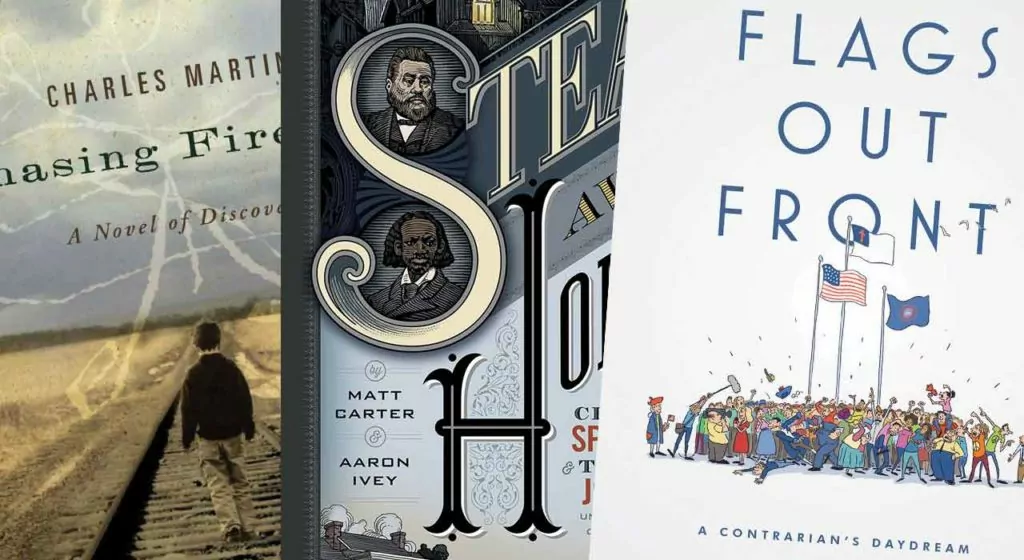
Steal Away Home: Charles Spurgeon and Thomas Johnson
by Matt Carter and Aaron Ivey
290 pages / 2017
This is two biographies in one, about the little know relationship between the "Prince of Preachers" Charles Haddon Spurgeon and a former slave, Thomas Johnson.
The men couldn't have grown up in more different circumstances. Spurgeon was in the United Kingdom, and establishing his reputation as "the Prince of Preacher" while Thomas Johnson was still a slave in the America. Johnson first heard Spurgeon's name mentioned when the preacher's sermons and books were being burnt by slavery-defenders in the South. They didn't like the strong and clearly biblical way that Spurgeon had been denouncing slavery.
When emancipation came and Johnson was freed he also became a preacher. And with his heart inclined to the mission field in Africa, he eventually ends up at Spurgeon's bible college where the two meet and become friends. Perhaps one reason they became friends was because Spurgeon struggled throughout this life with depression, and his young friend Johnson knew something of that too, borne out of his despair as a slave. As true Christians brothers, they are a help and a companion to one each other.
While these two men are both real, I should note this is a fictionalized account. That means that while the broad details are all true, and much of the dialogue is taken from the men's works, this work should only be enjoyed for the general impression, not the specific details, it provides of their friendship.
I'll give one example of how this mix of fact and fiction does, on the one hand, stay very true to reality, but on the other hand, can give a bit of an inaccurate impression. When we read of how Spurgeon proposes to his wife-to-be, he comes off as quite the Prince Charming with all the right words, the perfect thoughtful present, and just the right timing. However, the authors have compacted the evening's events from events that took place over more than the one occasion. The facts are true, but this compaction of the timeline, to keep the story flowing, makes Spurgeon seem to be quite the suave fellow – super suave even.
Steal Away Home is a wonderfully readable book, and attractively put together too. You aren't supposed to judge a book by its cover but it's wonderful when a good cover can give a reluctant reader just the encouragement they need to get started.
I'd recommend this to anyone with an interest in Church history, or in knowing more about the American South during slavery and after, or anyone who enjoys historical fiction or biographies.
Flags out Front
by Douglas Wilson
196 pages / 2017
Flags out Front asks, what if a Christian leader took a stand on principle and, no matter what pressure came, just would not back down? What might happen if, instead of wilting under that pressure, he fought back fearlessly?
Now, like Luther, Tom Collins didn’t set out to cause a fuss. This "mild mannered president of a dwindling southern" Bible college arrives on campus one day to find a prankster has swapped a couple of the flags at the campus entrance. Now, instead of the American flag flying above all, the Christian flag waves from on high, with the Stars and Stripes just below.
Collins doesn't know quite what to think. But, upon reflection, he concludes the change is one he's content to leave be.
Then the phone calls start coming. Conservative, patriotic sorts, wonder why the American flag is not in its central place. He hears from the other side too, from those who'd be happy enough to burn the flag, but don't want to see it waving below a Christian flag. Protests to the right, threats from the left, and yet Collins stands his ground.
And he's willing to stand alone. But his resolve is inspiring, and alone is the one thing he won't be. Quiet, meek, Dr. Collins becomes the rally point for Christians of all sorts...including some clever college students who know how to make some noise.
This is how is should be, and, maybe could be. Who knows what God would do with a fearless few? Actually, we already know: this year we're celebrating the 500th anniversary of the firestorm God started with one monk and his mallet.
Flags out Front is a funny, clever, political feel-good novel that most anyone would enjoy, particularly if you want to be inspired as to how Christians can do politics differently. I've foisted this off on a number of friends and family (and read about half of it out loud to my wife) and the response has been enthused all around.
Chasing Fireflies
by Charles Martin
340 pages / 2007
This is part murder mystery, part adoption story (times two), and part...well, super hero epic.
The murder mystery is an old one, and the person trying to solve is Chase Walker, journalist, and formerly a foster kid who bounced around from one house to another until he arrived on the doorstep of “Unc” and that's where he stayed. The murder victims are Unc's father and first wife, and while the police think the case is settled, Chase is not so sure.
The adoption-story-times-two involves Chase, adopted by Unc, and a nameless boy who was so badly abused his vocal chords have been damaged, leaving him mute. With Chase all grown up, Unc has space in his heart, and in his home, for another boy in need.
The super-hero of the story is Unc himself, a man so good as to be a bit unreal. That's the story's weakness, but also a lot of its charm. Unc is the father figure that us fathers want to be. He most often knows just the right thing to do or say. When Chase, as a boy, gets it into his head that his father is finally coming to get him, Unc does what he can to sooth the boy’s disappointment.
Unc walked up next to me and hung his arms across the fence railing. In his hands he held an empty mason jar with holes punched in the lid. He stood there a long time turning the jar. Inside, a single lightning bug fluttered off the sides of the glass. Every five or six seconds, he’d light his lantern. Unc turned the jar in his hand. “Scientists say that these things evolved this way over million of years.” He shook his head. “That’s a bunch of bunk. I don’t think an animal can just all-of-a-sudden decide it wants to make light grow out its butt. What kind of nonsense is that? Animals don’t make light.” He pointed to the stars.” God does that. I don’t know why or how, but I am pretty sure it’s not chance. It’s not some haphazard thing He does in His spare time.”
He looked at me, and his expression changed from one of wonder to seriousness, to absolute conviction. “Chase, I don’t believe in chance.” He held up the jar. “This is not chance, neither are the stars.”
He tapped me gently in the chest. “And neither are you. So, if your mind is telling you that God slipped up and might have made one giant mistake when it comes to you, you remember the firefly’s butt.”
Maybe Unc is a bit too wise, too patient and too good, but I was okay with that. That’s in part because the author is good at his craft and pulls it off. It’s also because there is something genuine about Unc – this is fatherhood as we want to practice it, this is sacrificial love the way it should be done, and this filling up a kid the way he ought to be. There is truth here.
Finally, while Unc may not be entirely realistic, the world he inhabits is.
There is some grit here. First off, several people are murdered. Also, one of the people Unc helps is an abused girl who later ran away to become an adult porn star. In addition, the physical abuse the mute boy has suffered is detailed and it included someone pinching and ripping his skin with pliers. That is about as descriptive as it gets, but these elements mean this is a book for adults only.
Another caution would be about the hero's faith. While God is made mention of throughout the book, Unc doesn't attend church, though that is in part because he isn't welcome there. He also has a seemingly superstitious understanding of baptism, going to extreme lengths to get someone baptized shortly before their death. But those will be minor matters to Christians with discernment.
Chasing Fireflies will likely make you cry, so if you don't like sentimental books, don't start it. On the other hand this is so much better than the average tearjerker because Martin's writing is simply remarkable.
Jon Dykstra and his siblings blog on books at www.ReallyGoodReads.com....