Transparent heart icon with white outline and + sign.

Life's busy, read it when you're ready!

Create a free account to save articles for later, keep track of past articles you’ve read, and receive exclusive access to all RP resources.

White magnifying glass.

Search thousands of RP articles

Equipping Christians to think, speak, and act

Open envelope icon with @ symbol

Get Articles Delivered!

Equipping Christians to think, speak, and act delivered direct to your Inbox!

A A
By:

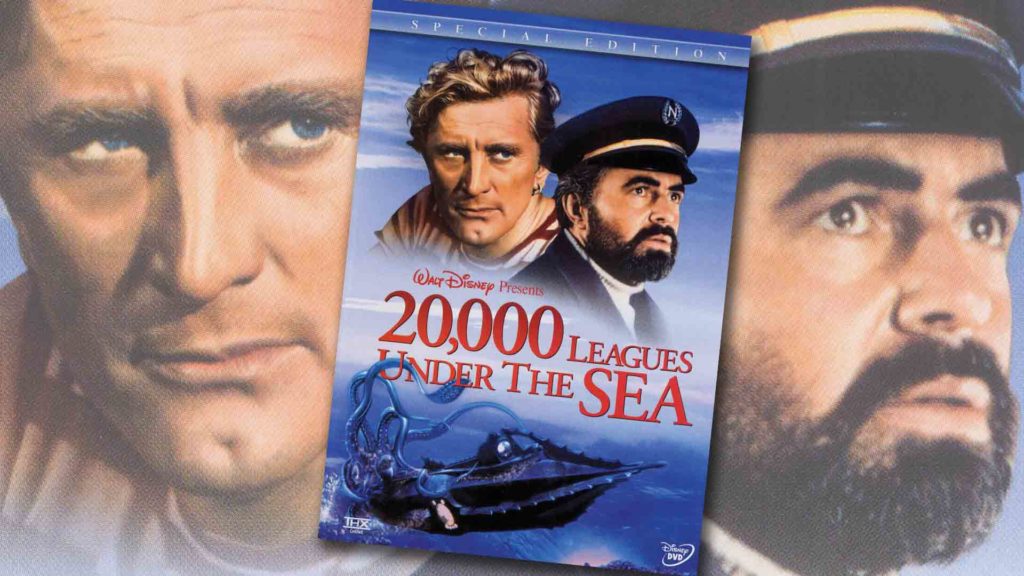
20,000 Leagues Under the Sea

Family / Classic
127 minutes / 1954
RATING 7/10

20,000 Leagues Under the Sea is a childhood favorite that I’ve been looking forward to sharing with my own kids. However, it’s been so long since I’d watched it, I wasn’t sure it would live up to expectations. I am happy to say it did!

The year is 1868, and it is a time of both sail and steam on the high seas. When rumors of a gigantic sea creature stop ships from venturing out onto the Pacific, the US government asks if oceans expert Professor Pierre M. Aronnax and his assistant Conseil will join a Navy expedition. The goal is to either disprove the creature’s existence or, if they find it is real, kill it. To that end, harpooner Ned Land (Kirk Douglas) is also invited along for the expedition.

However, Ned’s harpoons are no use against the creature’s hide because it is not flesh and bone but is, instead, made of iron and steel! What’s been destroying the ships turns out to be a submarine. When the sub destroys the Navy’s ship, only these three – the professor, Conseil, and Ned – survive. They end up being taken on board.

So who created this sub, and why is it being used to destroy ships all over the Pacific Ocean? I won’t give it away but as you might imagine, the submarine’s Captain turns out to be more than a little disturbed.

CAUTIONS

While there are some fantastic action scenes in the film – including a prolonged fight with a giant squid – even my timid 6-year-old managed to make it through them…though we did turn down the sound at that point, to help her out.

So the only caution I’ll share is in regards to the good guys’ morality – the three shipwreck survivors don’t agree on much, including what they think about the psychotic captain holding them captive. For any kid used to films where the good guys wear white, and where right and wrong are very easy to distinguish, this will be something quite different. Mom and dad should hit the pause button now and again to discuss how everyone is acting, and how that lines up with how God might want them to act.

CONCLUSION

Our whole family enjoyed this. It has action, but also some calm and wonderful underwater scenes where we get a peek at what it would be like to live always under the seas. I’d recommend it for ages 5 to 95, but I’ll add that this being an older film, the pacing is a little more patient than modern fare and, for an audience new to the classics, that might take some getting used to.

Still, it’s a classic for a reason – this definitely stands the test of time!

Enjoyed this article?

Get the best of RP delivered to your inbox every Saturday for free.


Red heart icon with + sign.
Family, Movie Reviews

The Lion, the Witch, and the Wardrobe

Family / Drama 2005 / 125 minutes Rating: 8/10 For those who have not read the C.S. Lewis book of the same name, this takes place during World War II. Four Pevensie children, Peter, Edmund, Susan, and Lucy, are among the thousands of children sent away from London to escape the dangers of ongoing German bombardments. They end up at the enormous house of a reclusive professor, and in exploring the house, the youngest of the children discovers a gateway into another world. No one believes little Lucy, though. They think she is just letting her imagination run away with her. But another world it is, populated by fauns, and talking beavers, and ruled over by a wicked White Witch who has kept this land of Narnia entombed in winter's embrace for more than one hundred years. There is also hope. A prophecy speaks of two sons of Adam and two daughters of Eve coming to help. So when Lucy finally manages to get her sister and brothers to come to Narnia with her, the prophecy seems ready to be fulfilled. But then Edmund disappears. And the White Witch gathers her army. And the newly arrived leader of the free animals of Narnia – a lion by the name of Aslan – doesn't seem able to stop her. Cautions While this won't be scary for kids over ten, the White Witch, her wolf minions, the battle scenes, and Aslan being killed in front of the White Witch's horde, could well be too much for younger viewers. Other cautions are of a more theological nature. The Bible speaks of God as like a lion (Hosea 5:14, Is. 31:4, Rev. 5:5, etc.) and makes other analogous comparisons between God and animals such as a mother hen, eagle, and bear (Matt. 23:37, Ex. 19:4, and Hosea 13:8). But what should we think of depicting God as a lion? On the one hand, Lewis isn't trying to say that Jesus is actually a lion – Narnia is supposed to be fantasy, not fact. But on the other hand, Lewis does make a close Aslan to Jesus connection in Aslan's sacrifice to save Edmund in The Lion, the Witch, and the Wardrobe, and Lewis is just a hair's breadth from stating the connection explicitly in The Voyage of the Dawn Treader (Book 5 in The Chronicles of Narnia), where Aslan tells Edmund and Lucy that in their world, "I have another name." Another objection is simply what Aslan gets wrong about forgiveness here. When Edmund returns to his siblings, Aslan says, "What's done is done. There is no need to speak to Edmund about what is past." But, of course, there is. Edmund didn't commit some mistake or oopsy – he betrayed everyone. It's a movie, sure, so there's only so much time, but to let Edmund reconcile without any sort of request for forgiveness or acknowledgment of the enormity of what he had done is to model the "C'mon, what's the big deal?" sort of repentance the world has on offer, which is exactly the sort that gets in the way of both true repentance and true forgiveness. Finally, in conversing with Peter, Aslan says that "there is a Deep Magic, more powerful than any of us, that rules over all of Narnia. It defines right from wrong, and governs all our destinies. Yours and mine." Insofar as Aslan represents Jesus here, Aslan is saying that there is a right and wrong apart from and above God Himself. Really? No. Good and bad aren't above Him, but their definitions spring out of the very character of God – Who He is defines what right and wrong are (see 2 Tim. 2:13, Matt. 5:48, Rom. 3:3-4, etc.). Conclusion There are three different adaptations of The Lion, the Witch and the Wardrobe to choose from, and this is the very best. While Netflix has plans for a fourth, it's hard to imagine how it could be better, and it is easy to anticipate – given some of the revisionist nonsense already leaking out (Aslan is to be voiced by a woman) – that it will be a great deal worse. But if you want a more gentle, calmer version, be sure to check out either the 1988 BBC TV series (a solid 6/10, with the talking animals portrayed via life-size puppets) or the quite good 1979 animated version, which rates a 7. Be sure to check out the trailer below. ...