Transparent heart icon with white outline and + sign.

Life's busy, read it when you're ready!

Create a free account to save articles for later, keep track of past articles you’ve read, and receive exclusive access to all RP resources.

White magnifying glass.

Search thousands of RP articles

Helping you think, speak, and act in Christ.

Open envelope icon with @ symbol

Get Articles Delivered!

Helping you think, speak, and act in Christ. delivered direct to your Inbox!


Red heart icon with + sign.
Adult non-fiction, Book Reviews, Economics

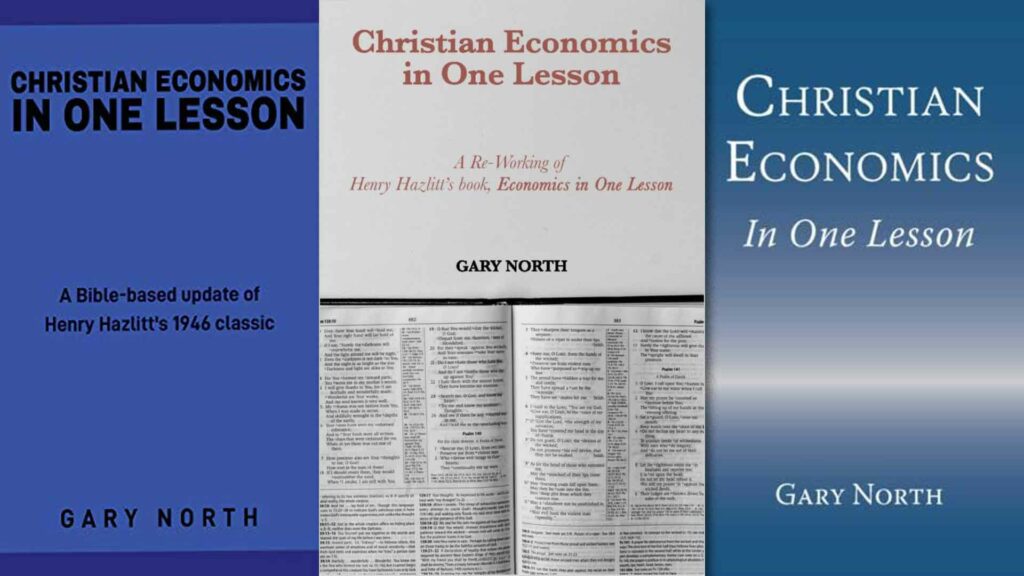
Christian Economics in One Lesson

by Gary North 2015 / 268 pages Henry Hazlitt’s Economics in One Lesson is what its title suggests, just one economic lesson explained in the first chapter – that we focus on the obvious impact of a government program, and don’t consider what otherwise might have happened with those dollars. It’s the seen vs. the unseen. That one lesson is then repeatedly applied to different situations in the 24 chapters that follow. In chapter 4, it is applied to public work projects: when the government builds a new sports stadium we can see the job created by its construction. What’s unseen is all the jobs that might have been created by businesses if they hadn’t had to pay the taxes to build that stadium. Overall, Hazlitt is making a general argument for less government and more economic freedom, but is making it on the basis of practicality: that a free market approach will make us all, overall, more prosperous (download the book for free). Effectiveness is the fruit, not the goal In his Christian Economics in One Lesson, Gary North makes his argument for free market economics on a very different basis: obedience. He also thinks the free market is the most effective way of making us all richer, but he sees that, not as a goal, but as a side effect – the fruit – of being obedient to God’s commands do not covet, and do not to steal. As his title suggests, he is riffing off of Hazlitt, and his chapters are a reworking of each of Hazlitt's. Economics is sometimes treated as a being simply about the math, about some sort of neutral accounting, pitting the different economic systems against each other to find out which creates the greatest benefit for society. Both socialists and capitalists could even agree that economics is about dealing with the problem of scarcity – there is only so much to go around, so how do we make the most of it? But North is arguing that economics is really a matter of ethics, and applying God's guidance on money, work, property, and covetousness to the real world. Then the better way is the way that obeys God’s commands. Now, like Hazlitt, North thinks the best system is the free market, and not the sort of so-called capitalism that involves getting government contracts and special favors. None of that crony "capitalism." This is, instead, a free market where people make exchanges voluntarily, and consequently, both sides benefit. No temptation to tweak But even as Hazlitt and North both hold to the free market system, it is significant that they got there very different ways. Hazlitt got there because the free market works – it is the most prosperous of all systems, doing more to raise people out of poverty than any other economic system before it. North arrives there because the free market is what results when we are obedient to God, respecting our neighbor's property and pushing back against our own covetousness. So, both support the free market. But for those like Hazlitt who arrived there for practical reasons, there will always be the temptation to tweak, and in doing so, to succumb to socialism. If capitalism works best, who's to say if capitalism plus just a smidge of socialism might not be better? Maybe just 5%? Or 10? How can we know unless we try? But there isn't the same temptation to tinker for Christians who choose the free market for its alignment with God's Word. We won't want to be 5% or 10% less obedient. And it is worth noting it is no coincidence that the economic system that most aligns with God's Word is also the one that best raises people out of poverty. That's simply God's love – He knows what is best for us, and when we obey, especially when we do so on a societal level, it goes better for us. Conclusion North's insight – that economics is about ethics, not efficiency; it is about obedience, and not prosperity – is a brilliant one, and worth the reinforcement that comes in the repeated applications that follow. If this isn’t the most important book I read last year, it is certainly in contention… and it can be downloaded for free here....

Red heart icon with + sign.
Economics

Two tales of trade: how free trade creates wealth

As Christians we know that man is prone to all sorts of evil, but we often forget that man is also prone to all sorts of stupidity. Much damage is done by well meaning people who embrace a bad cause – they aren’t trying to do evil, just the opposite in fact, but evil is done because these “good” people are acting out of their ignorance. In Economics this well-meant ignorance often causes serious harm. One telling example involves child labor. We abhor child labor, especially when the alternative is sending these same kids to school instead. But some years back, when a compassionate campaign against child labor moved Nike and Reebok to close plants in Pakistan and lay off 50,000 child workers in Bangladesh, these children didn’t go to school instead. The reason they were working in the first place was because they needed the very basics of life, so when they were laid off, thousands of them turned to prostitution, crime or simply starved to death1. Compassion, coupled with ignorance, forced these children from a barely tolerable situation to one that was much, much worse. Youth are even more susceptible to doing the wrong thing for the right reasons. Enthusiasm combined with inexperience results in an ardent teen who just wants to “Do something!” and off they go, in exactly the wrong direction. Christian youth might be even more inclined to this, since they know that “the love of money is the root of all kinds of evil” (1 Tim. 6:10). That seems to leave them prone to a specific type of economic error – some are deeply suspicious of the rich and their own rich First World countries, convinced that when a rich country trades with a poor country, if the rich get a good deal, it must have been at the expense of the poor. This in turn leaves them leery of free trade. The truth is, it is not through trade, but through the lack of it that rich countries victimize the poor. Now, if there was only a fixed amount of wealth to go around, then any country that got more wealth could only have done so by taking wealth away from someone else. But wealth can be created – there can be more to go around. And trade is one important way to create more wealth. Create wealth via trade? How can that be done? Let me demonstrate by way of a couple of illustrations. How trade creates wealth One day, in his economics class, a university professor was trying to explain to his students the benefits of trade. After lecturing on the subject for an entire week he found his students were still unconvinced. Thinking about it over the weekend he had a flash of insight and headed down to the local dollar store where he bought a range of small inexpensive toys. He bought 20 different toys in all, ranging from a whoopee cushion to a bag of marbles. When the students entered their Economics 101 classroom that Monday they were each given one of the small toys. Most of the students thought their presents were kind of neat, all except for the girl who received the whoopee cushion. She wasn’t quite sure why, but she was offended. The professor then began the class by asking each student to rate their present on a scale of 0-5 with a 5 meaning they really liked it. The twenty students gave their presents a combined rating of 38. The whoopee cushion girl rated hers a zero. Then the professor allowed the students five minutes to trade their presents...but only with students immediately to the right or left of them. The unhappy whoopee cushion girl managed a trade with a frat boy to her right, for a pack of giant playing cards. She was much happier with the cards, and the frat boy was strangely ecstatic with his new possession. Five minutes later the students were asked to rate their presents again, and the combined rating improved to 56. The frat boy gave his whoopee cushion a five. Finally the professor allowed the students to trade with anyone in the room. Once again the overall score went up – the combined rating after this exchange was boosted to 72. From round one to three, no new products were created, and yet people rated their toy higher each round. To put it another way, after making trades they felt what they were left with was worth more than what they originally had. They were getting wealthier. And the freer the trade, the more students were able to obtain what they really wanted, by doing just as the whoopee girl did, offering in exchange something they didn't value as highly. With the trading completed, the professor was overjoyed – his students finally understood how trade could create wealth! He let out a contented sigh and dropped down into his chair…which then produced another, decidedly more rude, sound. The frat boy loved free trade. ****** When I first published this illustration in the Canadian Student Review some students responded by insisting that while trade might benefit First World countries, that didn't mean it was good for everyone. They argued it didn't help the poorest countries since they have absolutely nothing of value to offer in trade. This objection simply isn't true. Whether it is natural resources, or simply cheap labor (even cheap child labor), every country has something to offer. It is true that wars, and corrupt governments, may make it impossible for citizens of a particular country to engage in trade. But that doesn't underscore a shortcoming with free trade, but instead highlights the devastating impacts of wars and corruption. So, as a response, I ended up writing a second story to illustrate how free trade would help even when some countries have much less to offer than others. How trade helps even poor countries It was a regular lunch hour in Mrs. Embargo’s grade 6 classroom and the kids were trading their snacks behind the teacher’s back. One of the kids, Ulysses Sam Austin (USA for short) always had at least a hundred Oreo cookies. He had so many he didn’t value them like he once did when his mom only packed five or ten in his lunch. Canada’s mom (some kids have names like Dallas and Dakota, so why not Canada?) always stuck an entire banana bread loaf in his lunch. The other kids weren’t quite so well off, and had a variety of snacks ranging from a handful of chips to a couple of carrot sticks. The carrot stick kid desperately wanted some banana bread because his mom didn’t have an oven so she couldn’t make it. It took a bit of bartering but eventually he managed to trade one of his carrot sticks for a small slice. It wasn’t a lot, but it was more than he could have gotten any other way. USA was getting quite sick of Oreos and was practically giving them away. It wasn’t that he was softhearted – some even accused him of being the class bully – but he had a surplus of cookies, and they weren’t very useful to him. He traded ten of them to the carrot stick boy for his last carrot. The next day Mrs. Embargo decided to crack down, “You children are going to have to eat what your parents packed in your lunch!” That made all the children very sad: USA because he was now stuck with only Oreos, Canada because he had nothing orange to eat, and especially the carrot stick kid, because Mrs. Embargo’s protectionist stance prevented him from trading for the banana bread he loved so dearly. ****** The truth is, it is not through trade, but through restrictions on trade that rich countries victimize the poor. In this illustration, without trade the poor carrot stick kid/country would never have gotten a slice of banana bread, as he was completely incapable of manufacturing it at home. In the real world, poor countries in Africa can produce some agricultural goods at a lower cost than we can in the West, yet instead of allowing them to compete with us, we may well slap a tariffs on their goods, in addition to spending billions on subsidizing our farmers. As columnist Elizabeth Nickson puts it, “these barriers dramatically reduce what poor countries can earn from farming, which is what most of their people do." She went on to note that, back in 2004, it was "estimated that protecting our markets from African produce costs these countries $100 billion US a year, or twice what they receive in aid.”2 Free, fair trade is a win-win prospect for both sides – the poorer nations wouldn’t trade at all if they didn’t think they were getting a benefit. And if we as Christians want to help the developing world in a substantial manner – far in excess of any material good we can do through our charitable giving – one of the most compassionate things we can do is tell our government to reduce tariffs and agricultural subsidies that, while helping our own farmers, do so at the expense of the poor. End notes 1 “Green power, black death” by Elizabeth Nickson, National Post Jan. 9, 2004 2 “Green power, black death” This article was first published in Feb. 2004 in Reformed Perspective magazine...